Janeese Lewis George Leads Unresolved Mayoral Race in Washington D.C. 2026

Evening Washington
Janeese Lewis George Leads Unresolved Mayoral Race in Washington D.C. 2026
Credit: Google Maps/32bjseiu/Instagram

Key Points

  • Unresolved Race: The primary election concluded without an official winner declared on election night due to thousands of uncounted mail-in ballots and the implementation of a new voting system.
  • Significant Lead: Ward 4 Councilmember Janeese Lewis George secured a substantial early double-digit lead, holding approximately 53 per cent of the first-choice votes compared to rival Kenyan R. McDuffie’s 37 per cent.
  • Historical Shift: As a prominent democratic socialist backed by organized labour, Lewis George’s strong performance signals a dramatic leftward ideological departure from the centrist administration of outgoing Mayor Muriel E. Bowser.
  • Inaugural Voting System: The June 2026 election marks Washington D.C.’s first-ever municipal contest utilizing ranked-choice voting, meaning secondary preferences will determine the final winner if no candidate achieves an absolute majority.
  • Federal Tensions: The local electoral outcome stands heavily impacted by national politics, following direct threats from President Donald Trump to strip D.C. of its home rule and enforce federal control if Lewis George takes office.

Washington (Evening Washington News) June 17, 2026 – Hours after the polling stations closed across the District of Columbia on Washington’s most consequential mayoral election in a decade, frontrunner Janeese Lewis George and her rival Kenyan R. McDuffie addressed their respective campaigns without an official winner being declared by election officials.

Who Led the First-Round Tabulations on Election Night?

Washington, D.C. — As reported by reporters Praveena Somasundaram, Jenny Gathright, Dan Diamond, and Cleve R. Wootson Jr. of The Washington Post on June 17, 2026, initial ballot counting revealed a highly fractured but decisive early advantage for the progressive wing of the local Democratic party.

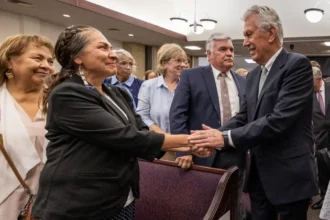
At midnight as Wednesday approached, supporters of the frontrunner, Ward 4 Councilmember Janeese Lewis George, filled the dance floor at her election night gathering at the historic Howard Theatre. In stark contrast, roughly a mile away at the campaign headquarters of former At-Large Councilmember Kenyan R. McDuffie, attendees gradually trickled out after the candidate departed the stage without definitive answers regarding the outstanding vote tallies.

According to municipal data updated in the early hours of Wednesday morning and published by The 51st political reporter Martin Austermuhle, Lewis George secured 52.79 per cent of the first-choice ballots (50,260 votes). McDuffie trailed significantly with 36.57 per cent (34,816 votes).

The remaining five candidates on the crowded Democratic primary ballot lagged far behind: real estate developer Gary Goodweather claimed 3.00 per cent, Rini Sampath received 2.93 per cent, Vincent Orange took 2.73 per cent, Hope Solomon secured 1.09 per cent, and Ernest Johnson finished with 0.53 per cent.

Why Has an Official Winner Not Been Declared?
The absence of a formal declaration stems from the District’s shifting electoral mechanics and a vast backlog of mail-in ballots.

As detailed by legal and political analysts for The 51st, the June 16 primary represents the first municipal election in Washington’s history to utilize ranked-choice voting. Under the new guidelines established by Initiative 83—which District voters approved in a 2024 landslide—voters are permitted to rank up to five candidates in order of preference.

Because the initial round of results released by the D.C. Board of Elections excludes a significant volume of mail-in ballots postmarked by election day, the finality of the tabulation remains fluid.

If no candidate secures a definitive absolute majority once all primary votes are logged, the lowest-ranking candidates will be systematically eliminated, and their supporters’ secondary preferences will be redistributed.

However, political reporters observed that because Lewis George currently hovers just above the 52 per cent mark in first-choice selections, McDuffie would require an statistically unprecedented surge among the remaining uncounted mail-in printouts to reverse the current deficit.

What Did the Leading Candidates Say to Their Supporters?
Despite the lack of an official designation from the city’s election board, both principal campaigns framed the fluid evening according to their strategic outlooks.

As reported by The 51st, Janeese Lewis George delivered an emotional, high-energy speech to an enthusiastic crowd at the Howard Theatre, stopping just short of a formal victory declaration. Lewis George stated:

“What seemed like a distant dream not long ago is already history unfolding before our eyes. If there was ever any doubt, let it now be laid to rest. It is the people of D.C. who elect the mayor of D.C. This moment is for those who refuse to surrender their hope in a government that works for all of us. Tonight, we are making history by showing this country that the dream of America is still alive in its capital city.”

Conversely, McDuffie maintained an optimistic but cautious public posture before his supporters departed his campaign venue. Addressing the crowd before the double-digit gap fully widened around 11:00 p.m.,

McDuffie expressed confidence regarding his long-term prospects, reminding voters that the transition to ranked-choice metrics meant the definitive tallying process would be extensive. He urged patience as election workers processed the mail-in backlogs, stating that he did not expect the final verified results to manifest for quite some time.

How Do the Candidates’ Platforms and Coalitions Differ?

The primary election serves as a critical ideological crossroads for the District, highlighting deep socioeconomic and demographic divisions across Washington’s wards.

As noted by The Washington Post, data compiled from a Washington Post-Schar School poll conducted between May 27 and June 1 indicated that Lewis George and McDuffie drew support from entirely distinct voter bases.

The Progressive and Labour Movement

Lewis George, a self-identified democratic socialist, aligned her campaign platform closely with organized labour and far-left economic policies.

As reported by Kurtis Hagans, the chapter chair of the Metro D.C. Democratic Socialists of America (DSA), the organization mobilized more than 300 members to canvas local neighborhoods. Her platform emphasizes sweeping systemic changes to address the local cost of living, including:

  • The implementation of universal, affordable childcare.
  • The construction of 72,000 housing units within five years.
  • Free municipal bus transit for residents receiving Supplemental Nutrition Assistance Program (SNAP) benefits.
  • Halting scheduled gas and electricity rate hikes while strengthening tenants’ rights against commercial landlords.

The Washington Post reported that this platform resonated strongest with voters primarily focused on the rising cost of living, white residents, self-described “very liberal” voters, and citizens who have recently moved to the District.

The Centrist and Business-Friendly Coalition

McDuffie structured his campaign as a moderate, pro-business alternative designed to offer a continuity of the policies enacted by outgoing Mayor Muriel E. Bowser, who unofficially signaled support for his candidacy without issuing a formal endorsement.

Backed by corporate advocacy groups such as Opportunity DC, McDuffie’s platform focuses on managed economic stabilization, including:

  • The creation of a “Stay in DC” fund to prevent the displacement of local small businesses.
  • The expansion of the Local Child Tax Credit rather than structural universal programs.
  • A commitment to build 12,000 new housing units and preserve 20,000 existing affordable units by 2030.
  • Strict adherence to public safety measures, including the enforcement of youth curfews to curb highly publicized “teen takeovers” and juvenile violence.

The Schar School polling indicated that McDuffie led decisively among voters whose primary concern was public safety, as well as moderate residents and Black voters.

What Controversies and External Pressures Impacted the Election?

The closing days of the primary campaign were marked by legal scrutiny and direct intervention from federal political figures.

As documented by local reporting agencies, the D.C. Office of Campaign Finance issued a late fine against Lewis George’s campaign due to its operational ties with local labour unions. While Lewis George publicly vowed to contest the regulatory action, voters interviewed at polling stations indicated the fine did not diminish their support.

Advisory Neighborhood Commissioner Josh Jacobson, a Lewis George voter, told reporters that the electorate largely viewed the race as a choice between structural change and a continuation of the Bowser administration.

Simultaneously, national politics cast a significant shadow over local ballot boxes. Earlier in June, President Donald Trump publicly intervened in the local race, threatening to bypass D.C.

Home Rule and execute a federal takeover of Washington’s municipal operations if Lewis George won. Trump stated that the federal government would

“take back Washington and run it on a federal basis”

to ensure that

“we’re not going to lose our businesses.”

When questioned by journalists on election night, Lewis George stated she suspected the president’s hostile rhetoric actually catalyzed her campaign’s momentum by solidifying her status as the most vocal anti-Trump candidate in the race.

At the Marie Reed Elementary School polling station in Adams Morgan, voter Alan Gordon echoed this sentiment, stating to reporters:

“Trump hates her, and I hate Trump. And I think she could take on the administration if need be.”

Conversely, other residents expressed concern over how a radical shift would affect the city’s relationship with a hostile White House. Voting at the Chevy Chase Community Center, resident Dan Ford expressed skepticism regarding Lewis George’s ambitious housing targets, stating he preferred McDuffie’s experienced background. Another voter, speaking anonymously to The Washington Post, remarked:

“I think Janeese George is brilliant… but I’m not so sure she’s a crisis manager and I don’t think this is her time.”

Background of the D.C. Mayoral Transition

The 2026 mayoral primary represents the first time in twenty years that Washington, D.C. has conducted a mayoral election without an incumbent candidate on the ballot. Outgoing Mayor Muriel E.

Bowser, a centrist Democrat who led the city through three consecutive terms marked by rapid gentrification, commercial development, and shifting local demographics, chose not to seek a fourth term in office.

Historically, the Democratic primary is the definitive election of consequence for the District of Columbia. Because registered Democrats outnumber opposition voters by a vast majority, the winner of the primary is virtually assured victory in the November general election.

For the past twelve years, the executive branch of the District government operated under a moderate, pro-business framework that prioritized corporate investment, downtown revitalization, and traditional policing strategies.

The rise of the Democratic Socialists of America and progressive legislative coalitions on the D.C. Council over the last six years created a deep structural rift between the executive mayor’s office and legislative councilmembers like Lewis George.

This local political realignment mirrors similar progressive shifts observed in other major American metropolitan areas, such as the mayoral victories of Brandon Johnson in Chicago and Zohran Mamdani in New York City.

Consequently, the 2026 vacancy opened a direct battle for the ideological soul of the nation’s capital, occurring amidst a broader local economic crisis fueled by the contraction of federal government employment and an acute shortage of affordable housing.

Prediction

The impending victory of Janeese Lewis George is highly likely to alter the daily lives and operating environment of District residents, local business owners, and municipal employees.

Because the Democratic nominee historically faces no viable opposition in the November general election, the double-digit lead means Washington will transition to its most progressive governance model since the establishment of Home Rule in 1974.

For working-class families and low-income residents, this development signals a rapid expansion of the municipal safety net.

The implementation of universal childcare and targeted utility rate freezes will likely alleviate immediate financial burdens for families currently spending disproportionate percentages of their income on basic necessities. Furthermore, SNAP recipients will see immediate transport cost reductions through the enactment of fare-free busing.

However, the local business community and real estate developers will face a significantly more restrictive regulatory environment.

Commercial landlords can anticipate aggressive legislative crackdowns regarding rent increases and tenant evictions, which may depress short-term real estate investment and stall private construction projects.

The most acute point of friction will impact the District’s broader population via an impending constitutional crisis with the federal government.

With President Trump threatening to revoke D.C. Home Rule, residents are likely to face a turbulent legal battle over the city’s self-governance. If the federal administration attempts to seize control of the Metropolitan Police Department, enforce federal immigration actions, or override local budgetary decisions, the resulting legal gridlock could paralyze local public services and trigger widespread civil demonstrations throughout the capital city.