
Key Points
- Incident Overview: A single-engine de Havilland DHC-3 Otter seaplane operated by Kenmore Air made an emergency landing and caught fire in Shallow Bay near Sucia Island, Washington.
- Occupants: All 11 individuals on board—10 passengers and one pilot—were accounted for and rescued from the water.
- Injuries: Four individuals sustained serious injuries, including head trauma, broken bones, and lacerations, with at least one person listed in critical condition.
- Flight Details: The aircraft (Flight 140) departed Lake Union in Seattle at approximately 4:30 p.m. PDT bound for Roche Harbor on San Juan Island before coming down at around 5:15 p.m. PDT.
- Multi-Agency Response: Rescue efforts were executed by the U.S. Coast Guard, local emergency medical services, the U.S. Navy, Canadian responders, and civilian Good Samaritan vessels.
- Operational Impact: Kenmore Air grounded all scheduled flights for Friday to dedicate full operational support to passengers, crew, and federal investigators.
- Investigation Active: The Federal Aviation Administration (FAA) and the National Transportation Safety Board (NTSB) have opened formal investigations to determine the cause of the forced landing and subsequent fire.
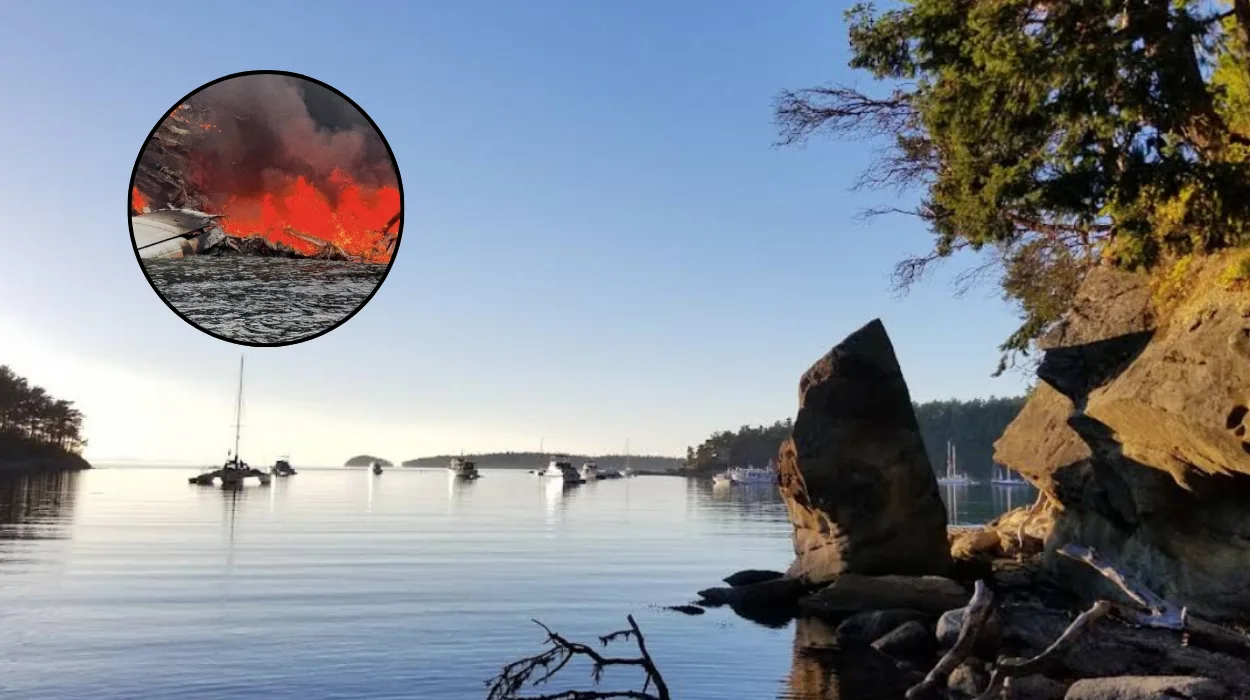
Washington (Evening Washington News) July 24, 2026 – All 11 people aboard a single-engine floatplane operated by Kenmore Air miraculously survived after the aircraft made a forced emergency landing and caught fire in Shallow Bay off Sucia Island on Thursday evening. Emergency response agencies confirmed that 10 passengers and one pilot were accounted for following a multi-agency rescue operation in the San Juan Archipelago. The de Havilland DHC-3 Otter plane, which had departed from Lake Union, Seattle, suffered severe structural damage and became engulfed in flames against rocks along the island’s shoreline shortly after coming down at approximately 5:15 p.m. PDT.
- Key Points
- How Did the Sucia Island Seaplane Emergency Unfold?
- What Is the Status of the Passengers and Pilot?
- How Are Authorities and Kenmore Air Responding?
- Background of Regional Seaplane Transport and Safety Protocols
- Prediction: How This Development Will Affect Island Communities and Aviation Operations
How Did the Sucia Island Seaplane Emergency Unfold?
According to statements provided by official response agencies and company representatives, Flight 140 departed Lake Union in Seattle at roughly 4:30 p.m. PDT with a final destination of Roche Harbor on San Juan Island. Approximately 45 minutes into the journey, the aircraft attempted an emergency water landing near Shallow Bay on the western edge of Sucia Island—a popular marine park situated about 80 nautical miles north of Seattle near the Canadian maritime boundary.
As reported by Shuvrajit Das Biswas of Hindustan Times, the U.S. Coast Guard Sector Puget Sound confirmed that the floatplane made a violent contact with the water surface before drifting toward shoreline rocks, where it caught fire. Eyewitness footage released by bystanders on social media showed the aircraft resting near the shore enveloped in thick black smoke and bright flames.
Speaking to ABC News, San Juan County Sheriff Eric Peter stated that civilian bystanders played a crucial role during the initial minutes of the crisis: “Swift actions from everyone prevented this from being worse,” Sheriff Peter noted, explaining that at least one civilian vessel immediately navigated to the crashing aircraft to pull passengers from the water before the fuselage was fully consumed by fire.
The U.S. Coast Guard confirmed that “numerous Good Samaritan vessels responded to assist” alongside state park rangers and local marine units.
What Is the Status of the Passengers and Pilot?
Following the rescue from the water, first responders concentrated efforts on emergency medical triage at nearby staging areas. The San Juan County Sheriff’s Office reported that injuries among the 11 rescued individuals ranged from lacerations and broken bones to serious head trauma, with one individual listed in critical condition.
As reported by The Lynnwood Times, medical personnel deployed air ambulances to transport the most severely injured victims:
- Bellingham Facilities: Two patients with serious trauma were airlifted to medical centres in Bellingham.
- Orcas Island / Local Facilities: Two additional patients were evacuated to facilities on Orcas Island and in Seattle via Airlift Northwest.
- Bellingham Coast Guard Station: The remaining seven occupants were brought to the U.S. Coast Guard Station in Bellingham for thorough medical evaluation and hypothermia checks.
Orcas Island Fire and Rescue (OIFR) confirmed their involvement in an official release, stating: “OIFR and San Juan County Sheriff’s Office are staged at Brandt’s Landing marina, waiting to receive patients with Airlift Northwest. OIFR has four ambulances ready. Four OIFR responders are on the water working with State Parks”.
How Are Authorities and Kenmore Air Responding?
In the immediate aftermath of the crash, Kenmore Air—recognised as the largest seaplane operator in the United States—announced a complete temporary suspension of operations.
As reported by The Independent, Kenmore Air Chief Executive Officer David Gudgel issued an official statement confirming the grounding of all scheduled flights:
“We are grateful that everyone aboard has been accounted for, and our immediate focus is ensuring our passengers and pilot receive the care and support they need. We extend our sincere thanks to the United States Coast Guard, local emergency responders, and everyone assisting in the response. Kenmore Air is fully cooperating with the investigating authorities, and we will continue providing verified information as it becomes available”.
Both the Federal Aviation Administration (FAA) and the National Transportation Safety Board (NTSB) have initiated formal investigations. Federal investigators are expected to focus on mechanical telemetry, weather conditions, pilot communication logs, and the structural integrity of the single-engine turbine de Havilland DHC-3 Otter.
Explore More Area Guide
US-Saudi Civil Nuclear Deal Strategy: Washington 2026
Trump backs Saudi nuclear pact over enrichment, Reuters Dubai 2026
Background of Regional Seaplane Transport and Safety Protocols
Seaplanes are an integral component of the transportation infrastructure across the Pacific Northwest, particularly throughout the Puget Sound and the San Juan Islands archipelago. Due to the geographical isolation of many islands, waterborne aircraft serve as primary links for commuters, seasonal tourists, mail delivery, and medical logistics between mainland hubs like Seattle and island communities.
Founded in 1946, Kenmore Air operates a fleet of floatplanes and land-based aircraft, moving more than 90,000 passengers annually across scheduled, scenic, and charter routes. The single-engine de Havilland DHC-3 Otter—often retrofitted with turboprop engines—is widely regarded as a workhorse of regional utility aviation due to its high-wing stability and short takeoff and landing (STOL) capabilities on open water.
Despite their reliable operational record, regional floatplane operations carry distinct environmental risks. Operating in coastal ecosystems exposes aircraft to sudden maritime fog, shifting tidal currents, and low-altitude flight paths over open water. Over the past decade, regulatory agencies including the NTSB have placed heightened scrutiny on floatplane safety standards, focusing on emergency egress training, automatic float inflation systems, and mandatory life-jacket protocols for passengers travelling over open water bodies.
Prediction: How This Development Will Affect Island Communities and Aviation Operations
The emergency landing and subsequent destruction of the Kenmore Air floatplane near Sucia Island is anticipated to trigger immediate regulatory, operational, and commercial ramifications across several stakeholder groups:
1. Air Passengers and Local Island Residents
In the short term, the grounding of Kenmore Air flights will create significant travel disruptions for residents and visitors throughout the San Juan Islands. With regional ferry systems frequently constrained by capacity and scheduling delays, floatplanes remain a vital transit lifeline. Passengers should anticipate reduced charter options, potential price surges across alternative commuter air services, and stricter pre-flight safety briefings regarding water egress and emergency equipment usage.
2. Commercial Seaplane Operators
Regulators such as the FAA and NTSB are likely to issue safety advisories or mandatory maintenance directives targeting single-engine turboprop floatplanes, particularly regarding fuel lines, engine thermal shielding, and post-impact fire suppression systems. Competitors and regional air taxis across Washington and Alaska will face heightened inspection scrutiny during routine maintenance cycles, potentially increasing operating costs across the sector.
3. Regulatory Authorities and Policy Impact
The survival of all 11 occupants will serve as a critical case study for maritime emergency response coordination. Federal transport safety boards will closely evaluate the timeline of the rescue—specifically analyzing how quickly civilian “Good Samaritan” mariners coordinated with federal assets. This incident could prompt the U.S. Coast Guard and local marine authorities to formalise voluntary civilian response networks and mandate improved real-time tracking transponders for low-altitude floatplanes operating in remote island passages.