Key Points
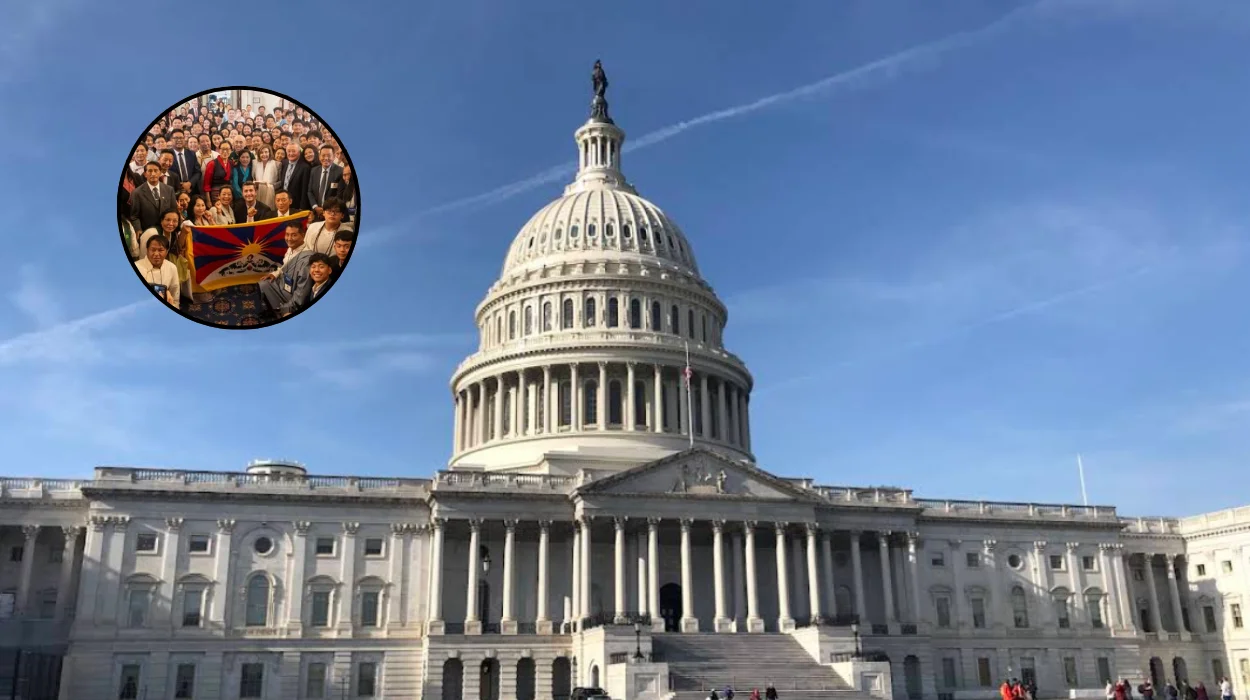
- Mass Advocacy Event: More than 225 Tibetan Americans and Tibet supporters from 27 U.S. states gathered in Washington, D.C., for the annual Tibet Lobby Day held on 8 and 9 June 2026.
- Legislative Focus: Activists held face-to-face meetings with U.S. Senators and Representatives to urge the passage of the newly introduced bipartisan bill, the Assuring the Future of Tibet Act (AFTA) of 2026.
- Youth Engagement: Organisers reported a notable increase in the participation of young Tibetan students, marking a demographic shift toward next-generation leadership in global diaspora advocacy.
- Leadership and Commemoration: A special reception at Capitol Hill celebrated the re-election of Sikyong Penpa Tsering as the political leader of the Central Tibetan Administration (CTA) and the election of the 18th Tibetan Parliament-in-Exile, alongside the 250th anniversary of the founding of the United States.
- High-Level Political Support: Speaker Emerita Nancy Pelosi addressed the delegation, alongside statements from Representative Namgyal Choedup and International Campaign for Tibet (ICT) President Tencho Gyatso, reinforcing American commitment to Tibetan human rights.
Washington, D.C.: (Evening Washington News) June 11, 2026. The International Campaign for Tibet, in coordination with North American Tibetan Associations, held its annual Tibet Lobby Day on 8 June 2026, drawing over 225 advocates to Capitol Hill to secure legislative guarantees for the Central Tibetan Administration.
- Key Points
- Why Did Over 225 Advocates Converge on Washington for Tibet Lobby Day?
- What Promises Did Congressional Leaders Make to the Tibetan Delegation?
- What Is the Assuring the Future of Tibet Act of 2026?
- Background of the Particular Development
- Prediction: How This Development Can Affect the Particular Audience
Why Did Over 225 Advocates Converge on Washington for Tibet Lobby Day?
The annual Tibet Lobby Day, spanning 8 and 9 June 2026, was executed under the strategic leadership of the International Campaign for Tibet (ICT) in tandem with regional Tibetan Associations. According to organizational briefings, the mobilization was structured around formal resolutions adopted during the annual North American Tibetan Associations Conference.
The delegation, representing 27 individual U.S. states, aimed to systematically lobby U.S. Senators, Congressmen, and Congresswomen to expand existing American statutory obligations regarding the Himalayan region.
A central characteristic of the 2026 campaign was its demographic composition. Organisers recorded a substantial influx of young Tibetan students among the active registrants, a group specifically prepared to manage ongoing digital and institutional advocacy.
On the evening of 8 June, the convention hosted a formal reception within the Capitol Hill complex. The event served a dual commemorative purpose: recognizing the semi-quincentennial (250th) anniversary of the United States’ founding, and marking the formal re-election of Sikyong Penpa Tsering as the chief political executive of the Central Tibetan Administration (CTA).
The reception further acknowledged the newly elected members of the 18th Tibetan Parliament-in-Exile, establishing a structural parallel between American democratic longevity and the institutional framework of the exile government in Dharamshala, India.
What Promises Did Congressional Leaders Make to the Tibetan Delegation?
The Capitol Hill reception featured high-level legislative participation, highlighted by an address from Speaker Emerita Nancy Pelosi.
As documented by event organizers and congressional records, Pelosi emphasized that the United States maintains a durable, cross-party consensus regarding the preservation of Tibet’s cultural and political identity.
As reported by administrative staff covering the proceedings, Speaker Emerita Nancy Pelosi stated that American support for the Tibetan people remains unwavering, noting that institutional efforts inside Congress would continue to challenge the forced assimilation policies enforced by the Chinese Communist Party (CCP) inside the Tibet Autonomous Region.
Following Pelosi’s remarks, Representative Namgyal Choedup, the Representative of His Holiness the Dalai Lama to North America, provided an operational briefing on the strategic requirements of the diaspora.
As recorded in transcripts from the ICT communication team, Representative Namgyal Choedup stated that
“the robust presence of young Tibetan-Americans on Capitol Hill sends an unmistakable signal to Beijing that the struggle for human rights and historical truth will not expire with the passing of generations.”
Complementing this perspective, Tencho Gyatso, the President of the International Campaign for Tibet, detailed the specific legislative mechanisms currently required to safeguard the continuity of Tibetan institutional governance.
As published on official ICT media platforms, President Tencho Gyatso stated that
“at a time when Beijing has abandoned any pretense of offering autonomy for Tibetans… the United States needs to take a bold step forward.”
Gyatso positioned the Central Tibetan Administration as an essential mechanism against authoritarian expansionism in Central Asia, asserting its status as the legitimate democratic voice for Tibetans globally.
What Is the Assuring the Future of Tibet Act of 2026?
The explicit legislative target of the 2026 Tibet Lobby Day was H.R. 8982, formally known as the Assuring the Future of Tibet Act (AFTA) of 2026. The bipartisan bill was introduced on 22 May 2026 by U.S. Representatives James P. McGovern (D-MA) and Michael McCaul (R-TX).
It builds upon the legal foundation established by the Promoting a Resolution to the Tibet-China Dispute Act (commonly referred to as the Resolve Tibet Act), which was cleared by Congress in 2024.
According to the official legislative text published by the U.S. House of Representatives, the Assuring the Future of Tibet Act of 2026 focuses heavily on post-succession continuity. It provides the statutory frameworks necessary for the U.S.
government to maintain uninterrupted diplomatic, financial, and institutional relations with the Central Tibetan Administration following the eventual passing of the 14th Dalai Lama, who is currently 90 years old.
As outlined by staff writers for the U.S. House of Representatives press gallery, Congressman James P. McGovern stated that
“the Dalai Lama won’t be with us forever. We must ensure that the U.S. government has the authority and the tools to continue its advocacy for the fundamental human rights of the Tibetan people.”
McGovern emphasized that recognizing the CTA as the legitimate, democratically elected representative body is a core national interest for the United States.
Concurrently, his Republican co-sponsor highlighted the geopolitical stakes involved in the formal recognition of the Dharamshala-based executive branch.
As reported by congressional correspondents, Congressman Michael McCaul stated that “the CCP continues to threaten Tibetans’ faith and freedom,” reaffirming a personal commitment made to the Dalai Lama during a bipartisan congressional delegation to Dharamshala. McCaul noted that the bill is designed to
“permanently cement our commitment to the Tibetan people and guarantee unbreakable ties with their democratic leadership.”
The specific legal provisions within AFTA demand that the U.S. Executive branch execute the following mandates:
- International Status: Instruct the American diplomatic corps to advocate for the Central Tibetan Administration to receive formal observer status within the United Nations General Assembly and associated international bodies.
- Diplomatic Courtesies: Direct the Department of State to grant CTA officials, specifically including the Sikyong (political leader), elevated senior-level engagements, diplomatic courtesies, and potential extensions of diplomatic security and immunities.
- Strategic Interest Clarification: Formalize into federal statute that the peaceful resolution of the Sino-Tibetan dispute constitutes a permanent strategic interest for United States foreign policy in the Indo-Pacific region.
Background of the Particular Development
The execution of the 2026 Tibet Lobby Day and the introduction of the Assuring the Future of Tibet Act represent an escalation in U.S. legislative pushback against the People’s Republic of China (PRC) regarding ethnic and religious minority policies.
Historically, U.S. policy was dictated by the Tibet Policy Act of 2002, which focused primarily on human rights reporting and humanitarian aid allocations. This framework was later updated via the Tibetan Policy and Support Act of 2020, which established that any interference by the Chinese government in selecting the next Dalai Lama would be treated as a violation of religious freedoms, opening up Chinese officials to targeted sanctions under the Global Magnitsky Act.
The immediate precedent for the current development occurred in July 2024 with the signing into law of the Resolve Tibet Act.
That piece of legislation explicitly rejected Beijing’s historical narrative regarding Tibet and made it official U.S. policy that the dispute over Tibet’s status remains unresolved under international law.
Explore More Local News
Shuo Wang Ranks #23 Forbes Self-Made Women List; Washington 2026
KMT Chief Cheng Li-wun Meets Steve Daines in Washington 2026
Prediction: How This Development Can Affect the Particular Audience
The primary audience impacted by this development consists of the global Tibetan diaspora, estimated at roughly 150,000 individuals, alongside the millions of Tibetans currently residing within the borders of the People’s Republic of China.
For the diaspora audience, the successful passage of AFTA will directly alter their legal and political operational environment. The institutionalization of senior-level diplomatic access for the Central Tibetan Administration means that elected leaders like the Sikyong will travel, convene, and interact with Western governments with protections and access levels approaching those of a sovereign state in exile.
This provides the diaspora with a permanent, legally protected platform to manage financial assets, coordinate educational programs, and sustain cultural conservation networks globally without fearing sudden shifts in American executive branch priorities.
For the internal Tibetan population, the effects will likely manifest through heightened geopolitical friction. Increased U.S. validation of the CTA typically prompts the PRC Ministry of Foreign Affairs to tighten security measures inside the Tibet Autonomous Region.
This often results in stricter digital surveillance, intensified border controls along the Himalayan escape routes into Nepal, and aggressive political re-education campaigns targeting local monastic institutions to counter what Beijing labels as foreign-backed “splittism.”