
Key Points
- Decisive Victory: The American League West-leading Seattle Mariners defeated the Washington Nationals 10-2 at Nationals Park to open a three-game interleague series.
- Weather Disruption: The game was subjected to a prolonged pre-game rain delay before the grounds crew prepared the field for first pitch.
- Offensive Explosion: Rookie Colt Emerson hit a crucial two-run home run during a five-run second inning that established a commanding early lead for Seattle.
- Dominant Pitching: Seattle starter Bryce Miller pitched a career-high eight innings, allowing just two runs to secure the win.
- Injury Concern: Mariners outfielder Randy Arozarena exited the game in the third inning due to an apparent lower-leg injury and is scheduled for re-evaluation.
Washington, D.C. (Evening Washington News) June 13, 2026 – The Seattle Mariners secured a commanding 10-2 victory over the Washington Nationals at Nationals Park on June 12, 2026, opening their three-game series with an offensive showcase following a significant weather delay. Rookie infielder Colt Emerson drove the offense with a two-run home run during a decisive five-run second inning, while starting pitcher Bryce Miller stifled the home team’s lineup over a career-high eight innings. The blowout victory solidified Seattle’s position atop the American League West standings but came at a physical cost, as starting outfielder Randy Arozarena was forced to leave the game early due to an apparent leg injury.
- Key Points
- How Did the Seattle Mariners Secure a Blowout Victory at Nationals Park?
- What Happened During the Decisive Five-Run Second Inning?
- How Serious is Randy Arozarena’s In-Game Leg Injury?
- How Did Bryce Miller Outpitch Zack Littell to Control the Game?
- Background of the Major League Baseball Interleague Development
- Prediction: How This Development Can Affect Major League Baseball Fans and Broadcasters
How Did the Seattle Mariners Secure a Blowout Victory at Nationals Park?
As reported by the Associated Press (AP), the Seattle Mariners capitalised on early pitching vulnerabilities and a sustained offensive surge to defeat the Washington Nationals.
The game, which commenced after a long weather delay that required extensive field preparation by the Washington grounds crew, quickly turned into a one-sided affair in the top of the second inning.
According to official Major League Baseball (MLB) tracking data, Seattle entered the matchup with a 36-34 record, holding first place in the highly competitive American League West division, while Washington sat at 35-34, fighting for positioning in the National League East.
The analytical breakdown provided by numberFire prior to the opening pitch established the Mariners as 59.5% statistical favourites, a projection that materialised rapidly once play began. Seattle’s hitters combined disciplined plate appearances with explosive power to tag Washington’s pitching staff for ten runs, effectively putting the game out of reach before the midway point of the contest.
What Happened During the Decisive Five-Run Second Inning?
The definitive turning point of the matchup occurred in the top of the second inning when Seattle’s batting order combined extra-base hits and aggressive baserunning to break a scoreless tie. According to the game narrative published by MLB.com reporters, Dominic Canzone initiated the damage by hitting a sharp two-run triple off Washington starter Zack Littell.
Canzone’s line drive deep into the outfield gaps allowed Randy Arozarena and Luke Raley to score, giving Seattle an initial 2-0 advantage.
Immediately following Canzone’s run-scoring triple, Miles Mastrobuoni extended the lead via a sacrifice fly. As detailed by AP staff photographers on the scene, Washington right fielder Dylan Crews executed a sliding catch on Mastrobuoni’s shallow fly ball, but it was deep enough to drive home Canzone from third base, pushing the score to 3-0.
The inning culminated in an explosive display from 20-year-old rookie Colt Emerson. Facing Littell with a runner on base, Emerson launched a ball deep into right-central field for a two-run home run. According to the direct audio and transcript broadcast data from the MLB.com sports desk, the play-by-play analysts noted:
“The 20-year-old launches one out of here. His fifth early on in his big league career and it’s a two-run shot here in the second to make it five nothing.”
This home run capped off the five-run frame, entirely altering the tactical dynamics of the game and forcing Washington into an early defensive recovery mode.
How Serious is Randy Arozarena’s In-Game Leg Injury?
While the offensive production provided structural comfort for Seattle, the third inning introduced serious personnel concerns for the visiting club.
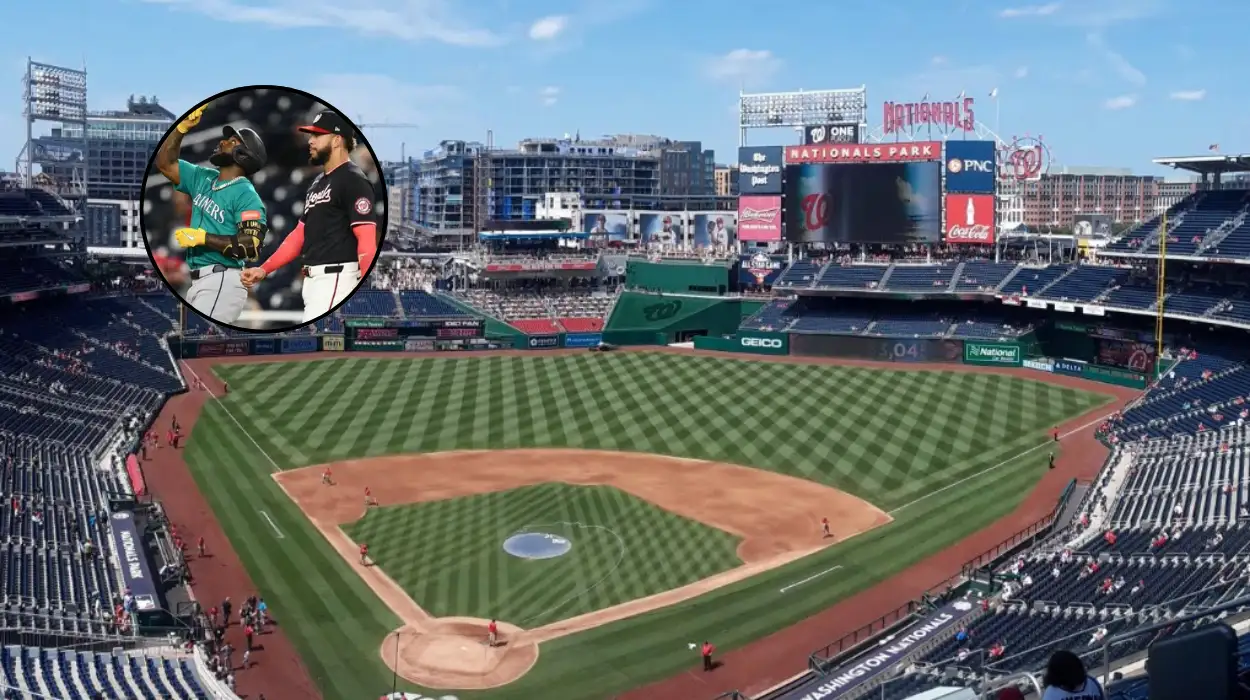
As reported by the Associated Press sports desk, outfielder Randy Arozarena sustained a leg injury while running through first base on a routine groundout. Visual evidence from the stadium showed Arozarena gesturing toward his leg at first base adjacent to Washington first baseman Luis García Jr. before being removed from the field by the training staff.
In the post-game press conference, Seattle Mariners Manager Dan Wilson addressed the media directly regarding the state of his starting outfielder. As transcribed by AP journalists, Manager Dan Wilson stated that:
“Arozarena might have suffered a hamstring strain, a spasm or a cramp and will be re-evaluated Saturday.”
The loss of Arozarena, who had earlier celebrated in the dugout after scoring on Canzone’s second-inning triple, represents a notable vulnerability for the Mariners’ outfield depth depending on the results of upcoming medical imaging.
How Did Bryce Miller Outpitch Zack Littell to Control the Game?
The pitching matchup showcased a stark contrast in execution between Seattle right-hander Bryce Miller and Washington right-hander Zack Littell. Game notes compiled by Richard W.
of The Nats Report indicated that Miller entered the game with a pristine 2-0 record and a 1.33 Earned Run Average (ERA), while Littell carried a 6-4 record supplemented by a 4.76 ERA across his prior appearances.
Miller fulfilled his statistical billing by limiting Washington’s batting order to just two runs over eight full innings of work, establishing a new personal career-high for longevity in a single major league game. Conversely, Littell struggled to find consistency following the lengthy rain delay.
His inability to escape the second-inning jam forced Washington manager Dave Martinez to activate the bullpen prematurely.
Relief pitcher Riley Cornelio entered the game in relief of Littell, but as noted by MLB.com track reporters, Cornelio eventually “lost his slider” and “could not find the strike zone with it” during the later frames, allowing Seattle’s Cole Young to jump on wild pitches and score the sixth run of the game to extend the margin to 6-1.
Background of the Major League Baseball Interleague Development
To understand the context of this June 2026 series, one must look at the broader landscape of the 2026 Major League Baseball regular season structure. Under the balanced schedule matrix implemented by MLB in recent years, every single franchise plays at least one series against every other team in the opposing league annually.
This scheduling format reduces traditional divisional games and elevates interleague matchups, such as this series between the AL West’s Mariners and the NL East’s Nationals, into critical components of postseason qualification.
Prior to the June 12 opener, both clubs were performing right around the competitive median, hovering just above the .500 mark. Seattle has relied heavily on an elite young starting pitching rotation featuring Bryce Miller, Bryan Woo, and George Kirby to sustain their division lead despite a high strikeout rate among their starting hitters.
Washington, conversely, is in the midst of integrating top-tier prospect talent—including outfielders Dylan Crews and James Wood—into everyday roles.
This series marks a critical mid-season cross-road where American League pitching styles clash directly against National League developmental lineups, creating a high-stakes environment for front offices evaluating their rosters ahead of the July trade deadline.
Prediction: How This Development Can Affect Major League Baseball Fans and Broadcasters
This statistical development is highly likely to impact the consumer habits and strategic planning of regional sports broadcasters and baseball fans in both the Pacific Northwest and the Mid-Atlantic regions.
For Seattle Mariners fans, the 10-2 victory reinforces the team’s viability as a genuine postseason contender, which historically correlates with sharp increases in local television ratings on Root Sports NW and higher average ticket pricing on secondary markets.
However, the potential loss of Randy Arozarena to a hamstring injury creates an immediate roster deficit. If medical imaging reveals a long-term strain, fans will likely see the front office call up top prospects from Triple-A Tacoma, shifting fan engagement toward player development metrics.
For Washington Nationals stakeholders and their dedicated audience viewing via Nationals.TV, the structural failure of starting pitching combined with bullpen regression emphasizes the ongoing volatility of the team’s rebuilding phase.
Broadcasters will likely shift their analytical focus away from win-loss columns and lean more heavily into tracking individual rookie milestones, such as the defensive efficiency of Dylan Crews or the plate discipline of James Wood.
Furthermore, if Seattle’s dominant performance continues through the weekend, it will signal to National League East fans that the local club remains a year away from true contention, cooling home attendance figures during the mid-summer months while altering betting line liabilities across major sportsbooks.