KMT Chief Cheng Li-wun Meets Steve Daines in Washington 2026

Evening Washington
KMT Chief Cheng Li-wun Meets Steve Daines in Washington 2026
Credit: Google Maps/scmp.com

Key Points

  • Kuomintang (KMT) Chairperson Cheng Li-wun met with bipartisan US lawmakers in Washington on Wednesday, June 10, 2026
  • The meetings included Republican Senator Steve Daines, a known ally of President Donald Trump, as well as Republican Representatives John Rose and Chuck Fleischmann, and Democratic Representative Thomas Suozzi
  • Cheng outlined the KMT’s position on defence procurement and energy policy, stating her party does not oppose American arms sales to Taiwan
  • The KMT supports continued military cooperation with Washington but emphasised that all defence acquisitions must be financially sound and follow legislative procedures
  • Cheng highlighted KMT legislative backing for a NT$780 billion (US$26 billion) special defence budget, which is lower than the DPP’s NT$1.25 trillion request but more than double the KMT’s previous proposals
  • Energy issues, particularly Taiwan’s nuclear energy policy, were a major focus during the meeting with Senator Daines
  • US lawmakers expressed frustration over the ruling Democratic Progressive Party’s anti-nuclear stance and welcomed the KMT’s more favourable position on nuclear energy
  • Cheng declined to confirm whether she would meet with US National Security Council officials due to the sensitive nature of such engagements
  • The Washington visit is the main stop of Cheng’s multi-city US tour, which has already included San Francisco, Boston, New York, and will continue to Los Angeles
  • Cheng also met with House Foreign Affairs Committee Chair Brian Mast to discuss cross-strait relations, US-Taiwan ties, and defence matters
  • This is Cheng’s first US trip since taking office as KMT chair in November 2025, following her rare April 2026 meeting with Chinese President Xi Jinping in Beijing

Washington (Evening Washington News) June 11, 2026 –Taiwan’s main opposition Kuomintang party leader Cheng Li-wun met with bipartisan United States lawmakers in Washington on Wednesday, June 10, delivering a clear message that the KMT deeply values defence cooperation with Washington while emphasising fiscal responsibility in military procurement decisions.

Why Is Cheng Li-wun’s Washington Visit Important for US-Taiwan Relations?

As reported by the editor of RTI (Chinese Television System), Cheng Li-wen (鄭麗文) met with bipartisan US lawmakers in Washington on Wednesday, June 10, with discussions centering on defence procurement and energy policy.

The visit represents a significant diplomatic engagement between Taiwan’s opposition party and American legislative officials, particularly at a time when US-Taiwan defence relations remain a critical component of Indo-Pacific security strategy.

According to RTI, Cheng said several members of Congress expressed concern about Taiwan’s defence budget and arms purchases, and she emphasised the KMT supports continued cooperation with the US on military procurement, seeking to clarify the party’s position directly with lawmakers. This direct engagement allows the KMT to address American concerns about Taiwan’s defence spending while maintaining the party’s longstanding position on cross-strait relations.

What Did Cheng Li-wun Say About American Arms Sales to Taiwan?

As reported by Southern Methodist University’s South China Morning Post, in those talks, KMT chairwoman Cheng Li-wun outlined the party’s position on defence and energy, saying her party did not oppose American arms sales to the island, according to Taiwan’s United Daily News.

This clarification addresses previous ambiguities about the KMT’s stance on US military sales to Taiwan.

According to the South China Morning Post report, Cheng told lawmakers that the KMT deeply valued military cooperation with Washington but all defence acquisitions had to be financially sound and in line with legislative procedures.

This position balances the party’s support for defence cooperation with concerns about fiscal sustainability and democratic legislative oversight.

How Does the KMT’s Defence Budget Proposal Compare to the DPP’s Request?

As reported by South China Monthly, Cheng highlighted the KMT’s legislative backing for a NT$780 billion (US$26 billion) special defence budget, noting that while the funding was lower than the NT$1.25 trillion requested by the ruling Democratic Progressive Party, it was more than double her party’s previous proposals.

According to Breaking Defense, the 113-seat legislature, which is controlled by the opposition Kuomintang (KMT) and Taiwan People’s Party, passed a $780 billion Taiwan Dollar ($25 billion) supplementary budget on Friday in a 59-0 vote with 48 lawmakers from Taiwanese President Lai Cheng-te’s Democratic Progressive Party (DPP) abstaining.

The approved supplemental budget is much lower than the NT$1.25 trillion proposed by the Lai administration, with the funding going towards two separate US arms packages for Taiwan.

As reported by Focus Taiwan, the ruling Democratic Progressive Party (DPP) on Friday expressed regret over a lower-than-it-had-hoped-for NT$780 billion (US$24.8 billion) budget passed earlier in the day by the opposition-controlled Legislature, warning that it could create a gap in Taiwan’s defense capabilities.

DPP spokesperson Lee Kun-cheng (李坤城) said it was regrettable that the opposition parties ignored the government’s repeated explanations of its proposed NT$1.25 trillion budget — for the purchase of US and domestically-developed weapons — and instead passed the much-reduced NT$780 billion version.

Why Did Energy and Nuclear Policy Become a Major Discussion Point?

According to RTI, energy issues were also a major focus, particularly in a meeting with Senator Steve Daines, a known ally of President Donald Trump. As reported by Focus Taiwan, during her visit to the US, American lawmakers also raised questions about Taiwan’s energy policy and nuclear power, with some of them expressing “frustration” over the ruling Democratic Progressive Party’s anti-nuclear stance and “welcoming” the KMT’s support for nuclear energy.

Cheng said she hopes Taiwan and the US can deepen cooperation on technologies related to nuclear energy. According to RTI, US lawmakers have shown interest in Taiwan’s nuclear energy policy, welcoming the KMT’s more favorable stance on it and expressing hope for deeper cooperation in energy and technology.

As reported by Taiwan’ Focus Taiwan, Cheng said that Taiwan is facing a serious power shortage crisis due to what she described as flawed energy policies pursued by the ruling Democratic Progressive Party.

This position contrasts with the DPP’s anti-nuclear stance and represents a significant policy difference between Taiwan’s major parties.

Explore More Local News

Syria Eyes Strategic Regional Energy Hub Role Following Sanctions Relief Washington 2026

Cycling the 18‑Mile Mount Vernon Trail — Washington DC 2026

Which US Lawmakers Did Cheng Li-wun Meet During Her Washington Visit?

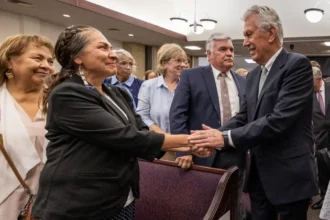
According to South China Monthly, her meetings on Wednesday also included talks with Republican representatives John Rose and Chuck Fleischmann, and Democratic Representative Thomas Suozzi. As reported by Focus Taiwan, Cheng met with Republican Sen. Steve Daines, Republican Reps. John Rose and Chuck Fleischmann, and Democratic Rep. Thomas Suozzi, according to the KMT.

As reported by RTI, discussions with House Committee on Foreign Affairs Chairperson Brian Mast also covered cross-strait relations, U.S.-Taiwan ties, and defense matters. According to Focus Taiwan, Cheng and her delegation met Wednesday with Rep.

Brian Mast, chairman of the House Foreign Affairs Committee, to discuss cross-strait relations, U.S.-Taiwan ties and defense issues, according to Chin.

What Is the Context of Cheng’s Multi-City US Tour?

According to South China Monthly, Washington is the main stop for Cheng’s multi-city US tour, which has already taken in San Francisco, Boston and New York.

As reported by CNA’s Focus Taiwan, Cheng and her delegation will begin their U.S. visit on the West Coast, visiting San Francisco before continuing to the East Coast, where they will visit New York, Washington, D.C., and Boston.

According to Focus Taiwan, Cheng’s first trip to the U.S. since taking office in November 2025 will include stops in San Francisco, Boston, New York, Washington, D.C., and Los Angeles.

As reported by Taiwan News, Cheng will travel to San Francisco first, then to Boston, New York and Washington, before returning to Los Angeles ahead of her flight back to Taiwan.

Why Did Cheng Decline to Confirm Meetings with US National Security Council Officials?

According to RTI, Cheng declined to confirm whether she would meet with U.S. National Security Council officials, citing the sensitive nature of such engagements.

This refusal reflects the diplomatic sensitivity surrounding meetings between Taiwan opposition party leaders and US administration officials, particularly at the National Security Council level.

What Is the Background of Cheng Li-wun’s Recent Diplomatic Activities?

As reported by BBC, during the meeting held at the Great Hall of the People in China, Xi remarked,

“The leaders of our two parties are convening today to protect peace and of our homeland, encourage the peaceful advancement of cross-strait relations, and to ensure that future generations inherit a bright and prosperous future”.

Xi expressed China’s readiness to enhance exchanges and dialogue with various parties, including the KMT, provided they oppose Taiwan’s independence.

According to ABC News, during their meeting in Beijing, she emphasized the need for both sides to move beyond political confrontations and seek systemic solutions to avert conflict, aiming for the Taiwan Strait to serve as a model for peaceful resolutions worldwide.

She articulated her desire for the trip to “plant seeds of peace” and urged President Xi for collaboration to “avoid war”.

As reported by CNA, this is Cheng’s first trip to the US since taking office in November 2025, following her rare April 2026 meeting with Chinese President Xi Jinping in Beijing.

According to NPR, the meeting precedes a summit scheduled in Beijing with President Donald Trump set for May, where Xi is expected to address his opposition to US military sales to Taiwan.

Background of Cheng Li-wun’s Washington Meeting and KMT-US Defence Cooperation

The meeting between KMT Chairperson Cheng Li-wun and US lawmakers on June 10, 2026, represents a continuation of ongoing diplomatic engagement between Taiwan’s opposition party and American legislative officials.

The defence budget negotiations have been a significant political issue in Taiwan since late 2025. As reported by TVBS News, President Lai Ching-te’s (賴清德) investment of NT$1.25 trillion in defense spending from 2026 to 2033 prompted both the Kuomintang (KMT) and the Taiwan People’s Party (TPP) to propose that President Lai deliver a national intelligence report to the Legislative Yuan. The Executive Yuan introduced a draft special act on procurement for enhancing defense, resilience, and asymmetric capabilities, amounting to NT$1.25 trillion over the next 8 years.

The KMT’s position on defence budget has evolved throughout 2026. As reported by Taiwan News, Cheng said she does not oppose an NT$800 billion (US$25.33 billion) arms purchase, but only if the US issues a formal Letter of Offer and Acceptance (LOA).

She reiterated that the budget could be set at NT$800 billion only after the US formally issues an LOA as a binding agreement.

Earlier in April 2026, Cheng said the KMT supports passing an initial NT$380 billion defense budget, which would be sufficient to cover the US$11.1 billion in arms packages approved for sale to Taiwan by the US in December 2025.

As reported by Taiwan News, during a KMT Central Committee meeting, Cheng said the party’s proposal of NT$380 billion (US$12 billion) plus future LOAs was intended to ensure the funding would be used solely for arms purchases.

The April 2026 meeting with Xi Jinping marked the first face-to-face meeting between KMT and Chinese Communist Party leadership in nearly a decade, since Xi’s 2015 summit with then-President Ma Ying-jeou. During this encounter, Xi expressed that China is open to “peaceful development” across the Taiwan Strait and referred to the people of both nations as “one family”.

Senator Steve Daines, who met with Cheng in Washington, has a history of engagement with Taiwan.

As reported by the US President’s official website, while meeting on the morning of September 22 with a delegation led by US Senator Steve Daines, President Tsai Ing-wen thanked the senator for his long-term support for Taiwan-US relations, and expressed hope that he will continue to enhance bilateral exchanges and cooperation in economic, trade, and security matters. Daines is known as a Trump ally and has been supportive of Taiwan-US relations.

The energy policy discussion reflects ongoing tensions between Taiwan’s major parties. The DPP has maintained an anti-nuclear stance, while the KMT has expressed more favorable views on nuclear energy as part of Taiwan’s energy strategy. This policy difference became a significant point of discussion during Cheng’s Washington meetings, with US lawmakers expressing frustration over the DPP’s position.

How Will Cheng Li-wun’s Washington Meeting Affect Taiwan’s Defence Budget and US-Taiwan Relations?

The development of Cheng Li-wun’s Washington meeting and the KMT’s clarified position on defence cooperation will affect several key audiences in Taiwan and the broader Indo-Pacific region.

For Taiwan’s ruling Democratic Progressive Party (DPP) and President Lai Ching-te’s administration, the KMT’s support for a NT$780 billion defence budget represents a significant political outcome.

The DPP had requested NT$1.25 trillion, and the opposition-controlled legislature’s passage of the reduced budget means the administration will receive less funding than requested for defence procurement. This could create gaps in Taiwan’s defence capabilities, as warned by DPP spokesperson Lee Kun-cheng, potentially limiting the government’s ability to purchase the full range of US and domestically-developed weapons it had planned.

For Taiwan’s legislature and opposition parties, the meeting clarifies the KMT’s position on defence spending and arms purchases. The KMT’s support for the NT$780 billion budget, which is more than double the party’s previous proposals of NT$380 billion, demonstrates the party’s evolution on defence issues while maintaining fiscal restraint. This positions the KMT as supporting defence cooperation with the US while advocating for financially sustainable spending levels.

For US lawmakers and the Trump administration, Cheng’s clarification that the KMT does not oppose American arms sales to Taiwan addresses previous ambiguities about the party’s stance. The KMT’s emphasis that defence acquisitions must be financially sound and follow legislative procedures aligns with US congressional concerns about Taiwan’s defence spending transparency and fiscal responsibility.

For Taiwan’s energy sector and nuclear power industry, the KMT’s favourable stance on nuclear energy and Cheng’s hope for deeper US-Taiwan cooperation on nuclear energy technologies could lead to policy changes if the KMT gains greater influence.

US lawmakers’ expressed frustration over the DPP’s anti-nuclear stance suggests potential US support for the KMT’s energy policy approach, which could influence Taiwan’s future energy decisions.

For cross-strait relations between Taiwan and China, Cheng’s continued emphasis on peace and her April 2026 meeting with Xi Jinping, combined with her Washington meetings on defence, demonstrates the KMT’s dual approach of maintaining defence cooperation with the US while pursuing peaceful cross-strait relations.

This balance could affect future negotiations between Taiwan and China, particularly regarding the Taiwan Strait’s status as a model for peaceful resolutions.

For US-Taiwan defence relations overall, the KMT’s clarified position supports continued military cooperation with Washington, which strengthens the bilateral defence relationship regardless of which party holds power in Taiwan.

The KMT’s legislative backing for substantial defence spending, even at reduced levels compared to the DPP’s request, demonstrates opposition party support for US arms purchases and defence cooperation.

The meeting’s timing, during Cheng’s first US trip since taking KMT office and following her rare meeting with Xi Jinping, positions the KMT as a key player in Taiwan’s foreign policy and defence decisions.

This could affect future US-Taiwan relations, particularly if the KMT returns to power in Taiwan’s upcoming elections, as the party has demonstrated support for defence cooperation while advocating for fiscal responsibility and peaceful cross-strait relations.