Key Points
- Oregon will not participate in President Donald Trump’s Great American State Fair in Washington, D.C., according to an official statement from Governor Tina Kotek’s office
- The state withdrew due to “the cost of participating in the Fair and growing concerns that the event in Washington, D.C. is shaping up to be a more partisan affair than originally presented”
- At least six to seven states have declined invitations: Oregon, Washington, North Carolina, Connecticut, Massachusetts, Illinois, and Maine, all governed by Democratic leaders
- Pennsylvania is still weighing its decision on participation
- The fair is organized by Freedom 250, a Trump-aligned nonprofit, and will run from June 25 to July 10, 2026, on the National Mall between the U.S. Capitol and Washington Monument
- Admission is free and open to the public, though advance registration is encouraged
- Despite state withdrawals, organizers say every state and territory will still be represented through tourism boards, state companies, or other organizations
- The event includes 50 state pavilions, a 110-foot Ferris wheel, a miniature “Triumphal Arch,” musical performances, military flyovers, and movie screenings
- Oregon and Washington are among the states that also need to stage their own anniversary events at home, citing cost considerations
- The fair is part of Trump’s year-long America 250 celebration commemorating the 250th anniversary of the Declaration of Independence
- Additional America 250 events include a UFC fight on the White House South Lawn, Patriot Games athletic competition, and what Trump promotes as the largest fireworks show globally on Fourth of July
- The UFC fight will feature at least seven clashes including fighters Ilia Topuria, Justin Gaethje, and Alex Pereira, observed by approximately 5,000 spectators
Washington (Evening Washington News) June 12, 2026 – Oregon officially withdrew from President Donald Trump’s Great American State Fair, marking the latest setback for the semiquincentennial celebration as multiple Democratic-led states decline participation over cost and partisan concerns. In a statement to KATU, Governor Tina Kotek’s office said Oregon withdrew because of
- Key Points
- Which States Have Declined to Participate in Trump’s Great American State Fair?
- Why Are Democratic Governors Citing Cost and Partisanship for Dropping Out?
- How Will the Fair Proceed Without Oregon and Other States’ Official Participation?
- What Are the Details of the Great American State Fair Schedule and Location?
- What Attractions and Events Will the Fair Feature Beyond State Pavilions?
- How Does the UFC Fight on White House South Lawn Fit Into America 250 Celebrations?
- What Other Setbacks Have Trump’s America 250 Events Experienced?
- How Has the Withdrawal Affected the Overall America 250 Celebration Timeline?
- Background of the Great American State Fair Development
- Prediction: How Oregon’s Withdrawal and State Dropouts Will Impact Washington State Residents and Pacific Northwest Audiences
“the cost of participating in the Fair and growing concerns that the event in Washington, D.C. is shaping up to be a more partisan affair than originally presented”.
Which States Have Declined to Participate in Trump’s Great American State Fair?
According to CNN and NOTUS reports, officials from seven gubernatorial offices will not be participating: Oregon, Washington, North Carolina, Maine, Massachusetts, Connecticut, and Illinois. The New York Times confirmed that at least five states have announced withdrawal, with Connecticut, Massachusetts, North Carolina, Pennsylvania, and Oregon all governed by Democratic leaders. Independent reported that Pennsylvania is still weighing up its decision on participation. A Twitter post from Dave Levinthal indicated Trump’s fair will be “minus six states”: Connecticut, Illinois, Maine, Massachusetts, North Carolina and Oregon.
Why Are Democratic Governors Citing Cost and Partisanship for Dropping Out?
As reported by Piper Hudspeth Blackburn of CNN, the states concerned are all led by Democratic governors who said their decision was based on cost considerations, given they need to stage their own events at home to mark the same anniversary.
That said, Oregon Governor Tina Kotek also pointed to what she considers to be the partisan nature of the event under Trump, CNN reported. The Times of India noted Oregon are skipping the event because of costs and perceived partisanship, with Governor Tina Kotek of Oregon pointing to the issue.
How Will the Fair Proceed Without Oregon and Other States’ Official Participation?
Those states will still be represented among the neo-classical pavilions, even if they do not provide input themselves, according to the Freedom 250 non-profit tasked with organizing the World’s Fair-style event. A Freedom 250 spokesperson told CNN:
“What we can say is that every state’s story will be told in a way that’s authentic to its people, history, and culture. Whether represented by a governor’s office, a tourism board, or a beloved state company or organization, every community will be celebrated”.
Officials from Oregon, Washington, and North Carolina told CNN they declined an invitation from the Trump administration to showcase their states at the giant fairgrounds being built on the National Mall.
What Are the Details of the Great American State Fair Schedule and Location?
Organizers with Freedom 250 said the “Great American State Fair,” a 16-day event set to run from June 25 through July 10, will stretch from the U.S. Capitol to the Washington Monument on the National Mall in D.C..
The Great American State Fair will be free and open to the public, though advance registration is encouraged. Operating hours include 10 a.m. to 9 p.m. Sunday to Wednesday, 10 a.m. to 11 p.m. Thursday to Saturday, and 10 a.m. until midnight on July 4. The fairground spans 12th Street, Washington, DC 20024, on the National Mall.
What Attractions and Events Will the Fair Feature Beyond State Pavilions?
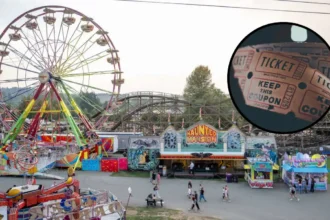
The fairground will feature a mini version of the president’s forthcoming “Triumphal Arch,” a 110-foot Ferris wheel and movie screenings, musical performances and military flyovers, according to the organizers.
Concept designs for the pavilions released by Freedom 250 reveal a miniature golf course for South Carolina, a replica of the Alamo occupying the Texas tent and an interactive fossil digging station for Montana. Visitors can try a mechanical milking cow at Michigan’s stand and take part in a virtual reality rodeo at the Wyoming pavilion. The fair is described by Trump as a
“unique, one-year exhibition featuring pavilions from all 50 states”.
How Does the UFC Fight on White House South Lawn Fit Into America 250 Celebrations?
Trump’s planned UFC cage fight on the White House lawn promises to be the most eye-opening spectacle of the festivities, with the president having an enormous arena built to accommodate it. The mixed martial arts extravaganza organized by UFC CEO Dana White will feature at least seven clashes involving Ilia Topuria, Justin Gaethje and Alex Pereira, among others.
It will be observed by around 5,000 spectators in person, from VIPs to members of the military, with many more watching on from large screens especially installed at Washington’s Ellipse Park nearby. UFC CEO Dana White promised the company “will absolutely” host a card on the White House lawn on July 4, 2026, telling The Associated Press:
“Think about that, the 250th birthday of the United States of America, the UFC will be on the White House south lawn live on CBS”.
What Other Setbacks Have Trump’s America 250 Events Experienced?
The drop out is the latest in trouble for Trump-related events to mark America’s birthday. Just weeks ago, a concert lineup was announced for a Trump-aligned concert series featuring acts including Milli Vanilli, C+C Music Factory and Martina McBride, but soon after announcing the lineup, many artists began to pull out.
Morris Day and The Time, Young MC, country singer Martina McBride and former Poison frontman Bret Michaels all backed out of planned appearances, leaving only the likes of Vanilla Ice and Flo Rida on the bill, drawing an angry reaction from Trump.
The president was reportedly furious about the exodus and pledged to headline himself instead, declaring that he is
“the No. 1 Attraction anywhere in the World”
and
“the man who gets much larger audiences than Elvis in his prime, and he does so without a guitar”.
He has also derided the acts who dropped out as “third rate,” “boring” and overpaid.
How Has the Withdrawal Affected the Overall America 250 Celebration Timeline?
Today, President Donald J. Trump launched the year-long Great American State Fair in celebration of America’s 250th birthday, according to a White House fact sheet from July 3, 2025. In July 2026, the White House Task Force on Celebrating America’s 250th Birthday, in partnership with the America 250 Commission, will host the Great American State Fair on the National Mall.
Additional America 250 celebrations announced by President Trump include the Patriot Games, an athletic competition for high school students across the country.
Among activities announced or proposed for the America250 initiative are a National Garden of American Heroes, reinstated by Trump via executive order, a Great American Road Trip highlighting popular travel routes and historic landmarks, a student writing and art contest, and a time capsule to be buried in Philadelphia on July 4, 2026.
Background of the Great American State Fair Development
The Great American State Fair is part of President Donald Trump’s America 250 campaign, a yearlong celebration commemorating 250 years since the signing of the Declaration of Independence on July 4, 1776. The White House launched the initiative at a kick-off celebration on July 3, 2025, with Trump describing it as advancing plans to
“throw the greatest birthday party in American history”.
The fair is organized by Freedom 250, a Trump-aligned non-profit tasked with organizing the World’s Fair-style event. Each of the 50 states and territories will be represented by their own pavilion at the giant fairgrounds being erected on the National Mall in Washington, D.C., with each offering an experience relevant to the culture and traditions of that state.
Preparations for the semiquincentennial celebrations have not run entirely smoothly, with numerous artists dropping out of a major concert planned as its centerpiece, many claiming they had been misled about its likely political overtones.
The current list of America 250 events includes the state fair on the National Mall, a UFC fight at the White House, a physical fitness competition in Orlando, a Grand Prix through Washington’s streets, and what Trump promotes as the largest fireworks show globally on Fourth of July.
Prediction: How Oregon’s Withdrawal and State Dropouts Will Impact Washington State Residents and Pacific Northwest Audiences
Oregon’s decision to withdraw, alongside Washington state’s similar opt-out, will directly affect Pacific Northwest audiences in several measurable ways. Washington state also opted out of the fair, which is organized by Freedom 250, a nonprofit aligned with Trump.
Both states will still need to stage their own events at home to mark the 250th anniversary, meaning Pacific Northwest residents seeking anniversary celebrations will have access to locally organized alternatives rather than traveling to Washington, D.C..
For Oregon residents specifically, the withdrawal means the state’s pavilion will be represented through a tourism board or state company rather than the governor’s office, potentially affecting the authenticity and depth of Oregon’s cultural presentation at the fair. The cost savings from not participating—Oregon cited participation costs as too high—will allow the state to redirect resources toward homegrown anniversary events that may better reflect Pacific Northwest values on climate change and reproductive rights, issues highlighted in The Independent’s coverage.
For Washington state travelers who might have considered attending the fair, the $0 admission price becomes less relevant since they won’t have an official state pavilion showcasing Washington’s traditions, though they can still visit other 50 state pavilions.
The partisan concerns raised by Governor Kotek suggest Pacific Northwest audiences may increasingly view America 250 events as politically charged rather than unifying national celebrations, potentially affecting attendance at remaining Trump-administration events like the White House UFC fight. Additionally, with six to seven blue states absent, the fair’s representation of the nation’s political diversity will be skewed toward Republican-led states, which may influence how Pacific Northwest visitors perceive the event’s claim to represent “all 50 states” authentically.