Key Points
- Major Legal Shift: The United States Supreme Court has struck down long-standing statutory restrictions on the amount of money political parties can spend in direct coordination with federal candidates.
- 6–3 Ideological Split: Operating along partisan lines, the conservative majority deemed the restrictions an unconstitutional infringement on political parties’ First Amendment free-speech rights, while the liberal minority issued a stark dissent.
- Immediate Financial Impact: The ruling allows national party committees to immediately leverage massive financial reserves to buy lower-rate television and radio advertisements in coordination with individual campaigns.
- Altered Electoral Landscape: By empowering traditional party apparatuses to spend uncapped amounts alongside candidates, the decision diminishes the relative monopoly of independent super PACs while widening funding disparities between parties.
- Corruption Warnings: Decried by critics and the dissenting justices as an open invitation to quid pro quo corruption, the ruling leaves base donor limits intact but permits parties to act as expansive checking accounts for individual nominees.
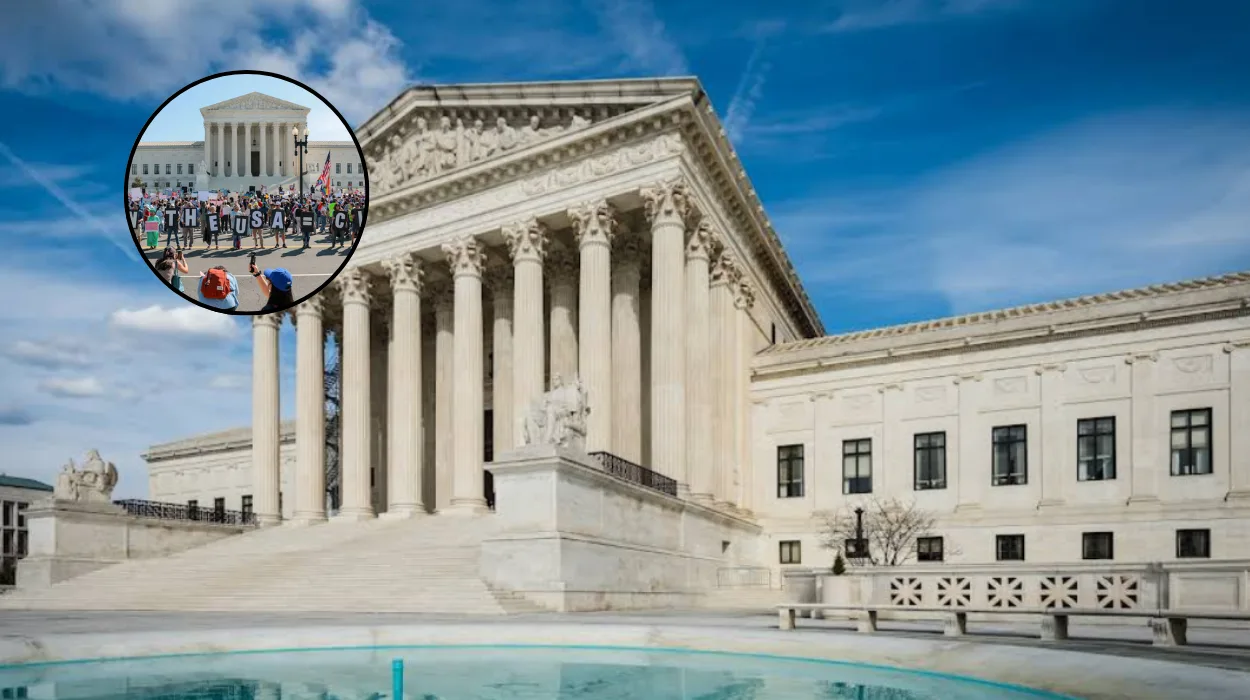
Washington (Evening Washington News) July 1, 2026 — The United States Supreme Court has delivered a sweeping victory to congressional Republicans by striking down federal limits on how much money political parties can spend in direct coordination with their candidates. In a decisive 6–3 ruling that fell entirely along ideological lines, the high court’s conservative majority declared that capping these coordinated expenditures violates the First Amendment guarantee of free speech. The landmark decision is expected to fundamentally reshape the financial mechanics of American elections, unleashing a torrent of centralized party capital directly into congressional and presidential campaigns ahead of the crucial upcoming midterm elections.
- Key Points
- How Did the Supreme Court Rule on Campaign Coordination Limits?
- What Arguments Convinced the Court to Strike Down the Restrictions?
- Why Did the Dissenting Justices Oppose the Campaign Finance Ruling?
- What Do Outside Legal Experts and Watchdogs Say About the Ruling?
- Background of Campaign Finance Deregulation at the Supreme Court
- Prediction: How This Development Can Affect the American Electorate and Political Campaigns
- The Financial Advantage of Ad Subsidies
- The Resurgence of Traditional Party Power
How Did the Supreme Court Rule on Campaign Coordination Limits?
As detailed in the majority opinion for National Republican Senatorial Committee v. Federal Election Commission, the high court determined that statutory constraints placed upon political party spending done in explicit alignment with a candidate’s campaign are unconstitutional.
Writing for the majority, Justice Brett Kavanaugh asserted that the federal government lacks the constitutional authority to muzzle political organizations at the exact moment they seek to support their chosen nominees. Justice Kavanaugh observed that:
“It will allow all political parties — including the DNC and RNC and the respective Senate and House campaign committees, as well as other parties and party committees — to participate more freely and compete more fully in the political process, and to coordinate more closely with their candidates.”
The court’s decision specifically invalidated portions of the Federal Election Campaign Act (FECA), which had long forced national parties to maintain strict legal firewalls between their independent advertising campaigns and the internal strategic operations of individual candidates.
Under the previous regime, if a party committee wished to directly consult with a candidate on scriptwriting, timing, or target audiences for a broadcast advertisement, the expenditure was subject to strict statutory caps that varied depending on the population of the state or district.
By erasing these boundaries, the court has allowed parties to function essentially as parallel financial arms for individual campaigns.
What Arguments Convinced the Court to Strike Down the Restrictions?
The legal challenge was spearheaded by Vice President JD Vance alongside congressional Republicans, who petitioned the judiciary to dismantle the coordinated spending caps.
As reported by Justin Jouvenal and Julian Mark of The Washington Post, the petitioners successfully argued that money spent on political communication is an inalienable facet of modern speech, a doctrine tracking back to the foundational 1976 precedent established in Buckley v. Valeo.
The Federal Election Commission, under the guidance of the current executive administration, aligned its formal posture with the Republican petitioners.
Representing the government, Solicitor General D. John Sauer argued before the bench that the statutory limits unconstitutionally burdened the right of political associations to engage in expressive political advocacy alongside their own candidates.
Because the defense of the law was abandoned by the executive branch, the Supreme Court appointed outside counsel Roman Martinez to argue in favor of keeping the caps, supported by legal briefs from Democratic campaign committees who urged the preservation of the rules.
In assessing the constitutional parameters of the case, the conservative majority noted that the only permissible ground for restricting campaign finance speech is the prevention of explicit quid pro quo corruption—defined strictly as a direct exchange of political favors for financial benefits—or its appearance. Justice Kavanaugh determined that existing regulatory safeguards are already robust enough to prevent such an occurrence without the need for coordinated spending caps. As Justice Kavanaugh explained in the text of the ruling:
“Importantly, disclosure does not stand on its own. Rather, the combination of the base contribution limits plus the earmarking rules plus the disclosure requirements together serve the Government’s anti-circumvention interests here — without unduly restricting core political party speech.”
Why Did the Dissenting Justices Oppose the Campaign Finance Ruling?
The three liberal justices on the high court strongly resisted the majority’s constitutional interpretation, painting a dark picture of an electoral system increasingly subservient to concentrated wealth.
In a sharply worded dissent, Justice Elena Kagan warned that eroding the boundary between candidate funding and party structures creates an easy avenue for wealthy special interests to bypass individual donation limits. As Justice Kagan observed:
“The majority invalidates Congress’s restriction of coordinated expenditures, thus enabling a party to serve as an alternative checking account for a campaign. As a result, a donor will be able to give a party as much as half a million dollars (as compared to the $7,000 he can give directly to the candidate) to cover the candidate’s bills. And the candidate can seek just such a donation.”
Justice Kagan and her dissenting colleagues argued that by allowing unlimited coordination, a politician can actively solicit massive checks from a single wealthy individual to a national party committee, knowing that the party can immediately pivot and spend that exact sum on tailored, candidate-directed television spots.
This dynamic, the dissent maintained, effectively hollows out individual candidate donation caps and invites the very appearance of systematic corruption that campaign finance laws were designed to prevent.
What Do Outside Legal Experts and Watchdogs Say About the Ruling?
The decision drew immediate condemnation from campaign finance reform advocates and progressive legal institutions, who viewed the ruling as part of a multi-decade judicial campaign to dismantle electoral regulations.
In an official public statement released by the Brennan Center for Justice, Michael Waldman expressed profound concern over the escalating role of money in public life, stating:
“Here, the Court again overrode the law passed by Congress, going against the wishes of the vast majority of the American public who want reasonable campaign finance limits. The questions at the heart of this case were for Congress to answer, not nine unelected justices. The Court‘s campaign finance vendetta has given wealthy donors outsized influence, resulting in a fusion of private wealth and political power unseen since the Gilded Age.”
Conversely, Republican party leaders and conservative strategist networks praised the decision. Proponents argued that national parties are inherently transparent, democratically accountable institutions, making them far healthier vehicles for political spending than shadow-bound independent groups or insulated corporate operations.
Background of Campaign Finance Deregulation at the Supreme Court
The ruling represents the latest milestone in a consistent, twenty-year trajectory under the stewardship of Chief Justice John G. Roberts Jr. to steadily roll back federal restrictions on political speech and campaign financing.
The high court has repeatedly demonstrated high receptivity to the legal argument that financial limitations on electioneering function as direct limitations on political expression.
The most notable predecessor to this ruling occurred in the watershed 2010 case Citizens United v. Federal Election Commission.
In that 5–4 decision, the Supreme Court ruled that corporations, labor unions, and outside associations could spend unlimited amounts of money on elections, provided that those expenditures were made entirely independently of a candidate’s official campaign.
This decision birthed the modern era of the “Super PAC”—independent expenditure-only committees capable of accepting uncapped donations from billionaires and corporate treasuries.
Four years later, in the 2014 case McCutcheon v. Federal Election Commission, the high court further weakened regulations by striking down aggregate limits on how much a single wealthy donor could give in total to all federal candidates and political party committees during a single two-year election cycle.
The legal foundations for this specific challenge were also cemented recently in the 2022 decision Federal Election Commission v. Ted Cruz for Senate.
In that case, Texas Republican Senator Ted Cruz successfully challenged a provision of the 2002 Bipartisan Campaign Reform Act (BCRA) that capped the amount of post-election campaign contributions that could be used to repay personal loans a candidate made to their own campaign.
Writing for the majority in the Cruz case, Chief Justice Roberts rejected government anti-corruption arguments, setting a stringent evidentiary standard that the FEC failed to meet in defending the coordinated spending limits.
Prediction: How This Development Can Affect the American Electorate and Political Campaigns
This judicial development will significantly reshape the balance of power within the American political ecosystem, carrying direct consequences for political parties, individual congressional candidates, and the broader voting public.
In the short term, this ruling is positioned to heavily favor Republican campaigns due to a widening fundraising gap between the national party organs.
According to data reported by The Washington Post, top Republican party committees concluded their May reporting cycle with approximately $256 million sitting in the bank with zero debt.
In stark contrast, competing Democratic committees held roughly $127 million in cash reserves while carrying $18 million in debt.
Because the national parties can now inject these funds directly into candidate operations without restriction, the $129 million fundraising advantage possessed by the GOP will translate directly into immediate localized campaigns, putting cash-strapped Democratic candidates at a distinct structural disadvantage.
The Financial Advantage of Ad Subsidies
A critical systemic shift will occur in how political advertisements are purchased across America’s media markets. Federal communications law mandates that broadcast television and radio stations must offer candidate campaigns the “lowest unit charge” for advertising space in the weeks leading up to an election.
Historically, outside political organizations like Super PACs were legally excluded from these discounted rates, forcing them to pay massive premiums to air the exact same length of political programming.
Because national parties can now coordinate directly with candidates, they can utilize their massive, multi-million-dollar central funds to purchase media packages directly through the candidate’s campaign apparatus.
This change effectively stretches the purchasing power of party money, enabling a dramatically higher volume of political advertisements to hit public airwaves for the exact same dollar amount.
The Resurgence of Traditional Party Power
For the broader electorate, this ruling will likely trigger a shift in who controls the messaging of political campaigns. For the past decade and a half, billionaire-funded Super PACs have held outsized influence over elections, often dictating which candidates survived primaries through heavy independent spending.
Because national parties can now offer unlimited, highly coordinated financial backing directly to nominees, power is expected to shift back toward traditional party leaders and established political machines.
While individual voters will still face contribution caps of $3,500 per election cycle directly to a candidate, wealthy donors can maximize their influence by writing checks up to $44,300 per year to national party committees.
Consequently, ordinary citizens can expect an election environment increasingly saturated with party-controlled, highly synchronized media blitzes, further elevating the role of high-dollar fundraising networks in defining the national political discourse.