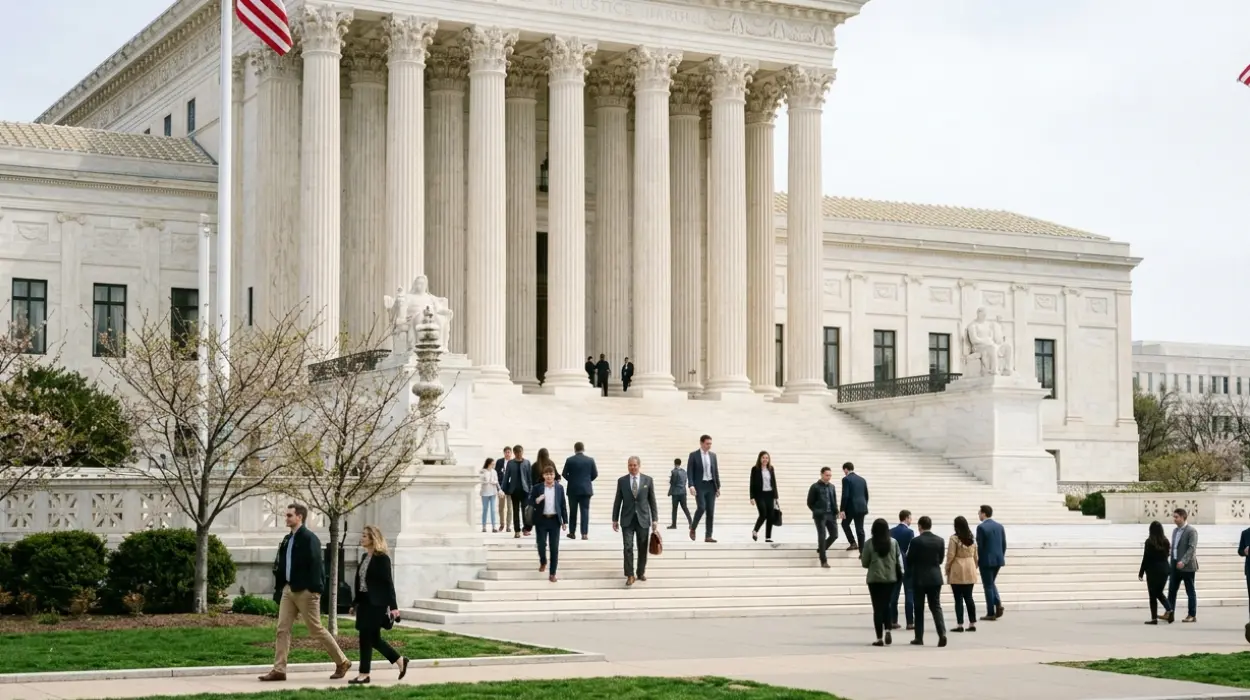
The Supreme Court of the United States serves as the highest federal court, established under Article III of the U.S. Constitution. It holds ultimate appellate jurisdiction over federal and state cases involving constitutional or federal law issues.
- What is the Supreme Court of the United States?
- When was the Supreme Court of the United States established?
- Who are the current justices on the Supreme Court?
- How does the Supreme Court select cases?
- What is the role of the Chief Justice?
- What powers does the Supreme Court have?
- What are landmark Supreme Court decisions?
- How does the Supreme Court hear cases?
- Where does the Supreme Court meet?
- Why is judicial review important?
- How has the Supreme Court changed over time?
- What is the impact of Supreme Court decisions?
What is the Supreme Court of the United States?
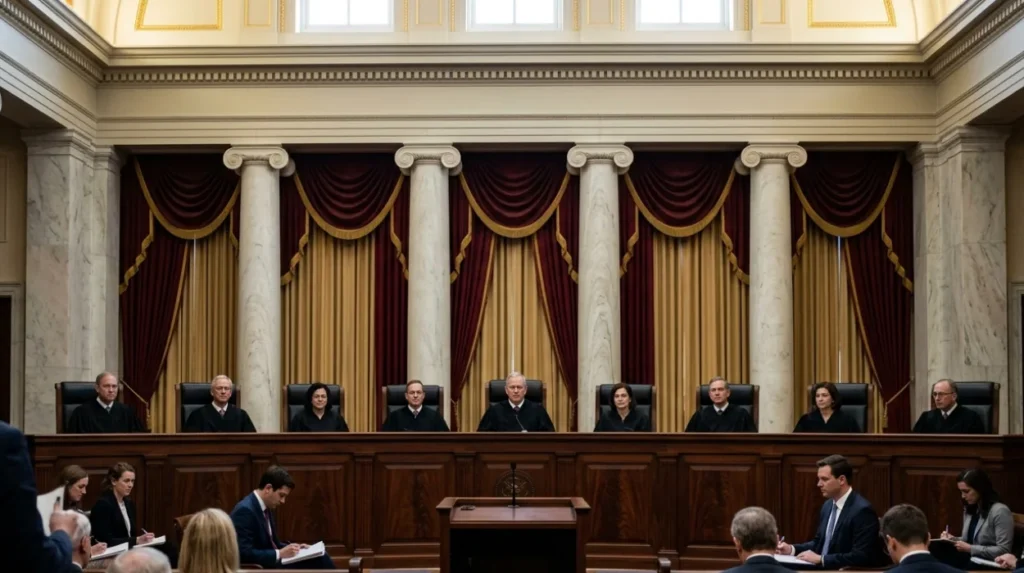
The Supreme Court of the United States (SCOTUS) is the head of the federal judiciary, with nine justices including one Chief Justice and eight Associate Justices, appointed for life terms by the President with Senate confirmation. It resolves major legal disputes and interprets the Constitution.
The Court operates from the Supreme Court Building in Washington, D.C. Article III, Section 1 of the U.S. Constitution vests judicial power in one supreme Court and inferior courts established by Congress. The Judiciary Act of 1789, passed by the First Congress on September 24, 1789, set the initial structure with a Chief Justice and five Associate Justices.
This act divided the nation into districts and circuits, requiring justices to hold circuit courts twice yearly. Congress fixed the number at nine justices via the Judiciary Act of 1869, codified in 28 U.S.C. §1 on June 25, 1948. The Court’s decisions bind all lower courts and government branches.
Justices maintain lifetime tenure unless they die, retire, resign, or face impeachment and removal. Presidents nominate candidates based on legal expertise, judicial philosophy, and political alignment, subject to Senate advice and consent.
When was the Supreme Court of the United States established?
The Supreme Court of the United States traces to Article III of the Constitution ratified in 1788, with the Judiciary Act of 1789 on September 24 defining its structure, and first session on February 2, 1790. It began with six justices.
George Washington nominated John Jay as the first Chief Justice, confirmed by the Senate on September 26, 1789. The Court convened in New York City, then the capital, before moving to Philadelphia and finally Washington, D.C. Early sessions faced low caseloads, focusing on circuit riding duties.
The Court gained prominence under Chief Justice John Marshall from 1801 to 1835. Marshall established judicial review in Marbury v. Madison (1803), asserting the power to strike unconstitutional laws. Congress adjusted the Court’s size six times between 1789 and 1869, settling at nine to balance regional representation.
The Supreme Court Building opened in 1935, providing a permanent home designed by Cass Gilbert. Before that, the Court met in the Capitol basement or rented spaces.
Who are the current justices on the Supreme Court?
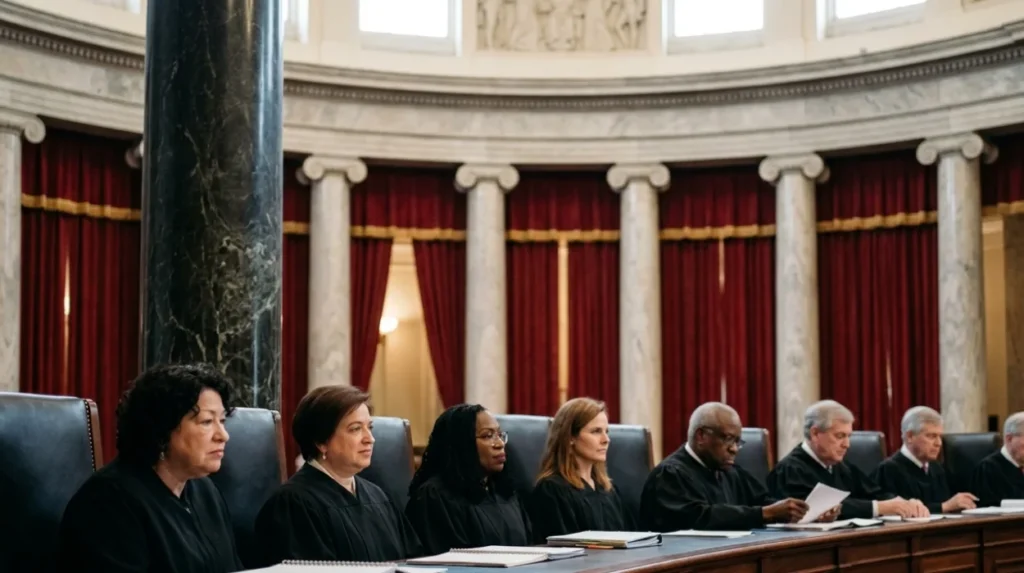
As of April 2026, the Supreme Court comprises Chief Justice John G. Roberts, Jr., and eight Associate Justices: Clarence Thomas, Samuel A. Alito, Jr., Sonia Sotomayor, Elena Kagan, Neil M. Gorsuch, Brett M. Kavanaugh, Amy Coney Barrett, and Ketanji Brown Jackson. All serve lifetime terms.
John G. Roberts, Jr., born January 27, 1955, became Chief Justice on September 29, 2005, nominated by President George W. Bush. Clarence Thomas, born June 23, 1948, joined on October 23, 1991, nominated by President George H.W. Bush. Samuel A. Alito, Jr., born April 1, 1950, took office January 31, 2006, also nominated by Bush.
Sonia Sotomayor, born June 25, 1954, became the first Hispanic justice on August 8, 2009, nominated by President Barack Obama. Elena Kagan, born April 28, 1960, joined on August 7, 2010, nominated by Obama. Neil M. Gorsuch, born August 29, 1967, filled the seat vacated by Antonin Scalia on April 10, 2017, nominated by President Donald Trump.
Brett M. Kavanaugh, born February 12, 1965, joined on October 6, 2018, nominated by Trump. Amy Coney Barrett, born January 28, 1972, took office October 27, 2020, nominated by Trump. Ketanji Brown Jackson, born September 14, 1970, became the first Black woman justice on June 30, 2022, nominated by President Joe Biden.
Vacancies arise from death, retirement, or resignation; the Senate must confirm nominees by majority vote. No justice has been removed via impeachment since 1805.
How does the Supreme Court select cases?
The Supreme Court selects cases through certiorari, granting review to about 1-2% of 7,000-8,000 annual petitions via a “rule of four,” where four justices vote to hear it. It prioritizes cases with national significance.
Attorneys file writs of certiorari to the Clerk after lower court exhaustion. The Court lists petitions on a docket; justices review without oral argument. At the weekly conference, the Chief Justice assigns discussion; four votes suffice for certiorari.
The Court issues 70-90 opinions yearly from granted cases. It controls its docket under 28 U.S.C. §1254, declining most petitions via summary denial. Original jurisdiction cases, like state disputes, bypass certiorari.
Factors include circuit splits, constitutional questions, and federal law conflicts. Deadlines fall in July, October, January, and April conferences.
What is the role of the Chief Justice?
The Chief Justice leads the Supreme Court, presiding over sessions, assigning opinion writers in majority cases, and serving as circuit justice for the D.C. Circuit. John G. Roberts, Jr., holds this position.
The Chief Justice sets the conference agenda and speaks first. In ties, the Chief votes last. The role includes administrative duties over the federal judiciary, appointing committee chairs, and managing the budget.
Historically, John Marshall elevated the position through unanimous decisions and nationalism. Charles Evans Hughes reformed procedures in the 1930s. The Chief administers presidential oaths.
What powers does the Supreme Court have?
The Supreme Court exercises judicial review to declare laws or executive actions unconstitutional, holds appellate jurisdiction over federal issues, and original jurisdiction in state or diplomat cases. Its rulings bind all branches.
Judicial review, from Marbury v. Madison (1803), invalidates violations of the Constitution. It reviews statutes, treaties, and orders under cases or controversies. Appellate power covers state supreme court decisions on federal questions.
Original jurisdiction under Article III, Section 2 includes disputes between states, like boundary cases (e.g., New Jersey v. New York, 1997), or U.S. versus a state. It enforces separation of powers by checking Congress and the President.
Rulings apply retroactively unless specified otherwise. Enforcement relies on executive branch compliance.
What are landmark Supreme Court decisions?
Landmark decisions include Marbury v. Madison (1803) establishing judicial review, Brown v. Board of Education (1954) ending school segregation, Roe v. Wade (1973, overturned 2022) on abortion, and Obergefell v. Hodges (2015) legalizing same-sex marriage nationwide. They shape law.
Marbury v. Madison declared Section 13 of the Judiciary Act unconstitutional. Dred Scott v. Sandford (1857) denied citizenship to African Americans, fueling Civil War tensions. Plessy v. Ferguson (1896) upheld “separate but equal,” overturned by Brown v. Board.
Miranda v. Arizona (1966) required rights warnings for arrests. New York Times v. United States (1971) protected Pentagon Papers publication. Citizens United v. FEC (2010) expanded corporate political spending. Dobbs v. Jackson (2022) returned abortion regulation to states.
These 10+ cases redefine rights, federalism, and commerce.
How does the Supreme Court hear cases?
The Supreme Court hears cases in open sessions from October to June, with 60-90 minute oral arguments per side, followed by private conferences and opinion drafting over months. Briefs precede arguments.
Counsel submit merits briefs 45 days post-certiorari; amicus briefs add perspectives. The Court schedules arguments; justices question attorneys. Conference votes assign opinion writing.
Drafts circulate; coalitions shift. Opinions release with dissents or concurrences. Rehearings occur rarely.
Three types exist: majority (precedential), concurring (agree on result), dissenting (oppose).
Where does the Supreme Court meet?
The Supreme Court meets in the Supreme Court Building at 1 First Street, Northeast, Washington, D.C., opened October 7, 1935. Public sessions occur in the courtroom.
Designed by Cass Gilbert, the neoclassical marble structure features a Great Hall and 92-foot ceiling courtroom. It houses offices, library with 500,000+ volumes, and the Thurgood Marshall Room.
Sessions run Monday-Wednesday; live audio broadcasts since 2020. Visitors access via One First Street entrance.
Why is judicial review important?
Judicial review allows the Supreme Court to invalidate unconstitutional laws, protecting rights, enforcing separation of powers, and upholding the Constitution as supreme law. Established in 1803, it defines the Court’s authority.
It safeguards minorities from majority overreach, as in protecting free speech. Checks include striking executive orders exceeding authority. Over 180 laws declared unconstitutional since 1803.
Implications include federalism balance; states challenge federal acts. Future relevance grows with polarized politics.
How has the Supreme Court changed over time?
The Supreme Court expanded from six justices in 1789 to nine in 1869, gained judicial review in 1803, ceased circuit riding in 1911, built a dedicated facility in 1935, and issued landmark civil rights rulings post-1950. Reforms enhanced efficiency.
Early Court rode circuits; Judiciary Act of 1891 created circuit courts of appeals. Rule of four adopted in 1925 via Judiciary Act. Televised arguments declined; audio released in 2020.
Demographics shifted: first woman (Sandra Day O’Connor, 1981), Black (Thurgood Marshall, 1967), Hispanic, and woman of color justices. Caseload peaked at 10,000 petitions annually by 1980s, now stabilized.
Three eras define it: Marshall (nationalism), Taney (states’ rights), Warren (rights expansion).
What is the impact of Supreme Court decisions?
Supreme Court decisions bind lower courts, alter laws nationwide, influence policy, and spark amendments like the 14th and 16th after rulings. They affect 330 million Americans.
Brown v. Board desegregated schools, prompting Civil Rights Act of 1964. Roe v. Wade (1973-2022) shaped healthcare; Dobbs decentralized it. Obergefell mandated marriage equality in 50 states.
Economic impacts include minimum wage via West Coast Hotel v. Parrish (1937). Statistics: 1,650+ volumes of U.S. Reports document 35,000+ cases since 1790. Implications persist in elections and rights debates.
What is the Supreme Court of the United States?
The Supreme Court of the United States is the highest court in the federal judiciary and the final interpreter of the U.S. Constitution. It consists of nine justices—one Chief Justice and eight Associate Justices—who are nominated by the President and confirmed by the Senate.
It operates from the Supreme Court Building in Washington, D.C., and has ultimate appellate authority over cases involving federal or constitutional law. Its decisions are binding on all lower federal and state courts.
The Court was established under Article III of the U.S. Constitution (ratified in 1788), and formally organized by the Judiciary Act of 1789, which set its initial structure.