
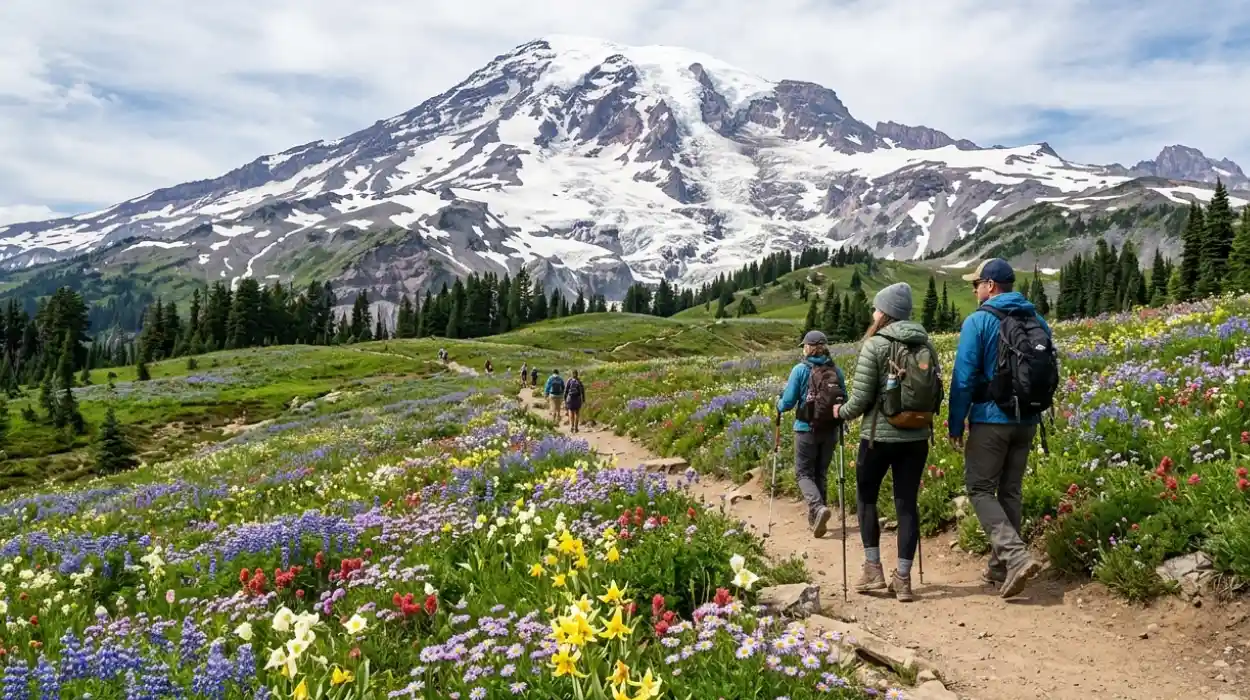
Wildflower season at Mount Rainier National Park runs from mid-July through early August, with peak bloom occurring during the first two weeks of August. The season depends on snowmelt timing, elevation, and annual weather patterns, with flowers visible from late June through September.
- What is the best time to see wildflowers at Mount Rainier?
- Where are the best wildflower viewing spots at Mount Rainier?
- Paradise Area
- Sunrise Area
- Mowich Lake and Spray Park
- Other Notable Viewing Locations
- Which wildflower species bloom at Mount Rainier?
- Blue and Purple Wildflowers
- Red and Pink Wildflowers
- White Wildflowers
- Yellow and Orange Wildflowers
- How does elevation affect wildflower bloom timing at Mount Rainier?
- What trails are best for families with children?
- How do I prepare for a wildflower viewing trip to Mount Rainier?
- What rules govern wildflower viewing at Mount Rainier?
- Why are Mount Rainier’s wildflowers ecologically important?
- How has climate change affected Mount Rainier’s wildflower seasons?
- What safety considerations apply during wildflower viewing?
- When should I visit Mount Rainier outside peak wildflower season?
Mount Rainier National Park, located in Washington State, rises 14,411 feet above sea level and contains over 60 wildflower species across forest, subalpine, and alpine life zones. The park’s renowned meadows, particularly at Paradise and Sunrise, display carpets of blue lupine, yellow glacier lilies, white avalanche lilies, and crimson paintbrush during the summer months. Hundreds of species inhabit all three life zones, creating one of North America’s most spectacular alpine wildflower displays.
What is the best time to see wildflowers at Mount Rainier?
The optimal wildflower viewing window is late July to early August, specifically August 1 to August 8, when Paradise and Sunrise showcase their most vibrant blooms. Expect peak bloom during the first two weeks of August if snowmelt follows typical patterns.
Wildflower timing varies by elevation and microclimate. Spray Park and Grand Park, approximately 1,000 feet lower than Paradise, bloom earlier due to reduced mountain shadow. Sunrise Meadows and areas above Paradise bloom later, with Summerland blooming the latest. The bloom period spans six weeks from mid-July through late August, ensuring something flowers throughout the season.
Weather patterns dictate exact timing. The park’s wildflower peak depends heavily on precipitation and temperature, making accurate predictions difficult. In most years, many flowers bloom by mid-July, and meadows become “very impressive” by August 1. Frost typically arrives by late August, ending peak-season blooming, though meadows remain beautiful with changing leaf colours and seed pods.
Check the official Mount Rainier wildflower status page before visiting for current bloom reports and photos from park staff. The National Park Service updates this resource regularly during the summer season.
Where are the best wildflower viewing spots at Mount Rainier?
Top wildflower viewing locations include Paradise (Skyline Trail), Sunrise (Burroughs Mountain), Tipsoo Lake, and Mowich Lake, each offering distinct meadow access and flower varieties. These areas feature the park’s most accessible wildflower meadows with established trails.
Paradise Area
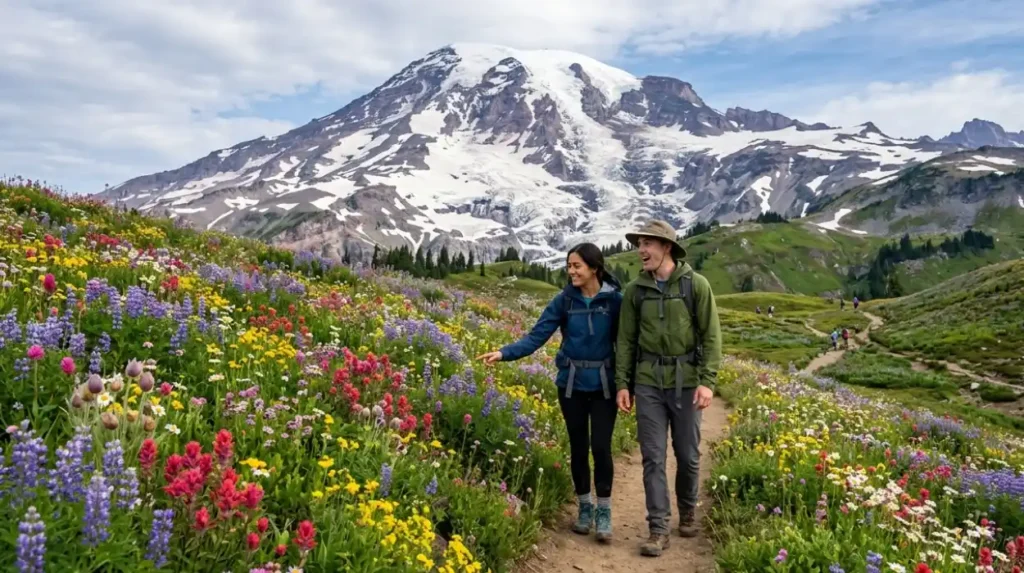
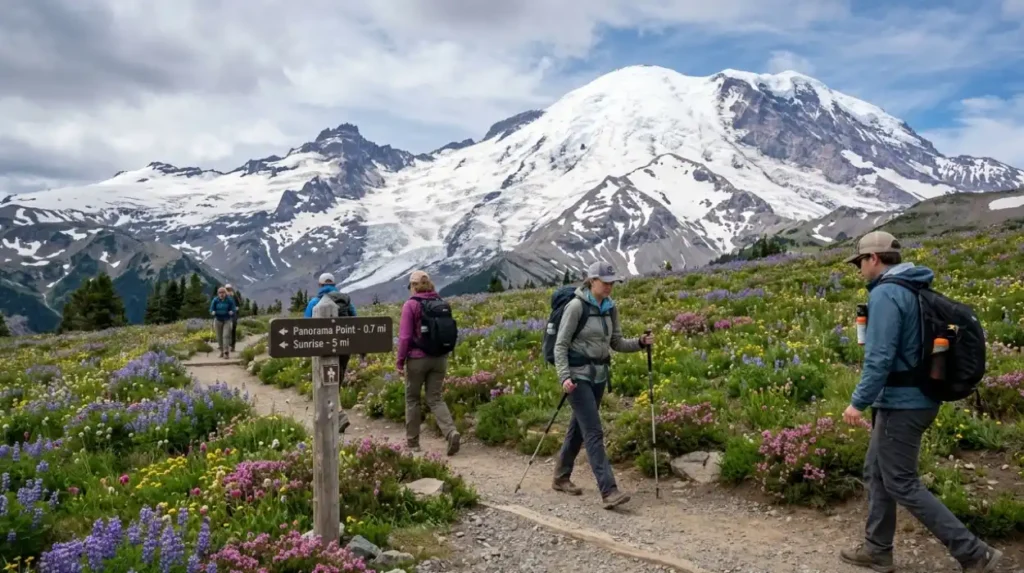
Paradise sits at an elevation of 5,400 feet and serves as the park’s primary wildflower destination. The Skyline Trail provides the most comprehensive wildflower experience, offering 5.5 miles round-trip with 1,700 feet of elevation gain and 4.5 hours of hiking time.
Key trails from Paradise include:
- Skyline Trail: Main loop through prime meadows, passing Panorama Point at 6,800 feet
- Glacier Vista Trail: Shorter alternative with similar wildflower exposure
- High Lakes Trail: Accesses multiple subalpine lakes surrounded by blooms
- Deadhorse Creek Trail: Family-friendly option with wildflowers sprinkled throughout meadows
The meadows around Paradise display blue lupine, yellow glacier lilies, white avalanche lilies, and crimson paintbrush. Avalanche lilies edge park roads and subalpine trails, while pasqueflowers line trails from early bloom through seed pod stage.
Sunrise Area
Sunrise sits at 6,400 feet in elevation, making it the park’s highest accessible point by vehicle. The Sunrise Visitor Centre provides maps and elevation-based bloom information.
Key trails from Sunrise include:
- Burroughs Mountain Trail: Offers panoramic meadow views with golden glacier lilies
- Sunrise Loop through Shadow Lake: Easy access to diverse wildflower patches
- Palisades Lake Trail: Family-friendly route with rainbow-coloured meadows
- Berkley Park Trail: Longer hike past Frozen Lake featuring golden glacier lilies and white avalanche lilies
- Sourdough Ridge Trail: Following signs past Frozen Lake, where snowmelt reveals fresh blooms
Sunrise subalpine trails showcase pasqueflowers from early bloom to “bedhead” (seed pod) stage, plus scarlet and magenta paintbrush dotting trails and meadows.
Mowich Lake and Spray Park
Mowich Lake serves as the trailhead for Spray Park, which harbours more than 60 wildflower varieties along its shoreline. The trail leads through forests, past streams, to Tolmie Peak.
Important accessibility note: The SR165/Fairfax Bridge closure since 2024 eliminates vehicular access to Mowich Lake from SR165, requiring long-distance hiking via the Wonderland Trail for trail access. This permanent closure significantly impacts Spray Park accessibility for most visitors.
Other Notable Viewing Locations
Tipsoo Lake provides easily accessible wildflower viewing near the park’s eastern entrance. The site requires no long trek, offering incredible mountain views combined with gorgeous blooms.
Reflection Lakes along Stevens Canyon Highway offer accessibility just off the parking area with mountain, water, and bloom views. The Lakes Trail provides a scenic route from Paradise for visitors preferring longer treks.
Van Trump Park, accessible above Comet Falls, represents another worthwhile wildflower destination.
Which wildflower species bloom at Mount Rainier?
Mount Rainier hosts over 60 wildflower species across 14 categories, including Indian paintbrush, avalanche lily, glacier lily, lupine, beargrass, and tiger lily. Species are organised by colour: blue/purple, red/pink, white, and yellow/orange.
Blue and Purple Wildflowers
Blue and purple wildflower species include:
- Alpine Aster: Fields of purple asters bloom during peak season
- Broadleaf Lupine: Arctic lupine creates rich blue carpets across meadows
- Cascade Aster: Subalpine daisy varieties appear in lower elevations
- Cusick’s Speedwell: Exhibits exquisite blue colouring during the summer months
- Harebell: Delicate blue bell-shaped flowers
- Mountain Bog Gentian: Pale blue gentian appears in wet meadows
- Rockslide Larkspur: Appears in disturbed alpine areas
- Showy Jacob’s Ladder: Large flowering perennial
- Spreading Phlox: Pink-purple ground cover
Red and Pink Wildflowers
Red and pink wildflower species include:
- Indian Paintbrush (magenta and scarlet varieties): Creates broad scarlet and magenta brushstrokes across trails
- Cascade Huckleberry: Pink flowering shrub
- Cliff Penstemon: Specialised rock-face species
- Elephanthead: Unique helmet-shaped flowers
- Lewis’ Monkeyflower: Bright pink tubular blooms
- Pink Mountain Heather: Low-growing evergreen shrub
- Rosy Spirea: Clustering pink flowers
- Western Columbine: Exquisite red and yellow цветок
White Wildflowers
White wildflower species include:
- Avalanche Lily (Erythronium montanum): White bulbs up to 6cm long, historically important food for Indigenous peoples
- Avalanche Lily (Erythronium grandiflorum): Yellow glacier lily variant appearing at receding snow banks
- Beargrass: Clumping grass with white flower spikes
- American Bistort: Dense white flower clusters
- Marsh Marigold: Early-season white-yellow blooms
- Pasqueflower: One of the first to appear, typically the third week of July
- Pearly Everlasting: Thin white petals with yellow centres
- White Mountain Heather: Compact white flowering shrub
Yellow and Orange Wildflowers
Yellow and orange wildflower species include:
- Glacier Lily: Yellow variant appearing with melting snow in July
- Arrowleaf Groundsel: Tall yellow plumes
- Broadleaf Arnica: Bright yellow sun-facing flowers
- Fan-Leaf Cinquefoil: Five-petaled yellow flowers
- Tiger Lily: Wild tiger lily appears mid-July through early August
- Subalpine Buttercup: Bright yellow ground cover
Over 100 different species bloom in high meadows alone during peak season. The wildflower show continues until snow flies, with different species succeeding one another throughout summer.
How does elevation affect wildflower bloom timing at Mount Rainier?
Elevation directly controls bloom timing, with lower elevations blooming 2–3 weeks earlier than higher alpine meadows due to earlier snowmelt. Spray Park at approximately 4,500 feet blooms around mid-July, while Paradise at 5,400 feet peaks late July, and Summerland above 6,000 feet peaks early August.
Snowpack depth determines actual bloom dates more than calendar dates. Snow typically disappears from tree-line areas around mid-to-late July in most seasons. It takes several weeks for snow to clear areas near or above treeline, delaying high-elevation blooms.
The 15-day bloom window varies significantly by elevation. Early bloomers like avalanche lilies and pasqueflowers appear in the third week of July at Paradise. Later species, including lupine, paintbrush, arnica, and aster, bloom several weeks after early bloomers.
Watch for snow patches in August. Even in August, snow may persist on Mount Rainier, particularly at higher elevations. Crossing snow patches on marked trails protects wildflowers from trampling, especially around Paradise and Sunrise meadows.
What trails are best for families with children?
Family-friendly wildflower trails include Deadhorse Creek Trail (Paradise), Palisades Lake Trail (Sunrise), and Trail to Reflection Lakes, all offering easy access with minimal elevation gain. These trails deliver views of water plus fields of Indian paintbrush, western pasqueflower, and valerian varieties.
Deadhorse Creek Trail provides easily accessible wildflower viewing sprinkled throughout meadows with a rainbow of colours. The trail requires no strenuous climbing, making it suitable for all ages.
Palisades Lake Trail at Sunrise features beautiful wildflowers without long trek requirements. This easy hike delivers water views combined with abundant blooms.
Reflection Lakes Trail starts just off Stevens Canyon Highway parking, requiring no long trek while offering mountain, water, and bloom views. The scenic route from Paradise along the Lakes Trail serves families preferring moderate walking distances.
Watch children carefully near meltwater streams and snow patches. Always check for trail closures and alerts before heading out with children. Early July brings skunk cabbage, trillium, and coltsfoot in bloom at lower elevations for early-season family visits.
How do I prepare for a wildflower viewing trip to Mount Rainier?
Prepare by mapping trails before arrival, checking current wildflower status, arriving early for parking, bringing cameras with telephoto settings, and wearing sturdy boots for snow crossings. Visit the Sunrise Visitor Centre for maps and area-specific bloom information.
Photography preparation: Use telephoto lenses or smartphone telephoto settings to capture myriad colours without macro equipment. Midday lighting provides maximum sun exposure, while golden hour at twilight creates dreamy images.
What to bring: Cameras, scrapbooks for pressing flower specimens (a unique way to commemorate visits), water, snacks, and layers for temperature changes. Always check current trail conditions from wilderness information centres or ranger stations before heading out.
Timing strategy: Aim for the third week of July or the first week of August on weekdays to avoid weekend crowds. By late August, frost sometimes ends peak-season blooming.
Navigation preparation: Map out trails before arriving so you know the best routes and optimal visiting times. The Flowers of Rainier website provides two-page PDF maps/guides available for printing, featuring photo inserts of flowers likely encountered on 14 described hikes.
Safety preparation: Stay on marked trails even when crossing snow patches, particularly in meadows around Paradise and Sunrise. Going off-trail tramples wildflowers you came to enjoy.
What rules govern wildflower viewing at Mount Rainier?
Picking wildflowers is prohibited everywhere in Mount Rainier National Park and all National Park System units. Leave flowers exactly as you find them so they seed the landscape and bloom again for future visitors.
Stay on marked trails at all times, even when snow patches force detours. Off-trail wandering tramples wildflower meadows, destroying the very blooms visitors come to photograph.
National Park Service entrance fees apply, though free admission occurs on August 9 annually. Check the park website for current fee schedules and free admission dates.
Respect wildlife, including bears, elk, and deer, that feed on wildflower bulbs and foliage. Arctic lupine, beargrass, and avalanche lily bulbs historically served as important food sources for Indigenous North American peoples.
Checkers complete this process: verify trail status at wilderness information centres, confirm bridge closures (especially SR165/Fairfax Bridge affecting Mowich Lake access), and check weather forecasts before departure.
Why are Mount Rainier’s wildflowers ecologically important?
Mount Rainier’s wildflowers form the foundation of three distinct life zones (forest, subalpine, alpine) supporting hundreds of plant species and diverse wildlife populations. The flowers provide critical food sources for bears, elk, deer, and Indigenous peoples who harvest bulbs.
Yellow avalanche-lily (Erythronium grandiflorum) serves as a favourite food for grizzly bears and black bears, which use their claws to comb the soil for nutritious bulbs. Elk and deer relish the foliage of avalanche lilies and glacier lilies.
Native Americans historically harvested avalanche lily bulbs, which could be boiled or dried for use in stews and other dishes. The narrowly ovoid bulbs reach up to 6cm long, representing significant nutritional resources.
The six-week blooming period from mid-July through late August creates sequential flowering patterns where different species bloom at different times. This staggered blooming ensures continuous pollinator resources throughout the summer months.
Wildflower meadows support insect populations, including bees, butterflies, and other pollinators essential for ecosystem health. The expansive meadows at Paradise and Sunrise demonstrate how 50 feet of seasonal snowmelt creates explosive alpine plant growth that carpets the landscape with colour.
How has climate change affected Mount Rainier’s wildflower seasons?
Earlier snowmelt shifts bloom timing, with warmer springs causing flowers to appear sooner than historical averages. The National Park Service notes peak bloom depends heavily on “weather and precipitation patterns,” making accurate predictions increasingly difficult as climate variability increases.
Snowpack reduction shortens the time snow takes to disappear from tree-line areas, traditionally occurring around mid-to-late July. Reduced winter precipitation delays meadow access, while excessive snowpack extends the wait for visible blooms.
观测表明 bloom periods remain six weeks long, but start and end dates shift annually based on precipitation totals and spring temperatures. Frost dates also vary, with light frosts sometimes arriving by late August during cooler years.
The changing climate affects specific species differently. Avalanche lilies and pasqueflowers, typically appearing in the third week of July at Paradise, may bloom earlier or later depending on spring conditions. Lupine, paintbrush, arnica, and aster, blooming several weeks after early bloomers, show similar variability.
Park scientists monitor bloom timing through wildflower reports and photo documentation from staff and volunteers across the park. The Mount Rainier Flickr group collects visitor photos showing annual variation in bloom intensity and timing.
What safety considerations apply during wildflower viewing?
Punch-line safety: Stay on marked trails, check avalanche and weather conditions, carry bear spray in bear country, and prepare for rapidly changing mountain weather. Even in August, snow persists on Mount Rainier, requiring careful crossing techniques.
Altitude awareness: Paradise sits at 5,400 feet, Sunrise at 6,400 feet, and trails reach 6,800 feet at Panorama Point. Altitude sickness affects some visitors above 5,000 feet, causing headache, nausea, or dizziness.
Weather preparedness: Mountain weather changes rapidly, requiring layering systems and rain protection even during summer. Frost can occur by late August, ending peak blooming.
Trail closure awareness: The SR165/Fairfax Bridge closure prevents vehicular access to Mowich Lake and Spray Park trailhead until the bridge reopens. The Wonderland Trail remains accessible for long-distance hikers, but requires planning and permits.
Wildlife safety: Bears, elk, and deer inhabit meadow areas where wildflowers grow. Maintain safe distances from wildlife, store food properly, and make noise while hiking to avoid surprising animals.
When should I visit Mount Rainier outside peak wildflower season?
Late-season visitors arrive mid-August through September, experiencing changing leaf colours, huckleberry ripening, and seed pod development, replacing colourful blossoms. Meadows remain very beautiful after light frosts, thanks to autumn colour transitions.
Early-season visitors arrive late June through mid-July, viewing skunk cabbage, trillium, and coltsfoot in bloom at lower elevations. Glacier lilies and avalanche lilies emerge with melting snow throughout July.
Year-round access: Mount Rainier National Park remains open throughout the year, though wildflower meadows dress differently by season. Winter offers snow landscapes with 50 feet of seasonal accumulation, while autumn displays bright red huckleberry bushes.
Berry season follows wildflower season, with blueberries and huckleberries ripening somewhere on or near the mountain from late August through September. Even if you miss peak bloom, something blooms through mid-to-late September.
Plan weekday visits during the third week of July for optimal wildflower viewing with reduced crowds. Early arrival ensures parking availability at popular trailheads, including Paradise and Sunrise
What is the best time to see wildflowers at Mount Rainier National Park?
The best time to see wildflowers at Mount Rainier is from late July through early August, with peak bloom usually occurring between August 1 and August 8.
Wildflower timing depends on:
Snowmelt
Elevation
Spring and summer weather patterns
Most blooms appear from:
Late June at lower elevations
Mid-July in Paradise
Early August in higher alpine areas