The Library of Congress is the world’s largest library and the research arm of the United States Congress, located in Washington, D.C. To enter its historic Thomas Jefferson Building, every visitor must hold a free timed‑entry ticket, available online on a rolling 30‑day basis. This system controls crowd flow, protects the building’s historic interiors, and ensures a safer, more predictable experience for tourists, students, and local visitors, including evening‑time explorers.
- What is the Library of Congress and why does it require timed entry?
- What is a timed‑entry pass and how does it work?
- How do you reserve a timed‑entry pass in advance?
- How can you get a same‑day timed‑entry ticket?
- How do group visits work with timed‑entry passes?
- What are the entry times, building hours, and capacity limits?
- What should you bring and do on the day of your visit?
- Why is this timed‑entry system important long term?
- How does this system affect evening visitors in Washington, D.C.?
This guide explains exactly what the timed‑entry pass is, how and when to reserve it, and what to expect on your visit, so you can plan a smooth, uninterrupted evening trip to the Library of Congress.
What is the Library of Congress and why does it require timed entry?
The Library of Congress (LOC) is the national library of the United States, founded in 1800 and housed in three main buildings: the Thomas Jefferson Building, the John Adams Building, and the James Madison Memorial Building. It holds more than 170 million items, including books, manuscripts, maps, photographs, films, and sound recordings, and serves as the primary research library for Congress and the broader public.
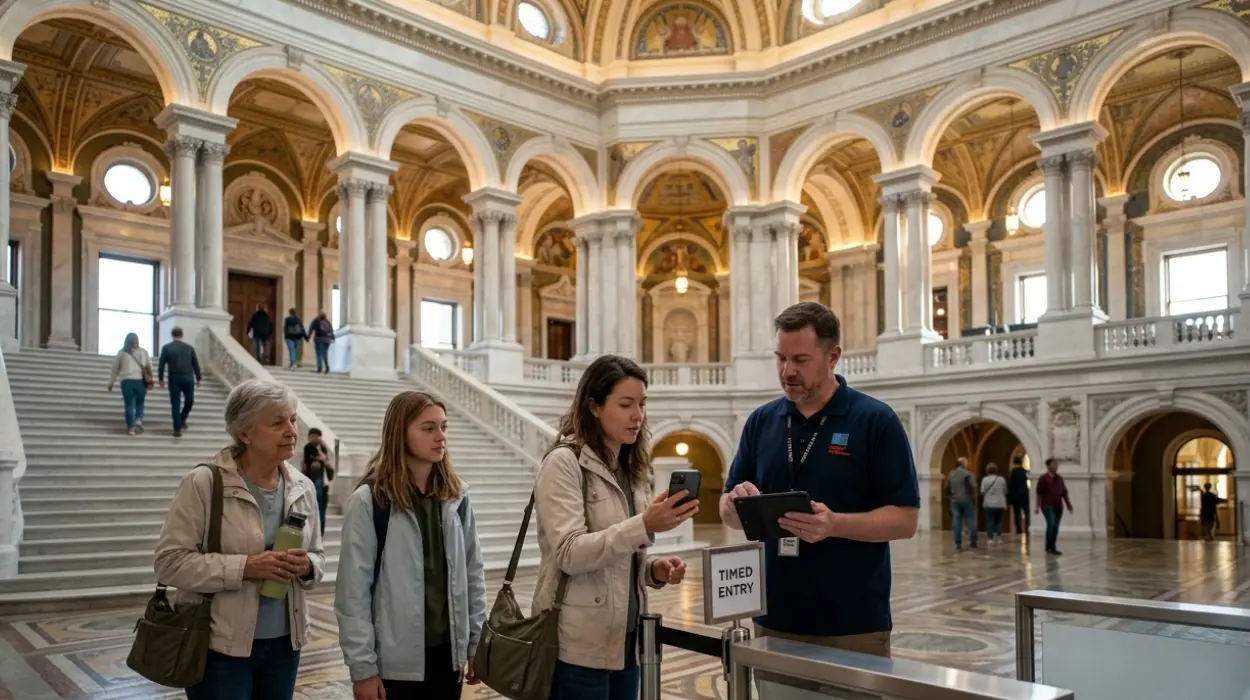
The Thomas Jefferson Building, on First Street SE between the U.S. Capitol and Union Station, is the original and most iconic structure, known for its grand Great Hall, marble columns, and stained‑glass dome. Because this building attracts large numbers of tourists and researchers, especially during peak months from March through July, the Library introduced free timed‑entry passes to manage visitor volume and prevent overcrowding indoors.
Timed entry means each ticket is tied to a specific date and 15‑minute entry window, such as 10:00 a.m., 10:15 a.m., or 3:00 p.m. This allows the Library to distribute arrivals more evenly, reduce security‑screening lines, and preserve fragile historic spaces by limiting the number of people inside at one time.
For evening visitors, it is important to note that timed‑entry tickets for the Thomas Jefferson Building are released only up to 3:00 p.m. in 15‑minute increments, and the building’s public hours typically end around 5:00 p.m. on weekdays, so an evening visit must still be booked within the available daytime window.
What is a timed‑entry pass and how does it work?
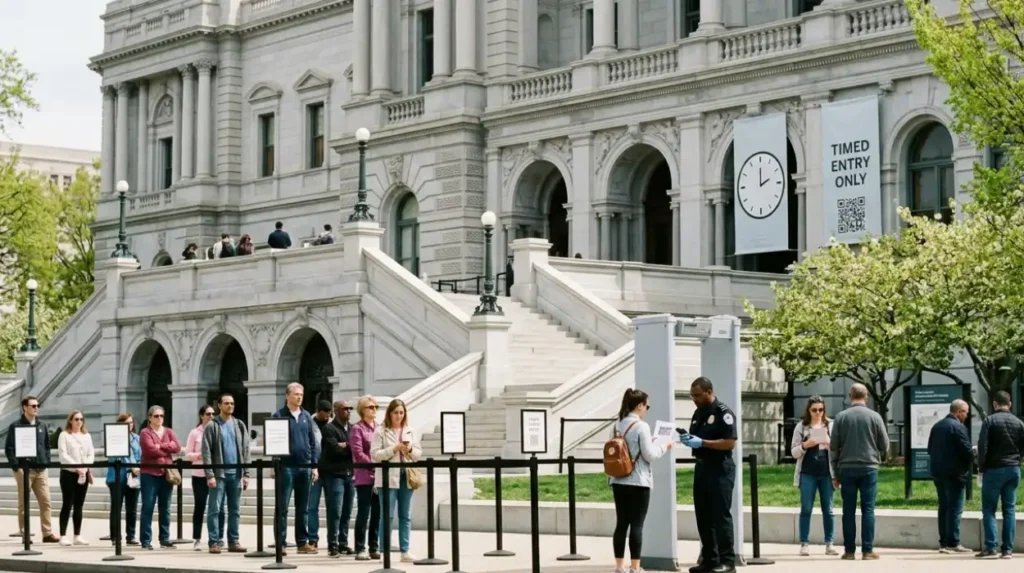
A timed‑entry pass for the Library of Congress is a free, digitized reservation that grants access to the Thomas Jefferson Building at a specific day and 15‑minute entry time. Every visitor, regardless of age, must have either a pre‑reserved ticket or a same‑day pass, which can be shown on a mobile device or printed at home.
The reservation system operates on a rolling 30‑day calendar, meaning passes for a given date become available exactly 30 days in advance. For example, on April 23, 2026, you can reserve tickets for dates up to May 23, 2026, choosing from entry slots that usually run from 10:00 a.m. to 3:00 p.m. in 15‑minute blocks.
Each individual can reserve up to 20 timed‑entry tickets per visit, which covers most families and small groups. For groups of 21 people or more, visitors must use the Library’s group‑reservation form instead of the standard online ticket portal, with requests accepted up to 60 days in advance and processed within about three business days.
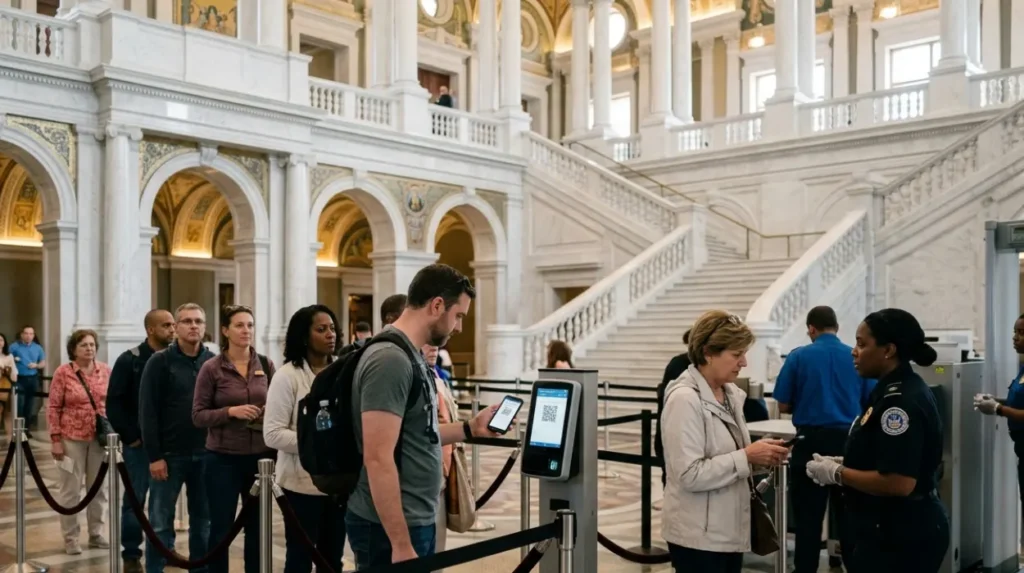
On the day of your visit, you present your pass at the security checkpoint on the West Main Street entrance of the Thomas Jefferson Building, where staff verify your time and admit you through screening. The ticket is not a tour ticket; it is purely an access pass, and you are free to explore the public spaces, including the Great Hall and certain exhibit areas, for as long as the building remains open that day.
How do you reserve a timed‑entry pass in advance?
Reserving a timed‑entry pass in advance is done entirely online through the Library of Congress’s official ticketing partner, Etix, via the Library’s “Visit” page. The process is self‑serve, does not charge a fee, and follows the same steps for individuals, families, and small groups.
Here is the step‑by‑step mechanism:
- Go to the official ticketing page. Open the Library of Congress “Visiting the Library” section and follow the link to the timed‑entry ticket reservations, which directs to the Etix calendar for the Thomas Jefferson Building.
- Select a date. Use the calendar to choose your desired visit date, keeping in mind that tickets are only available 30 days in advance and slots fill fastest during peak tourist months (March–July).
- Choose an entry time. Pick an available 15‑minute window, typically between 10:00 a.m. and 3:00 p.m. on weekdays; slots appear grayed out when sold out.
- Enter visitor details. Input the number of tickets needed (up to 20 per person), your email address, and any contact information requested by the system.
- Confirm and receive the pass. After submission, Etix emails a confirmation with a scannable barcode; you can save this to your phone or print it.
The system remembers prior reservations only to the extent of your email account; if you delete emails or change devices, you must keep the pass easily accessible or re‑download it from the ticketing page. If you need to change your date or time, you must cancel the original reservation and create a new one, since the platform does not allow direct edits to existing tickets.
How can you get a same‑day timed‑entry ticket?
If you cannot book 30 days in advance, the Library of Congress releases a limited number of free same‑day timed‑entry tickets each morning. These passes are for walk‑in visitors who did not plan far ahead but still want to enter the Thomas Jefferson Building during the same calendar day.
Same‑day tickets are made available online at 9:00 a.m. Eastern Time through the same Etix reservation calendar used for advance bookings. A small number of entry slots are released at that time, and they disappear quickly once taken, especially during spring and summer months and weekends.
To secure a same‑day pass:
- Set a daily reminder. Mark 9:00 a.m. ET on your phone or calendar and open the Library’s ticketing link exactly at that hour.
- Check the current day. Select “today’s date” in the calendar and look for any remaining 15‑minute entry windows between 10:00 a.m. and 3:00 p.m.
- Complete the reservation immediately. If slots show as available, proceed through the standard reservation steps and confirm your order before the timers expire.
If no same‑day tickets appear online, the system has likely sold out for that day, and you cannot walk in without a pass. There is no walk‑up physical ticket counter at the Library; all passes must be reserved and presented digitally or on paper before entering.
How do group visits work with timed‑entry passes?
For parties of 21 people or more, the Library of Congress requires group timed‑entry passes instead of individual online reservations. This applies to school trips, tour‑bus groups, community organizations, and large family gatherings that exceed the standard 20‑ticket limit.
Group passes are scheduled Tuesday through Saturday from 10:00 a.m. to 5:00 p.m., with the last entry window at 4:00 p.m. Requests can be submitted up to 60 days in advance, which is double the 30‑day window for individual tickets, but the Library needs approximately three business days to review and confirm each group request.
To reserve a group visit:
- Use the group reservation form. Access the “Group Reservation (20+ People)” page on the Library’s website and complete the form with the number of visitors, preferred date and time range, school or organization name, and contact details.
- Wait for confirmation. The Library responds by email or through the form’s confirmation system, assigning specific entry times and ticket type.
- Distribute passes to the group. Once confirmed, the organizer downloads or prints enough passes for each member and ensures they all arrive within the assigned 15‑minute window.
Same‑day group reservations are not accepted; large groups must plan well in advance and coordinate arrival times to avoid missing their slot. Guided tours for groups are offered separately through the Library’s tour program and may require an additional registration step beyond the timed‑entry pass.
What are the entry times, building hours, and capacity limits?
The Thomas Jefferson Building’s public hours generally run from 10:00 a.m. to 5:00 p.m. on weekdays, with slightly reduced or different hours on weekends and holidays. Public entry occurs only between 10:00 a.m. and 3:00 p.m., with 15‑minute timed windows, so visitors must arrive at the security checkpoint within that morning‑to‑early‑afternoon window even if they plan to stay later.
Security lines and building capacity limits are tied to the timed‑entry system. The Library does not publish an exact visitor‑per‑hour cap, but the staggered 15‑minute slots and the 30‑day‑in‑advance release window function as soft capacity controls. During peak months such as March through July, lines can grow longer, and some visitors arriving close to their scheduled time may experience brief waits.
Each timed‑entry pass is valid only for one person, and scanning the same barcode more than once is not allowed. If a visitor arrives significantly outside their assigned 15‑minute window, staff may deny entry or reassign them to the next available slot if the Library is under capacity, but this is not guaranteed.
Evening hours are not currently offered for general public access; the main historic building closes at 5:00 p.m. on weekdays, and other LOC buildings such as the Adams and Madison buildings have separate hours that still focus on day‑time operations. Special evening events, such as lectures or concerts, may have separate registration and may not require the standard timed‑entry pass, but these are announced on the Library’s events calendar.
What should you bring and do on the day of your visit?
On the day of your visit, you must bring your timed‑entry pass, a valid photo ID for each adult, and any bags or belongings that comply with the Library’s security rules. The pass can be shown on a smartphone or printed, and each member of your group must present their own ticket or be included on a group reservation.
Before leaving, check the Library of Congress “Visit” page for any last‑minute changes to hours, security procedures, or special events that might affect lines or access. Arrive at least 10–15 minutes before your assigned entry time, as security screening can take several minutes, especially during busy periods.
At the West Main Street entrance, present your barcode to staff, pass through a security checkpoint similar to a museum or airport (with bag X‑rays and metal‑detection), and then enter the building. Inside, you can walk through the Great Hall, view featured exhibits, and use public restrooms, but the timed‑entry pass does not automatically grant access to reading rooms or research areas, which require separate registration and a Library of Congress card.
You may bring small personal items such as cameras, phones, and notebooks, but large bags, backpacks, and food are subject to restrictions; the Library recommends leaving bulky items at home or in a hotel safe. A visitor‑services desk is available to answer questions, provide maps, and direct you to galleries, restrooms, and exit points.
Why is this timed‑entry system important long term?
The timed‑entry system matters because it balances public access with preservation, safety, and operational efficiency. Historic buildings like the Thomas Jefferson Building were not designed for modern tourist volumes, and uncontrolled crowds can wear down marble floors, strain air‑handling systems, and make navigation difficult for visitors with mobility needs.
From a security perspective, spread‑out entry windows help screening staff process visitors more smoothly and reduce the risk of bottlenecks at checkpoints. This is especially relevant in Washington, D.C., where many federal buildings and cultural institutions use similar timed or reservation‑based systems as part of broader congestion‑management strategies.
For local residents and evening visitors, the system forces advance planning, which can be a minor inconvenience but also improves the likelihood of a high‑quality visit. By reserving a specific 15‑minute slot, you reduce the chance of long waits, overcrowded galleries, or being turned away because the daily capacity has been reached.
In the long term, timed‑entry is likely to persist or expand as the Library of Congress continues to manage growth in attendance, especially during peak tourist seasons and major national events when Washington, D.C., draws large crowds. The system may also be adapted for special exhibitions or events, with additional tiers such as timed general admission plus separate timed tickets for high‑demand displays.
How does this system affect evening visitors in Washington, D.C.?
Evening visitors in Washington, D.C. must adapt to the fact that the Library of Congress’s timed‑entry passes are designed for daytime entry, even though the city’s tourism schedule often centers on evening activities. The last entry window is typically at 3:00 p.m., and the building closes at 5:00 p.m., so true “evening” visits are not possible for general public access.
Local residents and hotel guests can still combine the Library with nearby evening attractions by scheduling their visit between 10:00 a.m. and 3:00 p.m. and then walking to the U.S. Capitol, Union Station, or restaurants along the Mall later in the day. For those who prefer to explore the area at night, the exterior of the Thomas Jefferson Building is illuminated and can be viewed from the Capitol grounds or nearby streets, but interior access still requires a timed pass during open hours.
The timed‑entry system adds one extra step for evening‑oriented tourists: they must book a pass in advance or at 9:00 a.m. same‑day, even if they plan to visit the rest of the city’s landmarks at night. This encourages visitors to treat the Library of Congress as a structured daytime stop rather than an impromptu night‑time detour, which in turn helps the Library maintain stable staffing, security, and conservation standards.
For residents of evening‑oriented neighborhoods such as Capitol Hill and nearby corridors, the requirement also supports predictable visitation, shorter lines, and easier planning for family outings or school trips that align with busier afternoon and early‑evening family schedules. Over time, timed entry anchors the Library of Congress into Washington, D.C.’s broader cultural‑tourism ecosystem while protecting its historic fabric and visitor experience.
What is the Library of Congress?
The Library of Congress is the national library of the United States located in Washington, D.C., and it contains over 170 million items including books, maps, manuscripts, and recordings.