
Spokane, Washington’s second-largest city with a 2024 population of 229,447, sits along the Spokane River and features Spokane Falls—the largest urban waterfall in the United States. This guide covers the city’s top attractions, including Riverfront Park, Manito Park, Riverside State Park, Mount Spokane, and cultural landmarks that define the “Lilac City.”
- What is Spokane Washington and why is it famous?
- What are the top attractions in Spokane Washington?
- Why should you visit Riverfront Park?
- What makes Spokane Falls unique?
- What gardens and parks are in Manito Park?
- What outdoor activities does Riverside State Park offer?
- How long is the Spokane River Centennial Trail?
- What is the elevation and distance of Mount Spokane?
- What cultural landmarks define Spokane?
- What is the history of Gonzaga University?
- What collections does the Northwest Museum of Arts and Culture hold?
- What plants grow at John A. Finch Arboretum?
- When is the best time to visit Spokane?
What is Spokane Washington and why is it famous?
Spokane is Washington’s second-largest city with 229,447 residents, famous for Spokane Falls—the largest urban waterfall in the U.S.—and its annual Lilac Festival dating to 1938.
Spokane, officially named Spokane City, is located in eastern Washington state at the edge of the Pacific Northwest. The city earned its nickname “Lilac City” in the early 1930s when community leaders encouraged garden clubs to plant lilac bushes throughout the city. By 1938, Manito Park contained 144 lilac bushes, and the first Lilac Festival parade featured one float and seven decorated cars. The lilac is not native to Spokane; the first bush arrived in 1882 from Minnesota in a trunk.
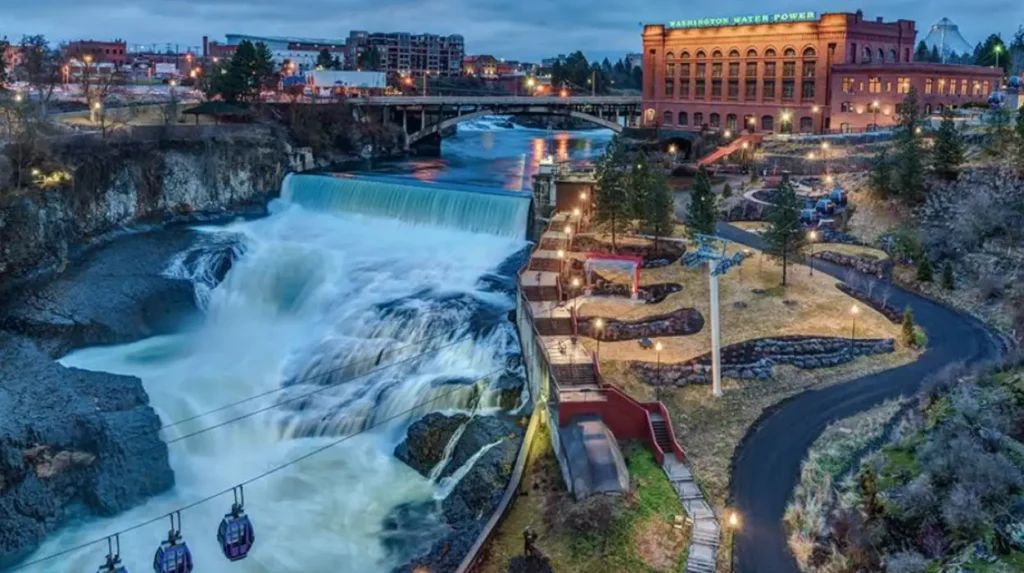
The Spokane River winds through downtown, creating the majestic Spokane Falls that visible from multiple viewpoints including Riverfront Park. The falls consist of two sections: a 60-foot-tall upper falls and lower falls, totaling around 100 feet in drop. The main drop spans over 500 feet in width. Spokane serves as the cultural and economic hub of the Inland Northwest region.
What are the top attractions in Spokane Washington?
Riverfront Park, Spokane Falls, Manito Park, Riverside State Park, and Mount Spokane comprise Spokane’s top five attractions, with Riverfront Park serving as the 100-acre downtown jewel containing America’s largest urban waterfall.
Why should you visit Riverfront Park?
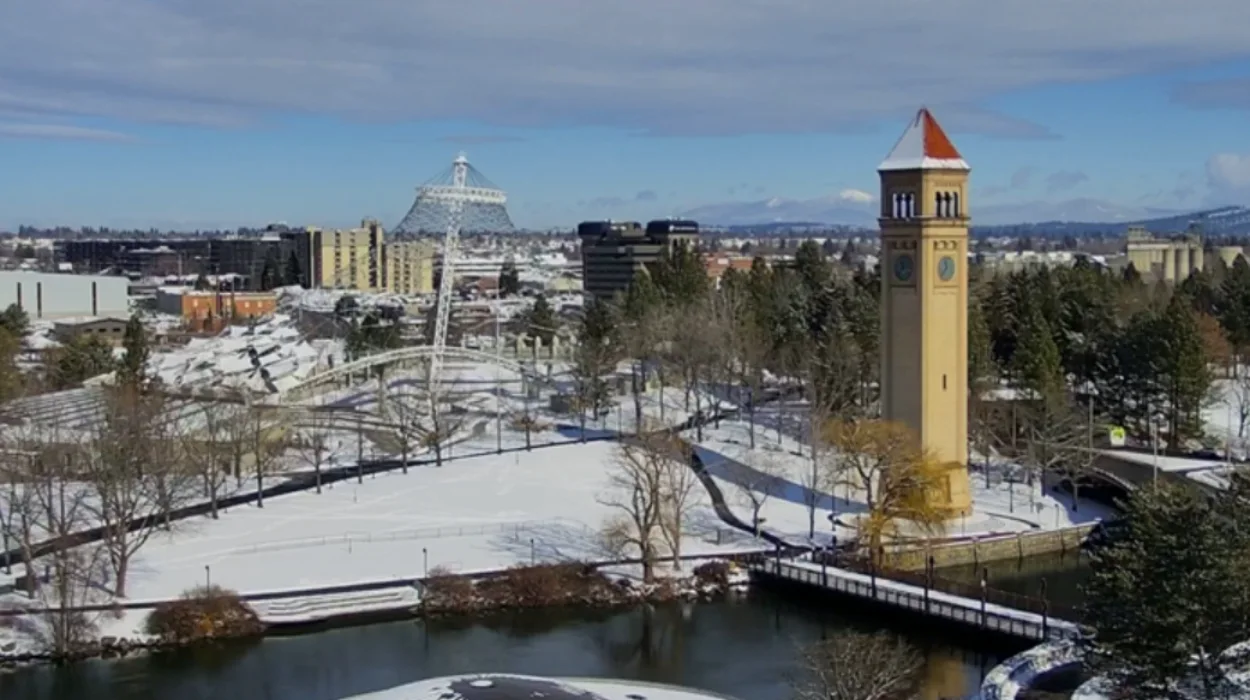
Riverfront Park is Spokane’s 100-acre “jewel of downtown” featuring Spokane Falls, the Numerica SkyRide gondola, Looff Carrousel, and the Numerica Skate Ribbon, transformed from rail yards during Expo ’74 World’s Fair in 1974.
The park’s history traces to the late 19th century when mills and factories lined the riverbanks. In 1974, Expo ’74—a World’s Fair themed on environmental preservation—catalyzed Spokane’s transformation into a cultural hub. The event reshaped the downtown landscape, turning industrial railroad yards into a lush public venue.
Key attractions include the Numerica SkyRide Over the Falls, voted one of North America’s best gondola rides, offering breathtaking views of Spokane Falls especially during spring when water flow peaks. The Looff Carrousel, built in 1909 by master carver Charles Looff, is a National Historic Landmark featuring hand-carved horses and original chariots. The Pavilion, originally constructed for Expo ’74, serves as a central feature.
The giant Red Flyer Wagon has been a park staple since 1989. The steel sculpture called the “garbage goat” has guarded the park since Expo ’74. Families find plenty to see with the Numerica Skate Ribbon, a seasonal ice skating ribbon in winter and water feature in summer. The U.S. Pavilion, another Expo ’74 remnant, houses exhibitions and events.
What makes Spokane Falls unique?
Spokane Falls is the largest urban waterfall in the United States, with a total drop of approximately 100 feet divided into a 60-foot upper falls and lower falls, visible from Riverfront Park and multiple downtown viewpoints.
The waterfall pours into the Spokane River, which winds through downtown Spokane. The upper falls measures around 100 feet in height at the main drop and spans over 500 feet in width. During spring, when the river is at its fullest, the falls display their most powerful flow. The urban cascade spans a half-mile on the Spokane River.
Spokane earns its “River City” nickname from the Spokane River winding through the city center. The falls represent one of the most beautiful waterfalls in Washington state. Viewpoints include Riverfront Park, downtown bridges, and the SkyRide gondola providing aerial perspectives.
What gardens and parks are in Manito Park?
Manito Park features the vibrant Duncan Garden with formal layouts, Rose Gardens, walking paths, and Cinnabar Lake, located just minutes from downtown Spokane on Grand Boulevard.
The park’s Duncan Garden showcases manicured formal landscaping with vibrant seasonal flowers. Rose Gardens contain multiple rose varieties blooming throughout summer. Walking paths wind through the park offering views of landscaped gardens. Cinnabar Lake provides a scenic water feature within the park grounds.
By 1938, Manito Park contained 144 lilac bushes that helped establish Spokane’s “Lilac City” identity. The park serves as a key location for the annual Lilac Festival, which has been a spring tradition since 1938. Manito Park represents one of Spokane’s oldest and most cherished public spaces.
What outdoor activities does Riverside State Park offer?
Riverside State Park spans 11,000 acres with 80 miles of trails for hiking, mountain biking, and horseback riding, plus camping, fishing, swimming, boating, and rock climbing along the Spokane River, Little Spokane River, and Lake Spokane shoreline.
Located just nine miles northwest of downtown Spokane, Riverside is one of Washington’s largest state parks. The park encompasses the Nine Mile Recreation Area, Little Spokane Natural Area, and part of Lake Spokane. Activities include hiking, equestrian areas, and a 600-acre ORV (off-road vehicle) park.
Camping options include Bowl and Pitcher, Lake Spokane, and equestrian area sites with standard sites, partial utility sites, full hookup sites, cabins, and group camps. Facilities feature restrooms, showers, picnic tables, grills, kitchen shelters (several reservable), picnic shelters, horseshoe pits, amphitheater, and sports fields.
The “Bowl and Pitcher” formation is a famous geological feature where the Spokane River flows through basalt walls. Fishing, swimming, boating, and paddle boarding are available with boat launches and docks. Birding and wildlife viewing opportunities exist throughout the park. Rock climbing, metal detecting, snowmobiling, and cross-country skiing are seasonal activities.
A Discover Pass is required for entry at $10 daily or $30 annually. The park operates year-round with reservable campsites, cabins, yurts, group camps, vacation houses, kitchen shelters, marina spots, and retreat centers available online.
How long is the Spokane River Centennial Trail?
The Spokane River Centennial Trail is a 37-mile paved National Recreation Trail following the Spokane River from the Idaho state line to Nine Mile Falls, Washington, designated in 2010 for alternate transportation and recreation.
The trail branches into rural west and east endpoints reaching into Idaho, totaling 61 miles for the full coordinated effort. In 1979, Spokane County Parks proposed a bicycle/pedestrian pathway along the Spokane River. By 1986, the group proposed a 10.5-mile trail named “Centennial Trail” to coincide with Washington State’s 100th birthday in 1989.
Creative thinking expanded the idea into a two-state recreational trail from Lake Spokane to Coeur d’Alene Lake’s east side, approximately 60 miles. Roughly 30 miles of safely separated trail were completed by 1992 through community cooperation. The metropolitan center section runs through downtown Spokane.
The trail offers 39 miles of natural beauty following the historic Spokane River. It connects and transforms communities through the power of trails. The paved surface accommodates cyclists, pedestrians, and alternate transportation users year-round.
What is the elevation and distance of Mount Spokane?
Mount Spokane reaches 5,883 feet elevation, located 10 miles north of Spokane on US 2 plus 20 miles east on SR 206, with over 100 miles of trails in the nearly 14,000-acre Mount Spokane State Park, Washington’s largest state park.
Mount Spokane is a southern outpost of the Selkirk Mountains and prominent local landmark rising above the Spokane Valley. The park contains nearly 14,000 acres with over 100 miles of trails and fire roads for hiking, trail running, mountain biking, horseback riding, and skiing.
The summit hike is a 6.0-mile roundtrip with 1,000 feet elevation gain at moderate difficulty. Trail No. 130 starts from Bald Knob picnic and camping area, traversing open forest on high slopes with views west across rolling hills and prairies. Trail No. 140 ascends 967 feet in 2.2 miles through old growth stands, old fire patches, and meadows.
The CCC (Civilian Conservation Corp) built the stone Vista House at the 5,883-foot summit summit. Views include east to Idaho’s Cabinet Mountains and lakes Pend Oreille and Coeur D’Alene, north along Washington’s Selkirk Mountains spine, south across Spokane Valley to Mica Mountain and Dishman Hills, and west across prairies to channeled scablands and Columbia Plateau.
A drive to the 5,883-foot summit is possible, but the 3-mile hike from Bald Knob offers a scenic alternative. The Upper Kit Carson Loop Road (gated) junction features a CCC-built CCC lodge used primarily by skiers for warming up. A 0.1-mile walk from the Summit Road reaches the Vista House.
Discover Pass is required for park entry. Dogs are permitted on leash. The mountain features exceptional huckleberry patches along Trail 140.
Explore More Things to do
Wildlife Viewing in San Juan Islands: Ultimate Washington Travel Guide for Orcas
Lopez Island Washington Guide: Peaceful Island Escape in San Juan Islands
What cultural landmarks define Spokane?
Gonzaga University (founded 1887), Northwest Museum of Arts and Culture (68,000+ objects), and John A. Finch Arboretum (56.65 acres, 2,000 trees) comprise Spokane’s primary cultural landmarks.
What is the history of Gonzaga University?
Gonzaga University is a private Jesuit university founded in 1887 by Father Joseph Cataldo, named after Aloysius Gonzaga, comprising 105 buildings on 152 acres along the Spokane River near downtown, well known for Men’s Basketball.
In 1881, Father Cataldo purchased 320 acres along the Spokane River’s north bank at a location called “the old piece of gravel near the falls”. In 1887, Jesuit priests, teachers, and students emerged on that granite foundation. The university was originally intended as a school for local tribes and settler families. Cataldo purchased the initial 30 acres from Northern Railroad for $936.
Gonzaga was founded for young men looking to become priests. The Bulldogs burst onto the national basketball scene over the last 20 years. Gonzaga has become a national brand in college basketball. The university is accredited by the Northwest Commission on Colleges and Universities. Gonzaga University and Spokane have grown together throughout shared milestones.
What collections does the Northwest Museum of Arts and Culture hold?
The Northwest Museum of Arts and Culture (MAC) contains over 68,000 objects in Regional History, Fine Art, and American Indian Art, including the world’s largest Plateau Indian art collection with 10,000 photographic images.
The Regional History Collection broadly represents exploration, settlement, economics, communications, and domestic arts themes. An extensive textile collection includes quilts and clothing from the mid-19th century to present. The Fine Art Collection features regional contemporary art and renowned regional artists.
Highlights include works by Doug Safranek, Kristen Capp, James Lavadour, Jim Hodges, Patti Warashina, and Edward and Nancy Reddin Kienholz’s major installation piece. The American Indian Collection represents culture groups throughout the Americas. One of the finest Plateau material culture collections in the United States includes 10,000 photographic images of Plateau Indian culture.
The museum maintains over one million objects including fine art, artifacts, documents, photographs, and material culture from Americas, Europe, and Asia. Current exhibits include “America at 250” (May 23, 2026–Feb 14, 2027), “An Eye for Detail” (European paintings 1500–1900), and “The Mountains Are Calling” (Inland Northwest outdoor history).
What plants grow at John A. Finch Arboretum?
John A. Finch Arboretum spans 56.65 acres with approximately 2,000 trees and shrubs including 65 lilac groups, a rhododendron grove, conifer and maple collections, and over two miles of hiking trails following Garden Springs Creek.
The arboretum is located at West 3404 Woodland Boulevard in Spokane’s West Hills neighborhood. John A. Finch, a former Spokane mayor and park board head, is honored by the arboretum’s name. More than 2,000 different species of trees, shrubs, and flowers from around the world occupy 65 acres.
Year-round highlights include a rhododendron glen, conifer array, and extensive maple collection. The landscape follows Garden Springs Creek with several walking paths. Over two miles of hiking trails wind through forest, providing views of local and foreign plant species. Finch Arboretum is open dawn to dusk.
The arboretum is found just minutes southwest of downtown Spokane. Lilacs represent a key collection given Spokane’s “Lilac City” identity. The botanical garden serves as an extensive tree and plant education resource.
When is the best time to visit Spokane?
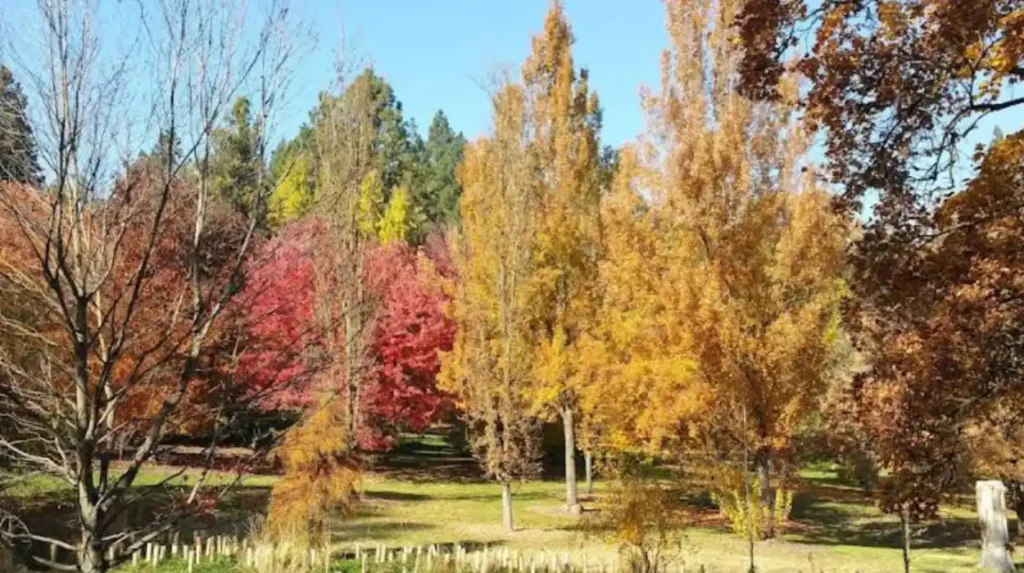
June and September offer Spokane’s best weather with comfortable temperatures, while spring (April–May) features peak Spokane Falls flow and the Lilac Festival, and winter (December–February) provides skiing at Mount Spokane.
Spokane experiences snowy, very cold winters and short, dry summers. Spring brings the river at its fullest, making Spokane Falls most powerful. The annual Lilac Festival has been a spring tradition since 1938. Summer features comfortable temperatures ideal for hiking Centennial Trail and Riverside State Park activities.
Fall offers crisp air and scenic views at Mount Spokane with huckleberry patches along Trail 140. Winter enables skiing and snowshoeing at Mount Spokane State Park. The SkyRide gondola provides optimal spring views when falls are most powerful. Plan visits considering seasonal activity preferences and weather conditions.
Spokane, Washington delivers accessible Pacific Northwest adventure with urban waterfall access, 11,000-acre state park wilderness, 37-mile river trail, 5,883-foot summit hiking, and century-old cultural institutions—all within a 229,447-person city famous for lilacs since 1938.