
Washington fall foliage results from chlorophyll degradation in deciduous foliage and alpine larches during autumn photoperiod reduction. Decreasing daylight triggers abscission layers in leaf stems, revealing underlying yellow carotenoid pigments and stimulating red anthocyanin synthesis under bright, cool weather conditions.
- When is peak fall foliage season in Washington state?
- What are the best scenic driving routes for autumn leaves in Washington?
- Where are the top alpine larch hiking trails in the Cascade Range?
- How does geography influence foliage timing across Washington regions?
- What key native tree species create Washington autumn leaf displays?
- What permits and regulations are required for Washington fall leaf peeping?
Botanical Mechanisms of Pigment Transformation
Photoperiod reduction serves as the primary environmental cue for autumn phenology in Pacific Northwest flora. As solar exposure decreases following the autumn equinox on September 22, trees cease chlorophyll production. Chlorophyll is the green pigment responsible for photosynthesis. Deciduous plants reabsorb nutrients from leaves, storing nitrogen and carbohydrates in branches and roots for spring growth.
Chlorophyll degradation reveals accessory pigments that remain present throughout the growing season. Carotenoids produce yellow, orange, and brown hues. Specific carotenoid compounds include lutein, which generates yellow tones, and beta-carotene, which creates orange tones. These compounds absorb blue-green light and protect leaf tissue from light-induced damage during nutrient reabsorption.
Synthesis of Anthocyanin Pigments
Unlike carotenoids, anthocyanin pigments do not exist in leaves during the summer growing season. Trees synthesize anthocyanins in early autumn when vascular tissues close. An abscission layer of suberin cells forms at the base of the leaf petiole, restricting liquid flow into and out of the leaf.
Sugars produced during sunny daytime hours remain trapped within leaf cells. High concentrations of trapped glucose combine with bright sunlight and crisp night temperatures between 32°F and 45°F to drive anthocyanin synthesis. Anthocyanins produce red, purple, and crimson foliage colors. Cold, non-freezing temperatures accelerate chlorophyll breakdown while maintaining cell membrane integrity long enough for maximum anthocyanin production.
Physiological Adaptations of Deciduous Conifers
The alpine larch (Larix lyallii) and western larch (Larix occidentalis) are deciduous conifers native to the Pacific Northwest. Unlike evergreen conifers, larch needles turn bright yellow and shed every autumn.
Larch needles contain chlorophyll and carotenoids inside needle parenchyma cells. In late September, larches extract up to 60 percent of nitrogen and phosphorus from their needles prior to needle drop. This nutrient recycling process allows larches to survive in nutrient-poor, rocky subalpine soils above 5,000 feet in elevation.
When is peak fall foliage season in Washington state?
Peak fall foliage in Washington state occurs in two distinct windows from mid-September to early November. High-elevation alpine larches reach peak intensity during the first two weeks of October, whereas lowland maples and valley hardwoods peak between mid-October and early November.
Primary Foliage Phases and Chronology
Foliage progression in Washington follows an altitudinal and species-based timeline divided into 3 distinct phases: subalpine brush, alpine larches, and lowland hardwoods.
Subalpine shrubs initiate color transformation first. High-altitude ground covers experience low temperatures and shortened photoperiods by mid-September. Vine maple (Acer circinatum) and black huckleberry (Vaccinium membranaceum) display red and purple foliage along mountain passes between 3,000 feet and 5,500 feet elevation from September 15 to October 1.
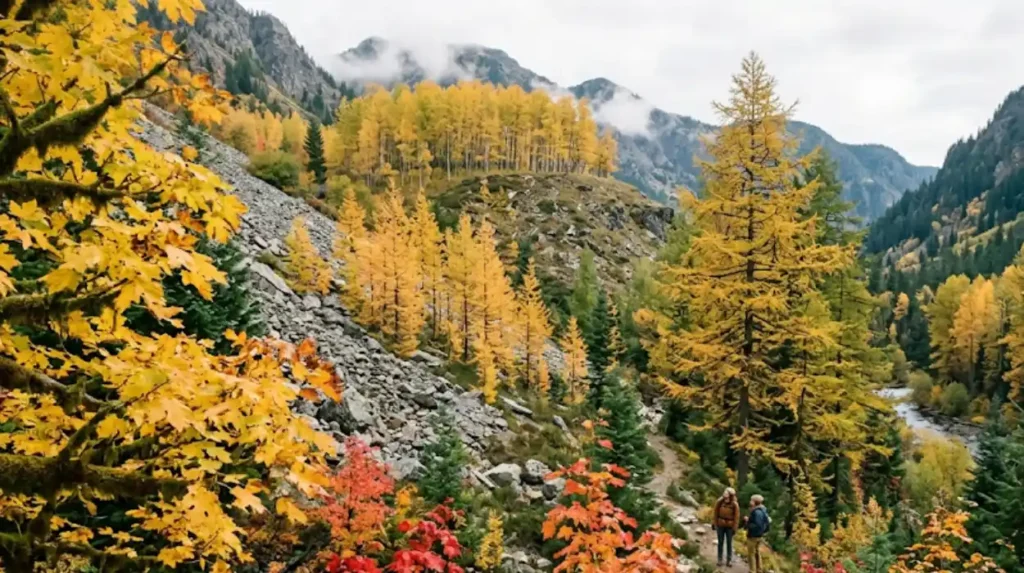
The second phase features alpine larches (Larix lyallii). Needles transition from green to lime green in late September, reaching golden peak color during the first 14 days of October. This window is short, as high-altitude frost, wind, and autumn snowstorms trigger needle drop within 10 to 14 days of peak coloration.
The third phase encompasses lowland deciduous forests and urban park systems. Bigleaf maple (Acer macrophyllum), black cottonwood (Populus trichocarpa), and quaking aspen (Populus tremuloides) turn yellow and orange between October 15 and November 10. Low-elevation river valleys retain colorful leaves longer due to mild ocean-influenced temperatures.
Environmental Variables Influencing Seasonal Timing
Three meteorological variables dictate annual timing shifts: summer precipitation, autumn temperature drops, and solar radiation.
- Summer Soil Moisture: Drought stress forces trees into premature dormancy, causing leaves to brown and drop without displaying bright colors. Adequate summer rain preserves leaf health, enabling complete pigment transition.
- Temperature Patterns: Warm autumn days combined with cool, non-freezing nights accelerate anthocyanin synthesis. Early freezing temperatures below 28°F kill leaf tissue, ending color development and causing rapid defoliation.
- Wind and Storm Events: High-velocity atmospheric river systems in late October stripped deciduous canopies. Rain and wind accelerate defoliation, reducing the duration of peak color displays in coastal and Cascade pass regions.
What are the best scenic driving routes for autumn leaves in Washington?
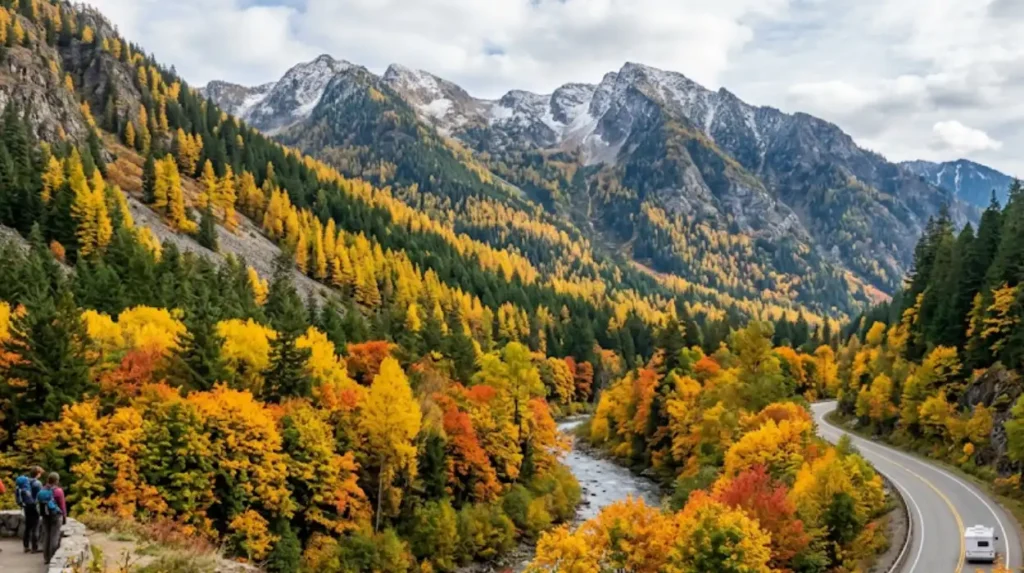
The top scenic driving routes for Washington fall foliage include North Cascades Highway 20, Stevens Pass Highway 2 through Tumwater Canyon, Chinook Pass Scenic Byway Highway 410, and Columbia River Gorge Highway 14. These corridors deliver concentrated color displays annually.
North Cascades Highway 20
State Route 20 crosses the Cascade Range, reaching an elevation of 5,477 feet at Washington Pass. This 140-mile corridor connects Marblemount on the west side with Winthrop in the Methow Valley.
The route features 3 distinct ecological zones: western hemlock-fir forest, subalpine larch zones, and eastern pine-aspen woodlands. Between Marblemount and Newhalem, bigleaf maples line the Skagit River, peaking from mid-to-late October.
As Route 20 climbs toward Rainy Pass (4,855 feet) and Washington Pass (5,477 feet), subalpine slopes display golden alpine larches (Larix lyallii) alongside red vine maples. Early October offers peak viewing near the Liberty Bell Mountain pullout. East of the pass, the road descends into the Methow Valley, where quaking aspens and black cottonwoods display yellow canopies through late October.
Stevens Pass Highway 2 and Tumwater Canyon
U.S. Route 2 runs 115 miles from Gold Bar over Stevens Pass (4,061 feet) to Leavenworth and Wenatchee. The corridor follows the Skykomish River on the west and the Wenatchee River on the east.
Tumwater Canyon is a 15-mile section of Highway 2 directly west of Leavenworth. The Wenatchee River carves through granite walls covered in bigleaf maples, vine maples, and Douglas firs. Color peaks in Tumwater Canyon from October 10 to October 25.
West of the summit, the Stevens Pass Greenway features red vine maple patches against dark evergreen conifers. Pullouts at Deception Falls and Skykomish offer viewing locations for lowland foliage along river corridors.
Chinook Pass Scenic Byway Highway 410
State Route 410 travels from Enumclaw up through Mount Rainier National Park, over Chinook Pass (5,430 feet), and down into the Naches River Valley.
The high point at Chinook Pass provides views of Tipsoo Lake, Mount Rainier (14,411 feet), and surrounding subalpine slopes covered in red huckleberry and yellow vine maple. Peak foliage along the high pass occurs from late September to early October.
East of Chinook Pass, Route 410 follows the Naches River through dry forest ecosystems. Western larch (Larix occidentalis) and quaking aspens line the highway, reaching peak golden color between October 10 and October 25.
Columbia River Gorge State Route 14
State Route 14 runs along the northern bank of the Columbia River, covering 113 miles from Washougal to Goldendale. The route offers views of the Oregon side of the gorge and access to Washington side canyons.
Deciduous species along Route 14 include bigleaf maple, Oregon white oak (Quercus garryana), black cottonwood, and red alder (Alnus rubra). Lower elevation (sea level to 500 feet) and river thermal regulation delay peak foliage until late October and early November. Key viewing stops include Beacon Rock State Park, St. Cloud Day Use Area, and the Catherine Creek Recreation Area.
Where are the top alpine larch hiking trails in the Cascade Range?
The top alpine larch hiking trails in the Cascade Range are Maple Pass Loop, Blue Lake Trail, Lake Ingalls Trail, and Colchuck Lake Trail. Located above 5,000 feet elevation, these trails feature dense stands of Larix lyallii turning golden annually.
Maple Pass Loop Trail
Maple Pass Loop is a 7.2-mile circuit located within the Okanogan-Wenatchee National Forest along State Route 20. The trailhead sits at an elevation of 4,860 feet, ascending to a high ridge at 6,650 feet.
The trail gains 2,160 feet of elevation, traversing 3 environmental zones: montane forest, subalpine parkland, and alpine ridge. Lower sections feature red vine maple and huckleberry shrubs.
Between 5,800 feet and the ridge summit, the trail passes through old-growth alpine larch groves (Larix lyallii) overlooking Lake Ann and Black Peak (8,970 feet). Peak larch color on Maple Pass occurs during the first two weeks of October. The trail requires a Northwest Forest Pass or America the Beautiful Pass for vehicle parking.
Blue Lake Trail
Blue Lake Trail is a 4.4-mile round-trip hike located 5 miles east of Rainy Pass on State Route 20. The trail begins at 5,150 feet elevation and ends at Blue Lake at 6,250 feet, gaining 1,100 feet of vertical elevation.
The route ascends through subalpine fir (Abies lasiocarpa) and Engelmann spruce (Picea engelmannii) before reaching Blue Lake basin. A dense stand of golden alpine larches lines the western shore of Blue Lake beneath the granite spires of Early Winters Spires (7,800 feet) and Cutthroat Peak (8,050 feet). The gradient allows accessibility for hikers seeking high-yield larch views. Peak timing spans October 1 to October 12.
Lake Ingalls Trail
Lake Ingalls Trail is a 9-mile round-trip hike in the Alpine Lakes Wilderness, accessed via Teanaway River Road near Cle Elum. The trail ascends 2,500 feet of elevation, starting at 4,200 feet and crossing Ingalls Pass at 6,500 feet.
Ingalls Pass opens into Headlight Basin, an alpine cirque filled with alpine larches. The larches frame views of Mount Stuart (9,415 feet), a serpentinite rock peak. The contrast between orange-gold larch needles, dark grey granite, and red ultramafic soil attracts hikers from late September through mid-October.
Colchuck Lake Trail
Colchuck Lake Trail is an 8-mile round-trip hike located in the Enchantment Permit Area near Leavenworth. Starting at the Stuart Lake Trailhead at 3,400 feet, the trail climbs 2,280 feet to Colchuck Lake at 5,680 feet.
The trail follows Icicle Creek and Colchuck Creek before climbing steep granite steps to the lake basin. Golden alpine larches circle the lake perimeter and line Aasgard Pass (7,840 feet). Reflected foliage off the turquoise water occurs during peak larch timing from October 1 to October 15.
Explore More Things to do
Washington State Small Towns Worth Visiting: Complete Travel Guide 2026
12 Easy Fall Day Trips From Washington, DC — Harpers Ferry 2026
How does geography influence foliage timing across Washington regions?
Geography influences Washington foliage timing through elevation gradients, temperature shifts, and rain shadow microclimates created by the Cascade Range. High alpine zones turn first in mid-September, followed by eastern rain shadow valleys, and finally low-elevation western coastal corridors in October.
Marine vs. Continental Microclimates
The Cascade Range acts as a topographical barrier dividing Washington into 2 primary climate zones: maritime western Washington and continental eastern Washington.
Western Washington experiences a maritime climate regulated by Pacific Ocean currents. Winter temperatures stay moderate, and humidity levels remain high. This oceanic influence delays the onset of freezing night temperatures, extending leaf lifespan. Lowland maples, alders, and cottonwoods west of the Cascades retain green leaves longer, peaking between October 15 and November 5.
Eastern Washington experiences a continental climate characterized by drier air, reduced cloud cover, and greater temperature fluctuations between day and night. Nighttime temperatures drop quickly in autumn, triggering rapid chlorophyll breakdown and anthocyanin production. Deciduous trees in eastern valleys turn 7 to 14 days earlier than identical species located at equivalent elevations west of the Cascade crest.
Elevation Gradients and Temperature Inversions
Temperature drops an average of 3.5°F for every 1,000 feet of elevation gain, an environmental parameter known as the environmental lapse rate. High elevations reach foliage-triggering temperature thresholds earlier in the season than valley floors.
- Subalpine Zone (5,000 ft – 7,000 ft): Experiences frost by early September. Plants turn from mid-September to early October.
- Montane Zone (2,500 ft – 5,000 ft): Reaches peak color from October 5 to October 20.
- Lowland Valleys (0 ft – 2,500 ft): Maintains green foliage into mid-October, reaching peak color between October 20 and November 10.
During autumn high-pressure systems, cold air settles into low-lying valley bottoms overnight while warmer air remains aloft, a condition called a temperature inversion. Cold air trapped in river basins like the Methow, Wenatchee, and Yakima valleys can accelerate foliage transformation along riverbanks even before mid-elevation slopes turn.
What key native tree species create Washington autumn leaf displays?
Washington autumn leaf displays consist of native species including bigleaf maple, vine maple, alpine larch, western larch, quaking aspen, black cottonwood, and Pacific dogwood. These deciduous trees and deciduous conifers produce vibrant red, orange, and yellow hues across diverse ecosystems.
Deciduous Conifers: Larch Species
Washington contains 2 species of native deciduous conifers: alpine larch (Larix lyallii) and western larch (Larix occidentalis). Deciduous conifers bear cones and possess needle-like foliage, yet shed all needles every autumn.
Alpine larch (Larix lyallii) grows exclusively at high elevations between 5,000 and 7,500 feet. It inhabits rocky terrain, granite talus slopes, and subalpine cirques along the Cascade crest and Okanogan Highlands. Trees grow 30 to 50 feet tall, developing thick bark that resists freezing winds. Needles turn bright gold from October 1 to October 15.
Western larch (Larix occidentalis), also called tamarack, grows at lower elevations between 2,000 and 5,500 feet. It reaches heights of 100 to 180 feet in eastern Washington forests, such as the Colville National Forest, Selkirk Mountains, and Blue Mountains. Western larch needles turn a uniform yellow-gold in mid-to-late October, approximately two weeks after alpine larches peak.
Maple Species: Bigleaf and Vine Maple
Maples generate high-contrast foliage displays in damp western Washington forests and river corridors.
Bigleaf maple (Acer macrophyllum) is the largest maple in North America, reaching heights of 50 to 100 feet with leaves measuring up to 12 inches across. Leaves turn bright yellow and golden-orange from mid-to-late October. Mosses and ferns often cover the limbs of bigleaf maples, creating multi-layered ecological displays in rainforests like the Hoh Rain Forest and Quinault Valley.
Vine maple (Acer circinatum) grows as an understory tree or large shrub, reaching heights of 10 to 25 feet. It thrives along stream banks, forest edges, and mountain slopes. Vine maple leaves turn early, displaying yellow, orange, and crimson red from mid-September through mid-October. Exposure to direct sunlight stimulates anthocyanin production, causing sunny hillside vine maples to turn dark red, while shaded understory trees turn pale yellow.
Aspen, Cottonwood, and Hardwood Species
Quaking aspen (Populus tremuloides) forms clonal groves connected by single underground root systems. Aspens grow in eastern Washington, particularly in the Methow Valley, Spokane County, and the foothills of the Okanogan Mountains. Aspen leaves feature flattened petioles that tremble in light wind. Leaves turn yellow-gold between late September and mid-October.
Black cottonwood (Populus trichocarpa) is the largest hardwood tree in western North America, growing up to 150 feet tall along river systems. Cottonwoods outline major river valleys, including the Skagit, Snoqualmie, Yakima, and Columbia Rivers. Leaves turn golden-yellow in late October, contrasting with surrounding dark evergreen Douglas firs and western red cedars.
Pacific dogwood (Cornus nuttallii) grows as a small understory tree in lowland forests. Its smooth foliage turns reddish-purple in mid-October.
What permits and regulations are required for Washington fall leaf peeping?
Recreational leaf peeping in Washington requires specific state and federal parking passes depending on land ownership. Visitors need a Northwest Forest Pass for National Forest trailheads, America the Beautiful Pass for National Parks, and Washington Discover Pass for state parks and recreation lands.
Federal Recreation Permits and Land Management Jurisdictions
Federal lands in Washington fall under 2 primary land management agencies: the United States Forest Service (USFS) and the National Park Service (NPS).
The United States Forest Service manages National Forest lands, including Mount Baker-Snoqualmie, Okanogan-Wenatchee, Gifford Pinchot, and Colville National Forests. Trailheads in these areas require a Northwest Forest Pass ($30 annual pass or $5 day pass) displayed on the vehicle dashboard. The Interagency America the Beautiful Pass ($80 annual) satisfies parking pass requirements at all federal forest sites.
The National Park Service manages Mount Rainier National Park, Olympic National Park, and North Cascades National Park Service Complex. Vehicle entrance fees are $30 to $35 per vehicle for a 7-day pass. The America the Beautiful Interagency Pass covers entry fees at Mount Rainier and Olympic National Parks. North Cascades National Park does not charge an entrance fee along Highway 20, though USFS trailheads adjacent to park boundaries require a Northwest Forest Pass.
Timed entry reservation systems apply to high-visitation zones during peak seasons. Mount Rainier National Park utilizes timed entry reservations for the Paradise and Sunrise corridors during summer and early autumn. Visitors must verify current National Park Service regulations prior to autumn travel.
State Recreation Permits and Conservation Rules
Washington State Parks and Recreation Commission, the Washington Department of Fish and Wildlife (WDFW), and the Washington State Department of Natural Resources (DNR) manage state recreation lands.
Parking at state parks, state forests, wildlife areas, and natural area preserves requires a Washington State Discover Pass. A Discover Pass costs $30 for an annual pass or $10 for a single-day pass. Failure to display a Discover Pass results in a $99 civil infraction fine.
Visitors must adhere to Leave No Trace environmental ethics across public lands. Autumn foliage seekers must keep vehicles on designated paved or gravel pullouts along mountain highways. Parking on soft road shoulders damages subalpine vegetation and soil stability.
High-elevation hiking trails, such as those in the Enchantment Permit Area and North Cascades Wilderness, require hikers to remain strictly on established trails. Subalpine soils and alpine larches (Larix lyallii) possess fragile root systems easily damaged by off-trail foot traffic. Campfires are restricted across subalpine wilderness zones above 5,000 feet elevation to prevent wildfires and protect fragile high-altitude ecosystems.