
Key Points
- Washington Talks Resuming: Israel and Lebanon are scheduled to initiate a new round of US-mediated talks in Washington, DC, on Tuesday to address border security and military positioning.
- Identification of Pilot Zones: Negotiators aim to establish specific “pilot zones” where security responsibilities will transition from the Israeli military to the Lebanese Armed Forces (LAF).
- Supervised Transition: Under the proposed framework, the Lebanese army will operate under close United States supervision, taking control of areas not currently held by Israeli forces.
- Partial Israeli Withdrawal: The framework requires the Israeli military to partially withdraw from positions along the “Yellow Line,” an operational boundary established by Israel approximately 8 kilometres (5 miles) inside Lebanese territory.
- Contradictory Stances on Permanent Presence: Despite negotiation frameworks, Israeli officials, including Prime Minister Benjamin Netanyahu, maintain that the Israeli army will not completely withdraw from occupied sectors in southern Lebanon.
- Recent Escalation in Casualties: The diplomatic developments follow a heavy weekend of military activity, with over 200 Israeli air strikes on Friday and Saturday resulting in 105 deaths and more than 150 injuries, according to Lebanese health officials.
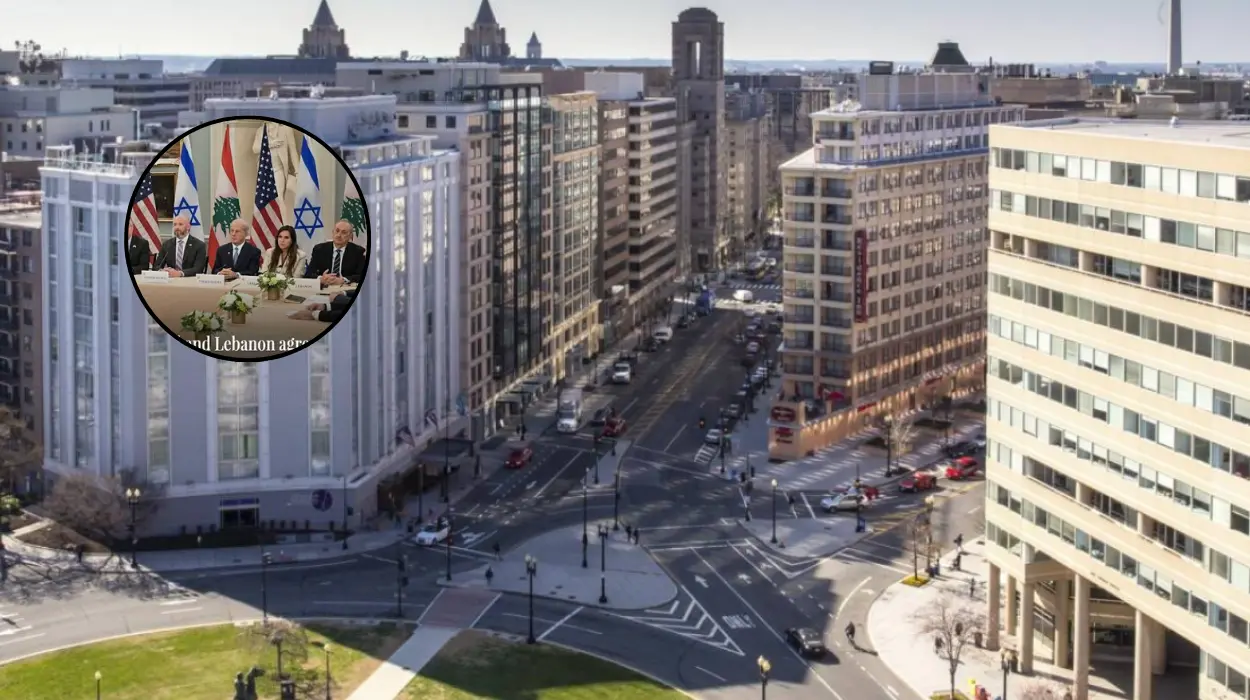
Washington, DC (Evening Washington News) 22 June 2026 – Israeli and Lebanese negotiators are scheduled to convene in the United States capital on Tuesday to identify specific “pilot zones” for transferring security responsibilities to the Lebanese Armed Forces. As reported by an unnamed Israeli source speaking to the Israeli daily newspaper Haaretz on Monday, the diplomatic framework will require the Israeli military to execute a partial withdrawal from the area designated as the “Yellow Line.”
- Key Points
- What is the “Yellow Line” and How Will the Security Transfer Function?
- Will Israel Completely Withdraw From Southern Lebanon?
- What is the Immediate Human Cost Preceding the Washington Talks?
- Background of the Border Development
- Prediction and Regional Implications
- Impact on the Lebanese Armed Forces (LAF)
- Impact on Northern Israeli Communities
This Yellow Line represents an operational boundary established by Tel Aviv that extends approximately 8 kilometres (around 5 miles) inside Lebanese territory from the shared international border.
Under the terms currently under review for these US-sponsored talks, the Lebanese army is projected to assume operational responsibility for specific zones that are not actively controlled by Israeli forces.
The source cited by Haaretz clarified that the Lebanese army’s deployment and subsequent operations within these designated pilot zones would take place under close US supervision.
This upcoming session in Washington, DC, represents the latest iteration of multi-round, US-mediated diplomatic efforts designed to establish a sustainable security apparatus along the volatile border.
What is the “Yellow Line” and How Will the Security Transfer Function?
The operational mechanism of the proposed transition hinges on strict geographic demarcations and bilateral verification. According to the reporting published by Haaretz, the identification of the pilot areas will serve as a test case for broader stabilization along the frontier.
The primary mandate involves shifting the security burden to the sovereign Lebanese state forces in areas where Israeli ground units are not dug into permanent positions.
However, the diplomatic track faces immediate structural hurdles regarding territorial sovereignty. Writing for Haaretz, the tracking journalist highlighted statements from the Israeli official indicating that while partial repositioning away from the 8-kilometre Yellow Line boundary is on the table, it does not equate to a full evacuation.
The US mediation team intends to act as a third-party oversight body, directly supervising Lebanese army movements to ensure that non-state actors do not reoccupy the vacuums left by any partial Israeli adjustments.
Will Israel Completely Withdraw From Southern Lebanon?
The prospects of a smooth transition are complicated by explicit counter-statements from the highest levels of the Israeli executive branch. Israeli officials, led directly by Prime Minister Benjamin Netanyahu, have repeatedly and publicly stated that the Israeli army will not withdraw from the areas it currently occupies in southern Lebanon.
This creates a diplomatic divergence between the transitional “pilot zone” framework being discussed in Washington and the declared strategic policy of the Israeli government. Israel continues to maintain a physical military presence across multiple sectors in southern Lebanon. Some of these territories have been held under varying degrees of control for decades, while others were newly seized during the ground operations of the 2023–2024 war.
The Israeli administration maintains that its continuous presence is an essential national security requirement to prevent cross-border incursions.
What is the Immediate Human Cost Preceding the Washington Talks?
The diplomatic track in Washington arrives amidst a sharp intensification of hostilities on the ground. As reported by correspondents from the Anadolu Agency operating inside Lebanon, the Israeli military significantly escalated its aerial campaign over the weekend, conducting more than 200 strikes across both the southern and eastern regions of the country on Friday and Saturday.
While the Israeli military command issued statements claiming that these operations strictly targeted active Hezbollah military sites, field reporters from Anadolu Agency documented that a significant proportion of the munitions struck residential homes and local civilian infrastructure.
The human toll of this weekend escalation has been verified by sovereign medical authorities. According to official data released by Lebanon’s Ministry of Public Health, the air strikes on Friday and Saturday alone killed 105 individuals and left more than 150 others wounded.
These figures contribute to a broader, long-term casualty count compiled by Lebanese authorities since the intensification of the conflict.
Official Lebanese government figures show that since 2 March, Israeli military operations inside Lebanon have killed more than 4,100 people and caused injuries to over 12,000 others.
The mounting toll has intensified pressure on international mediators to secure a functional framework during Tuesday’s sessions in the United States.
Background of the Border Development
The current security crisis along the Israel-Lebanon border is rooted in a complex history of border disputes, non-state military presence, and repeated conventional military incursions.
The international border, historically defined by the 2000 United Nations Blue Line, has seen persistent volatility due to the presence of Hezbollah forces operating in southern Lebanon, outside the exclusive control of the central Lebanese government in Beirut.
The situation transformed into a large-scale conventional conflict during the war of 2023–2024. During this period, Israel launched extensive air campaigns and subsequent ground operations into southern Lebanon with the stated objective of pushing hostile forces back from its northern communities and creating a permanent buffer zone.
This led to the establishment of tactical operational boundaries like the “Yellow Line,” an internal marker slicing 8 kilometres deep into Lebanese territory.
Prior diplomatic efforts, anchored by UN Security Council Resolution 1701 from an earlier conflict era, mandated that the area between the Blue Line and the Litani River should be free of any armed personnel, assets, and weapons other than those of the Government of Lebanon and UNIFIL.
However, the failure to fully realize this mandate led to the current environment, where Israel occupies newly seized sectors and demands third-party verification—hence the introduction of direct United States supervision over the Lebanese Armed Forces in the proposed pilot zones.
Prediction and Regional Implications
The outcome of the Washington talks regarding the establishment of “pilot zones” will directly influence several distinct populations across the region, most notably Lebanese civilians residing in the southern border sectors, displaced families from northern Israel, and the institutional structure of the Lebanese Armed Forces.
For civilian populations inside southern Lebanon, a successful implementation of the pilot zones under US supervision could signal the slow return of local administrative governance and a reduction in localized air strikes.
However, because Prime Minister Netanyahu has explicitly ruled out a complete withdrawal, these areas are highly likely to remain fragmented.
Residents returning to zones handed over to the Lebanese army will likely face a highly militarized environment, divided by checkpoints, with the constant threat of renewed hostilities if the security arrangements break down.
Impact on the Lebanese Armed Forces (LAF)
The Lebanese Armed Forces will be placed under immense institutional strain. Assuming control under direct US supervision requires the LAF to act as an exclusive security provider and prevent any unauthorized military governance by non-state factions. If the LAF successfully stabilizes these pilot zones, it could lead to increased international funding and hardware allocations from Western allies.
Conversely, if they fail to secure these areas or find themselves caught between remaining Israeli positions and local armed factions, it could undermine the institutional credibility of the Lebanese military.
Impact on Northern Israeli Communities
For the residents of northern Israel who were evacuated during the 2023–2024 hostilities, these pilot zones represent a cautious test case for regional stabilization. A partial Israeli army repositioning away from parts of the Yellow Line will only be viewed as a success by this audience if the US-supervised Lebanese army demonstrates total operational control.
If security incidents or cross-border friction persist within the pilot zones, it will likely delay the permanent return of displaced Israeli civilians and prompt further defensive military responses from Tel Aviv.