
Key Points
- Washington State’s greenhouse gas emissions fell by around 0.5% between 2021 and 2022.
- Total emissions dropped by approximately half a million metric tonnes, according to the Department of Ecology.
- Officials argue the figures show climate policies are working, while critics dispute their effectiveness.
- Transportation and buildings emissions increased, while other sectors such as electricity and agriculture declined.
- Renewable energy, particularly hydropower, played a major role in the reduction.
- Critics warn the state is not on track to meet its 2030 emissions reduction targets.
- The Climate Commitment Act and Clean Fuel Standard are expected to drive future reductions.
- Washington generated over $4 billion from carbon pricing, funding thousands of projects.
- A delay in federal data has caused a lag in emissions reporting, with reforms planned for annual updates.
Olympia (Evening Washington News) April 29, 2026 – Washington’s latest greenhouse gas emissions report indicates a slight reduction in carbon output, but the findings have sparked a renewed debate over whether the state’s climate policies are achieving meaningful progress.
- Key Points
- What does the latest emissions report reveal about Washington’s climate progress?
- Why are officials and critics interpreting the same data differently?
- Which sectors contributed to the emissions changes?
- How are current policies expected to influence future emissions?
- What role does funding from carbon pricing play?
- Why is there a delay in emissions data reporting?
- What are Washington’s emissions targets and challenges ahead?
- Background: Washington’s climate policy framework
- Prediction: How could this development affect residents and businesses?
What does the latest emissions report reveal about Washington’s climate progress?
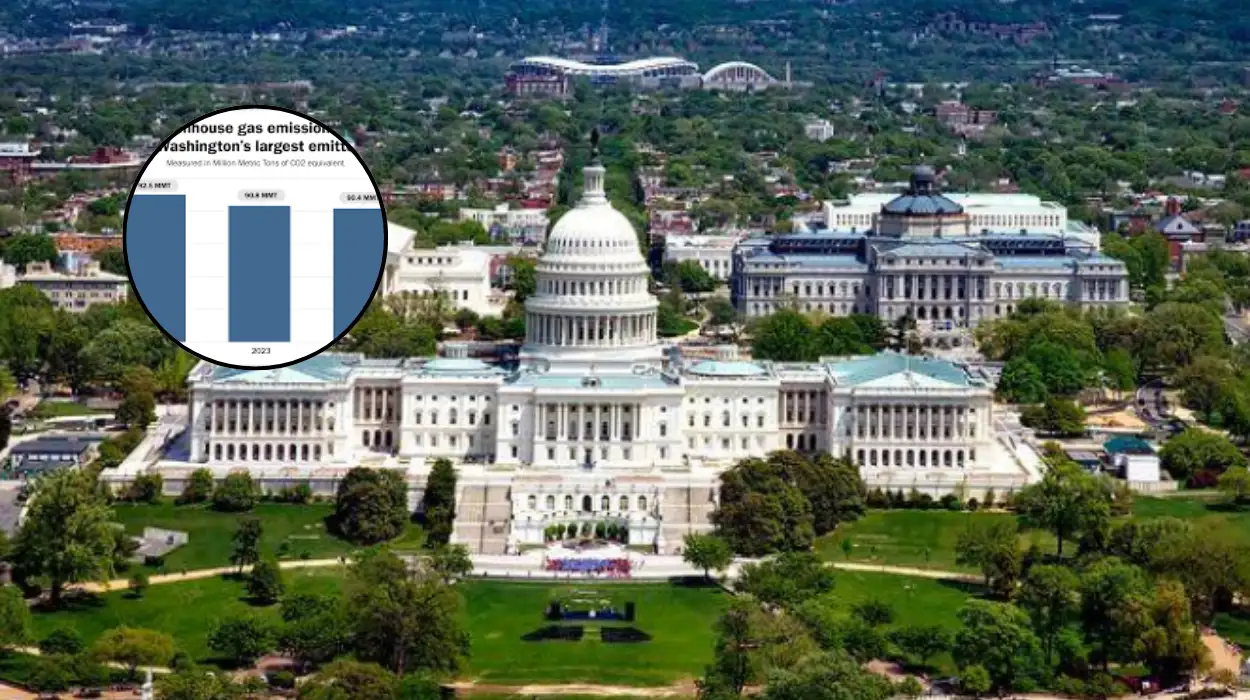
According to the Department of Ecology’s newly released greenhouse gas emissions inventory, the state’s emissions declined by roughly half a percentage point between 2021 and 2022. This equates to a reduction of approximately 500,000 metric tonnes of carbon dioxide.
As reported by the Washington State Standard staff, the total emissions for 2022 stood at 96.1 million metric tonnes.
The agency noted that the reduction is comparable to removing around 109,000 cars from the road for a year.
Casey Sixkiller, Director of the Department of Ecology, stated:
“Washington is a leader in fighting climate change. That said, we must remain laser-focused to make even more progress in combatting this threat.”
The report is part of the state’s ongoing effort to track emissions trends and evaluate the impact of environmental policies.
Why are officials and critics interpreting the same data differently?
State officials and environmental advocates view the marginal decline as evidence that Washington’s climate policies are beginning to yield results.
They point to long-term trends showing emissions have dropped by more than 13% since 2000, despite significant population growth and economic expansion.
However, critics argue the reduction is too small to indicate meaningful progress.
Todd Myers, Vice President for Research at the Washington Policy Center, told the Washington State Standard:
“Every year, we either see emissions go up or tiny reductions like this, and yet every year, the comments from the Department of Ecology leadership is, ‘our policies are working.’ Clearly they are not working.”
Myers further stated that achieving the state’s 2030 targets would require annual emissions reductions of 5–7%, levels comparable to those seen during the COVID-19 pandemic when economic activity sharply declined.
This divergence highlights a broader disagreement over how to measure success—whether incremental progress is sufficient or whether more aggressive reductions are necessary.
Which sectors contributed to the emissions changes?
The report identifies mixed trends across different sectors of the economy.
- Transportation emissions increased by about 500,000 metric tonnes.
- Building-related emissions also rose by a similar amount.
- Emissions from electricity generation, agriculture, and industrial processes declined.
Researchers attribute much of the overall reduction to increased reliance on renewable energy sources, particularly hydropower.
The report notes that hydropower availability depends heavily on snowpack levels. In years with lower snowpack, the state relies more on fossil fuels.
Although 2022 benefited from strong snowpack, Washington has experienced recurring drought conditions in recent years, which could affect future emissions patterns.
How are current policies expected to influence future emissions?
Several major policy initiatives are expected to shape Washington’s emissions trajectory in the coming years.
- The Climate Commitment Act, implemented in 2023, requires major polluters to pay for their carbon emissions and transition towards carbon neutrality.
- The Clean Fuel Standard, also launched in 2023, aims to reduce transportation emissions by promoting cleaner fuel alternatives such as biofuels and electric vehicle infrastructure.
- The Clean Energy Transformation Act includes a no-coal policy, which took full effect at the end of 2025, although there has been federal pressure to keep the state’s last coal plant operational.
Leah Missik, Washington Legislative Director for Climate Solutions, told the Washington State Standard:
“We have made really significant steps, but to meet our targets, we really need to do more.”
Missik emphasised the importance of investing in projects that both reduce emissions and maintain affordability for residents.
What role does funding from carbon pricing play?
The Climate Commitment Act has generated significant revenue through carbon pricing mechanisms.
- Over $4 billion has been collected from major emitters since the policy’s introduction.
- More than $1.5 billion has been allocated to over 3,600 projects across 37 state agencies.
According to the Department of Ecology, these investments are aimed at accelerating the transition to clean energy, improving infrastructure, and reducing emissions across multiple sectors.
However, critics question the effectiveness of this spending.
Todd Myers argued:
“A lot went to expanding government, not actually delivering reductions.”
This disagreement reflects ongoing scrutiny over how climate funds are allocated and whether they are producing measurable environmental benefits.
Why is there a delay in emissions data reporting?
The report released in 2026 covers emissions from 2022, highlighting a significant time lag in data availability.
The Department of Ecology attributes this delay to reliance on federal data sources. To address this issue, the agency is developing in-state data systems to improve timeliness.
Officials have also announced a shift from biennial to annual reporting, with the next emissions report expected in December.
Preliminary forecasts suggest that emissions may have continued to decline in 2023 and 2024, largely due to increased adoption of renewable energy.
What are Washington’s emissions targets and challenges ahead?
Washington law mandates a reduction in greenhouse gas emissions to approximately 51 million metric tonnes by 2030. This represents a 45% decrease from 1990 levels.
Meeting this target will require sustained and substantial annual reductions, significantly higher than the 0.5% decrease recorded in the latest report.
Experts highlight several challenges:
- Rising emissions in transportation, the largest contributing sector.
- Dependence on variable hydropower resources.
- The need for accelerated adoption of clean technologies.
- Balancing economic growth with environmental goals.
While state officials remain optimistic, critics warn that current trends may not be sufficient to meet statutory targets.
Background: Washington’s climate policy framework
Washington State has implemented a series of policies aimed at reducing greenhouse gas emissions over the past two decades.
Key milestones include:
- Early 2000s: Peak emissions levels recorded, followed by gradual decline.
- 2021: Passage of the Climate Commitment Act, establishing a cap-and-invest system.
- 2023: Introduction of the Clean Fuel Standard and implementation of carbon pricing.
- 2025: Enforcement of the no-coal policy under the Clean Energy Transformation Act.
The state’s approach combines regulatory measures, market-based mechanisms, and public investment to transition towards a low-carbon economy.
Despite these efforts, emissions reductions have been uneven across sectors, with transportation remaining a persistent challenge.
Prediction: How could this development affect residents and businesses?
The findings of the latest emissions report are likely to influence both policy decisions and public discourse in Washington.
For residents, potential impacts include:
- Continued investment in public transport and electric vehicle infrastructure.
- Possible changes in fuel prices due to clean fuel requirements.
- Expanded access to energy-efficient housing and renewable energy programmes.
For businesses:
- Increased compliance costs for high-emission industries under carbon pricing.
- Opportunities in clean energy, technology, and infrastructure sectors.
- Greater regulatory scrutiny and expectations for emissions reporting.
For policymakers, the report may intensify pressure to accelerate climate action, refine spending strategies, and address gaps in emissions reductions—particularly in transportation.
The extent to which Washington can meet its 2030 targets will depend on how effectively current policies are implemented and whether additional measures are introduced in response to ongoing challenges.