Key Points
- Removal of Signage: Workers removed Donald Trump’s name from the Kennedy Centre in Washington D.C. during the early hours of Saturday morning.
- Judicial Mandate: The action follows a judge’s ruling that the performing arts landmark cannot be renamed without an official act of Congress.
- Missed Deadline: The Department of Justice (DOJ) initially indicated the government would miss the 11:59 pm Friday deadline due to weather-related safety concerns.
- Short-lived Tenure: The name change lasted less than six months, having been implemented in December after a board vote.
- Operational Details: The removal of the letters took approximately 30 minutes under the cover of tarps and scaffolding.
Washington (Evening Washington News) June 13, 2026 — Workers stripped the name of Donald Trump from the John F. Kennedy Centre for the Performing Arts early on Saturday morning, complying with a federal court order that prohibited the unilateral rebranding of the national landmark. The predawn operation saw the removal of “The Donald J. Trump” from the facility’s official title, restoring the venue to its original name nearly six months after the controversial renaming took place. The removal follows a high-stakes legal battle centered on whether the centre’s board had the statutory authority to alter the name of a monument established by Congress to honour the 35th President of the United States.
- Key Points
- Why was Donald Trump’s name removed from the Kennedy Centre?
- How was the removal operation conducted?
- What led to the initial renaming of the venue?
- Who was involved in the legal dispute?
- Background of the Kennedy Centre Development
- Prediction: How this development will affect the American public and the arts community
Why was Donald Trump’s name removed from the Kennedy Centre?
The removal was the direct result of a judicial ruling stating that the performing arts landmark cannot be renamed without a specific act of Congress.
According to reports from Rahmat Gul of the Associated Press, the work began in the early hours of Saturday after a period of legal uncertainty regarding the deadline for compliance.
As reported by legal correspondents at the Associated Press, the Department of Justice (DOJ) had filed a late-night notice on Friday stating that the government would technically miss a court-ordered deadline of 11:59 pm to have the signage removed. The DOJ cited
“thunderstorms that could pose safety risks for the workers”
as the primary reason for the delay, initially seeking a 12-hour extension to complete the task safely.
How was the removal operation conducted?
Despite the request for an extension, crews moved quickly once the weather permitted. Witnesses on the scene observed workers erecting scaffolding late on Friday evening.
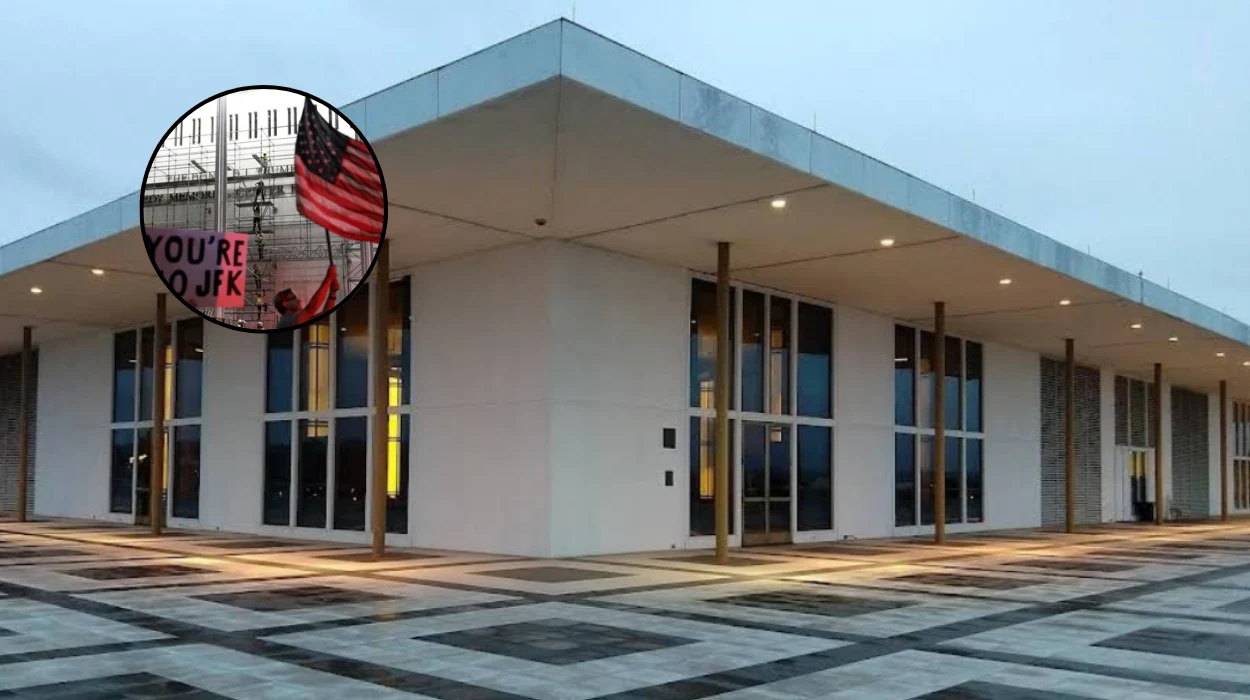
In an effort to maintain a level of privacy or perhaps to mitigate public gathering, workers draped tarps over the temporary structures during the predawn hours.
According to reporting by the Associated Press, workers were seen actively removing the individual letters of the Trump name around 3:10 am.
The operation was described as efficient, taking approximately 30 minutes to strip the branding from the building’s facade. This concludes a brief chapter in the history of the 50-year-old venue where it bore the name of the current board chair alongside that of John F. Kennedy.
What led to the initial renaming of the venue?
The controversy began in December when the centre’s board, which Donald Trump chairs, held a vote to rename the facility
“The Donald J. Trump and The John F. Kennedy Memorial Centre for the Performing Arts.”
Almost immediately following the board’s decision, workers began affixing the new name to the building, a move that drew swift criticism from historians, Kennedy family supporters, and constitutional scholars.
As noted by various media outlets covering the December transition, the board’s move was seen by critics as an overreach of executive influence over a federally established institution.
The legal challenge that followed argued that because the Kennedy Centre was created by a specific act of Congress in 1958 (and renamed in honour of JFK in 1964), any subsequent name change would require the same legislative process rather than a simple board resolution.
Who was involved in the legal dispute?
The Department of Justice represented the government’s interest in attempting to maintain the renaming, while the opposition focused on the sanctity of the original congressional designation. While the DOJ argued for the board’s right to manage the facility’s identity, the presiding judge ultimately sided with the interpretation that the name
“John F. Kennedy Centre for the Performing Arts”
is codified in federal law.
As reported by the Associated Press, the DOJ’s court filing on Friday evening was a final attempt to manage the logistics of the removal. The filing stated:
“the government would miss a court-ordered deadline… because of thunderstorms that could pose safety risks.”
This admission of a missed deadline prompted a small crowd of onlookers and photographers to wait through the night to witness the final removal.
Background of the Kennedy Centre Development
The John F. Kennedy Centre for the Performing Arts holds a unique position in American culture. It is not merely a theatre but a “living memorial” to President Kennedy. Its origins trace back to the National Cultural Centre Act of 1958, signed by President Dwight D. Eisenhower. Following the assassination of John F.
Kennedy in 1963, Congress designated the unfinished centre as a living memorial to the late president, providing federal funding to ensure its completion.
The centre was officially opened in 1971. Because it is a federal entity that receives annual appropriations from Congress for its maintenance and operation, it is subject to different rules than private New York or West End theatres.
The board of trustees is appointed by the President, but their powers are historically limited to the artistic and operational management of the site, rather than the power to alter its foundational identity.
The December vote to add Trump’s name was the first time in the institution’s history that a sitting board chair sought to share the titular honours of the memorial.
Prediction: How this development will affect the American public and the arts community
The removal of the Trump name is likely to have significant ripples across the American political and cultural landscape. For the general public and historians, this serves as a reinforcement of the “Living Memorial” status of national landmarks.
It establishes a legal precedent that executive-appointed boards cannot unilaterally alter the branding of monuments dedicated by Congress, ensuring that the historical intent of such sites remains protected from the shifting winds of political administrations.
For the performing arts community, this development may lead to a push for greater autonomy or a more clearly defined separation between the board’s political appointees and the institutional identity of the centre. We can expect:
- Legislative Review: Congress may seek to tighten the language of the National Cultural Centre Act to explicitly forbid any future naming additions without a two-thirds majority in both houses.
- Board Restructuring: There will likely be increased public pressure regarding the chair’s role, potentially leading to calls for a non-partisan or career arts professional to lead the board to avoid future “branding” conflicts.
- Restoration of Focus: With the signage removed, the centre will likely pivot back to its primary mission—showcasing world-class performance—though the memory of this legal battle will remain a footnote in the building’s 21st-century history.