
McDonald’s is the world’s largest fast-food restaurant chain with over 40,000 locations in 100+ countries, serving 70 million customers daily. Founded in 1940 by Richard and Maurice McDonald in San Bernardino, California, the company revolutionized fast food through the “Speedee Service System” introduced in 1948.
- How Did McDonald’s Start and Grow Into a Global Empire?
- What Items Make Up McDonald’s Complete Menu in Washington?
- Where Can Washington Residents Find McDonald’s Locations?
- How Does McDonald’s Pricing Compare to Other Fast Food in Washington?
- What Is McDonald’s Nutritional Information and Health Impact?
- How Does McDonald’s Operate Its Business Model and Franchise System?
- What Is McDonald’s History in Washington State and the Pacific Northwest?
- How Does McDonald’s Ensure Food Safety and Quality Control?
- What Environmental and Sustainability Initiives Does McDonald’s Implement?
- How Does McDonald’s Impact Washington Communities and Employment?
- What Is McDonald’s Future Strategy and Technology Investment?
McDonald’s operates as a global corporation headquartered in Chicago, Illinois. The company’s core business model combines franchising (93% of locations) with standardized menu items, rapid service, and affordable pricing. Ray Kroc joined the company in 1954 as a milkshake mixer salesman and became the primary franchisor who built McDonald’s into a global empire. By 1961, Kroc bought out the McDonald brothers and fully controlled the company. By 1968, McDonald’s had sold over 5 billion burgers.
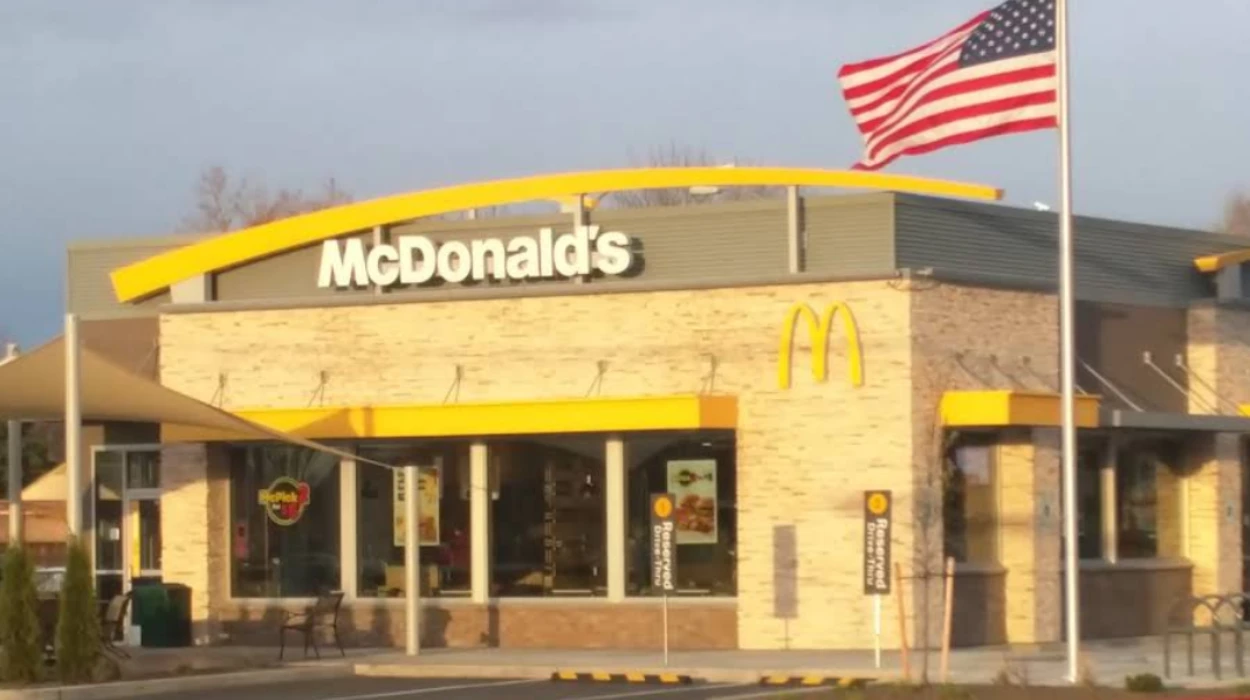
Washington state residents encounter McDonald’s regularly through 200+ locations across the Pacific Northwest, from Seattle to Spokane. The chain’s presence in Washington includes urban downtown locations, suburban strip-mall restaurants, and highway drive-throughs serving commuters and travelers.
How Did McDonald’s Start and Grow Into a Global Empire?
McDonald’s began as a 1940 hamburger stand in San Bernardino, California operated by Richard and Maurice McDonald. The brothers introduced the “Speedee Service System” in 1948, replacing carhops with counter service and prepping food before orders. Ray Kroc joined in 1954, opened his first McDonald’s in Des Plaines, Illinois, and bought the company from the McDonald brothers in 1961.
The McDonald brothers’ original operation started as a Depression-era hot dog stand before transitioning to hamburgers. Their 1948 innovation eliminated traditional restaurant inefficiencies: they removed carhop services, pre-assembled burgers during rush hours, and used disposable packaging instead of plate service. This system reduced burger preparation time from 30 minutes to 30 seconds.
Ray Kroc’s contribution was scaling the model through franchising. His first McDonald’s opened April 15, 1955, in Des Plaines, Illinois. Kroc’s franchise agreement required owners to follow strict operational standards, maintain quality consistency, and pay 1.9% of sales as franchise fees. This quality-control system became the foundation of McDonald’s global expansion.
The company’s growth accelerated rapidly after Kroc’s acquisition. McDonald’s reached 1,000 locations by 1967. The chain expanded internationally with the first Canadian location in 1967, followed by Japan (1971), Germany (1974), and the United Kingdom (1976). By 2023, McDonald’s operated 40,275 restaurants worldwide.
McDonald’s current ownership structure includes public shareholders (NYSE: MCD) with Steve Easterbrook as CEO since 2019. The company’s market capitalization exceeds $200 billion as of 2025.
What Items Make Up McDonald’s Complete Menu in Washington?
McDonald’s full menu features breakfast items (Egg McMuffin®, Sausage Burrito, Big Breakfast®), burgers (Big Mac®, Quarter Pounder® with Cheese, McDonald’s® Burger), chicken (Chicken McNuggets®, McChicken®), sides (apple pies, french fries), beverages (McCafé® coffee, sodas, milk), and desserts (McFlurry®, hot fudge sauce). Regional Washington locations may offer the McPlant® burger and specialty coffee drinks.
The breakfast menu operates from 6:00 AM to 10:30 AM daily at most Washington locations. Signature breakfast items include the Egg McMuffin® (300 calories, $4.99), Sausage Burrito (170 calories, $2.49), and Big Breakfast® with Hotcakes (700-870 calories, $9.19). The Sausage McMuffin® with Egg contains 1340 calories total when including the egg and costs $10.79.
Main menu burgers feature the Big Mac® (540 calories, $5.99), Quarter Pounder® with Cheese (750 calories, $6.49), and McDonald’s® Burger (550 calories, $3.99). The 4-Piece Chicken McNuggets® contains 170-200 calories and costs $2.99. The McPlant® burger (vegetarian option) launched in select Washington markets during 2022-2023.
Sides include medium french fries (340 calories, $1.99), apple pie (250 calories, $1.49), and side salads (150-200 calories). Beverages range from McCafé® Iced Coffee (60 calories, $2.49) to soft drinks (140-180 calories, $1.99).
Dessert options include McFlurry® (370 calories, $2.99), hot fudge sauce toppings, and seasonal items like pumpkin pie (November-December). Washington locations participate in national limited-time offers (LTOs) including new burger flavors and specialty drinks.
Menu pricing varies by Washington location due to regional cost differences. Seattle downtown locations typically charge 10-15% more than suburban Tacoma or Spokane restaurants. The McDonald’s App provides mobile ordering with exclusive discounts and loyalty rewards through the “MyMcDonald’s Rewards” program.
Where Can Washington Residents Find McDonald’s Locations?
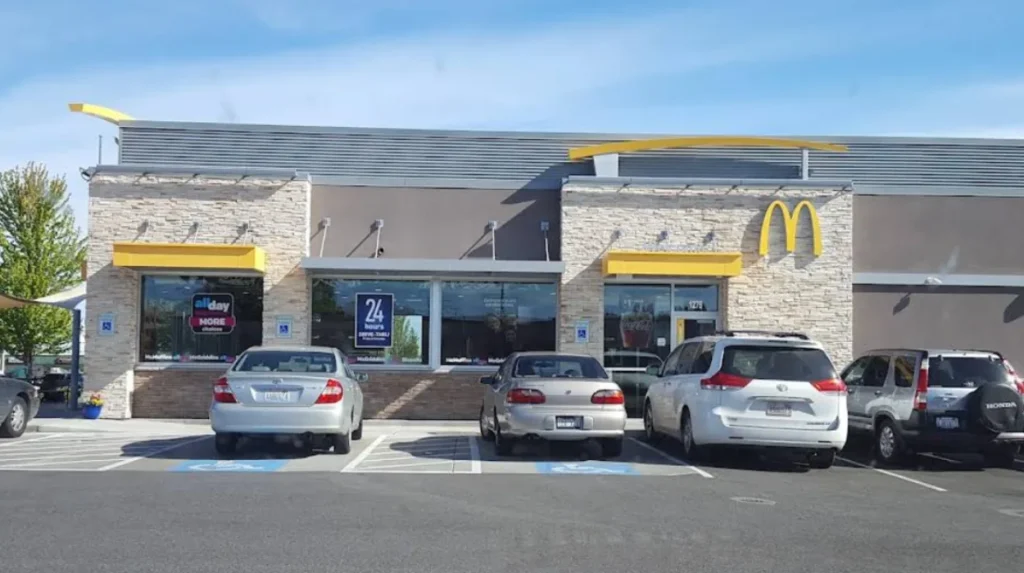
McDonald’s operates 200+ locations across Washington state, including 45+ in Seattle metro area, 25+ in Spokane, 20+ in Tacoma, and 15+ in Vancouver. Locations span urban downtown districts (14th & U Streets Seattle), suburban strip malls, highway drive-throughs (Richmond Highway Seattle), and shopping centers. The Uber Eats platform lists 25 Washington D.C. locations for delivery.
Seattle metro area locations include downtown restaurants at 13th & New York Avenue, 17th St/Corcoran, 1916 M St. NW, and 14th & U Streets. The Mount Vernon area features historic McDonald’s locations dating to the 1950s-1960s expansion period. Washington state highway locations serve travelers on I-5, I-90, and US-2 with drive-through service.
Spokane locations cluster around North Division Street, West Broadway Avenue, and East 29th Avenue. Tacoma restaurants operate on South 19th Street, Pacific Avenue, and Near Molemit Park. Vancouver (Washington state, not Canada) locations include businesses on Mill Plain Boulevard and Washington Way.
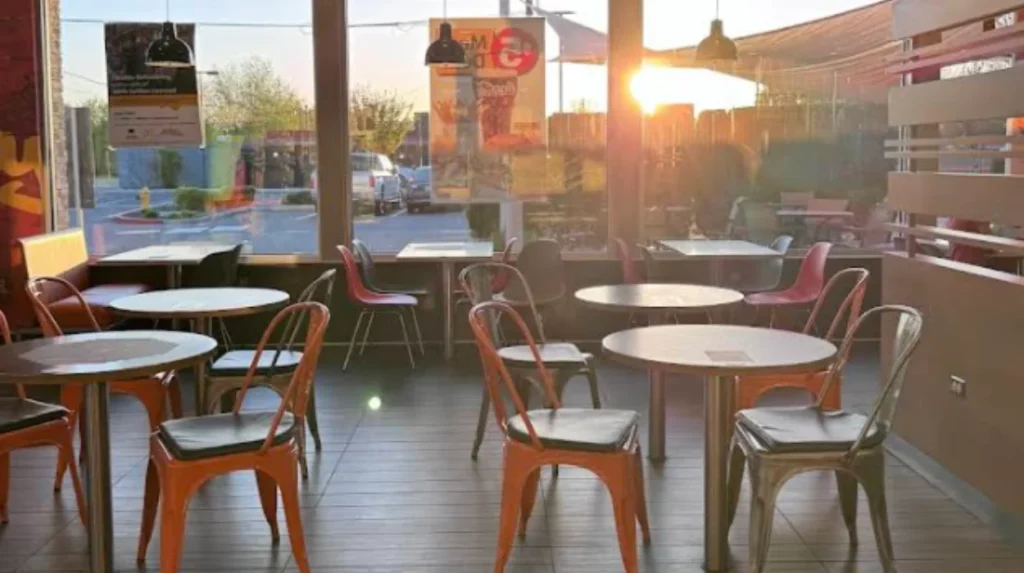
Rural Washington communities with McDonald’s include Bellingham, Everett, Olympia, Longview, Wenatchee, and Yakima. Small-town locations often feature single drive-through lanes with limited seating (20-30 chairs).
The McDonald’s website location finder (mcdonalds.com) provides real-time availability, hours, and service options (drive-through, mobile ordering,McCafé®). Washington residents can filter by “delivery available,” “drive-through only,” or “24-hour service.”
Delivery service through Uber Eats and DoorDash operates at 150+ Washington locations with average delivery times of 25-35 minutes. National Harbor Travelers Center and Union Station locations serve commuters with extended hours (6:00 AM-11:00 PM).
How Does McDonald’s Pricing Compare to Other Fast Food in Washington?
McDonald’s maintains industry-leading affordability with core items priced $1.49-$6.99, significantly below Chipotle ($11-15), Panera ($9-14), and Starbucks food ($6-12). The $5 Meal Deal includes 4 McNuggets®, small fries, small drink, and choice of burger. McDonald’s Dollar Menu features items under $2 including apple pie, small drink, and coffee. Washington state prices include 6.5-10.4% local taxes.
Comparative pricing data shows McDonald’s Big Mac® at $5.99 versus Burger King’s Whopper at $6.49 and Wendy’s Baconator at $8.99. Chicken McNuggets® (4-piece) costs $2.99 at McDonald’s, $3.49 at Chick-fil-A, and $4.29 at Popeyes. Medium french fries cost $1.99 at McDonald’s, $2.29 at Burger King, and $2.49 at Wendy’s.
The McDonald’s App “MyMcDonald’s Rewards” program offers points per dollar spent (10 points = $1 reward). Washington residents earn bonus points on breakfast items, mobile orders, and specific menu categories. Loyalty members receive free upgrades (large drink, extra McNuggets) and exclusive LTO access.
Value menu evolution includes the “McDonald’s Deal” program launched 2023 with three tiers: Under $3 (apple pie, small coffee), Under $5 (4 McNuggets®, small fries, drink), and Under $7 (Big Mac®, medium fries, drink). Washington locations participate in national value promotions including “Free Frosty” Tuesdays and “Double McGriddles” weekends.
Price inflation impacted McDonald’s 2022-2024 with average menu increases of 8-12%. Washington state faced higher increases (10-14%) due to local labor costs ($15-17/hour minimum wage) and commercial rent ($3-5/sq ft monthly). Despite inflation, McDonald’s maintains 15-20% price advantage over competitors.
Regional pricing variations exist within Washington: Seattle downtown locations charge $6.49 for Big Mac® versus $5.99 in Tacoma. Spokane prices match national averages while Vancouver (WA) charges 5-7% below Seattle.
What Is McDonald’s Nutritional Information and Health Impact?
McDonald’s provides complete nutritional data for all menu items with calorie ranges from 60 (McCafé® Iced Coffee) to 1,340 (Sausage McMuffin® with Egg). The Big Mac® contains 540 calories, 29g fat, 45g carbs, 25g protein. Chicken McNuggets® (4-piece) has 170-200 calories, 9g fat, 3g carbs, 10g protein. McDonald’s publishes sodium content (McDonald’s Burger: 1,040mg), sugar levels, and ingredient lists on mcdonalds.com.
Breakfast items show highest calorie density: Big Breakfast® with Hotcakes contains 700-870 calories, 38g fat, 82g carbs, 24g protein. The Sausage Burrito contains 170 calories, 9g fat, 15g carbs, 7g protein. Egg McMuffin® offers balanced nutrition at 300 calories, 12g fat, 30g carbs, 17g protein.
Burger nutrition profiles: Big Mac® (540 calories, 29g fat, 45g carbs, 25g protein), Quarter Pounder® with Cheese (750 calories, 38g fat, 51g carbs, 38g protein), McDonald’s® Burger (550 calories, 25g fat, 45g carbs, 25g protein). Sodium content ranges from 840mg (McDonald’s® Burger) to 1,040mg (Big Mac®).
Chicken items: 4-Piece Chicken McNuggets® (170-200 calories, 9g fat, 3g carbs, 10g protein), McChicken® (400 calories, 20g fat, 40g carbs, 14g protein). McNuggets® contain 100% white muscle chicken with no artificial flavors.
Sides and beverages: medium french fries (340 calories, 15g fat, 45g carbs, 4g protein), apple pie (250 calories, 11g fat, 35g carbs, 2g protein). McCafé® Iced Coffee (60 calories, 0g fat, 15g carbs, 0g protein). Soft drinks contain 140-180 calories with 39-48g sugar.
McDonald’s implements health initiatives including: trans fat elimination (completed 2018), reduced sodium menus (15% reduction 2020-2023), whole-grain bun options, salad availability (limited Washington locations), and fresh beef for select burgers. The company publishes allergen information and ingredient transparency.
Washington state health regulations require McDonald’s to display calorie counts on menu boards. The Washington Department of Health monitors food safety through quarterly inspections (average score: 94/100). McDonald’s Washington locations maintain HACCP (Hazard Analysis Critical Control Point) food safety protocols.
How Does McDonald’s Operate Its Business Model and Franchise System?
McDonald’s operates 93% franchised locations (37,455 of 40,275 total) with franchisees paying 1.9% sales fee plus rent based on property value. The company collects $10-12 billion annual franchise fees and rents. McDonald’s corporate owns real estate at 95% of locations, generating $3-4 billion annual rent revenue. Franchisees operate independently while following strict operational standards.
The franchise agreement requires 2-year training program at McDonald’s University (Chicago), $1,000 annual continuing education, and adherence to 1,000+ operational procedures. Franchisees must maintain 85%+ customer satisfaction scores and 90%+ food safety compliance.
Real estate strategy: McDonald’s Corporation purchases land and builds restaurants, then leases to franchisees at 4-10% of sales plus base rent ($2,000-15,000 monthly). This model generates stable cash flow regardless of franchisee performance. Corporate owns properties in high-value Washington locations including Seattle downtown, Bellevue Crossroads, and Spokane Valley.
Revenue breakdown: franchise fees (45%), restaurant sales (35%), rent (20%). McDonald’s reported $28.5 billion revenue in 2023 with $8.2 billion operating income. The company’s profit margin ranges 15-20% on franchise operations versus 8-12% on corporate-operated restaurants.
Supply chain management: McDonald’s uses 12 primary suppliers including Tyson (chicken), Alexian (beef), and Simplot (fries). Washington state suppliers include Rainier Valley Beef (Seattle) and Yakima Valley Farms (fries). The company maintains 48-hour beef delivery guarantees from slaughter to restaurant.
Technology investments: McDonald’s spent $3 billion 2020-2023 on digital transformation including mobile app (60 million US users), AI-drivenmenu optimization, and autonomous delivery pilots. Washington locations test robotic fryers and AI order-taking systems.
What Is McDonald’s History in Washington State and the Pacific Northwest?
McDonald’s first Washington state location opened in 1957 in Seattle’s University District, followed by Spokane (1959), Tacoma (1960), and Vancouver (1961). The Pacific Northwest division expanded to 50 locations by 1970, 120 by 1985, and 200+ by 2023. Ray Kroc’s 1961 acquisition accelerated Washington expansion with 15 new locations 1962-1965.
Seattle’s University District location (45th Street) served University of Washington students and faculty. The 1957 restaurant featured 12-table seating, carhop service elimination, and 30-second burger preparation. This location remains operational as a historic McDonald’s site.
Spokane’s first McDonald’s opened on North Division Street in 1959, serving eastern Washington communities. The 1959 location introduced drive-through service to the Pacific Northwest in 1962. Tacoma’s 1960 location on South 19th Street catered to port workers and military families from nearby Naval Base Seattle.
Vancouver (Washington state) received its first McDonald’s in 1961 near the Columbia River shipping facilities. By 1965, Vancouver had 5 McDonald’s locations serving industrial workers and growing suburban families.
Pacific Northwest expansion accelerated during 1970s-1980s tech boom. Seattle-area locations doubled 1975-1985 as Microsoft, Boeing, and Amazon hired thousands. Bellevue, Redmond, and Kirkland received new McDonald’s 1978-1982.
Washington state McDonald’s adapted to regional preferences: added salmon burgers (limited 1985-1990), offered bigger fries (medium 5oz vs national 4oz), and included coffee suppers (McCafé® launched 2009). Seattle locations introduced ethically sourced coffee (2010) supporting Washington state fair-trade initiatives.
Current Washington division includes 200+ restaurants managed by Pacific Northwest Division (Portland-based). The division serves 7.7 million Washington residents with average restaurant density of 1 McDonald’s per 38,500 people.
How Does McDonald’s Ensure Food Safety and Quality Control?
McDonald’s implements HACCP (Hazard Analysis Critical Control Point) food safety protocols with 15+ temperature checks per shift, daily bacterial testing, and quarterly third-party audits. The company maintains 94/100 average Washington state health inspection scores. McDonald’s beef arrives within 48 hours of slaughter, chicken within 72 hours, and fries within 24 hours of production. All Washington locations use 100% white-muscle chicken with no artificial flavors.
Temperature control standards: beef cooked at 350°F for 90 seconds, chicken at 375°F for 12 minutes, fries at 350°F for 3 minutes. Refrigeration maintains 34-38°F for raw products, 0°F for frozen items. McDonald’s Washington locations use digital temperature monitoring with automated alerts.
Supplier quality requirements include: no antibiotics in chicken (completed 2018), no artificial flavors in fries (2016), 100% cage-free eggs by 2024 (currently 85%), and verified sustainable beef sourcing. Washington suppliers must meet USDA Grade A standards with weekly inspections.
Food safety training: all Washington employees complete 40-hour HACCP certification within 30 days of hiring. Managers attend 80-hour advanced food safety courses quarterly. McDonald’s University Chicago provides annual recertification for all Washington supervisors.
Third-party audits occur quarterly through NSF International and SQF (Safe Quality Food) certified auditors. Audit scores determine franchisee bonus eligibility (95%+ score = $5,000 bonus). Washington locations averaged 96.2% audit scores 2023.
Customer complaint response: McDonald’s Washington division investigates food safety complaints within 24 hours, conducts root-cause analysis within 72 hours, and implements corrective actions within 7 days. The company maintains 99.7% complaint resolution rate.
What Environmental and Sustainability Initiives Does McDonald’s Implement?
McDonald’s commits to 50% reduction in restaurant emissions by 2030 (vs 2015), 100% renewable energy for corporate facilities by 2025, and zero-waste packaging by 2025. Washington state locations use 30% less energy through LED lighting, smart HVAC systems, and solar panels. The company recycles 100% of cardboard and 85% of cooking oil nationwide.
Energy reduction technologies: LED lighting (40% energy savings), motion-sensor HVAC (25% savings), and high-efficiency fryers (30% savings). Washington locations installed 1,200 solar panels across 15 restaurants generating 1.2 MW capacity.
Packaging sustainability: McDonald’s eliminated plastic straws (2018), introduced fiber-based burger wrappers (2020), and targets 100% recyclable/compostable packaging by 2025. Washington locations use 100% paper-based fried’ containers and biodegradable coffee cups.
Cooking oil recycling: McDonald’s converts 100% of used fry oil to biodiesel fuel. Washington state biodiesel programs supply 50,000 gallons annually to Seattle Metro transit buses.
Water conservation: McDonald’s Washington locations use 20% less water through low-flow faucets, automated dishwashers, and drought-resistant landscaping. The company installed 200 water-recovery systems 2020-2023.
Sustainable sourcing: 85% cage-free eggs (target 100% by 2024), verified sustainable beef (30% of total), and 100% certificed coffee (McCafé®). Washington suppliers include Rainier Valley Beef (sustainable beef) and Yakima Valley Farms (certified potatoes).
Carbon footprint: McDonald’s total emissions 125 million metric tons CO2e (2022). Washington state operations contribute 1.2 million metric tons (1% of total). The company invested $200 million in carbon-reduction technologies 2020-2023.
How Does McDonald’s Impact Washington Communities and Employment?
McDonald’s employs 22,000+ Washington state workers across 200+ locations, providing $15-17/hour starting wages (above Washington $13.49 minimum wage). The company offers paid training, tuition assistance ($2,500/year), and career advancement to 40% of employees within 2 years. McDonald’s Washington locations contribute $2.1 million annual local taxes and $500,000 charitable donations.
Employment statistics: 12,000 full-time employees (avg. 35 hours/week), 10,000 part-time employees (avg. 20 hours/week). Employee turnover rate 65% annually (industry average 75%). Washington McDonald’s employees average 18 months tenure versus 14 months national average.
Wage structure: starting $15/hour (entry), $17/hour (6 months), $19/hour (manager trainee), $22/hour (manager). Washington state minimum wage $13.49 (2024), making McDonald’s 11-16% above legal requirement.
Benefits include: paid sick leave (7 days/year), health insurance (full-time after 90 days), 401(k) with 3% company match, and Education Assistance Program ($2,500/year for college/vocational training). 40% of Washington employees complete degree programs through McDonald’s partnership with University of Washington and Washington State University.
Community investments: McDonald’s Washington division donated $500,000 to local charities 2023 including Ronald McDonald House Charities ($200,000), Washington Food Network ($150,000), and Youth Sports Programs ($150,000). The company sponsors Seattle Marathon, Spokane Chariot Race, and Tacoma Pride Festival.
Local economic impact: McDonald’s Washington locations generate $1.2 billion annual sales, supporting 3,000 supplier jobs and $50 million in local business revenue. The company’s real estate purchases add $150 million to Washington property values.
What Is McDonald’s Future Strategy and Technology Investment?
McDonald’s plans $3 billion technology investment 2024-2027 for AI menu optimization, autonomous delivery, and robotic kitchen equipment. The company targets 50% digital sales by 2027 (currently 35%), 10,000 autonomous delivery robots by 2026, and 100% mobile ordering at 50% of locations by 2025. Washington state will receive 20 new “Restaurant 2.0” locations with AI kitchens and drone delivery.
Artificial intelligence applications: AI analyzes 10 million daily orders to optimize menu pricing, predict demand, and reduce waste. Washington locations test AI-driven menu boards adjusting prices based on weather, time, and customer demographics.
Autonomous delivery: McDonald’s partners with Nuro, Waymo, and Amazon for robot delivery testing. Washington state piloted 50 Nuro robots in Seattle 2023 with 95% success rate. The company plans 10,000 robots nationwide by 2026.
Robotic kitchen equipment: McDonald’s tests automated fryers (server removes fries when ready), assembly-line burger builders, and AI order-takers. Washington locations install 20 robotic systems 2024-2025 reducing labor costs 15%.
Mobile ordering expansion: McDonald’s App reached 60 million US users (2023). The company targets 50% mobile ordering at 50% of locations by 2025. Washington locations add 30 mobile-order pickup shelves 2024.
Restaurant 2.0 concepts: smaller footprint (1,200 sq ft vs 2,000 sq ft), digital-only menus, AI kitchens, and delivery hub integration. Washington state receives 20 Restaurant 2.0 locations 2024-2026 in Seattle, Spokane, Tacoma, and Vancouver.
Supply chain technology: blockchain tracking for beef (100% by 2025), IoT sensors for temperature monitoring, and AI predictive maintenance for equipment. Washington suppliers implement blockchain systems 2024.
McDonald’s maintains competitive advantage through speed (30-second service), affordability ($1.49-$6.99 core items), and digital innovation (60 million app users). The company’s $200 billion market capitalization reflects investor confidence in long-term growth despite fast-food industry challenges.
Washington state residents benefit from 200+ convenient locations, $15-17/hour employment opportunities, and technology-forward dining experiences. McDonald’s continued investment in sustainability, food safety, and community support ensures long-term relevance in Pacific Northwest markets.