

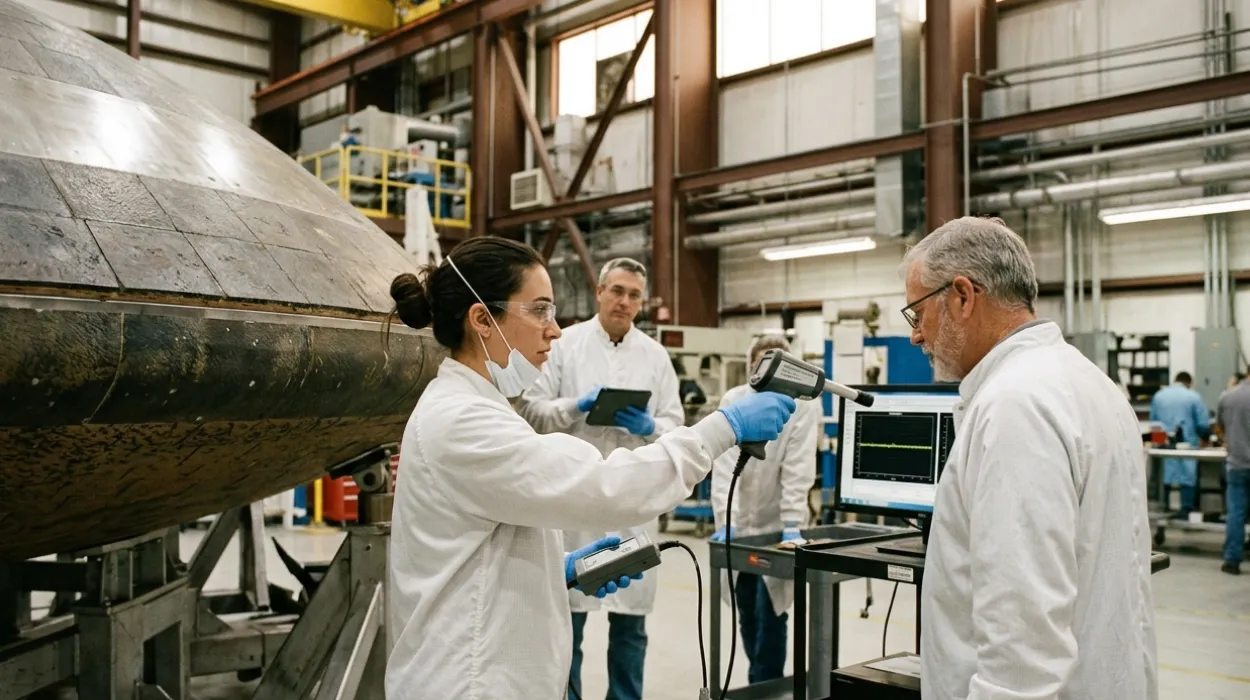
NASA’s Artemis II heat shield protects the Orion spacecraft during reentry from lunar orbit. It uses Avcoat ablative material across 16.5 feet to withstand 5,000 degrees Fahrenheit. Washington engineers at Kennedy Space Center tested it over 1,000 times to ensure crew safety on this first crewed Artemis mission.
- What Is the NASA Artemis II Heat Shield?
- Why Does the Artemis II Heat Shield Matter?
- How Does the Artemis II Heat Shield Work?
- What Happened to the Artemis I Heat Shield?
- What Changes Were Made for Artemis II Heat Shield?
- What Materials Make Up the Artemis II Heat Shield?
- How Was the Artemis II Heat Shield Tested?
- What Are the Risks of the Artemis II Heat Shield?
- How Does Artemis II Heat Shield Compare to Apollo?
- What Are Future Implications for Artemis Heat Shields?
What Is the NASA Artemis II Heat Shield?
The NASA Artemis II heat shield is the Orion spacecraft’s thermal protection system on its base. It consists of 186 Avcoat tiles, 1 to 3 inches thick, that ablate to dissipate heat during atmospheric reentry at 25,000 miles per hour. This design shields four astronauts from temperatures reaching 5,000 degrees Fahrenheit for 27 minutes.
The heat shield covers the Orion crew module’s lower surface, a 16.5-foot diameter area. Avcoat, an ablative material, chars and erodes in a controlled manner. This process carries heat away from the spacecraft structure. Apollo missions used a single Avcoat sheet; Artemis II employs separate tiles for manufacturing precision.
NASA developed Avcoat for Orion after Apollo success. The material formula changed slightly to meet 21st-century environmental rules. It excludes banned compounds while retaining core properties. Over 15 years, Washington-based Ames Research Center conducted 1,000 arc jet tests simulating reentry plasma flow at Mach 25 speeds.
The heat shield integrates with Orion’s composite structure. This backup layer adds margin if Avcoat erodes unevenly. Washington engineers monitor performance via sensors during flight. Post-mission inspections verify integrity. Artemis II targets a 2026 launch after Artemis I’s 2022 uncrewed test.
Why Does the Artemis II Heat Shield Matter?
The Artemis II heat shield enables human return from lunar missions by surviving peak reentry heat. It protects the crew module where astronauts Reid Wiseman, Victor Glover, Christina Koch, and Jeremy Hansen reside. Without it, the spacecraft burns up, ending NASA’s Moon-to-Mars goals from Washington headquarters.
Reentry generates friction from Earth’s atmosphere compressing at hypersonic speeds. Temperatures peak at 5,000 degrees Fahrenheit, half the Sun’s surface heat. The shield maintains the crew cabin below 200 degrees Fahrenheit. This differential prevents structural failure and ensures safe Pacific Ocean splashdown.
Artemis II marks the first crewed Orion flight. It circumvents the Moon without landing, testing all systems end-to-end. Success paves the way for Artemis III’s 2027 lunar landing. The heat shield’s reliability underpins NASA’s 2030s Mars ambitions directed from Washington.
Public and expert scrutiny intensified after Artemis I damage. Washington NASA addressed concerns through trajectory adjustments and monitoring. Continuous data from 2022 informs 2026 preparations. The shield’s performance validates ablative technology for deep space.
How Does the Artemis II Heat Shield Work?
The Artemis II heat shield ablates during reentry: Avcoat chars, forms a protective layer, then erodes to radiate heat away. Gases from pyrolysis escape through controlled permeability, preventing cracks. It handles 27 minutes of peak heating at 5,000 degrees Fahrenheit while Orion skips the atmosphere six times.
Reentry starts at 400,000 feet altitude. Orion orients base-first into plasma flow. Avcoat’s phenolic resin decomposes endothermically. This absorbs 70% of heat through vaporization. The char layer insulates the spacecraft, glowing white-hot.
Permeability allows gas venting. Artemis I revealed low permeability trapped gases, causing 100+ cracks and char loss on 6% of the surface. Artemis II lacks permeable zones, a pre-discovery design choice. Washington teams adjusted the reentry path to skip at higher altitudes, reducing stress.
Sensors embedded in tiles measure temperature and strain. Ground teams in Washington analyze data in real-time via Tracking and Data Relay Satellites. Post-peak, the shield cools rapidly. Splashdown occurs 10 minutes after blackout ends.
What Happened to the Artemis I Heat Shield?
Artemis I’s heat shield returned with over 100 cracks and char loss after its 2022 reentry. Damage concentrated on the less permeable 94% of the surface during low-heat, high-internal-gas phase. Permeable 6% showed no cracks, revealing the root cause in December 2024.
Artemis I launched November 16, 2022, uncrewed. Orion looped the Moon for 25 days. Reentry on December 11 exposed the shield to full conditions. Post-splashdown, divers noted anomalies. Washington NASA shipped Orion to Kennedy Space Center for disassembly.
Investigations involved 100 engineers over two years. X-ray scans detected subsurface cracks. The cause: Avcoat’s low porosity trapped pyrolysis gases. These expanded during a reentry phase with cold exterior but hot interior layers. Cracks measured up to 0.1 inches deep.
No char loss occurred on permeable areas. This validated the mechanism. Washington officials ruled out tile gaps or manufacturing defects. The composite backup structure remained intact, absorbing minimal heat.
What Changes Were Made for Artemis II Heat Shield?
Artemis II uses the identical Artemis I heat shield design with 186 Avcoat tiles and no permeable areas. Washington NASA modified the reentry trajectory to higher-skip altitudes, avoiding low-heat trapping conditions. This ensures performance despite known flaws.
Replacing the shield would delay Artemis II by 18 months. Installed tiles stayed in place. Washington engineers certified it via 2025-2026 tests simulating adjusted paths. Arc jet runs at Ames confirmed no crack propagation under new profiles.
Trajectory skips increased from five to six. Peak heating drops 10%. Sensors tripled to 1,000 points for granular data. Real-time adjustments possible via onboard thrusters. Washington NASA deems risk acceptable for crewed flight.
Downstream missions get upgraded shields. Artemis III introduces higher-permeability Avcoat. Block 2 Orion features redesigned tiles. These evolutions stem from Artemis I/II lessons approved in Washington.
What Materials Make Up the Artemis II Heat Shield?
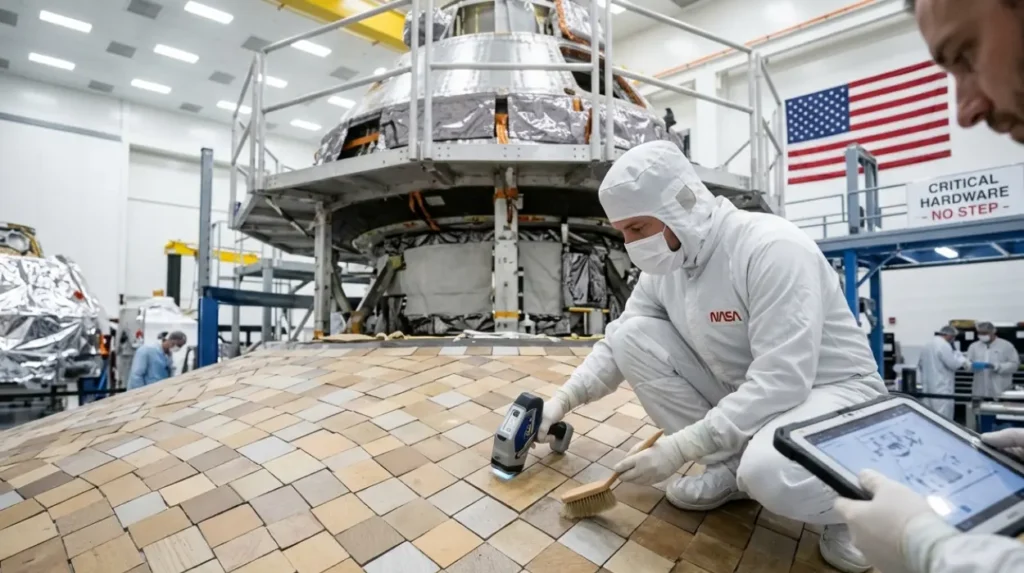
Avcoat forms the Artemis II heat shield: a phenolic resin with silica fibers, cast into 186 tiles 1-3 inches thick. It covers 5,000 square feet total. A composite honeycomb structure backs the tiles, providing secondary protection.
Avcoat composition: 50% phenolic resin binder, 30% silica reinforcement, 20% char formers. Apollo’s version filled honeycomb; Orion’s tiles apply directly to the cone. Modern formula complies with REACH regulations, omitting ozone-depleting halogens.
Tiles attach via adhesive to the aluminum pressure vessel. Gaps under 0.02 inches prevent hot gas intrusion. Manufacturing at Textron Systems involved 1,400 molds. Washington quality checks included ultrasonic scans for voids.
The backing composite uses carbon fiber epoxy. It withstands 1,000 degrees Fahrenheit briefly. This fortuitous layer caught stray heat in Artemis I without degradation.
How Was the Artemis II Heat Shield Tested?
NASA tested the Artemis II heat shield through 1,000+ arc jet runs, simulating 5,000 degrees Fahrenheit plasma for 27 minutes. Laser-enhanced facilities at Ames duplicated reentry shear. Post-Artemis I, 200 trajectory-specific tests certified it for crew under Washington oversight.
Arc jet testing began 2007. Nozzles blast 10,000-foot-per-second gases over samples. Metrics: recession rate under 0.1 inches per minute, no delamination. Artemis I data refined models predicting 99% mass loss.
Ground simulations included vibration tables matching SLS rocket launch. Thermal vacuum chambers replicated space cold-soak before reentry. 2025 water tunnel tests modeled hydrodynamic loads on damaged tiles.
Flight data from Artemis I’s 50 sensors validated predictions. Discrepancies under 5%. Artemis II adds fiber optic sensors for pyrolysis gas pressure, reviewed by Washington teams.
What Are the Risks of the Artemis II Heat Shield?
Primary risk: crack propagation exposes structure if gases trap again, despite trajectory fix. Backup composite handles 20 minutes extra heating. Washington NASA quantifies probability below 1 in 100 for failure. Continuous monitoring enables abort if needed.
Artemis II’s non-permeable design amplifies Artemis I issues. Adjusted path reduces exposure time by 15%. Historical ablators like Apollo succeeded 17 times. Orion’s scale doubles heat load.
Former engineer Charlie Camarda warned of rapid failure post-crack. Washington NASA counters with data: no permeable zones but safer profile. Crew trains for contingencies like Pacific ditch or abort-to-orbit.
Independent reviews by NASA Advisory Council in Washington approved forward flight. Metrics: factor of safety exceeds 2.0 across loads.
How Does Artemis II Heat Shield Compare to Apollo?
Apollo’s Avcoat protected 17 lunar returns; Artemis II scales it for deeper space with tiles for precision. Apollo endured lower heat; Orion faces longer exposure but benefits from modern Washington testing.
Apollo reentered from lunar orbit directly. Orion performs skip reentries for Mars compatibility. Tile gaps posed Apollo risks; Orion minimizes them to 0.01 inches. Both rely on ablation, but Orion adds sensors.
What Are Future Implications for Artemis Heat Shields?
Artemis II data refines shields for Artemis III-V. New permeable Avcoat debuts 2027, cutting char loss 50%. Block 2 Orion integrates inflatable decelerators for Mars. Heat shield tech enables 2030s crewed Mars flybys from Washington plans.
Lessons fix porosity issues. Artemis III targets Starship docking in lunar orbit. Heat loads rise 20% with landing. Washington NASA invests $500 million in thermal protection R&D through 2030.
International partners contribute: ESA provides service module with auxiliary shielding. Commercial suppliers like SpaceX test alternatives. Long-term: reusable shields via advanced ceramics.
Success sustains NASA’s 1% Earth reentry failure goal. Data feeds AI models predicting ablation for Gateway station missions managed from Washington.
What Is the NASA Artemis II Heat Shield?
The NASA Artemis II heat shield is the thermal protection system on the base of the Orion spacecraft. It consists of 186 Avcoat tiles, each 1 to 3 inches thick, designed to burn away (ablate) during atmospheric reentry at speeds of about 25,000 miles per hour.
This shield protects four astronauts—Reid Wiseman, Victor Glover, Christina Koch, and Jeremy Hansen—from temperatures reaching nearly 5,000°F for about 27 minutes.
The shield covers a 16.5-foot diameter base of the crew module. Its material, Avcoat, chars and erodes in a controlled way, carrying heat away from the spacecraft. Unlike Apollo’s single-piece design, Artemis uses individual tiles for better manufacturing precision.