Spokane historic districts are geographically defined areas containing collections of buildings, structures, and landscapes officially recognized for their architectural preservation quality and cultural heritage. The City of Spokane Historic Preservation Office manages these municipal assets under local and national designation frameworks.
- How Did the Great Fire of 1889 Shape Spokane Architecture?
- What Are the Architectural Characteristics of Browne’s Addition?
- How Does Corbin Park Reflect the Progressive Era Urban Planning Model?
- What Role Did Hillyard Play in Spokane Industrial and Cultural History?
- How Did the Mid-Century Modern Movement Transform Spokane?
- What Protection Mechanisms Govern Spokane Register Historic Districts?
The municipal designation framework partitions historic areas into two specific regulatory types. The first type consists of National Register Historic Districts, which function primarily as honorific classifications that qualify property owners for federal rehabilitation tax credits. The second type consists of Local Historic Districts, which enforce strict public design review processes managed by the Spokane Historic Landmarks Commission to prevent unauthorized exterior alterations.
The legal establishment of a local historic district requires an explicit municipal process outlined in the Spokane Municipal Code. Property owners within a proposed boundary must execute a formal balloting process that achieves a majority affirmative vote of all affected property titles. Once ratified, properties are governed by neighborhood-specific design standards that regulate building materials, structural additions, and demolition permits.
Spokane maintains 23 distinct historic districts, consisting of 17 National Register districts and 6 Spokane Register districts. These areas serve as architectural records of the municipal expansion patterns that occurred between 1889 and 1974.
How Did the Great Fire of 1889 Shape Spokane Architecture?
The Great Fire of 1889 destroyed 32 commercial blocks in the downtown core, forcing a complete civic rebuilding process using fireproof masonry materials. This sudden reconstruction window attracted national architects who established Spokane as a center of Richardsonian Romanesque architecture.
The environmental disaster occurred on August 4, 1889, obliterating the predominantly wood-framed central business district. The municipal government immediately banned wood-frame construction within the urban core, mandating that all replacement structures utilize brick, stone, and terra cotta. This regulatory mandate generated an unprecedented building boom, resulting in the construction of approximately 100 masonry commercial buildings within a 12-month period.
The high concentration of wealth generated by regional silver, gold, and lead mines in the nearby Coeur d’Alene district financed this reconstruction. Wealthy mine operators commissioned elite architects to design durable, imposing headquarters. Architects like Kirtland Cutter, Herman Preusse, and John K. Dow dominated this era, introducing styles that projected permanence and industrial power.
The dominant style resulting from this transition was Richardsonian Romanesque, characterized by heavy stonework, deeply recessed entries, and rounded masonry arches. Examples of post-fire architectural execution include:
- The Review Building (built 1891), featuring massive granite arches and programmatic brick detailing.
- The Peyton Building (built 1898), showcasing a highly structured rusticated stone facade.
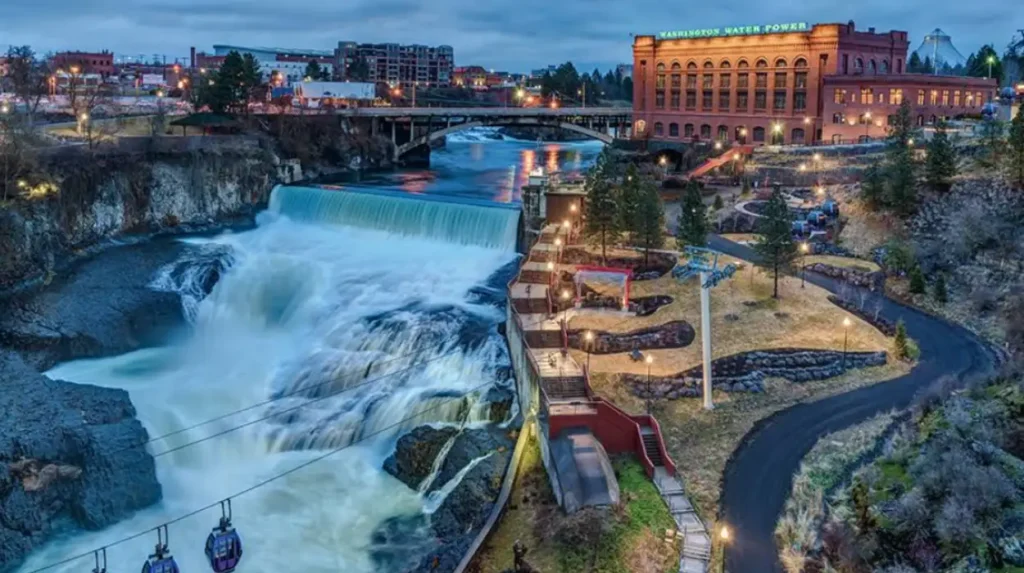
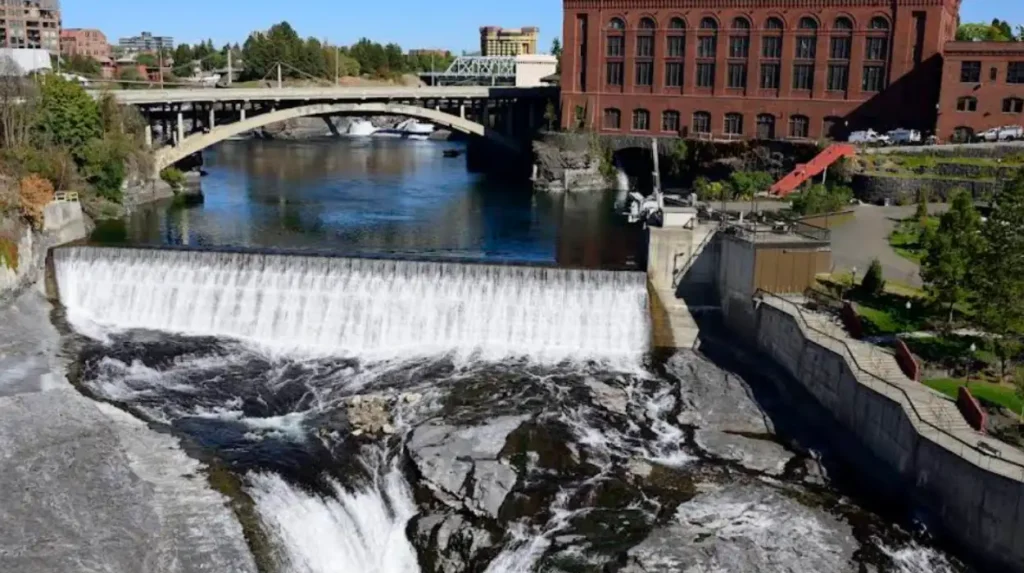
- The Washington Water Power Post Street Substation (built 1910), implementing industrial Romanesque arches directly over the Spokane Falls.
What Are the Architectural Characteristics of Browne’s Addition?
Browne’s Addition features an eclectic concentration of late-19th-century elite residential estates, transitioning into dense early-20th-century multi-family apartment blocks. The primary architectural styles in this district include Queen Anne, Tudor Revival, Shingle Style, and American Craftsman.
Browne’s Addition developed as the premier residential enclave for Spokane capital elites during the mining boom of the 1890s. Located on a bluff overlooking the Spokane River, the neighborhood provided a clean geographic separation from the industrial pollution of the downtown railyards. The neighborhood became Spokane’s first National Register Historic District in 1976 and later achieved Local Historic District status to protect its architectural diversity.
The early residential infrastructure exhibits extreme stylistic ornamentation meant to display personal wealth. Architects integrated irregular floor plans, expansive covered verandas, multi-gabled roofs, and towers. The structural foundations typically utilize locally quarried basalt, while the upper stories display intricate woodwork and imported brick.
The neighborhood experienced a demographic and structural shift after 1910, driven by the expansion of the municipal streetcar network. Large single-family lots were subdivided to build high-density brick apartment complexes, such as the Amman (built 1904) and the Breslin (built 1910). This densification introduced classical revival elements to the district, mixing multi-family brick structures alongside the original mining mansions.
How Does Corbin Park Reflect the Progressive Era Urban Planning Model?
Corbin Park reflects the Progressive Era urban planning model by utilizing a symmetrical oval street grid centered around a public municipal park space. The surrounding residential structures consist of highly intact American Craftsman bungalows and historic Foursquare homes.
The site originally functioned as Washington state’s primary regional fairgrounds and racetrack from 1887 until 1899. Following the closure of the recreational facility, pioneer industrialist D.C. Corbin acquired the land and platted it specifically as a high-density, planned residential community. The design abandoned the rigid gridiron street layout used in downtown Spokane, introducing a continuous oval perimeter road that insulated the interior residences from external commercial traffic.
This layout directly aligned with the national “City Beautiful” movement of the early 20th century. The movement asserted that structured park spaces and harmonious residential architecture would improve civic morality and public health. The central 11-acre park block was deeded directly to the municipal government, ensuring permanent public access to green space.
The building codes enforced within the Corbin Park plat produced structural uniformity in scale, setbacks, and building materials. The homes, built primarily between 1902 and 1915, represent the transition from Victorian ornamentation to functional, hand-crafted design. Examples of these styles include:
- The American Foursquare (such as the D.C. Corbin House), utilizing box-like two-story geometries, hip roofs, and central dormers.
- The Arts and Crafts Bungalow, showcasing wide overhanging eaves, exposed rafter tails, and heavy tapered porch columns.
- The Dutch Colonial Revival, implementing characteristic gambrel roof profiles and symmetrical window alignments.
What Role Did Hillyard Play in Spokane Industrial and Cultural History?
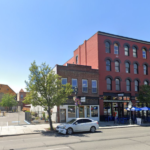
Hillyard functioned as a specialized, self-contained rail town built specifically to house the Great Northern Railway’s primary locomotive repair and construction shops. The architecture consists of a brick commercial district surrounded by workers’ wood-frame cottages.
Railroad magnate James J. Hill established Hillyard in 1892 to serve as the western hub for his transcontinental rail network. The town operated completely independently from Spokane until its formal municipal annexation in 1924. The entire economy of the district was tied to the operation of the Great Northern rail yards, which employed over 1,500 specialized mechanics, boilermakers, and laborers during its peak operational years.
The commercial core along Market Street was built using unreinforced brick masonry designed to withstand heavy industrial use and frequent fires. The buildings featured flat roofs, simple corbeled brick cornices, and large street-level storefront windows designed for retail access. This business district provided a stark contrast to the elite, ornamental style found on Spokane’s South Hill.
The cultural fabric of Hillyard was defined by its diverse immigrant workforce, including large populations of Italian, Irish, and German rail workers. This concentrated working-class population generated a distinct cultural landscape characterized by fraternal lodges, union halls, and multi-family boarding houses. The neighborhood preserves this layout, retaining its identity as a distinct blue-collar rail hub within the broader Inland Northwest region.
How Did the Mid-Century Modern Movement Transform Spokane?
The Mid-Century Modern movement introduced minimalist design aesthetics, open floor plans, and innovative structural systems to Spokane between 1948 and 1974. This architectural phase culminated in the design and construction of the Expo ’74 World’s Fair site.
Following World War II, Spokane experienced a severe residential and commercial expansion phase that required fast, efficient building techniques. A new generation of modern architects, trained in international and modernist design principles, rejected historical revival styles. Architects such as Warren C. Heylman, Bruce Walker, and Kenneth Brooks transformed the city’s skyline using reinforced concrete, plate glass, and structural steel.
This style was defined by its focus on functional design and integration with the surrounding environment. Residences built during this era feature low-pitched or flat rooflines, deep structural cantilevers, and floor-to-ceiling glass window walls that connected internal living spaces with external pine landscapes. The Comstock-Shadle Historic District serves as a primary example of this post-war residential design.
The movement reached its peak when Spokane hosted the Expo ’74 World’s Fair, making it the smallest city in history to host a designated universal exposition. The fair required the complete removal of the historic downtown rail yards to construct an environmentally focused urban park. The surviving structures from this era include the standard-setting Washington State Pavilion (now the First Interstate Center for the Arts) and the iconic US Pavilion, which features a historic open-air steel cable tent structure.
What Protection Mechanisms Govern Spokane Register Historic Districts?
The protection of Spokane Register Historic Districts is maintained through mandatory Certificates of Appropriateness, property tax incentives, and specific municipal preservation ordinances. These mechanisms ensure that all structural changes align with established federal and local preservation criteria.
The primary legal tool used to control physical changes within a local historic district is the design review process. Property owners must obtain an official Certificate of Appropriateness before executing any exterior modifications, additions, or demolitions. The Spokane Historic Landmarks Commission reviews all construction applications to verify compliance with the Secretary of the Interior’s Standards for Rehabilitation.
To balance these strict design restrictions, the City of Spokane provides substantial financial incentives to encourage property maintenance and historic preservation. The Special Valuation program allows property owners to subtract 100% of their qualified rehabilitation expenses from their total assessed property value for a continuous 10-year period. This tax deduction lowers the financial barrier for executing historically accurate structural renovations.
These regulatory and financial frameworks protect the city’s unique architectural landscape from urban decay and speculative real estate development. By preserving these historic districts, Spokane maintains its tangible connection to its industrial, cultural, and architectural past. This system ensures that the built environment continues to serve as an educational and cultural resource for future generations.