Restored George Washington Portrait Unveiled at New York Capitol, Albany 2026

Evening Washington
Restored George Washington Portrait Unveiled at New York Capitol, Albany 2026
Credit: Google Maps/NY Office of General Services

Key Points

  • Historical Artwork Reinstalled: The prominent 1813 oil-on-canvas portrait of George Washington by artist Ezra Ames has returned to public display in the State Street Lobby of the New York State Capitol.
  • Extensive Preservation Work: Conservationists at the Williamstown + Atlanta Art Conservation Centers spent over a year stabilizing the artwork, mitigating the impacts of structural aging, adding UV protection, and restoring its grand golden frame.
  • Environmental Deterioration Countered: The restoration was necessitated by physical vulnerabilities including fading, discoloration, chipping, oxidation, and structural canvas stress caused by significant fluctuations in temperature and humidity within the high-traffic lobby.
  • Alignment with U.S. 250th Anniversary: The masterpiece’s return marks a key milestone for state officials as New York prepares for the upcoming semiquincentennial celebrating the 250th anniversary of the United States Declaration of Independence.
  • Accompanying Educational Initiatives: Alongside the painting’s unveiling, the nearby New York State Museum will launch its “Revolutionary New York” exhibit on July 1 to honour historical contributors to the Revolutionary War.
  • Public Access Restored: The artwork is immediately available for public viewing via free year-round guided weekday tours conducted by the state’s Office of General Services.

Albany (Evening Washington News) June 29, 2026 – A historic 1813 oil painting of George Washington has officially been reinstalled in the State Street Lobby of the New York State Capitol building following an intensive, year-long restoration project. The monumental portrait, created by renowned early 19th-century Albany artist Ezra Ames, had been temporarily removed from public view to undergo complex conservation treatments aimed at reversing centuries of environmental damage and structural decay.

Led by the New York State Office of General Services (OGS), the preservation initiative successfully stabilized the vulnerable masterpiece, ensuring its long-term survival just as the state and nation begin localized historical programming ahead of the semiquincentennial—the 250th anniversary of the United States Declaration of Independence.

What Particular Conservation Work Was Required to Stabilise the Ezra Ames Portrait?
The restoration of the two-century-old oil-on-canvas portrait involved a highly specialized technical intervention designed to address the physical consequences of prolonged public display.

Because the painting has resided in high-traffic administrative spaces for generations, its material components had experienced advanced structural vulnerabilities.

As reported by journalist Samuel King of the New York Public News Network, the artwork had suffered from the natural, compounding impacts of aging, which included visible fading, pigment discoloration, paint chipping, and chemical oxidation.

To counter these vulnerabilities, the Office of General Services dispatched the painting to the professional laboratories of the Williamstown + Atlanta Art Conservation Centers.

Over a twelve-month period, expert conservators executed a precise stabilization regimen. According to official agency records released by OGS, specialists systematically treated the localized chipping, cleaned the oxidized varnishes that had obscured the original color profile, and repaired the canvas structure.

Additionally, the conservation team integrated modern defensive measures, including the application of an advanced ultraviolet (UV) protective layer to insulate the pigments from light-induced degradation.

The expansive, ornate golden frame housing the canvas also underwent independent structural restoration and cosmetic refinement before the entire assembly was cleared for transport back to the Capitol building.

How Do Environmental Conditions inside the Capitol Lobby Threaten Historic Oil Paintings?

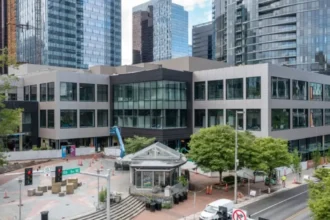
The decision to pull the painting from its public station was directly influenced by the volatile atmospheric conditions of the State Street Lobby, a major thoroughfare inside the New York State Capitol. While the location provides maximum public visibility, it exposes sensitive historic materials to rapid, unregulated microclimatic changes that accelerate physical decay.

As stated by Joseph Madeira, Director for Curatorial and Visitor Services for the New York State Office of General Services, to the New York Public News Network:

“The temperature fluctuates quite a bit, the humidity changes quite a bit, and all of those changes have an impact on the canvas. And so, we monitor these things very closely, and occasionally we have to do some work to make sure that this is preserved for future generations.”

Historic canvases are highly hygroscopic, meaning they naturally absorb and release moisture in response to surrounding air currents. When humidity rises, canvas fibers expand; when the air dries, they contract.

Over decades, this continuous mechanical stress forces the underlying textile to warp and pull away from the dried layers of oil paint adhering to its surface, culminating in the brittle cracking and paint loss observed prior to the restoration.

Highlighting the delicate condition of the piece upon arrival at the conservation laboratory, Briann Greenfield, Executive Director of the Williamstown + Atlanta Art Conservation Centers, noted to the New York Public News Network:

“It’s incredible to see it back. When they’re in our labs, it’s a little bit like being in a hospital, you know. Things come in an incredibly vulnerable state.”

What Official Statements Were Made by New York State Leaders regarding the Artwork’s Revealing?

The structural return and public unveiling of the George Washington portrait were met with formal statements from state administrative heads, who framed the restoration as a vital act of historical stewardship.

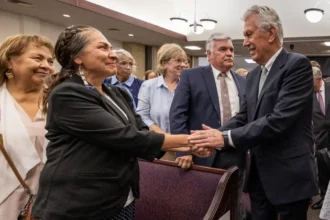
The public return of the painting on June 25, 2026, was structured to emphasize New York’s central role in early American political governance.

In an official agency publication distributed by the New York State Office of General Services, OGS Commissioner Jeanette Moy celebrated the collaborative preservation victory, stating that:

“Our collaboration with the Williamstown + Atlanta Art Conservation Centers on the intricate restoration of George Washington’s portrait is especially meaningful in the lead-up to our nation’s 250th anniversary. Not only is this portrait an important piece of New York’s history, but it also reflects the complicated story of America’s founding.”

State cultural entities similarly emphasized the educational imperative of maintaining public access to original artifacts within functioning legislative environments rather than isolating them exclusively inside museum vaults.

As documented in the official state announcement, New York State Museum Executive Director Jennifer Saunders affirmed the broader civic value of the display, stating:

“As stewards of this portrait, the Office of Cultural Education is delighted to see it once again displayed in the New York State Capitol, where it can be viewed by legislators, visitors, and members of the public as a reminder of our nation’s founding. Alongside other George Washington artifacts in the collections of the New York State Museum and New York State Library, this portrait represents an important connection to our shared history.”

Background of the Particular Development

The commissioning, survival, and modern display trajectory of the Ezra Ames portrait reflect over two centuries of architectural and political changes within Albany’s legislative spaces.

To understand its historical relevance, it must be noted that Ames did not paint George Washington from a live sitting; instead, the 1813 canvas was a deliberate, localized homage inspired by Gilbert Stuart’s famous 1796 Lansdowne Portrait, which currently resides on permanent display in Washington, D.C.

Ezra Ames settled in Albany in 1793 and rapidly ascended to become the city’s preeminent early 19th-century portraitist, ultimately producing more than 400 completed works.

His prolific output focused heavily on local New York political elites, including prominent legislative figures such as George Clinton and John Taylor, whose original likenesses also form a core component of the Capitol’s permanent art collection.

The state government commissioned Ames to produce the Washington portrait in 1813, and it has remained on continuous public display in Albany in various capacities ever since.

According to curatorial timelines maintained by Joseph Madeira, the painting was traditionally positioned in high-profile areas adjacent to executive power, hanging directly outside the formal Office of the Governor from the 1980s until 2012.

In 2012, in an effort to integrate the masterpiece into broader public-facing historical tours, administrative curators relocated the massive framed painting to its current home in the State Street Lobby.

The physical return of the artwork is deliberately timed to coincide with a broader, multi-institutional cultural push across Albany.

On July 1, the nearby New York State Museum is scheduled to open its highly anticipated “Revolutionary New York” historical exhibition.

This specialized installation is explicitly curated to honor the diverse array of New York citizens who participated directly in the Revolutionary War, as well as the subsequent generations of activists and residents who worked to implement and expand the social and political promises of the nation’s founding documents.

Explore More Local News

Washington Must Protect Technological Crown Jewels From Chinese Espionage: Washington 2026

Washington Links Carbon Market With CA and QC: Seattle 2026

Prediction: How This Development Can Affect the Particular Audience

The successful reinstallation of the conserved Ezra Ames portrait is expected to directly influence three distinct audiences: public tourists, state educators, and traveling historical enthusiasts arriving in Albany during the upcoming semiquincentennial cycle.

For the regional public and visiting tourists, the return of the painting immediately enhances the material value of the Capitol’s free public programming.

As outlined in scheduling updates provided by Lucas Day of the Finger Lakes Daily News, the Office of General Services integrates the artwork directly into its year-round, 45-minute guided weekday tours departing from the State Street Lobby at 10:00 a.m., noon, and 2:00 p.m.

State tourism models suggest that the presence of high-profile, freshly restored founding-era artifacts will drive higher baseline visitor engagement through the summer and autumn months, particularly when combined with the supplementary Friday evening walking tours operating through the end of August.

For state educators and domestic students, the physical restoration provides a tangible focal point for civic instruction.

Rather than viewing digital reproductions, educational groups visiting the Capitol can analyze the specific artistic choices of an Albany native, drawing direct stylistic comparisons to Gilbert Stuart’s federal archetypes. This physical proximity is anticipated to foster deeper historical inquiry among students regarding how early Americans constructed political iconography.

Finally, for the specialized audience of historical enthusiasts tracking the United States’ 250th anniversary events, the concurrent opening of the “Revolutionary New York” exhibition at the New York State Museum establishes Albany as a highly coordinated hub for early American historical tourism.

By presenting a synchronized display of conserved fine art alongside curated military and civilian artifacts, state planners are positioned to attract a larger share of national commemorative tourism traffic, thereby elevating the capital’s profile as a primary guardian of the nation’s early constitutional and revolutionary heritage.