
Key Points
- Exclusive Access Granted: Media personnel have been given an unprecedented, up-close look inside seven of Washington, D.C.’s most historic, highly restricted, and architecturally significant diplomatic properties.
- Diplomatic Strategy Beyond the White House: While the White House remains the primary symbol of American politics, ambassadorial estates function as vital, private engine rooms where international relations, treaties, and national interests are quietly advanced over dinners and private gatherings.
- Cultural Fusion and Artifacts: The featured properties—including Villa Firenze (Italy), the British Ambassador’s estate, and the Algerian residence—display an array of unique historical treasures, ranging from antique bowling alleys and ancient orchids to ceremonial silver weaponry and Warhol masterpieces.
- Strategic Architectural Dialogue: Many properties combine distinct local American materials with regional homeland aesthetics to project political influence, promote trade, and foster familiarity with visiting United States dignitaries.
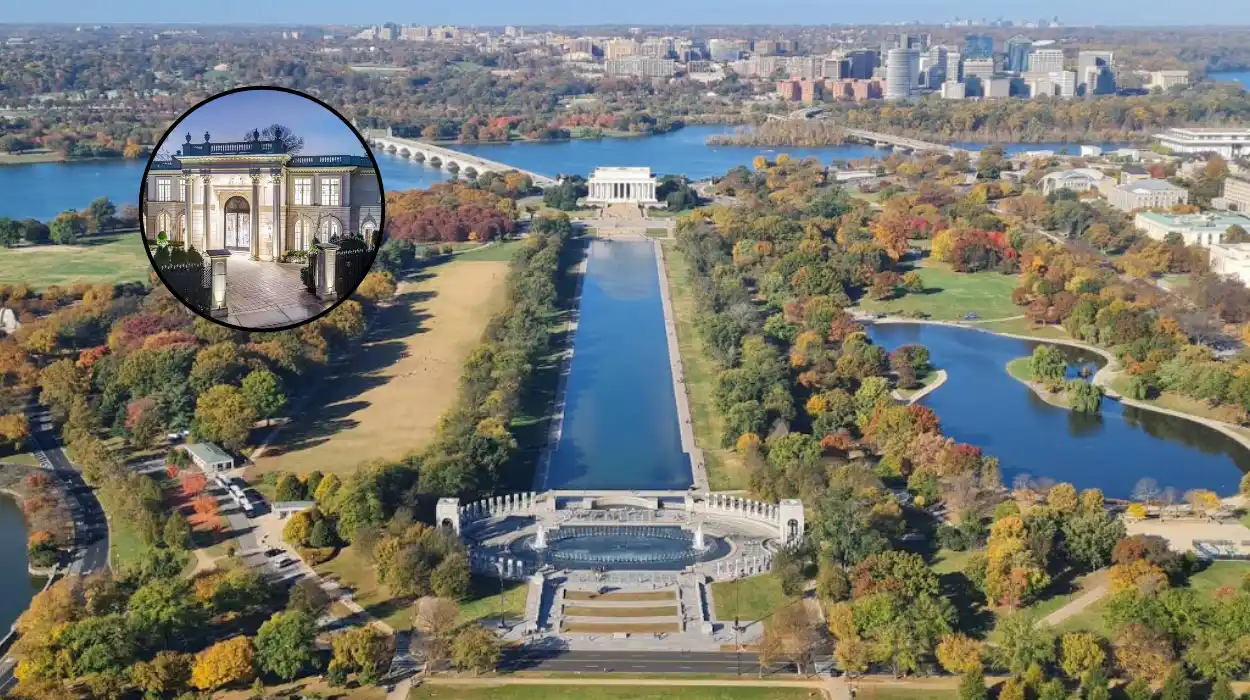
Washington, D.C. (Evening Washington News) May 25, 2026, has revealed rare glimpses into the highly secure and architecturally historic ambassadorial residences lining the streets of the nation’s capital. While American history and foreign policy have traditionally been associated with the public halls of the White House or the State Department, these exclusive residences serve as the true quiet engine rooms of international diplomacy. Behind closed doors, crucial statecraft is routinely executed around private dinner tables, in quiet alcoves, and during highly curated garden parties.
- Key Points
- How Does Italy’s Villa Firenze Blend Tudor Architecture with Contemporary Art?
- What Historic Presidential Artifacts and Original Systems Are Maintained inside Foreign Estates?
- How Does Algeria Use Ceremonial Antiques to Signal Peaceful Diplomacy?
- Why Does the British Ambassador’s Estate Feature a 1,000-Orchid Greenhouse and Warhol Art?
- What Treasures Rest Inside the Libraries and Diplomatic Vaults of Asian Residencies?
- How Does Finland Use Wood, Wool, and High-Security Saunas to Conduct Statecraft?
- Background of Ambassadorial Statecraft in Washington, D.C.
- Prediction: How This Development Affects the Transatlantic and Global Diplomatic Community
As reported by Ted Muldoon of The Washington Post, international diplomats explicitly use these opulent, private spaces to build personal networks, project soft power, and aggressively further their respective national interests away from the public eye.
The deep-dive review covers seven properties, highlighting the interior design, historic preservation, and political utilities of these restricted zones.
How Does Italy’s Villa Firenze Blend Tudor Architecture with Contemporary Art?
According to the documentation compiled by Ted Muldoon of The Washington Post, the Italian ambassadorial residence, known formally as Villa Firenze, presents a unique architectural and aesthetic juxtaposition.
Built originally in 1927, the expansive mansion first belonged to the wealthy American Guggenheim family before being acquired by the Italian government.
Architecturally, the building is constructed in an English Tudor style, meaning there is nothing fundamentally Italian about its exterior layout.
However, the Italian government has strategically transformed the interior into an evolving exhibition of homeland culture. Inside the residence, visitors encounter heavy wooden frames and historic Tudor lines paired with Murano glass chandeliers, marble antiquities, and walls adorned with vibrant, contemporary Italian paintings.
Italian officials, including residence representative Peronaci, note that this distinct contrast between abstract, modern conceptual paintings and the traditional English surroundings provides an engaging aesthetic dialogue that lightens what could otherwise be a heavy wood-framed environment.
Furthermore, the residence boasts one of the very few functioning private antique bowling alleys inside Washington, D.C., which the ambassador regularly utilizes to entertain domestic and international guests in an informal setting.
What Historic Presidential Artifacts and Original Systems Are Maintained inside Foreign Estates?
The investigation by Ted Muldoon of The Washington Post further revealed that many of these properties act as living museums, preserving pieces of American political history that occurred directly within their walls.
In one of the historic residences, the sitting ambassador gestured to a heavily gilded, upholstered armchair situated prominently in the main living room, identifying it explicitly as the favourite chair of former United States President Lyndon B. Johnson.
When questioned about the historical origin and significance of keeping President Johnson’s preferred seating arrangement intact, the ambassador stated that they kept it simply because they “kept everything” associated with past diplomatic eras. This dedication to strict historic preservation extends beyond mere furniture.
The same estate continues to operate an completely original air-conditioning system that dates back to circa 1965, choosing to maintain historical infrastructure rather than modernising the interior spaces.
How Does Algeria Use Ceremonial Antiques to Signal Peaceful Diplomacy?
In his report for The Washington Post, Ted Muldoon detailed a visit to the Algerian ambassadorial residence, which is heavily furnished with regional cultural items, including custom light fixtures, traditional paintings, detailed ceramics, and hand-woven Algerian rugs. The interior design is intended to immediately immerse visitors in the heritage of North Africa.
During the walkthrough, Algerian Ambassador Lounès Boukadoum showcased a collection of antique weaponry housed inside the property’s dedicated tea room. Holding aloft an antique silver sword, Ambassador Boukadoum stated:
“This is a scimitar. Typically Algerian. But we are peaceful now. Just for decoration.”
Brandishing a matching silver dagger alongside the scimitar, Ambassador Boukadoum further clarified to the publication that because it is the house of a active diplomat, the weapons are never used for conflict, serving instead as historic educational talking points to demonstrate the historical evolution of Algerian society to visiting dignitaries.
Why Does the British Ambassador’s Estate Feature a 1,000-Orchid Greenhouse and Warhol Art?
As documented by Ted Muldoon of The Washington Post, the British Ambassador’s estate stands as one of the most prominent and purpose-built diplomatic compounds in Washington, D.C. Constructed in 1930, the towering stone building was explicitly designed by architects to feel deeply familiar to visiting American lawmakers and officials.
To achieve this, the construction incorporated native American materials, including Indiana limestone, Vermont white marble, and Pennsylvanian ribbon slate.
The current occupant, British Ambassador Christian Turner, lives at the massive property with his family and their dog, Tchui. Highlighting the demanding operational schedule required to maintain bilateral relations, Ambassador Turner stated to the publication:
“If I’m not using this house every night of the week, I’m not doing my job.”
The expansive six-acre grounds feature a historic greenhouse that curates roughly 1,000 individual orchids, including one rare botanical specimen that dates directly back to 1842. Inside the ambassador’s private study sits a historic painting of British military commander Bernard Montgomery placed on a display easel.
The home also hosts a highly valuable modern art collection, which includes a rare screen print of Queen Elizabeth II created by iconic American artist Andy Warhol, which was meticulously encrusted with industrial diamond dust.
What Treasures Rest Inside the Libraries and Diplomatic Vaults of Asian Residencies?
The historical reporting from The Washington Post also examined the extensive libraries preserved within D.C.’s older diplomatic quarters, where decades of international policy documents remain completely intact.
Upstairs within one of the major Asian residencies, dark wooden shelves hold books that span multiple generations of diplomatic service, leading up to the late 1970s when newer embassy complexes began to sprout across the city.
Wedged closely between vintage volumes of regional statistics and multi-volume encyclopedias, journalists discovered historical artifacts, including an original personal copy of a book belonging to former US President Harry S. Truman.
These libraries are meticulously maintained to preserve the exact intellectual environment where post-World War II treaties and Cold War strategies were negotiated by past envoys.
How Does Finland Use Wood, Wool, and High-Security Saunas to Conduct Statecraft?
According to the details published by Ted Muldoon of The Washington Post, the Finnish ambassadorial residence leverages authentic Nordic lifestyle elements to forge close ties with American political actors. Finnish Ambassador Leena-Kaisa Mikkola explained that the home relies heavily on natural wood and organic wool elements.
Ambassador Mikkola noted that these are things found in many different homes across Finland, whether in the urban capital area of Helsinki or deep within the forest wilderness of eastern Finland.
Most notably, the Finnish estate features two fully functioning saunas—one reserved specifically for the ambassador’s family and a separate unit designated for embassy staff and guests. In Finnish diplomacy, the sauna is regarded as a critical space for unfiltered, honest political discussions.
The fortunate few individuals who secure an exclusive invite to the embassy’s sauna society are escorted down a secure elevator into a heavily wood-paneled subterranean room.
The lighting inside is intentionally kept dim to encourage participants to follow traditional protocols. In the corner of the room, a heating element is piled high with stones to generate heavy steam.
At the top of the pile rest a handful of custom stones gifted to the embassy over the years. Notably, two of these custom stones are carved into the explicit shape of fighter jets—serving as a permanent, tactile reminder of Finland’s major multi-billion-dollar purchase of Lockheed-Martin F-35 aircraft from the United States defense sector.
Background of Ambassadorial Statecraft in Washington, D.C.
The development of ambassadorial residences as critical hubs of geopolitical influence in Washington, D.C., dates back to the late 19th and early 20th centuries. As the United States transitioned into a global economic and military superpower following the industrial boom and the First World War, foreign nations realized that standard office spaces were insufficient for high-stakes diplomacy.
Foreign governments began purchasing grand estates along Massachusetts Avenue—now famously known as Embassy Row—and surrounding historic neighborhoods like Kalorama and Georgetown.
Historically, these properties were acquired to provide a sovereign sanctuary where foreign emissaries could entertain American presidents, cabinet secretaries, and congressional leaders without the formal constraints of state departments.
Under the terms of the Vienna Convention on Diplomatic Relations, these residences are recognized as sovereign territory of the sending state. This legal status allows foreign nations to curate environments that serve as physical manifestations of their homeland’s culture, technology, and economic prowess.
The preservation of original mid-century infrastructure, presidential artifacts, and historically significant artwork underscores a long-standing tradition: the most enduring international alliances and trade agreements are frequently solidified not through formal communiqués, but through private hospitality and soft-power immersion.
Prediction: How This Development Affects the Transatlantic and Global Diplomatic Community
The public disclosure of the inner workings and symbolic layouts of these high-security residences is expected to trigger a renewed emphasis on “soft-power architecture” within the transatlantic and global diplomatic communities.
As modern statecraft becomes increasingly digitalized and susceptible to cyber-intercepts, high-ranking government officials, intelligence operatives, and foreign policymakers will increasingly pivot back to these secure physical sanctuaries to conduct sensitive negotiations.
For the specific audience of international diplomats, defense contractors, and political strategists stationed in Washington, the reinforcement of these traditional, face-to-face environments—such as Finland’s highly restricted sauna summits or Britain’s continuous nightly dinners—will remain indispensable for securing major bilateral agreements.
We can predict that foreign embassies will step up funding for historic home restorations and cultural curation, using native architecture as a deliberate tool to influence American defense procurement and trade policy. Furthermore, as global tensions necessitate secure, un-interceptable dialogues, these historic estates will see a substantial increase in usage, proving that the future of international geopolitics will continue to be heavily shaped around private dinner tables and restricted alcoves.