Key Points
- Strained Global Alliances: High-level diplomatic dynamics in Washington and internationally are experiencing rapid shifts, specifically highlighting a complex, multi-front peace talk landscape between the United States and Iran amidst ongoing Middle East instability.
- The Lake Lucerne Summit: U.S. Vice President JD Vance led high-stakes, direct negotiations with Iranian officials in Bürgenstock, Switzerland, establishing a “de-confliction cell” for Lebanon despite intense rhetorical friction from President Donald Trump.
- Strait of Hormuz and Nuclear Disputed Terms: Ongoing technical debates remain focused on a 60-day window to formalise the unfreezing of Iranian assets, uranium dilution, and maritime transit access through the vital Strait of Hormuz waterway.
- DNI Nomination Standoff: President Trump’s nomination of U.S. Attorney Jay Clayton to permanently head the Office of the Director of National Intelligence (ODNI) faces political hurdles in the Senate, leaving acting chief Bill Pulte under immense bipartisan scrutiny.
- Reflecting Pool Refurbishment Disruption: President Trump has alleged “vandalism” and corporate sabotage for the deteriorating conditions of Washington’s newly renovated $14.7 million Lincoln Memorial Reflecting Pool, which has suffered from significant algae blooms and peeling paint.
Washington D.C. (Evening Washington News) June 22, 2026 In a sequence of interconnected political and diplomatic developments, the fabric of traditional alliances and domestic administration goals continues to face severe friction. High-level peace talks in Bürgenstock, Switzerland, between U.S. Vice President JD Vance and senior Iranian officials concluded their initial high-level phase early Monday morning, shifting into low-level technical discussions.
- Key Points
- How Are the U.S.-Iran Negotiations Progressing in Switzerland?
- How Did Negotiators Get the Peace Talks Back on Track?
- Why Is Jay Clayton’s DNI Nomination Causing a Congressional Standoff?
- How Has Capital Hill Responded to Jay Clayton?
- What Is Causing the Disruption at the Lincoln Memorial Reflecting Pool?
- Who Is Being Blamed for the Damaged Infrastructure?
- Background of the Particular Development
- Prediction on How This Development Can Affect the Audience
The summit, heavily mediated by Qatari and Pakistani diplomats, resulted in an agreement to establish a joint “de-confliction cell” aimed at curtailing the ongoing conflict between Israel and the Iran-backed Hezbollah group in Lebanon. However, the diplomatic progress remains exceptionally fragile following a series of conflicting military threats from Washington and retaliatory declarations from Tehran regarding the transit status of the vital Strait of Hormuz shipping corridor.
Simultaneously, the domestic political landscape in Washington remains strained as President Donald J. Trump’s nomination of Jay Clayton—the current U.S. Attorney for the Southern District of New York—to become the permanent Director of National Intelligence (DNI) remains stalled in legislative limbo.
The delay has prolonged a volatile congressional standoff surrounding the current acting intelligence chief, Bill Pulte, whose total lack of intelligence experience has prompted bipartisan threats to block the renewal of crucial foreign intelligence powers under Section 702 of the Foreign Intelligence Surveillance Act (FISA). Adding to the domestic complications, President Trump has publicly blamed coordinated “vandalism” and chemical sabotage for the physical deterioration of the newly unveiled $14.7 million Lincoln Memorial Reflecting Pool makeover, which has transformed from its intended “American flag blue” into a murky green algae bloom with rapidly peeling industrial lining.
How Are the U.S.-Iran Negotiations Progressing in Switzerland?
As reported by Caitlin Huey-Burns of CBS News and correspondents from Reuters, the high-stakes diplomatic summit near Lake Lucerne brought U.S. Vice President JD Vance face-to-face with Iran’s parliamentary speaker, Mohammad Bagher Ghalibaf, and Foreign Minister Abbas Araghchi.
The baseline for these deliberations rests upon a 14-point Memorandum of Understanding (MoU) signed on June 17, 2026, by President Trump and Iranian President Masoud Pezeshkian, which established a temporary 60-day window to turn a shaky ceasefire into a permanent end to their multi-month war.
The sessions proved highly tense from the outset. According to reports from the Financial Times, the Iranian delegation initially refused to participate in a joint photo opportunity with American officials, entering the negotiating chamber 15 minutes late and only after members of the press corps were dismissed. Extreme friction developed when President Trump issued standard unilateral warnings from Washington via social media. Writing on his Truth Social platform, President Trump stated:
“Iran must immediately stop their highly paid PROXIES in Lebanon from causing trouble. If they don’t, we’ll hit Iran very hard again, just like we did last week, only harder!!!”
According to Iran’s semi-official Tasnim News Agency, this specific digital statement prompted the Iranian delegation to temporarily walk out of the venue in protest.
How Did Negotiators Get the Peace Talks Back on Track?
Despite the dramatic disruption, Vice President Vance and international mediators successfully drew the parties back to the table, continuing the direct talks until well past one o’clock in the morning.
Speaking to traveling reporters prior to his departure back to Washington, Vice President Vance minimized the impact of the external rhetoric, asserting that Trump’s remarks did not “throw a wrench in the system.” Vance stated:
“The technical negotiations may not solve every disagreement, but they will allow us to sit together as teams for the first time in history. The question before us now is how much more can we accomplish together? Can we turn over a new leaf? Can we change relations in the Middle East permanently, or do we go back to doing things the old way?”
According to a joint communique issued by Pakistani and Qatari mediators, the most concrete achievement of the summit was the creation of a formalized “de-confliction cell.”
This specific mechanism is designed to include representatives from the Lebanese government to track ceasefire violations and ensure the formal termination of military operations in southern Lebanon.
Why Is Jay Clayton’s DNI Nomination Causing a Congressional Standoff?
In Washington, the leadership structure of the nation’s spy apparatus remains highly unstable. As reported by TIME magazine, President Trump’s sudden nomination of Jay Clayton to lead the Office of the Director of National Intelligence was intended to pacify intense political blowback.
The position became vacant following the sudden resignation of Tulsi Gabbard, after which Trump appointed Bill Pulte—the current head of the Federal Housing Finance Agency and a staunch loyalist—as the acting national intelligence chief.
Because Pulte possesses virtually no background in state intelligence or national security affairs, his presence has created an absolute impasse in Congress. Senate Democratic Leader Chuck Schumer told reporters explicitly:
“Pulte has got to go. The DNI role is too important for him to be there. He has got to go, period. No matter what else they do.”
Democratic Senator Mark Warner of Virginia, the vice chair of the Senate Intelligence Committee, cautioned that the Senate would flatly refuse to extend the expiring foreign intelligence powers under Section 702 of FISA until Pulte is removed from the post.
How Has Capital Hill Responded to Jay Clayton?
In contrast to the hostility surrounding Pulte, Clayton’s nomination has drawn substantial bipartisan praise, yet his confirmation remains slow-moving.
Clayton previously served as the Chairman of the Securities and Exchange Commission (SEC) during Trump’s first term and has been serving as the U.S. Attorney for the Southern District of New York since April 2025.
Republican lawmakers have unified in their support of Clayton. In a public statement on X, Senator Lindsey Graham of South Carolina stated:
“Outstanding choice by President Trump to nominate Jay Clayton to be the new Director of National Intelligence. He has real-world experience, the complete confidence of the President and has performed every task in the public and private sectors in an exemplary manner.”
Similarly, Senator James Lankford of Oklahoma highlighted Clayton’s prior 61-37 confirmation success in 2017, praising his extensive legal management background in prosecuting international cartels and corporate threats.
Nonetheless, until the Senate Intelligence Committee completes its formal hearings, the oversight of the American intelligence apparatus remains divided between an embattled acting director and a permanent nominee stuck in legislative confirmation channels.
What Is Causing the Disruption at the Lincoln Memorial Reflecting Pool?
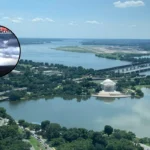
Closer to the White House, the physical infrastructure of the nation’s capital has become an unexpected venue for intense political recrimination. As documented by Anna Betts of The Guardian, President Trump’s highly publicized initiative to refurbish the 610-metre-long Lincoln Memorial Reflecting Pool has faced significant technical failure.
The project, completed on June 6, 2026, at an estimated cost of $14.7 million, utilized an experimental no-bid contracting process to line the basin with a specialized coating designed to make the water appear “American flag blue.”
However, within days of being refilled, the water rapidly transformed into a thick, swampy green hue.
When National Park Service employees attempted to remedy the bloom by dumping massive quantities of hydrogen peroxide into the basin, the chemical interaction caused the newly applied blue paint to blister, flake off, and float to the surface in large sheets.
According to scientific testing commissioned by The Atlantic and evaluated by Dr. Hans Paerl, a professor of marine and environmental sciences at the University of North Carolina at Chapel Hill, the chemical treatments inadvertently wiped out basic blue-green algae only to inspire an aggressive genus of green algae known as Scenedesmus to rapidly take over the ecosystem.
Who Is Being Blamed for the Damaged Infrastructure?
Rather than attributing the issue to subpar contractor application or ecological factors, President Trump issued an extensive statement on Truth Social blaming systematic, malicious sabotage. Without providing empirical evidence, Trump stated:
“We’ve had some real problems with Vandalism at the beautiful Reflecting Pool. They used something similar to the chemicals that were used on the National Mall to try to destroy and demean our beautiful work. Terrible vandals took some form of knife or blade to put a 250-foot long gash into it.”
The President further noted that the numbers “86 47″—a common restaurant slang term for elimination, paired with his designation as the 47th president—had been etched into the adjacent grass turf.
The resulting security crackdown led to the controversial arrest of 67-year-old David Hearn, a former Olympic canoe racer and watercraft composite company owner.
In an interview with The Associated Press, Hearn explained that he was merely on an 84-kilometre bicycle ride and paused out of civic curiosity to inspect the peeling material. Hearn stated:
“I didn’t destroy or break or peel anything. By the time I realized what was going on, I was being put in handcuffs. I reached down to see what it felt like. It was very rubbery. I was able to grab the end of that flapping piece, the already peeling piece. It was still attached to the bottom. I didn’t remove anything.”
Hearn was subsequently detained by National Guard troops and U.S. Park Police officers for five hours on a misdemeanor charge of destruction of government property.
President Trump has since announced that the federal government will “probably” be forced to fully drain the massive structure once again to execute comprehensive repairs.
Background of the Particular Development
The rapid fraying of alliances and administrative complications observed in June 2026 is the direct culmination of a highly unconventional foreign and domestic policy agenda instituted over the preceding twelve months. The broader geopolitical crisis traces its origins to late February 2026, when a series of localized military exchanges escalated into a hot war involving the United States, Israel, and Iran.
This conflict resulted in heavy U.S. air strikes targeting Iranian nuclear enrichment facilities and domestic infrastructure, followed by a retaliatory naval blockade and threats to permanently seal the Strait of Hormuz—a maritime choke point responsible for the transit of roughly 20 percent of the world’s petroleum consumption.
The economic fallout from this conflict forced international allies, particularly in Europe and the Asia-Pacific region, to grapple with immense energy price shocks and supply chain disruptions.
In response, a rising non-interventionist faction within the Republican Party, prominently championed by Vice President JD Vance, increasingly pushed the executive branch away from prolonged military engagement and toward a pragmatic, transactional diplomatic exit strategy.
This internal ideological shift culminated in the temporary April 8 ceasefire signed in Islamabad, Pakistan, and the subsequent June 17 Memorandum of Understanding.
This diplomatic pivot has alienated traditional hawkish conservative allies in Washington and caused deep anxiety within the Israeli government, which views any unilateral U.S. diplomatic normalization with Tehran as a direct threat to its independent security operations against Hezbollah forces in Lebanon.
Domestically, this preference for personal diplomacy and rapid institutional transformation has fundamentally disrupted traditional administrative governance structures.
The appointment of political loyalists with limited specialized background to elite cabinet and sub-cabinet positions—such as Bill Pulte to the ODNI—reflects a deliberate executive strategy to bypass established institutional bureaucracies, commonly referred to as the “deep state.”
This approach has provoked an unprecedented constitutional pushback from both Democratic and institutionalist Republican lawmakers, who are utilizing legislative levers, such as withholding the statutory reauthorization of critical intelligence gathering mechanisms like FISA Section 702, to force a return to conventional appointments. Similarly, the use of expedited, no-bid federal procurement tracks for symbolic municipal makeovers in Washington, D.C.—including the controversial architectural alterations to the Lincoln Memorial Reflecting Pool and the planned demolition of the White House East Wing—reflects a parallel effort to visually rebrand the federal capital, frequently placing aesthetic or political goals in direct conflict with established local environmental, legal, and engineering standards.
Prediction on How This Development Can Affect the Audience
The ongoing friction within global alliances and the domestic intelligence apparatus is poised to directly impact international security analysts, commercial maritime operators, and global commodity traders. If the technical negotiations currently underway in Switzerland fail to solidify the temporary provisions of the June 17 Memorandum of Understanding before the 60-day window expires, the immediate resumption of hostilities between the United States and Iran is highly probable.
For global shipping firms and energy markets, this would trigger an immediate escalation in maritime insurance premiums and volatile fluctuations in Brent Crude prices, as Iran would likely attempt to enforce a permanent closure or implement aggressive transit tolls within the Strait of Hormuz.
Furthermore, the establishment of the “de-confliction cell” in Lebanon, while bypassing direct Israeli signatures, means that any sudden tactical escalation between Israel and Hezbollah will instantly collapse the fragile Swiss framework, thrusting international corporate entities into a highly unpredictable secondary sanctions environment.
On the domestic front, the ongoing political stalemate over the leadership of the Office of the Director of National Intelligence poses an immediate risk to national security professionals and defense contractors relying on stable federal surveillance authorizations.
Should the June 2026 legislative deadline pass without a resolution to the Bill Pulte standoff, the lapse of FISA Section 702 will legally blind American intelligence agencies to a significant portion of foreign electronic communications.
This operational gap would severely degrade the real-time threat-detection capabilities of the homeland security apparatus, directly affecting counter-terrorism operations and corporate cybersecurity defenses against foreign state-sponsored digital incursions. Finally, the domestic fallout from the localized “vandalism” crackdowns and infrastructural failures within Washington indicates an increasingly hostile domestic political climate.
Citizens and visitors in the capital can expect intensified militarization of public spaces, heightened surveillance by the National Guard and U.S. Park Police, and extended disruptions to iconic national historic sites as the administration prioritizes aggressive legal and physical remediation measures to protect its capital development initiatives.