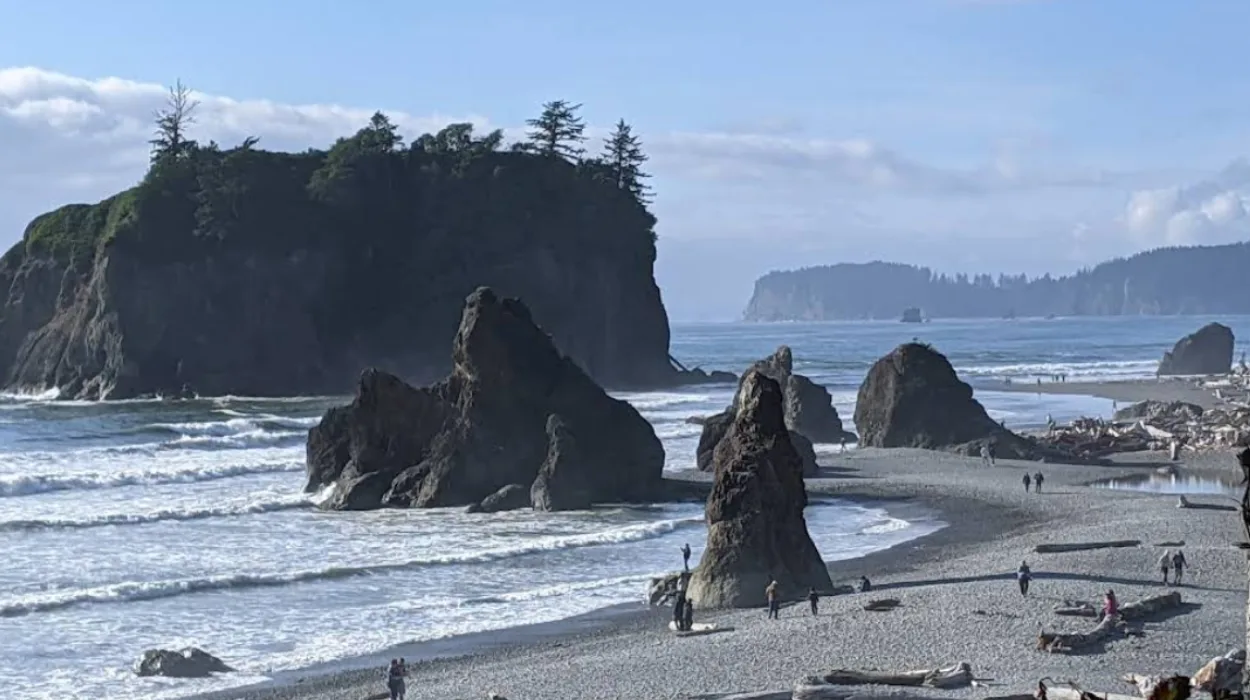
Ruby Beach is a coastal geographic feature located within the Kalaloch sub-district of Olympic National Park in Jefferson County, Washington. It sits at geographical coordinates 47°42′39″N 124°24′56″W, approximately 27 miles south of the city of Forks.
- Why is it called Ruby Beach?
- How did the geological features of Ruby Beach form?
- What makes Ruby Beach the best sunset viewing spot on the Olympic Coast?
- How do ocean tides impact the sunset experience at Ruby Beach?
- What marine wildlife can you observe at Ruby Beach during sunset?
- How do you safely access and navigate Ruby Beach?
- What are the best photography practices for capturing a Ruby Beach sunset?
- How does the local climate affect evening visits to Ruby Beach?
- What environmental regulations protect Ruby Beach?
The beach represents a highly dynamic marine ecosystem managed by the National Park Service. It forms the northernmost boundary of the southern coastal strip accessible directly via U.S. Route 101. The geographic entity is defined by its dramatic geological formations, high concentrations of marine driftwood, and a unique substrate composition that shifts between coarse sand, pebbles, and polished cobbles.
The site serves as a vital sanctuary for intertidal organisms and coastal avian populations, drawing hundreds of thousands of recreational visitors annually. The beach faces directly west into the Pacific Ocean, making it a critical baseline zone for monitoring coastal erosion, sea-level changes, and Pacific Northwest maritime weather patterns.
Why is it called Ruby Beach?
The name Ruby Beach originates from the presence of small, red mineral grains embedded within the coastal sand. These minerals are almandite garnets, which accumulate in dense, dark-pink patches along the shoreline due to the natural sorting action of ocean waves.
Almandite garnet is a specific type of iron-aluminum silicate mineral that exhibits a distinctive deep-red or purplish color. Geologically, these crystals serve as an indicator of high-pressure metamorphic environments. The precise geological origin of these garnets remains a subject of ongoing research by the Washington Department of Natural Resources.
The primary scientific consensus indicates that the minerals were transported southward from metamorphic complexes in British Columbia, Canada, via continental glaciers during the Last Glacial Maximum, approximately 20,000 years ago. As the glaciers melted, they left behind massive deposits of glacial till along the Olympic Peninsula. Ongoing marine erosion undercuts these coastal bluffs, releasing the dense garnet grains onto the shoreline. Because almandite garnets have a higher specific gravity than standard quartz sand, wave backwash washes away the lighter minerals while leaving the heavy, ruby-colored crystals concentrated on the beach surface.
How did the geological features of Ruby Beach form?
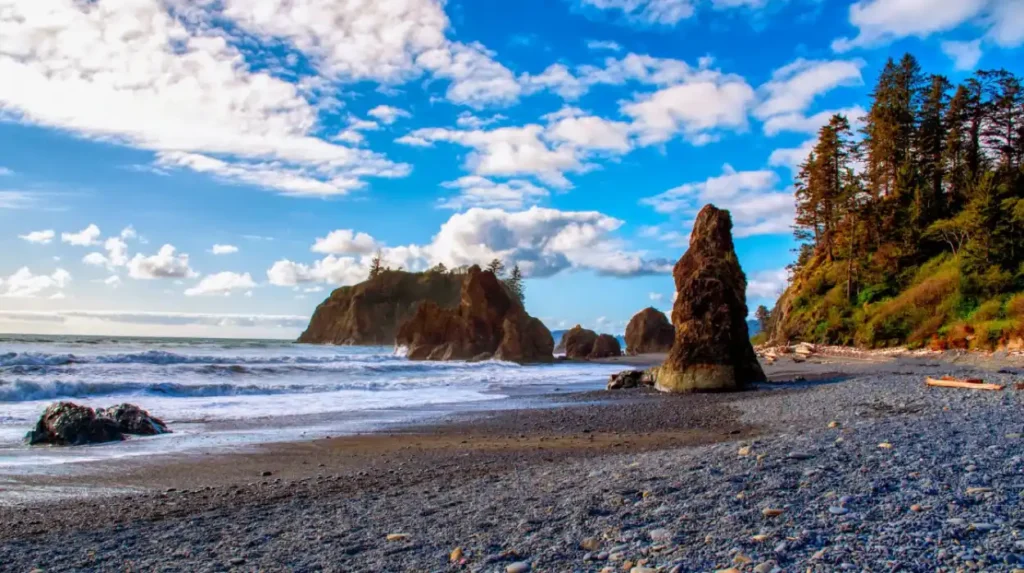
The unique landforms at Ruby Beach formed through millions of years of tectonic uplift, glacial deposition, and relentless marine erosion. The coastal landscape is shaped by the active convergent margin where the Juan de Fuca Plate subducts beneath the North American Plate.
This continuous tectonic compression forces the Olympic Peninsula upward, gradually elevating the coastline. The sea stacks, which are large isolated pillars of rock standing in the ocean, were originally part of the mainland cliffs. These structures are composed of resistant sedimentary rock types, specifically marine sandstone and conglomerate matrices.
The mechanism of sea stack formation follows a strict chronological sequence:
- Marine waves continuously strike the base of a coastal headland, targeting structural weaknesses such as faults, fractures, and joints.
- Hydraulic action and abrasion excavate the rock, forming sea caves on opposite sides of a headland.
- Over centuries, these caves deepen until they join, creating a structural sea arch.
- Ongoing weathering weakens the roof of the arch until it collapses under its own weight, leaving an isolated vertical pillar known as a sea stack.
Abbey Island, located just north of the main beach access point, represents an advanced stage of this process. It is a massive wave-cut platform that remains connected to the beach during low tides but becomes isolated as an island during high tides.
What makes Ruby Beach the best sunset viewing spot on the Olympic Coast?
Ruby Beach provides premium conditions for sunset viewing due to its unobstructed western horizon, its vast network of reflective tidal surfaces, and the dramatic silhouette framing provided by its high density of offshore sea stacks and marine driftwood.
Atmospheric conditions along the Pacific Northwest coast combine with the local topography to create highly complex light scattering during twilight hours. Because the beach faces the open Pacific Ocean without any intervening landmasses, the setting sun drops directly to the sea level horizon. This geometry maximizes the duration of the golden hour and twilight periods.
The presence of offshore sea stacks introduces physical verticality into the composition of the landscape. As the sun descends, these massive rock towers cast elongated shadows across the water and block portions of the direct sunlight, creating stark visual contrasts.
The physical mechanics of the beach surface enhance the distribution of light through two distinct environments:
- The Intertidal Zone: During low tides, the receding water leaves behind saturated, flat sandy plains and shallow tide pools. These surfaces act as natural mirrors, reflecting the ambient sky colours across the horizontal axis of the beach.
- The Driftwood Matrix: The upper boundary of the beach is lined with large logs of western red cedar and Sitka spruce. These weathered wooden structures capture low-angle light, casting complex shadow patterns and adding structural depth to the foreground.
How do ocean tides impact the sunset experience at Ruby Beach?
Ocean tides directly dictate the physical space available to visitors and alter the optical reflectivity of the landscape during sunset. The daily tidal cycle on the Washington coast shifts between two high tides and two low tides.
The vertical tidal range along the Olympic Peninsula frequently exceeds 2.7 metres within a single 6-hour cycle. When sunset coincides with a high tide, the incoming Pacific Ocean advances to the base of the upper driftwood wall, significantly narrowing the traversable beach. This restriction limits visitors to the upper gravel bars and eliminates access to the intertidal viewing zones. High water submerges the low-lying rocks, reducing the reflective surface area and stopping visitors from walking outward toward the sea stacks.
Conversely, when sunset coincides with a low tide, the receding water exposes hundreds of metres of level, saturated sand plains. This exposure creates a massive reflective field that duplicates the sky patterns on the ground. Low tide uncovers the bases of the sea stacks, allowing viewers to walk completely around formations that are entirely surrounded by deep water earlier in the day. It also exposes localized tide pools, which trap calm bodies of water that reflect the transition of sunset colours without the disruption of breaking ocean waves.
What marine wildlife can you observe at Ruby Beach during sunset?
The intertidal zones and offshore islands of Ruby Beach host diverse populations of marine invertebrates, mammals, and birds. These species become highly active during the low-light transitions of twilight and the changing of the tides.
The exposed rocky surfaces of the sea stacks support a complex vertical zonation of intertidal invertebrates. These organisms have developed specialized adaptations to survive continuous wave impact and daily exposure to the air.
The primary intertidal species include:
- Ochre Sea Stars (Pisaster ochraceus): Massive carnivorous invertebrates that display bright orange and deep purple transport pigments. They use hundreds of tube feet to anchor themselves firmly into rocky crevices.
- Aggregating Anemones (Anthopleura elegantissima): Soft-bodied predatory animals that open their green tentacles to capture drifting organic matter when submerged, but contract into small, sand-covered nodules to retain moisture during low tide.
- Gooseneck Barnacles (Pollicipes polymerus): Filter-feeding crustaceans that attach to wave-swept rocks via thick, fleshy stalks, forming dense colonies alongside California mussels.
Avian populations utilize the offshore sea stacks as protected nesting colonies. The islands are part of the Quillayute Needles National Wildlife Refuge, which protects critical habitat for species such as the tufted puffin, the glaucous-winged gull, and the common murre. During sunset, these birds return to their roosts in large numbers, flying in formations across the horizon. Marine mammals, including harbor seals (Phoca vitulina) and sea otters (Enhydra lutris), can also be observed navigating the kelp forests just beyond the breaking surf, using the calm waters behind the sea stacks to rest.
How do you safely access and navigate Ruby Beach?
Accessing Ruby Beach requires traversing a designated trail that descends 24 metres from the cliff-side parking lot to the shore. Safe navigation requires careful foot placement across a shifting barrier of marine driftwood and wet stones.
The access route begins at the main parking area off U.S. Route 101, which features vault toilets and informational displays managed by the National Park Service. The trail is approximately 0.4 kilometres long and features a graded, mostly paved surface that winds through a dense coastal forest of sitka spruce. As the trail approaches the shoreline, the pavement ends, transitioning into an unpaved path composed of loose gravel, soil, and exposed tree roots that can become slippery during frequent coastal rain events.
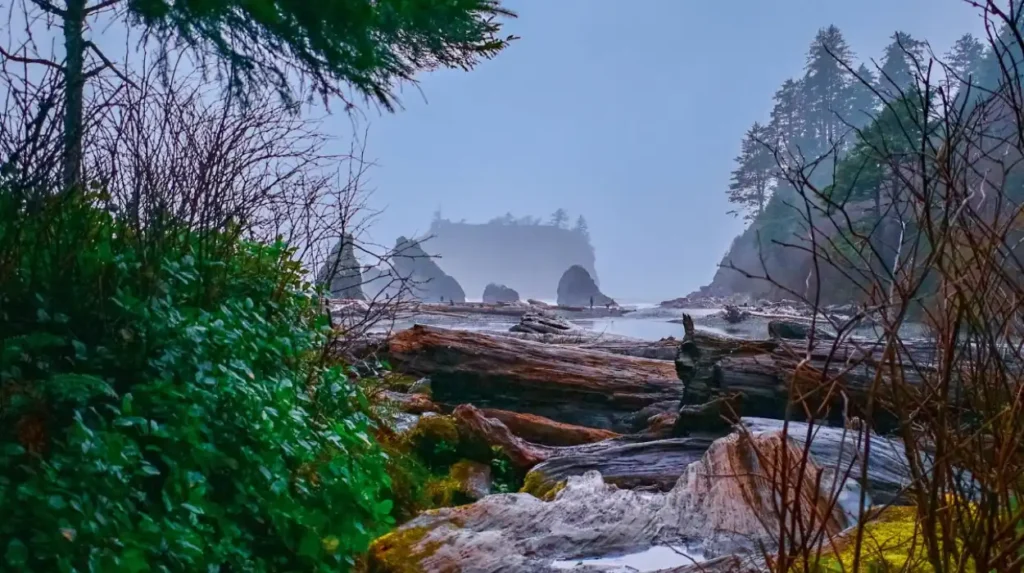
Upon reaching the foot of the trail, visitors must navigate a massive, continuous wall of driftwood logs that blocks direct access to the sandy shoreline. This driftwood accumulation is a natural feature of the Olympic Coast, consisting of old-growth trees washed down local river systems. Crossing this zone requires stepping over and between logs that may shift unexpectedly under human weight. These logs are frequently wet and covered in algae, increasing the risk of slips and falls.
Once past the driftwood barrier, navigation requires continuous awareness of the incoming tide to prevent getting stranded against the cliffs or isolated on sea stacks by rising waters.
What are the best photography practices for capturing a Ruby Beach sunset?
Capturing the sunset at Ruby Beach requires specific equipment and techniques to manage the extreme dynamic range between bright skies and dark rock formations. Professional photographers rely on stabilization tools and exposure control to capture the landscape.
The severe contrast between the setting sun and the dark sandstone sea stacks frequently exceeds the dynamic range capabilities of standard digital sensors. To balance this exposure, photographers utilize neutral density filters, which are optical glass elements placed over the camera lens to reduce light transmission. Graduated neutral density filters feature a dark upper half that reduces the brightness of the sky while leaving the lower portion clear to properly expose the darker beach foreground.
The table below outlines the optimal equipment configurations and camera settings for capturing different visual elements during a Ruby Beach sunset:
| Visual Objective | Required Equipment | Recommended Camera Settings |
| Silky Water & Smooth Waves | Heavy-duty tripod, 10-stop solid neutral density filter, electronic shutter release. | Shutter speed: 2 to 30 seconds, Aperture: f/11, ISO: 100. |
| Sharp Sea Stack Silhouettes | Standard tripod, wide-angle lens (14-24mm). | Shutter speed: 1/125 second, Aperture: f/8, ISO: 200 (Spot meter on the sky). |
| Intertidal Macro Detail | Circular polarising filter, macro lens or close-focus wide lens. | Shutter speed: 1/60 second, Aperture: f/4, ISO: 400 (Adjusted for moving water). |
Utilising a circular polarising filter is essential for controlling reflections on the surface of tide pools and wet sand. By rotating the filter, photographers can eliminate unwanted glare, exposing the rich colours of the underlying rocks, anemones, and garnets. Long-exposure photography transforms the turbulent Pacific surf into a soft, ethereal mist, contrasting with the hard, geometric lines of the sea stacks.
How does the local climate affect evening visits to Ruby Beach?
The coastal strip of Olympic National Park features a temperate oceanic climate, designated as Cfb under the Köppen climate classification system. This climate produces cool, damp, and unpredictable weather conditions that intensify during evening hours.
The region receives an average of 2,000 to 3,000 millimetres of precipitation annually, driven by moisture-laden air masses originating over the Pacific Ocean. As these marine winds hit the Olympic Peninsula, they lift and cool, generating frequent rain, drizzle, and dense marine fog. Evening temperatures at Ruby Beach remain low throughout the year, with summer nighttime averages ranging from 10°C to 13°C, and winter evening temperatures dropping between 2°C and 5°C.
Marine fog is a critical climatic factor that can rapidly alter visibility before sunset. Advection fog forms when warm, moist air moves over the colder waters of the California Current just offshore. This fog can move inland within minutes, completely obscuring the sun, the sea stacks, and the horizon.
Even on clear summer afternoons, onshore winds intensify significantly as the sun sets. This wind-chill effect lowers the ambient temperature felt by visitors, requiring wind-resistant, layered clothing and waterproof outerwear to maintain thermal safety during an extended evening visit.
What environmental regulations protect Ruby Beach?
Ruby Beach is protected by strict federal regulations enforced by the National Park Service and the National Oceanic and Atmospheric Administration. These laws preserve the ecological integrity of the intertidal zones and maritime wildlife habitats.
The beach operates under a strict “Leave No Trace” framework, codified under Title 36 of the Code of Federal Regulations. Because the shoreline is a delicate habitat, specific restrictions apply to all human activities within the zone.
The primary regulatory mandates include:
- The Marine Mammal Protection Act: It is illegal to approach, disturb, or feed marine mammals, including harbor seals that haul out on the sand or sea otters resting in the kelp beds. Visitors must maintain a minimum distance of 30 metres from these animals.
- Wildlife Refuge Boundaries: The offshore sea stacks are part of the Quillayute Needles National Wildlife Refuge. To protect nesting seabirds, climbing on any sea stack or island located above the high-water mark is strictly prohibited.
- Resource Preservation: It is illegal to collect, damage, or remove any natural resources from the beach. This prohibition covers the collection of almandite garnet sand, agates, jasper stones, marine shells, and driftwood logs.
- Pet Restrictions: While leashed dogs are permitted on Ruby Beach, they must be kept on a physical leash no longer than 1.8 metres at all times to prevent the harassment of native wildlife and shorebirds.
Compliance with these legal frameworks ensures that the high volume of annual tourism does not degrade the structural or biological components of this pristine coastal environment.
Where is Ruby Beach located?
Ruby Beach is located within Olympic National Park on the Olympic Peninsula in Jefferson County, Washington, approximately 27 miles south of Forks along U.S. Route 101.