Washington, DC’s Metro system is the fastest way for tourists to move between major neighborhoods, airports, and many key sights in the capital region. It uses a color-coded rail network operated by the Washington Metropolitan Area Transit Authority (WMATA), with SmarTrip as the main payment system and service that began in 1976.
- What is the DC Metro system?
- How does the DC Metro work?
- What do tourists need to pay?
- What should tourists know before boarding?
- Which Metro lines should tourists use?
- Which station works best for sightseeing?
- How do you use SmarTrip?
- What pass should a visitor buy?
- How do you read DC Metro stations?
- Why are transfer stations important?
- What Metro etiquette should tourists follow?
- What should you avoid doing?
- How do tourists reach the main attractions?
- Which trip patterns work best?
- Why does the DC Metro matter for tourists?
- What should visitors remember first?
What is the DC Metro system?
The DC Metro is Washington, DC’s regional rapid transit system, operated by WMATA, with rail and bus service across DC, Maryland, and Virginia. It began rail service in 1976, connects the capital region through color-coded lines, and gives visitors a direct way to reach central districts, airports, and suburbs.
The full agency name is the Washington Metropolitan Area Transit Authority, or WMATA. It was created by an interstate compact in 1967 to plan, build, finance, and operate transportation in the national capital area. Metrorail opened in phases, with the first phase starting in 1976, and the system grew into a core part of daily travel for residents and visitors alike.
For tourists, the Metro matters because it reduces the need to drive in a dense city with expensive parking and heavy traffic. It also links the District with nearby Virginia and Maryland, so it works for hotel stays, airport transfers, museum visits, and neighborhood dining trips.
How does the DC Metro work?
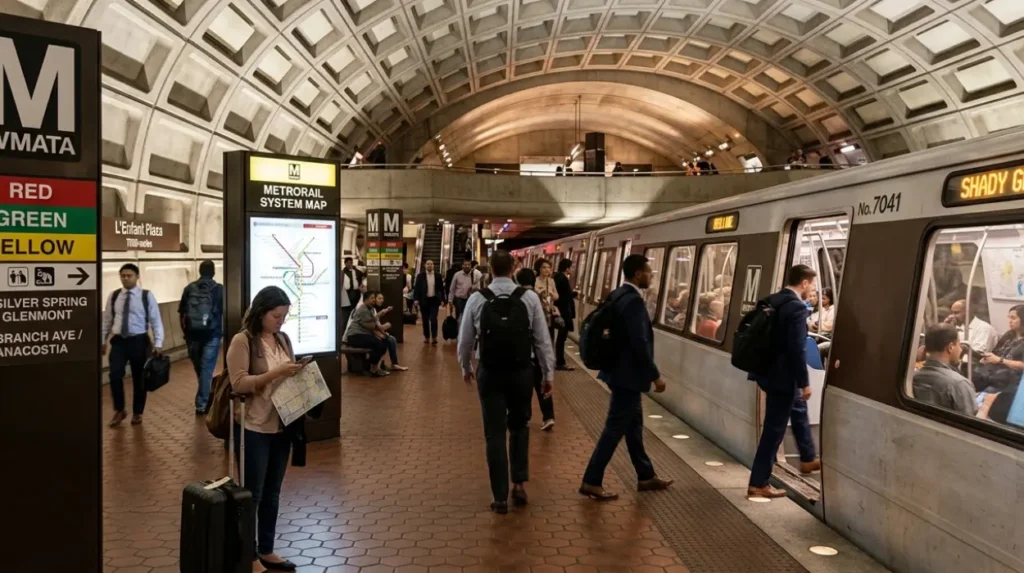
The DC Metro works through a fare-paid rail system with station gates, color-coded lines, timed transfers, and station signage that makes route planning simple. Riders tap in with SmarTrip, follow line and direction signs, and tap out at their destination to pay the correct fare.
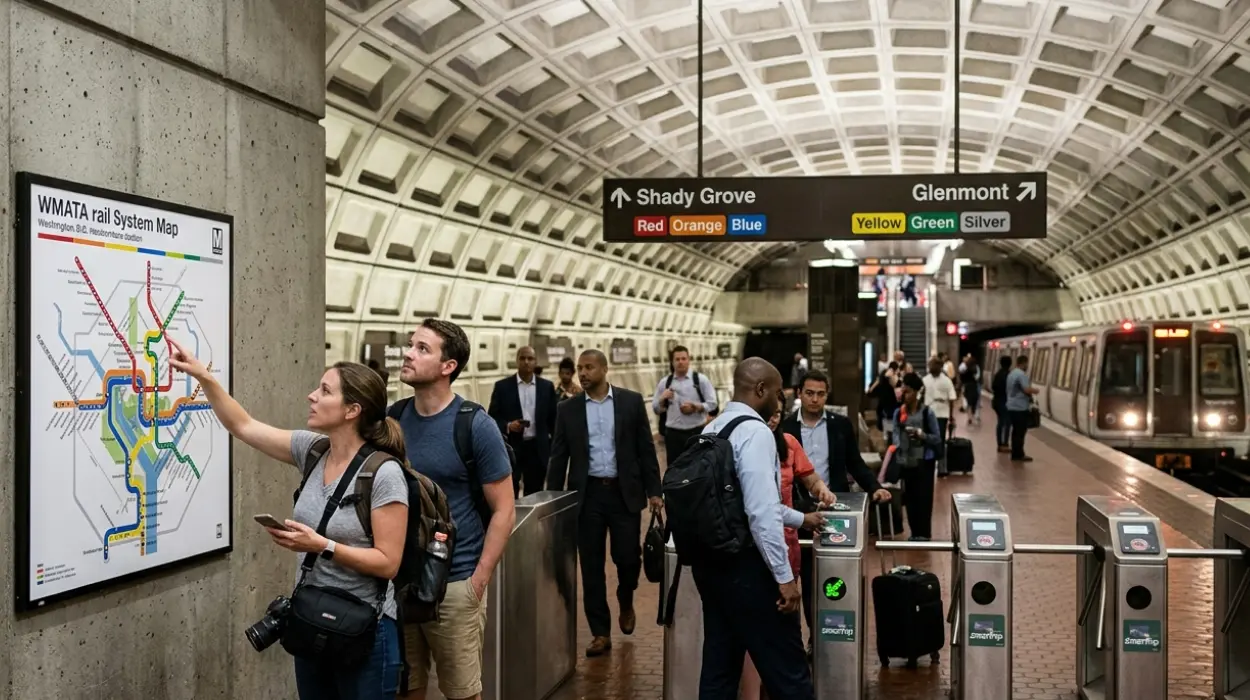
The rail network uses six color-coded lines: Red, Orange, Blue, Yellow, Green, and Silver. WMATA lists dozens of stations across the region, including stops in downtown DC, Arlington, Alexandria, Montgomery County, Prince George’s County, and farther suburbs in Virginia and Maryland. The system’s layout helps tourists understand that the line color matters more than the train name.
Metro’s structure also includes line interconnections that let riders transfer between services at major hubs. That matters for sightseeing because the best station for one landmark is often not the final destination for the whole trip, but a transfer point near a walkable corridor or a shuttle connection.
What do tourists need to pay?
Tourists normally use a SmarTrip card or mobile SmarTrip for rail and bus fares. WMATA’s published pass options include 1-day unlimited, 3-day unlimited, 7-day unlimited, and a 7-day short-trip pass, and the rail fare range varies by time of day and distance.
WMATA lists weekday rail fares from $2.25 to $6.75 during the main day period and lower fares after 9:30 p.m., with regular bus fares at $2.25 and express bus fares at $4.80. The agency also publishes transfer discounts, including free bus-to-bus transfers within two hours and discounted rail-to-bus transfers with SmarTrip.
The practical rule for tourists is simple: load enough value before you enter the station, then keep your card or mobile payment ready at the fare gate. That saves time, reduces confusion, and avoids holding up the line during busy periods.
What should tourists know before boarding?
Tourists should check train direction, line color, platform signs, and final destination before boarding. Metro trains run on published schedules, and service varies by day and time, with weekday service generally starting at 5 a.m. and weekend opening later.
WMATA publishes operating windows that include Monday through Thursday service from 5 a.m. to midnight, Friday until 2 a.m., Saturday from 6 a.m. to 2 a.m., and Sunday from 6 a.m. to midnight. Those hours matter for dinner plans, late museum exits, and airport trips.
Stations also have staff support, and WMATA encourages riders to ask for help when needed. That is useful for first-time visitors who need to confirm the correct platform, fare, or exit for a specific monument or hotel.
Which Metro lines should tourists use?
Tourists use the Red, Blue, Orange, Silver, Yellow, and Green lines to reach central Washington, airport connections, and popular neighborhoods. The most useful lines for visitors are usually the Blue, Orange, Silver, and Yellow lines for downtown access, plus the Red Line for major city corridors and transfers.
The Red Line is the system’s main north-south backbone through central DC and into Maryland. The Blue, Orange, and Silver lines are especially useful for reaching downtown, the National Mall area, Arlington, Alexandria, and east-west travel across the core region. The Yellow and Green lines connect important neighborhoods and transfer stations that help visitors move between attractions.
For tourists, the line choice usually depends on the hotel location and the landmark being visited. A hotel near a major station lowers travel time and makes it easier to reach museums, business districts, stadiums, and dining areas without using a car.
Which station works best for sightseeing?
Station choice depends on the itinerary, but central stations near the National Mall, downtown, and major transfer points offer the easiest tourist routing. WMATA’s station network includes dozens of key stops in DC, Arlington, and nearby Maryland and Virginia communities.
The National Mall sits between several Metro stations rather than on top of one station, so visitors often combine Metro with walking. That means the best station is the one closest to the first stop on your route, not necessarily the one that puts you at the exact monument door.
For airport arrival, Ronald Reagan Washington National Airport is the simplest because it has its own Metro stop on the Blue and Yellow lines. Washington Dulles International Airport is also accessible by Metro through the Silver Line extension, which gives tourists a rail link from the airport into the city.
How do you use SmarTrip?
SmarTrip is WMATA’s contactless payment system for Metro rail, Metrobus, parking, and some regional transit partners. Riders tap in and out on rail, and tap once on buses, using either a plastic SmarTrip card or contactless mobile payment.
WMATA says SmarTrip works as one payment method for rail, bus, and parking, and it supports contactless payments on smartphones and watches. The system also offers Auto Reload and balance protection for registered cards, which is useful for frequent visitors and longer stays.
For tourists, the main advantage is speed. You do not need exact cash, and you do not need to decode separate fare media for each trip. You just need enough stored value or the right pass for the length of your visit.
What pass should a visitor buy?
The right pass depends on trip length and how often Metro will be used. WMATA lists 1-day, 3-day, 7-day, and 7-day short-trip pass options, which fit short city breaks and longer sightseeing stays.
A visitor who plans several rides per day usually benefits from an unlimited option, while someone making only one or two trips per day can use stored value. The choice depends on distance, time of day, and whether the trip includes transfers or airport travel.
The best practical method is to estimate daily Metro use before arriving. A compact itinerary with museum visits, a hotel near a station, and one airport transfer usually points toward a pass or loaded balance rather than separate top-ups after every ride.
How do you read DC Metro stations?
DC Metro stations use clear color, line, and direction signage, so riders should follow the line name, terminal station, and platform indicators. Understanding the station layout is the key to moving like a local, because the correct platform matters more than the station name alone.
Stations in the DC area often serve more than one purpose, including commuter flow, airport access, downtown transfer, and neighborhood access. That is why tourists see heavy foot traffic during rush periods and calmer conditions at off-peak times.
The platform display tells you the line color and direction. If the station serves multiple lines, the correct platform still depends on the destination terminal, so checking the sign before entering the fare gate area saves time and avoids boarding the wrong train.
Why are transfer stations important?
Transfer stations help riders move between lines without leaving the system for a new fare. WMATA also publishes transfer discounts for eligible SmarTrip rides, which makes multi-leg travel practical for visitors with hotel, museum, and restaurant plans spread across the region.
A strong tourist itinerary usually uses one or two transfer hubs rather than many separate trips. That approach reduces confusion because you learn a station once and reuse it for several different destinations.
This matters most for travelers staying outside central DC. A hotel in Arlington, for example, can still support easy access to downtown if the chosen station sits on a line with a direct or simple transfer path into the city core.
What Metro etiquette should tourists follow?
Metro etiquette is straightforward: let passengers exit first, stand to the right on escalators, walk on the left, keep gates clear, and move efficiently through stations. These rules reduce crowding and match the behavior expected by regular riders in a busy regional transit system.
WMATA’s rider guidance explicitly says to stand to the right facing forward on escalators and walk on the left. It also advises riders to let exiting passengers leave the train before boarding, which keeps movement orderly at crowded stations.
Safety rules also matter. WMATA advises riders to hold the handrail, avoid running on escalators, stand clear of doors, and give priority to seniors and people with disabilities. Those rules support both safety and station flow.
What should you avoid doing?
Do not block the fare gate, the escalator left side, or the train doorway. These are the most common places where visitor behavior slows everyone else down, especially during commuting hours and major event departures.
Do not treat the Metro like a theme-park ride with a long pause at the platform edge. Move with the station rhythm, keep your bags close, and step aside after tapping through so other riders can pass.
Do not assume every station has the same level of crowding. Central stations near major tourist corridors fill much faster than outer stations, so timing and platform awareness matter more during rush periods.
How do tourists reach the main attractions?
Tourists reach major DC attractions by combining Metro with walking, bus links, or short rides from nearby stations. The system gets visitors close to many landmarks, but several famous sites still require a final walk because the city’s core is spread across broad federal spaces.
WMATA and tourism guides both note that Metro is convenient for the region but does not place riders directly at every monument. Many of the National Mall’s major memorials sit a meaningful walking distance from the nearest station, so visitors should plan for a short final walk.
This is normal in Washington, DC, because the city was built around large open civic spaces and wide avenues. Metro solves the regional trip, while walking solves the last block or two.
Which trip patterns work best?
The strongest pattern is hotel to station, station to transfer point, then a final walk to the attraction. That structure works well for the Smithsonian museums, downtown business districts, waterfront dining, and stadium events.
Airport-to-hotel trips also fit the Metro well. DCA connects directly by rail, and IAD also links to the system through the Silver Line, so visitors can often avoid a car from the moment they land.
For nearby suburbs, Metro is equally useful. It connects DC with Virginia and Maryland communities, which lets tourists stay outside the city center and still reach attractions quickly.
Why does the DC Metro matter for tourists?
The DC Metro matters because it is the fastest, most practical regional transit option for many visitors, with direct airport links, strong downtown coverage, and fare tools built for short stays. It also reduces the cost and stress of driving in a crowded capital city.
The system has expanded since 1976 into a six-line network with major rail corridors and a large station footprint. WMATA’s history shows a system designed for regional movement, not only downtown commuting, which is why it remains useful for visitors with mixed urban and suburban itineraries.
The bigger travel implication is simple. Tourists who understand line colors, SmarTrip, station etiquette, and walking distances move through Washington more confidently and waste less time. That turns Metro from a confusing map into a predictable part of the trip.
What should visitors remember first?
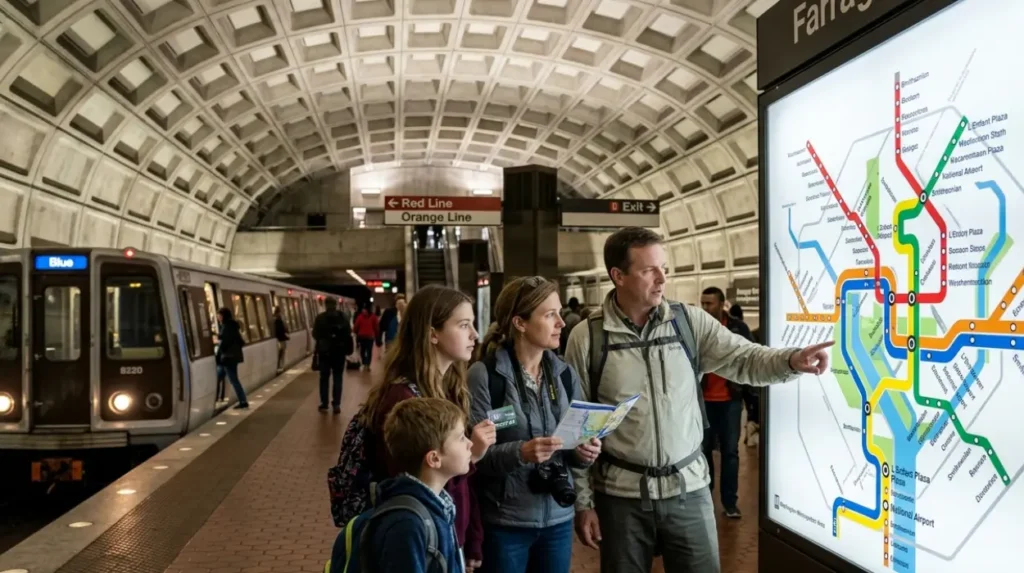
Visitors should remember four basics: use SmarTrip, match the train color and direction, let riders exit before boarding, and expect a short walk after many museum or memorial trips. Those four habits cover most of what tourists need to navigate DC like locals.
The Metro is not difficult once the structure is clear. The rail network is built for regional movement, the fare system is contactless, the service hours are published, and the station rules are designed for high-volume use.
A tourist who learns those basics gains a major advantage in Washington, DC. The city becomes easier to cross, airport transfers become simpler, and the main sights become more accessible without a car.
Is the Washington DC Metro easy to use for first-time tourists?
Yes, most travelers find it easy because of color-coded lines, clear signage, and simple tap-in/tap-out payment using SmarTrip.