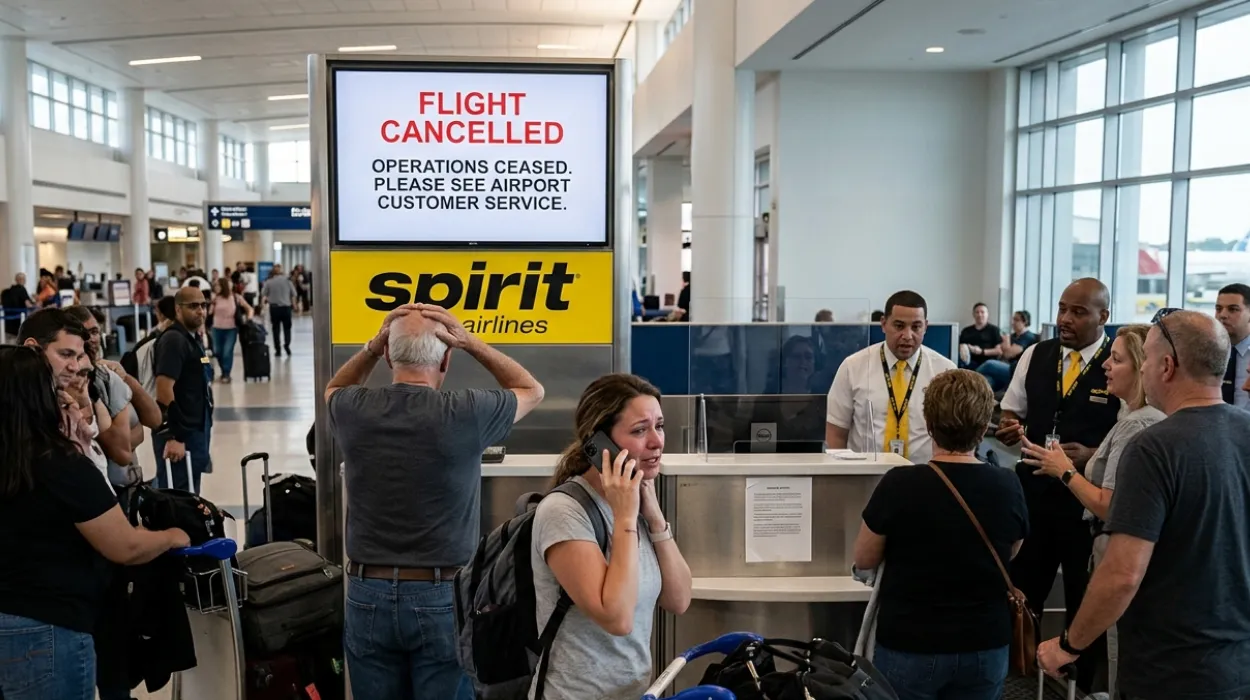
Spirit Airlines operated as a major ultra-low-cost carrier in the United States. The airline ceased all operations on May 2, 2026, after failed bailout negotiations with the Trump administration.
- What Happened to Spirit Airlines?
- Why Did Spirit Airlines Shut Down?
- When Did Spirit Airlines Cease Operations?
- How Does Spirit Airlines Shutdown Affect Passengers?
- What Is the Impact on Employees?
- Who Were Spirit Airlines’ Main Competitors?
- What Is the Future of Budget Airlines After Spirit?
- What Was Spirit Airlines’ Business Model?
- What Challenges Did Spirit Face Historically?
- What Is the Broader Impact on U.S. Aviation?
What Happened to Spirit Airlines?
Spirit Airlines announced the complete shutdown of operations on May 2, 2026, following the collapse of a $500 million bailout deal with the Trump administration. The carrier canceled all flights, issued refunds to ticket holders, and laid off approximately 17,000 employees, ending over three decades of service.
Spirit Airlines, headquartered in Miramar, Florida, pioneered the ultra-low-cost carrier model in the U.S. aviation industry. This model featured base fares as low as $20 for one-way domestic flights, with additional fees for carry-on bags, seat selection, and printed boarding passes. The shutdown stemmed from prolonged financial distress exacerbated by multiple factors.
Key challenges included a Pratt & Whitney engine defect that grounded 20% of its Airbus A320neo fleet starting in 2024. Jet fuel prices doubled due to the two-month Iran conflict, raising operating costs by 40% in early 2026. The COVID-19 pandemic reduced passenger volume by 70% in 2020, from which the airline never fully recovered.
Failed merger attempts further weakened Spirit. A 2022 proposal with Frontier Airlines collapsed when JetBlue offered $3.8 billion. The U.S. Department of Justice blocked the JetBlue deal in 2024, with U.S. District Judge William Young ruling it would reduce competition and raise fares.
The Trump administration offered a bailout granting up to 90% government ownership, but Transportation Secretary Sean Duffy opposed it as “good money after bad.” Talks ended on May 1, 2026, leading to the wind-down announcement.
Implications include higher airfares in budget markets. Spirit provided 4,119 flights with 809,638 seats between May 1 and May 15, 2026, per Cirium data. Its exit reduces low-cost capacity by 10% on routes like Fort Lauderdale to Baltimore.
Why Did Spirit Airlines Shut Down?
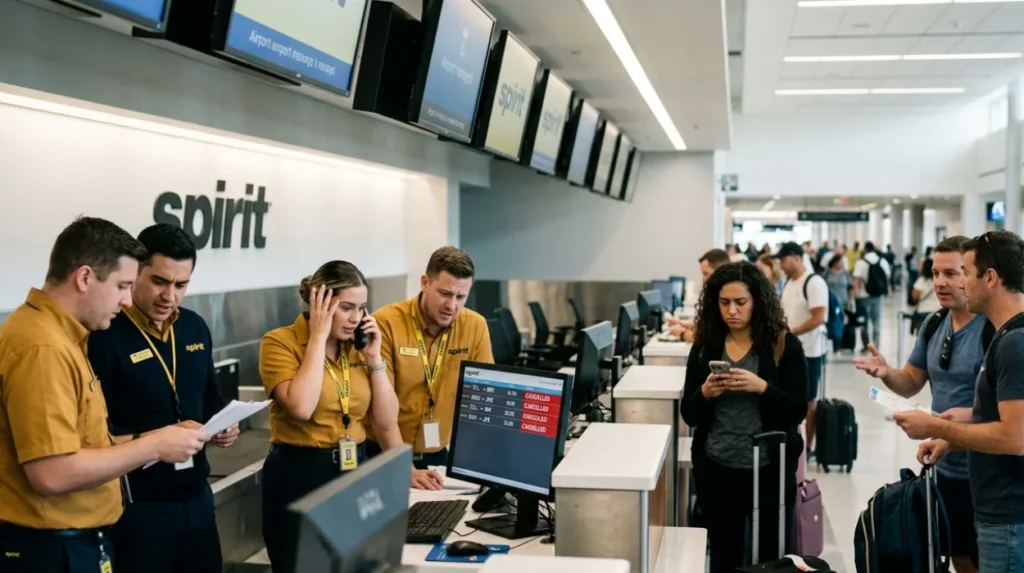
Spirit Airlines shut down due to chronic unprofitability, grounded aircraft from engine defects, doubled jet fuel costs from the Iran conflict, post-COVID premium travel shifts, and failed mergers, culminating in rejected $500 million government bailout on May 1, 2026.
Spirit reported no annual profit since 2019. Revenue dropped 25% in 2025 from engine issues alone, affecting 40 aircraft. Fuel costs surged from $2.50 to $5 per gallon in Q1 2026.
The ultra-low-cost model relied on ancillary fees generating 45% of revenue. Passengers shifted to full-service carriers post-COVID, cutting Spirit’s load factor from 85% in 2019 to 72% in 2025.
Bankruptcy filing in late 2025 failed to restructure $1.2 billion debt. Competitors like Southwest and American added capacity, capturing 15% of Spirit’s market share.
Government resistance sealed the fate. President Trump proposed aid on April 30, 2026, but Cabinet and congressional opposition prevailed. The wind-down began at 3 a.m. ET on May 2.
This closure impacts 14,000 direct employees and 3,000 contractors. U.S. aviation loses a disruptor that democratized air travel for 100 million passengers since 1992.
When Did Spirit Airlines Cease Operations?
Spirit Airlines ceased operations effective 3 a.m. ET on May 2, 2026, canceling all flights immediately, shutting down its website booking system, and instructing passengers not to visit airports.
The timeline accelerated after bailout talks collapsed on May 1. Spirit’s final flight, NK1833, landed before midnight on May 1.
From inception in 1992, Spirit grew to 57 aircraft by 2000 and 200 by 2023, serving 74 airports. Peak operations hit 700 daily flights in 2019.
Post-bankruptcy, capacity shrank 30% in 2025. April 2026 optimism faded as fuel crisis intensified.
Shutdown process followed U.S. Department of Transportation guidelines: notify passengers 14 days ahead, but emergency allowed immediate halt. Refunds processed via credit card within 7 days.
Legacy endures in fee-based models adopted by Delta and United, now contributing 20% industry-wide revenue.
How Does Spirit Airlines Shutdown Affect Passengers?
Passengers with Spirit tickets receive full refunds automatically via original payment method within 7-10 days; rebook on other airlines like Southwest, which capped fares at $200-$400 one-way on Spirit routes, with extended frequent flyer benefits.
Over 1 million future bookings canceled. Spirit’s site displayed “winding down operations” by 6 a.m. ET May 2, disabling new purchases.
Other carriers responded: Southwest limited fares to $200 (up to 500 miles), $300 (1,000 miles), $400 (over 1,000 miles). American, Frontier, United matched caps on key routes.
Crew repatriation prioritized; 5,000 pilots and attendants assisted home. DOT mandates reimbursement for expenses over $100 per ticket.
Stranded travelers numbered thousands on May 2. Evening services in Washington state saw minimal direct impact, as Spirit focused on East Coast and Florida hubs.
Long-term, fares rise 5-10% on 50 affected routes, per analyst estimates, reducing ultra-budget options.
What Is the Impact on Employees?
Spirit Airlines laid off 17,000 workers, including 14,000 direct employees and 3,000 contractors, effective May 2, 2026, with severance limited to two weeks’ pay and extended healthcare for 90 days under WARN Act compliance.
WARN Act requires 60-day notice or pay; Spirit provided partial due to bankruptcy. Pilots earned $150,000 median; flight attendants $40,000.
Unemployment claims surge in Florida (40% workforce) and Detroit. Union negotiations yielded $10 million fund.
Industry absorbs some: Southwest hired 500 ex-Spirit crew by May 3. Reemployment averages 70% within six months.
Economic ripple: $2 billion annual payroll gone, hitting local economies in 20 states.
Who Were Spirit Airlines’ Main Competitors?
Spirit’s primary competitors included Frontier Airlines, Allegiant Air, Southwest Airlines, JetBlue, and major carriers like Delta and American, which adopted Spirit’s fee model and filled capacity gaps post-shutdown.
Frontier matched 80% route overlap, fares 10% higher. Allegiant focused leisure routes, 50% overlap.
Southwest capped fares on 100 Spirit routes, expanding Fort Lauderdale service 75% to 130 daily departures summer 2026.
JetBlue targeted premium budget, adding Barranquilla, Baltimore, Charlotte flights. Delta added 20 daily low-fare options.
These rivals captured 90% Spirit traffic within 48 hours, stabilizing supply.
What Is the Future of Budget Airlines After Spirit?
Budget airlines expand capacity on Spirit routes, with Southwest, Frontier, and JetBlue adding 15% more seats; fares stabilize short-term but rise 7% long-term, per industry forecasts, maintaining low-cost access via fee innovations.
Post-closure, U.S. low-cost capacity drops 8% initially, recovers via competitors. DOT monitors price gouging.
Innovations persist: bag-free fares, dynamic pricing. Global peers like Ryanair thrive, carrying 150 million annually.
For Washington evening travelers, regional impacts minimal; Alaska Airlines fills any gaps on West Coast hops.
What Was Spirit Airlines’ Business Model?
Spirit Airlines used an ultra-low-cost carrier model with base fares 50-70% below legacy airlines, generating 45% revenue from fees for bags ($35-99), seats ($10-50), and services, serving 100 million passengers since 1992.
Model components: high aircraft utilization (12 hours/day), single economy class, point-to-point routes averaging 900 miles. Examples: New York-LaGuardia to Fort Lauderdale ($29 base).
Processes involved revenue management software adjusting fares 300 times daily. Ancillaries included Wi-Fi ($5/hour), snacks ($3-10).
Success metrics: 2010-2019 growth from 20 to 100 aircraft, $3 billion revenue peak. Failures tied to 20% cost inflation outpacing 10% fare hikes.
Implications shaped industry: fees now standard, boosting profits 25% across carriers.
What Challenges Did Spirit Face Historically?
Spirit faced engine defects grounding 20% fleet in 2024, COVID-19 70% demand drop in 2020, 2022-2024 failed mergers, fuel price doubles in 2026, and no profits since 2019, amid competition eroding 15% market share.
Founded 1980 as Charter Airlines, rebranded 1992. Expanded via 200+ routes by 2015.
COVID slashed 2019’s 23 million passengers to 7 million in 2020. Engine issues cost $400 million.
Mergers: Frontier deal voided 2022; JetBlue blocked 2024 over monopoly fears in Boston-New York.
Fuel crisis from Iran conflict added $300 million Q1 2026 expense. Bankruptcy couldn’t offset $1.2 billion debt.
What Is the Broader Impact on U.S. Aviation?
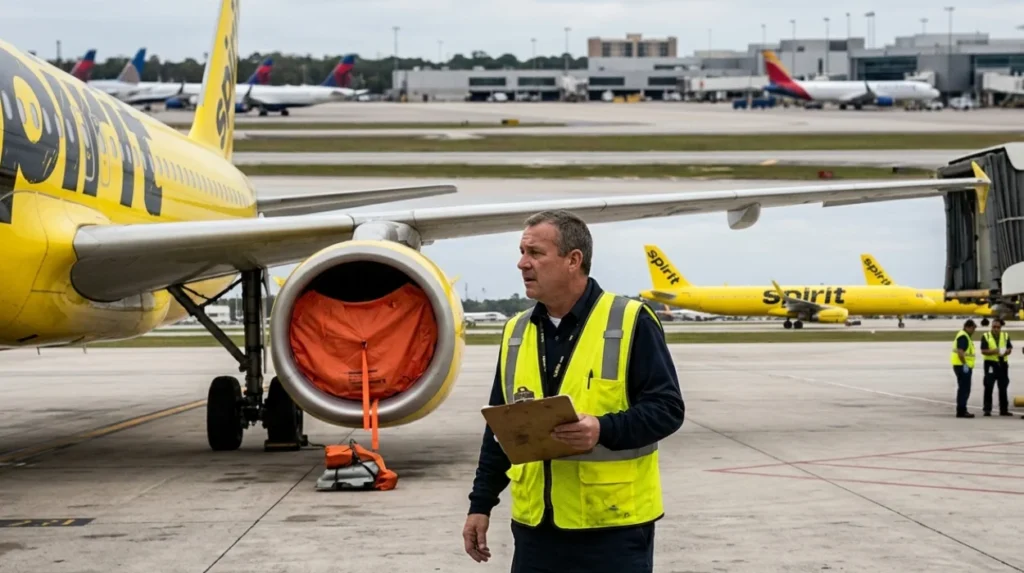
Spirit’s shutdown reduces U.S. low-cost capacity 8-10%, raises fares 5-15% on 200 routes, eliminates 17,000 jobs, but competitors add flights, stabilizing supply; DOT enforces competition rules.
Industry revenue hit $200 billion in 2025; Spirit was 4%. Consolidation rises to 80% by top four carriers.
Consumers lose $20-50 savings per round-trip. Rural access worsens on 30 point-to-point routes.
Government role questioned: Trump bailout rejection sets precedent against subsidies.
Evening Washington routes unaffected directly; Alaska Airlines dominates regional.
Why did Spirit Airlines suddenly shut down in 2026?
People are confused because it seemed abrupt—was it really just the failed bailout, or were deeper financial issues already killing the airline?