Key Points
- In late February 2026, North Korean Supreme Leader Kim Jong-un declared at the Ninth Party Congress that denuclearisation “can never happen” and described the country’s nuclear capabilities as “irreversible and permanent”.
- Kim stated that if the United States drops its “absurd obsession” with denuclearising North Korea and accepts reality for “genuine peaceful coexistence”, there is no reason not to sit down with the United States.
- Denuclearisation is excluded from US President Donald Trump’s latest National Security Strategy and National Defence Strategy, unlike previous years, though Trump’s policy of “complete denuclearisation” persists.
- Pyongyang historically sought US dialogue during socio-economic stress, such as post-Cold War isolation, the 1990s famine, and after threats like Trump’s “fire and fury” rhetoric.
- North Korea signed agreements like the 1994 Agreed Framework and the 2012 “Leap Day” deal under pressure, showing past willingness for phased sanctions relief in exchange for denuclearisation steps.
- DPRK’s improving ties with China (exports to China reached USD 257.4 million in December 2025) and Russia (generated USD 7.67-14.4 billion from Ukraine war support) reduce its need for US engagement.
- Russo-DPRK ties are a “marriage of convenience” tied to Russia’s Ukraine war, likely to diverge post-war due to differing interests.
- Experts like Joel Wit note past DPRK frustration with US demands for full denuclearisation before sanctions relief; Choe Son-hui at 2019 Hanoi summit sought relief for livelihood sanctions with “snap back” provisions.
- Former NSC chief Fred Fleitz believes a Trump-Kim summit possible this fall; policy recommends shelving denuclearisation talks temporarily for dialogue on economic cooperation to counter Beijing-Moscow influence.
- Dialogue requires good-faith signs, overlooking lapses, and potentially recognising Pyongyang as a “nuclear-enabled state” for “cold peace”.
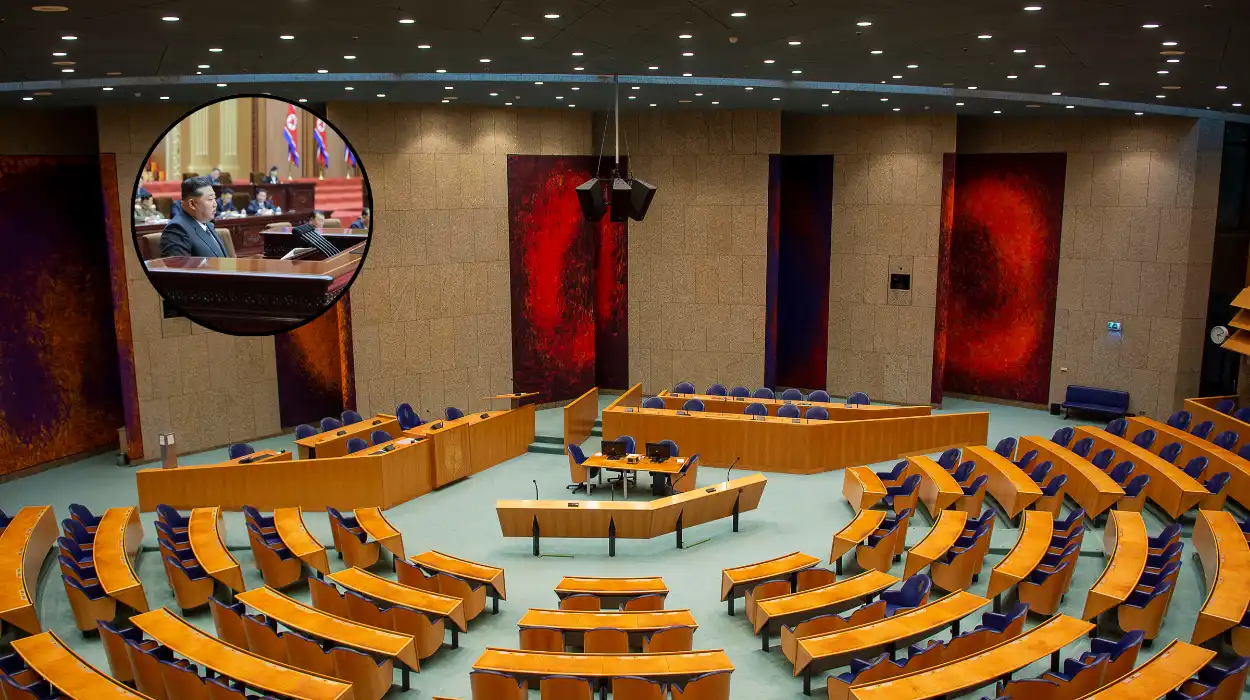
Washington (Evening Washington News) – April 22, 2026 –In late February 2026, during a speech at North Korea’s Ninth Party Congress, Supreme Leader Kim Jong-un declared that denuclearisation “can never happen” and that the country’s nuclear capabilities were “irreversible and permanent”, as reported via KCNA Watch (https://kcnawatch.org/newstream/1772075300-472506881/let-us-make-great-victory-and-glory-gained-through-indomitable-pioneering-struggle-lead-onto-steady-prosperity-and-leaps-forward-in-new-struggle-report-on-ninth-congress-of-workers-party-of-korea/). Kim went on to say, as covered by Reuters (https://www.reuters.com/world/asia-pacific/north-korea-can-talk-us-if-it-stops-insisting-denuclearisation-kim-says-2025-09-21/), “If the United States drops the absurd obsession with denuclearising us [North Korea] and accepts reality, and wants genuine peaceful coexistence, there is no reason for us not to sit down with the United States”.
- Key Points
- What Did Kim Jong-un Say About Denuclearisation at the Ninth Party Congress?
- Why Has Pyongyang Historically Sought Dialogue with Washington?
- How Have China and Russia Reduced US Leverage Over North Korea?
- Is the Russia-North Korea Alliance Sustainable Long-Term?
- What Is the Current State of US Policy Toward North Korea?
- Background of the Development
- Prediction: How This Development Can Affect US Policymakers
What Did Kim Jong-un Say About Denuclearisation at the Ninth Party Congress?
Kim’s comments, delivered at the Ninth Party Congress, signal Pyongyang’s firm rejection of denuclearisation as a negotiation prerequisite.
As detailed in the 9DASHLINE.com analysis by strategic analyst Hans Horan of the Hague Centre for Strategic Studies, these statements have prompted North Korea experts to interpret them as an openness to re-engage Washington in dialogue, provided denuclearisation remains off the table.
Denuclearisation is notably absent from US President Donald Trump’s latest National Security Strategy (https://www.whitehouse.gov/wp-content/uploads/2025/12/2025-National-Security-Strategy.pdf) and National Defence Strategy (https://media.defense.gov/2026/Jan/23/2003864773/-1/-1/0/2026-NATIONAL-DEFENSE-STRATEGY.PDF), marking a shift from prior years. NK News reported (https://www.nknews.org/2025/01/trump-to-pursue-complete-denuclearization-of-north-korea-white-house-says/) that the White House maintains Trump’s policy of “complete denuclearisation” of North Korea.
This leaves US policymakers in a position where re-engagement with the Democratic People’s Republic of Korea (DPRK) is desired, yet their core leverage point has become untenable.
Hans Horan writes in 9DASHLINE.com that US-DPRK dialogue is no longer feasible under current conditions with denuclearisation as a prerequisite. He argues that if the Trump administration seeks to resume diplomacy on Pyongyang’s terms, it must reassess factors that previously made such talks attractive.
Why Has Pyongyang Historically Sought Dialogue with Washington?
Pyongyang has pursued diplomatic engagement with the US during periods of acute socio-economic stress. Following the Cold War, the DPRK faced economic and ideological isolation as the Communist Bloc collapsed and China embraced markets, leading to the socialist command economy’s failure and the 1990s “Arduous March” famine, as noted by 38 North (https://www.38north.org/2025/12/succession-at-the-crossroads-scenarios-for-north-koreas-future/) and BBC News (https://www.bbc.com/news/world-asia-56685356).
This isolation, combined with pressures from its nuclear programme, prompted regular dialogue. Examples include the 1994 Agreed Framework signed with President Bill Clinton’s administration amid deliberations over striking North Korea’s nuclear facility (Arms Control Association: https://www.armscontrol.org/factsheets/us-north-korean-agreed-framework-glance). More recently, the 2012 “Leap Day” deal with the Obama administration followed the Gaddafi regime’s fall (38 North: https://www.38north.org/2019/03/editor030719/), and summits followed Trump’s “fire and fury” rhetoric.
Senior fellow Joel Wit at the Stimson Center, in his book Fallout: The Inside Story of America’s Failure to Disarm North Korea (JSTOR: https://www.jstor.org/stable/jj.34829404), states that Pyongyang at times genuinely sought denuclearisation deals for economic and political concessions like phased UN sanctions lifting. Wit notes North Korea’s frustration with Washington’s insistence on full denuclearisation first.
At the 2019 Hanoi summit, DPRK negotiator Choe Son-hui said they sought lifting of sanctions “hurt[ing] the livelihood of their people” with “snap back sanctions” if commitments failed, adding that
“Chairman Kim doesn’t understand your [Washington’s] method of calculation”
(JSTOR: https://www.jstor.org/stable/jj.34829404).
Hawkish US observers, as per Lowy Institute (https://www.lowyinstitute.org/the-interpreter/north-korea-s-time-buying-strategy), dismissed these as time-buying tactics to advance the nuclear deterrent.
How Have China and Russia Reduced US Leverage Over North Korea?
Pyongyang’s warming ties with Beijing and Moscow have eroded Washington’s influence. Sino-DPRK trade neared pre-pandemic levels in 2025, with DPRK exports to China hitting USD 257.4 million in December 2025 (NK News: https://www.nknews.org/2026/04/north-korean-economy-is-recovering-thanks-to-russia-china-ties-seoul/).
DPRK-Russia cooperation surged post-Russia’s 2022 Ukraine invasion. The South Korean Institute for National Security Strategy estimated Pyongyang earned USD 7.67-14.4 billion from troop deployments and arms exports (https://inss.re.kr/publication/bbs/js_view.do?nttId=41037787).
A UN Security Council report deemed this a “significant contribution” to Russia’s war (https://msmt.info/view/save/2025/06/20/6bb78b9d-aefd-44c4-b34a-8f545c0d9b3a-S_2025_340-EN.pdf).
These partnerships enable Kim to reject US terms, per Horan’s 9DASHLINE.com piece.
Is the Russia-North Korea Alliance Sustainable Long-Term?
The Russo-DPRK relationship is a “marriage of convenience” driven by mutual needs in Russia’s Ukraine war, not deep alignment (38 North: https://www.38north.org/2024/10/russia-dprk-relations-strategic-partnership-or-opportunistic-alliance/; Chatham House: https://www.chathamhouse.org/2024/12/north-korea-and-russias-dangerous-partnership/revival-north-korea-russia-relationship). Russia gains arms, soldiers, and labour; Pyongyang receives capital, technology, security guarantees, and KPA battlefield experience.
Defence Priorities fellow Daniel R. DePeris observes in 38 North (https://www.38north.org/2024/10/russia-dprk-relations-strategic-partnership-or-opportunistic-alliance/),
“when the war does end, and it will eventually end, the commonalities now binding Moscow and Pyongyang could give way to divergences”.
Post-Ukraine resource constraints may limit Russia’s support for DPRK escalations.
What Is the Current State of US Policy Toward North Korea?
Washington lacks a formulated plan for potential Russo-DPRK divergence. Former National Security Council chief of staff Fred Fleitz said in early April 2026,
“I believe there’s a good chance of a Trump-Kim summit this fall”
(NK News: https://www.nknews.org/2026/04/trump-could-meet-kim-jong-un-for-summit-this-fall-former-us-official/).
Uncertainty surrounds Trump’s stance. Horan recommends proactive dialogue on US-DPRK-ROK economic cooperation to counter Moscow-Beijing influence and exploit alliance cracks (Carnegie Endowment: https://carnegieendowment.org/research/2025/05/pursuing-stable-coexistence-a-reorientation-of-us-policy-toward-north-korea). Denuclearisation talks should be shelved temporarily to avoid breakdowns like post-2019 Hanoi (JSTOR: https://www.jstor.org/stable/jj.34829404).
Wit highlights past failures from mismatched expectations: US immediate concessions demands versus DPRK phased reductions and sanctions relief, amid mistrust.
David C. Kang of the University of Southern California, in Nuclear North Korea co-authored with Victor Cha (Columbia University Press: https://cup.columbia.edu/book/nuclear-north-korea/9780231189231/), asks, “why are we afraid of dealing with the North?” Persistent engagement could foster sustainable ties, potentially via partial recognition as a “nuclear-enabled state” for “cold peace” (Foreign Affairs: https://www.foreignaffairs.com/north-korea/north-korea-it-victor-cha), allowing influence over weakened ties to reduce Indo-Pacific nuclear risks.
Disclaimer: All views expressed are those of Hans Horan and do not necessarily represent those of 9DASHLINE.com. Hans Horan is a strategic analyst at the Hague Centre for Strategic Studies (https://hcss.nl/expert/hans-horan/).
Background of the Development
North Korea’s shift stems from post-Cold War isolation, including the 1990s famine after Soviet collapse, prompting deals like the 1994 Agreed Framework. Recent economic recovery via China trade (USD 257.4 million exports in Dec 2025) and Russia aid (USD 7.67-14.4 billion from Ukraine support) has bolstered Pyongyang, enabling Kim’s February 2026 rejection of denuclearisation. This contrasts with past pressures that drove dialogue, such as Obama-era and Trump summits amid threats.
Prediction: How This Development Can Affect US Policymakers
US policymakers may face prolonged negotiation stalemates if denuclearisation remains a prerequisite, given DPRK’s strengthened alliances. Temporary shelving of the topic for economic dialogue could sustain channels, potentially capitalising on post-Ukraine Russo-DPRK divergences to regain leverage. Risks include miscalculation from ambiguity, but persistent engagement might enable a “cold peace”, reducing escalation threats while monitoring alliance shifts.