Key Points
- President Donald Trump declared a crime emergency last August and ordered a large‑scale National Guard deployment to Washington, D.C.
- More than 2,500 National Guard troops remain in the city eight months later, patrolling streets, metro stations, parks and tourist areas.
- The operation is funded by the federal government and costs taxpayers more than 1 million dollars per day, with some estimates exceeding 1.6 million dollars per day.
- Deployments in other cities such as Los Angeles and Chicago have been limited or paused by courts, but Washington’s deployment continues largely unchecked.
- Local officials, including D.C. Council Chairman Phil Mendelson, have publicly noted the financial burden and questioned the long‑term strategy.
- The presence runs into a pivotal election year, yet city‑level politicians rarely highlight it in council debates or campaign rhetoric.
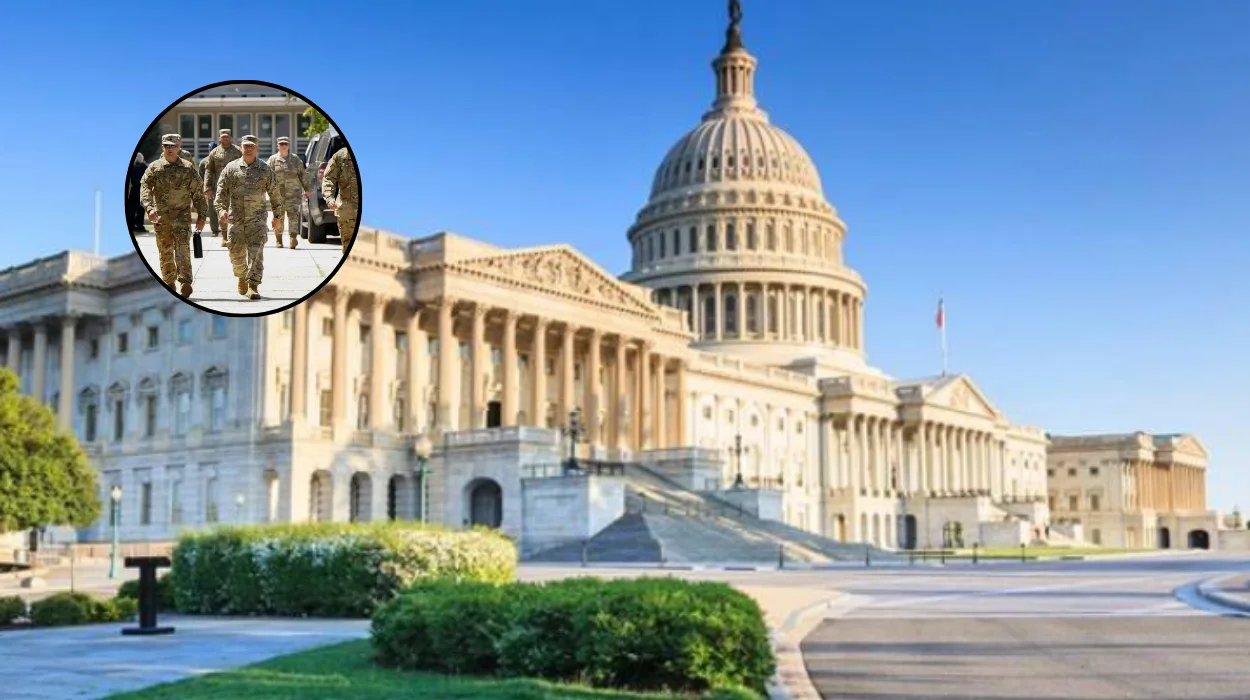
Washington (Evening Washington News)Eight months after President Donald Trump declared a crime emergency and sent the National Guard into the nation’s capital, more than 2,500 troops remain deployed across Washington, D.C., walking streets, patrolling metro stations and standing near landmarks such as the National Mall and the Tidal Basin.
As reported by military‑affairs journalists at the Department of Defense‑linked National Guard Public Affairs site, nearly 2,000 Soldiers and Airmen from six states plus the D.C. National Guard are
“on duty in Washington as part of Joint Task Force D.C.,”
supporting local and federal law‑enforcement agencies. Their stated mission is to provide a visible presence at key federal buildings, subway stations, the Washington waterfront and other high‑traffic areas, while the U.S. Marshals Service and the Metropolitan Police Department retain lead authority over incidents.
The deployment began in August 2025 after the White House said it was responding to a spike in violent incidents and a broader “law‑and‑order” argument that crime had rendered parts of the city unsafe. As detailed by reporters at BBC News, the move followed President Trump’s decision to send both National Guard troops and federal law‑enforcement agents to Washington, a step that Democratic Mayor Muriel Bowser strongly criticised as an “authoritarian push” and a power grab over local policing.
Today, the presence is so routine that tourists strolling between the Lincoln Memorial and Thomas Jefferson Memorial often see armed personnel in camouflage among the cherry‑blossom crowds. Yet, despite the highly visible security posture, the operation has not been formally tied to a clear exit timetable.
How much is the deployment costing taxpayers?
The continuing security footprint has already drawn scrutiny over cost.
In a report released by Democratic senators in the winter of 2026, journalists at The Hill noted that daily expenditures for the National Guard in Washington now exceed 1 million dollars, with some estimates closer to 1.65 million dollars per day.
According to the same analysis, the cumulative price tag since the August 2025 activation has reached around 330 million dollars, with projections suggesting it could top 400 million dollars if the mission runs through the end of the year.
As highlighted by policy‑watch outlet National Priorities Project, the figure could even surpass the entire annual budget of the D.C. Metropolitan Police Department, which stands at roughly 599 million dollars for fiscal year 2026.
Washington’s Council Chairman, Phil Mendelson, has repeatedly pointed out the fiscal strain. In an emailed exchange with reporters, he said,
“Taxpayers are paying more than a million dollars a day to have them walk around,”
a remark that journalists at The Hill and other outlets have cited as evidence of mounting unease among local officials.
The costs stem from extended active‑duty pay, logistics, housing and equipment for Guardsmen drawn from multiple states as well as the District, some of whom rotate in and out over several months.
Critics in the Senate have argued that the administration has not produced a transparent strategy document showing how the deployment has reduced specific crime metrics in Washington, according to reporting by The Hill and WTOP.
How have local officials and residents reacted?
Local political leaders have found themselves in a delicate position. Mayor Muriel Bowser, a Democrat, has previously pushed back against the idea that Washington is overrun by crime, telling BBC News that the federal intervention amounted to an “authoritarian push” rather than a measured public‑safety response.
Yet, as reporters covering city‑hall politics have observed, the Council has devoted relatively little floor time to the subject, and the deployment often goes unmentioned in many council meetings and candidate‑debate transcripts leading into the 2026 election cycle.
Journalists at The Hill have noted that part of the silence may reflect the political reality that the National Guard is under federal authority, and local officials have limited power to unilaterally terminate the mission without court intervention or a presidential order.
Some local advocates and civil‑liberties observers have raised concerns that prolonged militarised patrols could disproportionately affect minority‑neighbourhood foot traffic and raise questions about the line between security and military occupation, as captured in commentaries aired by U.S. news outlets and cable‑news segments.
By contrast, residents and visitors interviewed by local TV stations such as WJLA have expressed mixed views. Some said the extra officers made them feel safer, especially after recent carjackings and thefts near tourist areas, while others told reporters they felt uneasy about the number of armed personnel in residential zones.
Where does this stand in relation to other U.S. deployments?
The situation in Washington is distinct from state‑level National Guard activations elsewhere. In California, legal challenges successfully limited the scope of deployments in Los Angeles, and in Illinois some operations were paused by courts, prompting policy‑watch writers at outlets such as National Priorities Project to note that Washington’s federal‑controlled deployment has faced less direct judicial pushback.
Commentators at WTOP have reported that smaller‑scale security enhancements involving the Guard continue in other cities, including New Orleans, where guardsmen support public‑safety operations around major events, but these are typically shorter‑term and more narrowly defined. In contrast, Washington’s operation is unusually sustained, with overlapping federal and local law‑enforcement coordination and a much larger footprint.