Key Points
- Scorching Mid-Tier Temperatures: Washington, D.C. is recording a consistently hot, clear Thursday with maximum temperatures peaking near 90 degrees Fahrenheit (32 degrees Celsius) alongside a high UV index of 10.
- Aggravated Regional Drought Conditions: An ongoing lack of significant rainfall has amplified water stress across the Potomac River watershed, leaving 100 percent of the District of Columbia under formal drought classifications.
- Activation of Regional Drought Watch: The Metropolitan Washington Council of Governments (COG) Drought Coordination Committee has formally declared a regional drought watch, triggering calls for immediate voluntary water conservation.
- Potomac Flows near Historical Lows: Environmental monitoring shows that recent minor rainfall failed to recharge critical local waterways, forcing the flow of the Potomac River down to 132-year historical lows for this early summer period.
- Imminent Precipitation Prospects: Meteorologists expect dry conditions to persist through the workweek, with the next viable window for regional rain showers arriving overnight Saturday into Sunday morning.
Washington, D.C (Evening Washington News) June 4, 2026 – Local environment officials and meteorological experts have confirmed that Washington, D.C. is enduring a remarkably dry, sun-baked stretch this Thursday, with daily high temperatures reaching near 90 degrees Fahrenheit. According to real-time weather monitoring data published by Google Weather, the metropolitan area is currently registering a daytime temperature of 24 degrees Celsius (approximately 75 degrees Fahrenheit) en route to a forecast maximum temperature of 32 degrees Celsius (90 degrees Fahrenheit). Accompanied by light winds flowing from the northwest at 6 miles per hour and a low relative humidity of 42 percent, the immediate atmospheric conditions feel intensely dry.
- Key Points
- How severe are the current heat and dryness metrics in D.C.?
- Why did regional authorities declare a formal drought watch?
- What is the status of the Potomac River water supply?
- What voluntary water conservation actions are citizens being asked to take?
- When will the Washington metropolitan area see relief from rain?
- What is the historical background of droughts in the nation’s capital?
- Prediction: How will this escalating drought affect local communities?
However, beneath the clear blue skies lies a structural environmental challenge. The lack of sustainable precipitation has caused regional drought conditions to deteriorate dramatically, leading the Metropolitan Washington Council of Governments (COG) to issue a formal regional drought watch for the District and its surrounding jurisdictions.
Weather authorities indicate that the parched landscape will receive no immediate relief, as dry weather is locked in for the remainder of the workweek. The next statistically viable chance for regional rainfall is not projected to arrive until overnight Saturday into Sunday morning.
How severe are the current heat and dryness metrics in D.C.?
The underlying metrics for Thursday highlight an atmosphere characterized by extreme solar radiation and low moisture reserves. As detailed by meteorological records from Google Weather, the statutory UV index for the day has reached a peak level of 10, classified as “very high” to “extreme.”
This requires outdoor workers and residents to take aggressive sun protection measures. The daytime precipitation probability remains fixed at a nominal 10 percent, while nighttime conditions are expected to transition into a partly cloudy state with minimum temperatures dropping comfortably to 17 degrees Celsius (63 degrees Fahrenheit).
As reported by veteran meteorologists Topper Shutt, Kaitlyn McGrath, Miri Marshall, Grace Thornton, and Joe Speir of WUSA9, the current meteorological layout features an unseasonably low humidity profile despite the escalating heat. In a coordinated public brief, the WUSA9 weather team stated that
“Thursday will be mostly sunny and warmer but not humid. Thursday will make it back into the upper 80s before 90s return Friday into the weekend. Despite the heat, humidity stays very low so it will still be quite comfortable.”
This lack of moisture creates a deceptive environment where high temperatures feel manageable to the public, yet accelerate the evaporation of surface moisture from local soils and critical river basins.
Why did regional authorities declare a formal drought watch?
The decision to elevate the region’s climate status to a formal drought watch was dictated by systemic deficits across all primary hydrological indicators. In an investigative report published by Emily Leayman of ALXnow, it was confirmed that the Metropolitan Washington Council of Governments Drought Coordination Committee recommended the step after analyzing critical data feeds tracking precipitation, groundwater tables, localized streamflows, and reservoir storage levels across the Potomac River basin.
The emergency coordination measures affect nearly six million residents across Northern Virginia, suburban Maryland, and the District of Columbia. Writing for FFXnow, journalist Scott McCaffrey noted that
“the action impacts nearly 6 million residents across Northern Virginia, Maryland and the District. It is the first drought watch for the local area since an earlier one was cancelled in June 2025.”
Officials are now closely coordinating with regional water utilities, including Fairfax Water and Virginia American Water, to monitor extraction rates as the Potomac River faces severe stress.
What is the status of the Potomac River water supply?
The Potomac River serves as the primary source of drinking water for the vast majority of the Washington metropolitan area, rendering its current volume contraction a matter of significant public policy concern.
In an official administrative statement obtained by ALXnow, Michael Nardolilli, the executive director of the Interstate Commission on the Potomac River Basin (ICPRB), explained the severity of the situation. Nardolilli stated:
“Recent rains brought temporary relief from the area’s long dry spell that dropped the flow in the Potomac to 130-year lows for this time of year. Since then, however, the rains have stopped. As we go into the summer and fall months, when river flows are typically lower, residents are urged to use water wisely.”
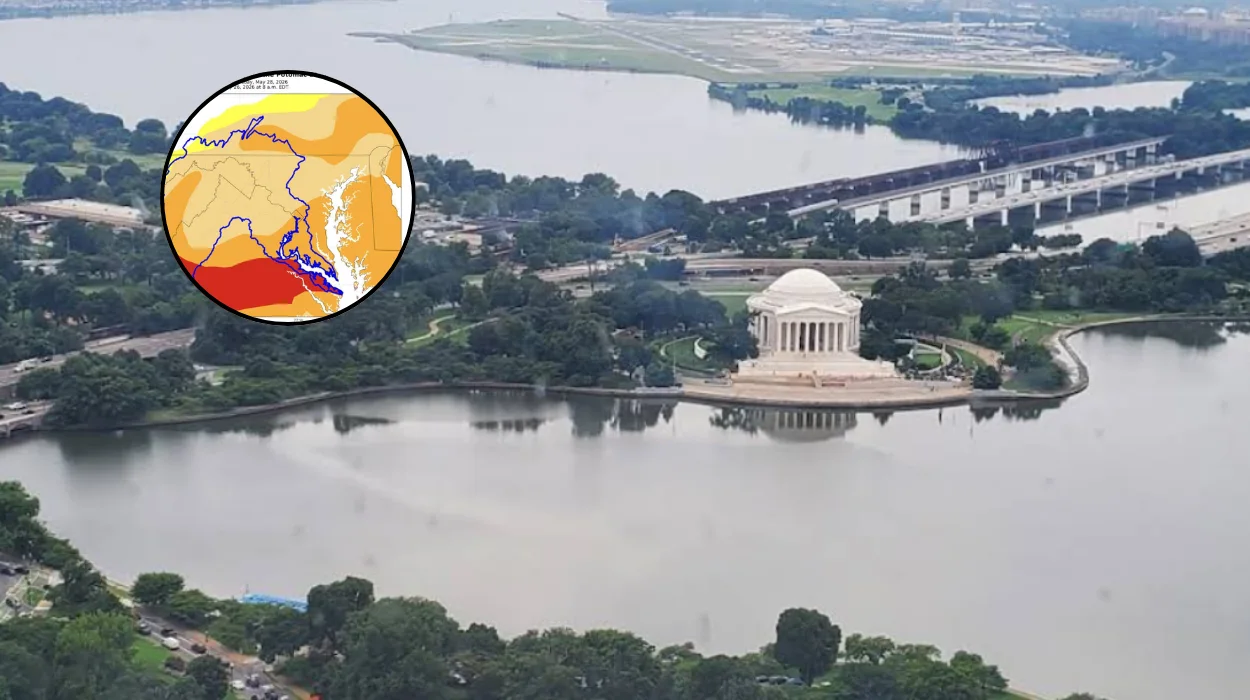
Data compiled by the U.S. Drought Monitor reinforces Nardolilli’s warnings. Statistics reveal that approximately 40 percent of the broader Potomac watershed is experiencing “severe drought” conditions or worse. For the District of Columbia specifically, the metrics are absolute: 100 percent of the land area within the District is classified as suffering from active drought, following the 13th-driest April recorded over a 132-year historical data set.
What voluntary water conservation actions are citizens being asked to take?
Because the current administrative phase is a drought watch rather than a drought emergency, authorities are relying on voluntary public compliance to avoid implementing mandatory water use caps. According to guidelines distributed by COG and reported by Scott McCaffrey of FFXnow, residents are requested to audit their daily routines. COG Executive Director Clark Mercer publicised the initiative, stating,
“Our region hasn’t seen extremely dry conditions like this in about two decades. We’re asking the public to help by incorporating simple, water-saving actions into their daily routines.”
The recommended conservation protocols cover both indoor and outdoor activities. Utilities are urging homeowners to limit showers to under five minutes, check internal plumbing fixtures and toilets for hidden leaks, and restrict the operation of dishwashers and washing machines to completely full loads.
Out-of-doors, residents are instructed to sweep driveways and sidewalks rather than hosing them down, use commercial car washes that recycle water, and adjust agricultural practices.
Additional irrigation tips provided by Virginia American Water specify that outdoor watering should occur exclusively during the early morning or late evening hours to eliminate up to 30 percent of water volume otherwise lost to midday solar evaporation.
Gardeners are also encouraged to utilize mulch beds to retain soil moisture and raise lawnmower blades to a height between 2.5 and 3.5 inches, which fosters a more drought-resistant root structure.
When will the Washington metropolitan area see relief from rain?
According to the short-range atmospheric modeling presented by WUSA9, the mid-Atlantic region remains trapped under a dominant high-pressure system that prevents incoming moisture fronts from penetrating the D.C. airspace.
This blocking pattern ensures that Friday and the first half of Saturday will remain entirely dry, with temperatures expected to climb even higher into the low 90s.
The break in this dry spell is timed around a weak low-pressure trough moving from the west. WUSA9 reports indicate that scattered showers and localized thunderstorms are tracking toward the area, with the primary arrival window set for late Saturday night into Sunday morning.
While this incoming front offers the prospect of measurable precipitation, hydrologists warn that a single overnight convective event will be insufficient to erase multi-month groundwater deficits or sustainably lift the Potomac River out of its historical low-flow status.
What is the historical background of droughts in the nation’s capital?
The implementation of a coordinated regional response framework dates back to the turn of the century, following severe climate disruptions in the late 1990s. As documented by regional historical files and reported by ALXnow, the Washington metropolitan area’s last mandatory water use restrictions occurred statewide in Maryland in 1999, following an intense period of eastern seaboard drought that threatened municipal infrastructure.
In response to that crisis, regional leaders formulated the COG Regional Drought Response Plan in 2000 to establish structured stages of water management: normal, watch, warning, and emergency.
Since the formal adoption of this plan 26 years ago, the D.C. area has rarely had to activate its upper tiers. The region has notably never entered the “drought warning” stage, which would trigger widespread mandatory cutbacks. Prior to the current 2026 declaration, the area navigated a prolonged drought watch that was enacted in the summer of 2024 and maintained for nearly a year before being rescinded in June 2025.
Before that sequence, the metro area had only required a brief, one-month drought watch protocol in 2010. The recurrence of a drought watch in 2026 emphasizes a pattern of tightening hydrological availability in the mid-Atlantic.
Prediction: How will this escalating drought affect local communities?
If the current trend of high-temperature, low-precipitation weather persists past the projected weekend rain window, it will alter operational realities for several key segments of the local population. For the general residential community, the immediate impact will remain limited to voluntary lifestyle modifications; however, prolonged depletion of the Potomac flow will inevitably push the Drought Coordination Committee to escalate the status from a “watch” to a “warning.” This transition would mark the first time in modern history that the capital enters this tier, likely bringing enforceable restrictions on lawn irrigation, vehicle washing, and commercial water use.
For municipal managers, infrastructure engineers, and regional agricultural operators, the continuing drought presents severe operational risks. Agricultural sectors in peripheral counties will face decreased crop yields due to severely low soil moisture, driving up the cost of local produce.
Concurrently, water utility operators like Fairfax Water will have to alter their intake and treatment procedures to account for increased sediment and pollutant concentrations that typically manifest when river volumes drop to historic lows.
While administrative leaders emphasize that decades of infrastructure investment protect the capital from an outright water shortage, sustained weather patterns of this nature will force permanent, structural changes in how the Washington metropolitan area consumes its most vital natural resource.