
Key Points
- Innovative Idea: Amazon has introduced a novel idea of a brick-and-mortar supermarket named Amazon Go that offers shoppers a unique experience where they will not have to stand in line, pay through cashiers, or wait at the checkout counter.
- Technology Utilization: The technology used at this shop involves an array of ceiling cameras and weight detectors on shelves based on computer vision that helps track items taken or returned by the customers.
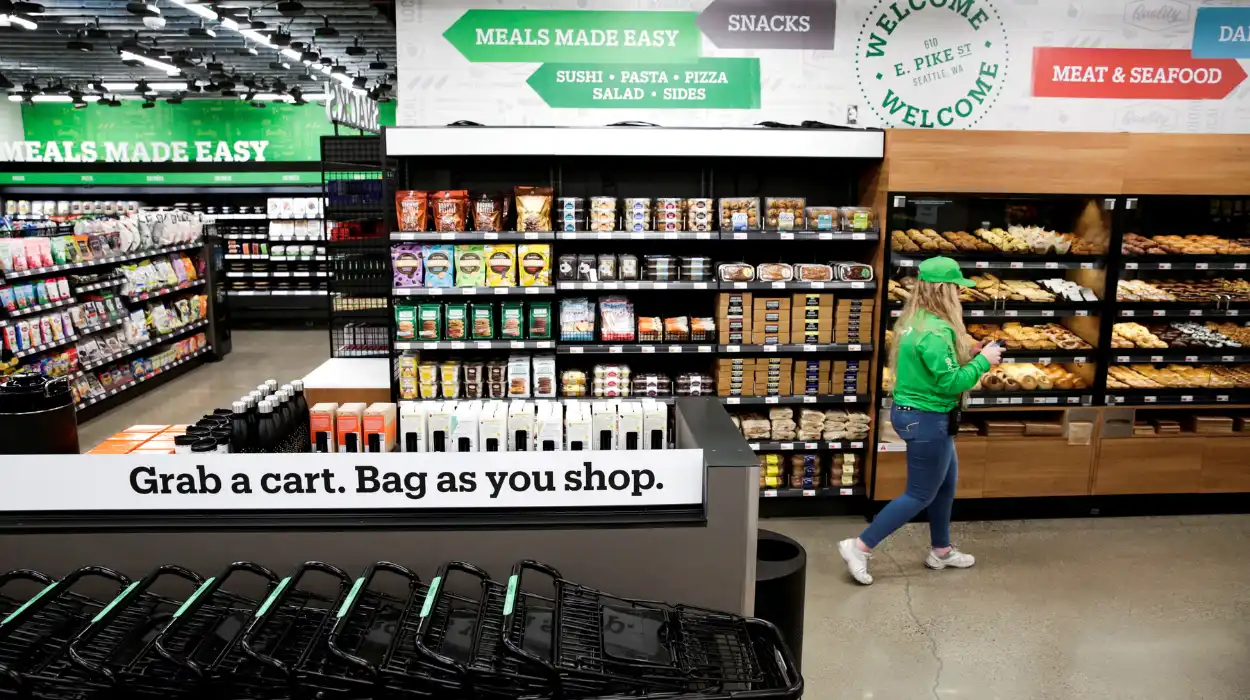
- Customer Entry: In order to enter the 1,800 square feet Amazon Go store that operates in Seattle, Washington, one has to open the Amazon Go app on the phone and scan the QR code at the turnstiles.
- Smooth Billing: As soon as the customer finishes purchasing the items from the store, he can leave the store, and his account will be automatically charged for the purchase.
Seattle (Evening Washington News) August 29, 2026 — In the heart of the Pacific Northwest, a quiet technological revolution took shape as e-commerce giant Amazon unveiled a physical retail blueprint designed to eliminate the most tedious aspect of traditional shopping: the checkout queue.
People walking past the Amazon Go brick-and-mortar grocery store witness a paradigm shift in how consumers interact with physical retail spaces, stripping away cashiers, shopping carts, and traditional registers in favor of computer vision and sensor fusion.
How Does the Amazon Go Checkout-Free Technology Actually Work?
The mechanics behind the automated store rely heavily on modern digital infrastructure and smartphone integration. As detailed by technology publication reports, shoppers must first download the designated mobile application and link it to an active payment method before entering the premises.
As reported by staff writers at The Verge, customers open the application on their mobile devices and scan the code at a bank of four glass turnstiles to gain entry into the compact, 1,800-square-foot convenience space. Once inside, an extensive array of ceiling-mounted cameras and weight sensors embedded within the shelving units track every movement.
As noted by international news agency correspondents, the system records precisely what items customers remove from the shelves or decide to put back, updating a virtual basket in real-time. When shoppers complete their selections, they can bypass registers entirely and walk straight out of the building, prompting the system to charge their on-file credit cards automatically.
Explore More Technology News
Disney+ Global Streaming Growth in Los Angeles 2026
Meta Launches Muse Glimmer AI Model in Washington, 2026
What Was the Initial Reaction and Strategy Behind the Launch?
The unveiling of the cashierless concept sparked intense global debate regarding the future of employment, automation, and privacy in the digital age. Industry analysts observed that while consumers relished the prospect of bypassing long lines, critics and commentators raised questions about corporate data collection and the broader socio-economic impact on retail cashiers.
As reported by retail commentators and analysts evaluating the launch, the initiative highlighted a profound irony in modern commerce: it required a dominant online retailer to engineer a software-driven solution to fix the frustrations of physical shopping. Retail strategists noted that traditional grocery chains had long tolerated checkout delays because queue spaces offered prime real estate for last-minute impulse purchases. By removing this friction point entirely, Amazon sought to redefine convenience.
As reported by business analysts following the initial rollout, company executives emphasized that the primary objective was meeting consumer demands for speed and efficiency. Dilip Kumar, Amazon’s vice president of physical retail and technology, stated in an interview with Reuters that the core question driving the innovation was fundamental:
“Do customers like standing in lines?”
Kumar further remarked to Reuters journalists regarding the broader application of the system:
“This has pretty broad applicability across store sizes, across industries, because it fundamentally tackles a problem of how do you get convenience in physical locations, especially when people are hard-pressed for time.”
What Challenges Did Amazon Face During Development?
Behind the sleek facade of the automated storefront lay years of rigorous technical testing and troubleshooting. Before opening the flagship location at the base of the company’s Day 1 building in Seattle, developers constructed a massive 15,000-square-foot mock supermarket inside a rented warehouse to test the limits of the software.
According to reports covering the technological hurdles of the project, early public deployment was temporarily delayed due to software tracking complications. Industry reporters noted that the overhead cameras and weight sensors initially struggled to accurately differentiate between multiple shoppers with similar body builds or to track items correctly when children picked up products and placed them on random shelves.
To overcome these obstacles, the tech giant restricted initial access exclusively to company employees during a lengthy beta testing phase beginning in December 2016. This controlled environment allowed engineers to refine the computer vision algorithms before welcoming the general public. Inside the store, human staffing was kept to a minimum, primarily consisting of greeters, culinary staff preparing fresh meals, and associates stationed to verify legal age requirements for alcohol purchases.
How Did This Concept Influence the Future of Global Retail?
The debut of the Seattle prototype served as a foundational stepping stone for subsequent expansions within the retail sector. Over the following years, the technology scaled beyond compact convenience outlets into larger formats, including the wider Amazon Go Grocery layout in Seattle’s Capitol Hill neighborhood, which handled a vastly expanded inventory of fresh produce, meat, and baked goods. Furthermore, the company explored licensing the underlying “Just Walk Out” infrastructure to third-party retailers globally, transforming an internal project into an industry-wide commercial product.
As the retail landscape continues to adapt to shifts in consumer behavior and labor dynamics, the initial street-level view of shoppers walking past the glass-fronted Seattle store remains an iconic milestone. It marked the exact moment when digital automation permanently breached the physical boundaries of everyday grocery shopping, altering consumer expectations for decades to come.