
Key Points
- The Metropolitan Washington Airports Authority (MWAA) manages a $7 billion capital improvement plan at Dulles International Airport.
- The Trump administration seeks to influence redevelopment with its own proposals for the international gateway to the U.S. capital.
- President Trump described Dulles as “terrible” and “incorrectly designed,” announcing plans for renovation during a White House Cabinet meeting.
- U.S. Transportation Secretary Sean P. Duffy launched an initiative to revitalise Dulles as part of efforts to improve the nation’s capital gateway.
- Private sector proposals range from $14.4 billion by Ferrovial to $35-50 billion by Phoenix/Ironbridge for full redevelopment.
- MWAA’s governance stems from an interstate compact between Virginia and the District of Columbia, ratified by Congress.
- Recent scandals include the dismissal of eight Dulles police officers over alleged payoffs from drivers.
- A new law doubles MWAA’s annual federal lease payment from $7.5 million to $15 million starting in 2027.
- Talks intensified in 2026, with Deputy Transportation Secretary Steve Bradbury confirming ongoing negotiations.
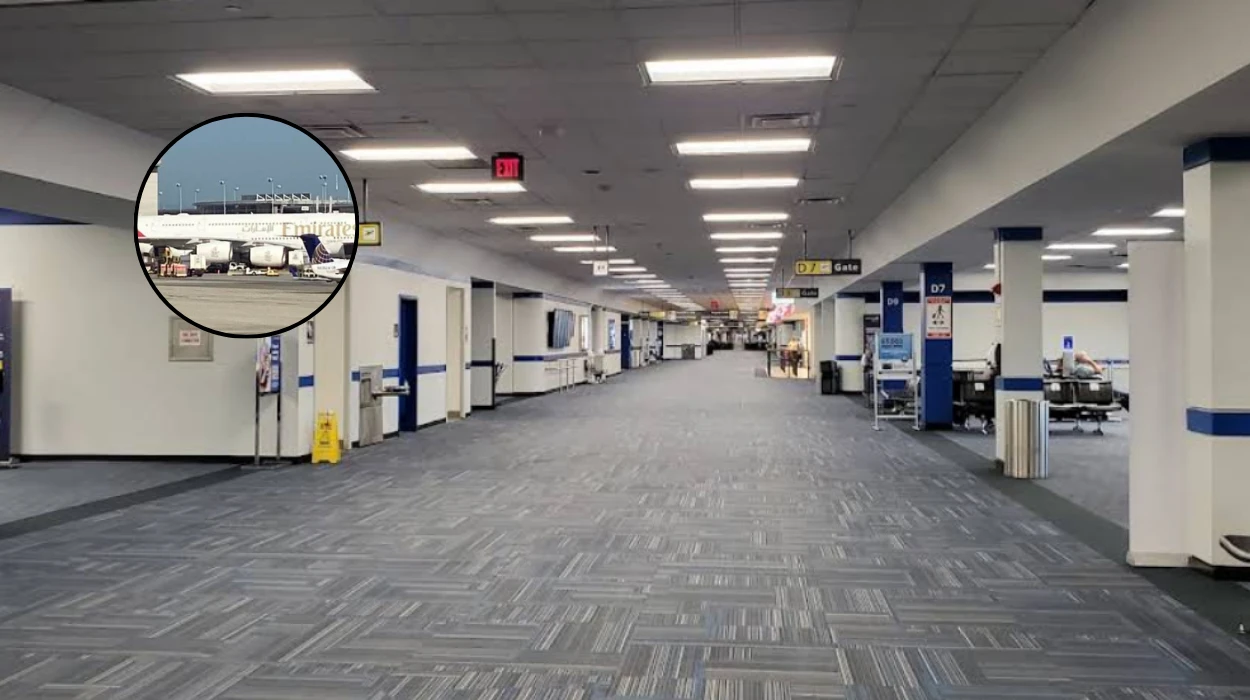
Washington (Evening Washington News) April 23, 2026 – The Metropolitan Washington Airports Authority continues to oversee a $7 billion capital improvement plan at Dulles International Airport amid efforts by the Trump administration to introduce its redevelopment ideas for this key international gateway to the U.S. capital.
- Key Points
- What Is the $7 Billion Capital Plan at Dulles?
- Why Did Trump Target Dulles for Redevelopment?
- What Role Does Transportation Secretary Duffy Play?
- How Do Recent Scandals Affect MWAA’s Finances?
- What Are the Private Sector Proposals in Detail?
- Background of the Dulles Development
- Prediction: Impact on Travellers and Businesses
What Is the $7 Billion Capital Plan at Dulles?
The MWAA approved a master capital plan in 2025 to spend at least $7 billion overhauling Dulles in the coming years.
This plan includes projects such as the APM System Extension at $1.15 billion, Reconstruction of Concourse A/Tier 1 at $750 million, New Terminal Adjacent Multi-Story Parking at $691 million, and Existing Road System Re-alignment at $398 million.
As reported by analysts at DWU Consulting, the MWAA’s legal and financial architecture is defined by Virginia Code §5.1-173, Title 49 USC §49106, the DOT Lease from 1987 extended in 2003, and the 2001 Indenture.
The authority issued a Request for Information (RFI) that drew responses from private firms outlining varied investment commitments.
Ferrovial proposed $14.4 billion under an Airport Investment Partnership Program (AIPP), a long-term concession for design, construction, operations, and lifecycle outcomes.
Phoenix/Ironbridge submitted the highest figure, a $35-50 billion rough order of magnitude for full redevelopment, including potential ground-up reconstruction of a new terminal complex for 50+ million annual passengers. Macquarie and TSI did not specify full amounts, with TSI offering $500 million to $1 billion for initial renovation, while GIP aligned with the MWAA Master Plan.
The airport authority stated it appreciates the administration’s interest and wants to build on the existing $7 billion plan, with a new concourse under construction set to open next fall.
Why Did Trump Target Dulles for Redevelopment?
President Donald Trump announced during a White House Cabinet meeting on 2 December 2025 that his administration plans to renovate Dulles International Airport in northern Virginia.
“We’re also going to renovate Dulles airport because it’s not a satisfactory airport,”
Trump remarked.
“It ought to be an exceptional airport, and currently, it is far from it. It’s quite inadequate.”
Trump added,
“We’re going to change that and transform Dulles airport — which serves Washington, Virginia, Maryland, and other areas — into something truly remarkable. We have a fantastic plan for it.”
Earlier in November 2025, Trump’s motorcade made an unscheduled visit to the Dulles terminal to evaluate potential future developments, according to the White House.
As covered by Reuters on 9 March 2026, officials revealed active negotiations between the U.S. Department of Transportation and MWAA to establish a unified plan.
Deputy Transportation Secretary Steve Bradbury noted at an industry forum that talks are ongoing. Sources indicated Trump convened a meeting on 25 February 2026 with United Airlines CEO Scott Kirby, whose airline handles nearly 70% of Dulles traffic.
United Airlines responded that it looks forward to working with Trump and the USDOT
“to continue to enhance the airport’s infrastructure and operations in a meaningful and cost-effective way.”
What Role Does Transportation Secretary Duffy Play?
On 2 December 2025, U.S. Transportation Secretary Sean P. Duffy announced a new initiative to explore revitalising Washington Dulles International Airport (IAD) into the international gateway the nation’s capital deserves. The initiative forms part of broader efforts described as making D.C. great again.
Duffy’s announcement aligned with Trump’s Cabinet remarks, positioning the Department of Transportation as central to coordinating federal input on Dulles upgrades.
How Do Recent Scandals Affect MWAA’s Finances?
The MWAA has faced scrutiny over governance and ethics. A federal audit highlighted rampant nepotism, shady contracting, and lax controls, with a congressional chair labelling it a
On 5 December 2025, eight Dulles airport police officers were dismissed following internal and criminal investigations into alleged payoffs from limo and ride-share drivers for illegal solicitation inside the terminal. This marks the latest scandal for the authority, despite promised reforms.
Additionally, the One Big Beautiful Bill Act, enacted in 2025, changes MWAA’s federal lease terms. Under the prior arrangement since 1987, MWAA paid $7.5 million annually to the federal government. The new law doubles this to at least $15 million beginning in 2027, potentially raising ticket prices and airport fees for travellers at Dulles and Ronald Reagan Washington National Airport.
The legislation, authorised under the Metropolitan Washington Airports Act of 1986, was designed for operational stability, infrastructure planning, and predictable financial terms.
What Are the Private Sector Proposals in Detail?
Responses to the MWAA’s RFI varied in scope. Ferrovial’s $14.4 billion focuses on phased renovation of the existing Saarinen terminal, gate expansion, and airside improvements.
Phoenix/Ironbridge’s $35-50 billion envisions broader redevelopment, landside expansion, and capacity doubling beyond current volumes. This higher range depends on federal and state support like grants or concessional financing.
Macquarie and TSI submissions lacked full investment figures, with TSI specifying $500 million to $1 billion initially. GIP’s estimates matched the MWAA Master Plan.
Trump described Dulles as a “bad facility” despite its historic Mid-Century Modern terminal, with the administration seeking proposals potentially including demolition of the main terminal.
Background of the Dulles Development
Dulles International Airport operates under the MWAA, created by an interstate compact between Virginia and the District of Columbia, ratified by Congress. The authority leases Dulles and Reagan National from the federal government since 1987 under the DOT Lease, extended in 2003.
The $7 billion capital plan builds on prior investments, addressing capacity for growing traffic, particularly from United Airlines. Federal involvement intensified post-2025 with Trump’s reelection, tying airport upgrades to broader infrastructure priorities. Scandals and lease changes add layers to financial navigation.
Prediction: Impact on Travellers and Businesses
This development can affect travellers and businesses reliant on Dulles through potential fee increases from the doubled $15 million annual lease payment starting 2027, as MWAA recovers costs via higher airport charges. Construction disruptions from the $7 billion plan or larger private proposals may delay flights and alter terminal access during upgrades.
Businesses, especially airlines like United handling 70% of traffic, could face shifted operations if federal plans override MWAA priorities, influencing schedules and costs. Long-term capacity growth to 50 million passengers might ease congestion but requires sustained funding amid political negotiations.