
Key Points
- Thousands of employees across Washington State engaged in a walkout for one hour on Monday, organizing a synchronized protest at about 125 different sites across the state.
- The work stoppage is being organized by the Washington Federation of State Employees (WFSE), which is the trade union for workers in state government, higher education, and public service.
- The protesting workers are asking for increased wages, enhanced safety measures in workplaces, and improved methods of retaining employees as the negotiation process for the next two-year contract agreement draws to a close.
- Tensions have increased between union workers and Democratic Governor Bob Ferguson’s administration after state negotiators have declared “not a dime” available for increasing salaries.
- According to the state law, a ratification agreement should be completed by October 1 to be eligible for inclusion in the budget.
- Although an agreement was reached last week regarding the health care cost sharing, the workers are unhappy with the previous proposals of possible furloughs and high employee turnover rates.
Olympia (Evening Washington News) September 3, 2026 — With contract negotiations hurtling toward a critical October 1 legal deadline, thousands of Washington state public employees stepped away from their desks and workstations on Monday to stage a mass coordinated walkout.
Organizing across more than 100 worksites from Aberdeen and Spokane to Bellingham and Richland, public servants clad in bright green union apparel sought to jolt stalled collective bargaining talks by demanding significant wage increases, enhanced physical safety protections, and effective fixes for chronic understaffing.
The statewide mobilization places intense political pressure on the administration of Democratic Governor Bob Ferguson as his office navigates the third consecutive budget deficit of his tenure.
Why Are Washington State Workers Walking Off the Job?
The core catalyst behind Monday’s sweeping protests stems from mounting exasperation at the bargaining table. According to updates provided by union leadership, negotiations for the upcoming 2027–2029 biennial contracts hit a brick wall during a mid-July session. As reported by Mario Lotmore of the Lynnwood Times, union bargainers claimed that representatives from the state’s Office of Financial Management (OFM)—acting on behalf of Governor Ferguson’s administration—asserted that “not a dime” had been authorized for employee compensation increases in the next budget cycle.
The Washington Federation of State Employees (WFSE), which acts as AFSCME Council 28 and represents roughly 52,000 public workers across general government and higher education sectors, slammed the state’s initial financial posture. As reported by Lauren Gallup of Northwest Public Broadcasting, Ashley Fueston, vice president of the WFSE, detailed the union’s grievances regarding the administration’s stance. Fueston stated that
“We are here because we love the work that we do, we love the state that we live in, and we want to provide services for the people that we do provide them for. But it’s hard for us to provide them when there’s no support, we’re consistently losing staffing, our workplaces aren’t safe, members are afraid that they won’t make it home to see their families by the end of the day.”
What Do State Officials Say in Response?
The growing labor unrest has brought Governor Bob Ferguson’s fiscal priorities under intense public scrutiny. Ferguson, a Democrat heading into the third year of his first term, is once again forced to steer the state through a challenging financial landscape defined by revenue shortfalls.
Addressing the friction surrounding the ongoing talks, Brionna Aho, communications director for Governor Ferguson, issued an explanatory statement via email. As reported by Lauren Gallup of Northwest Public Broadcasting, Aho wrote that
“Collective bargaining in times of budget crisis will always be very challenging. As he develops his budget, the governor is focused on preserving core services for the most vulnerable people in our state. In working to accomplish that goal, the governor will face many difficult choices and understands not everyone will be happy with his decisions.”
When questioned directly by reporters on Friday following a mini-protest at Western State Hospital where union members showered him with chants, Governor Ferguson offered a brief reply. As documented in reporting by the Daily Fly, Ferguson stated,
“We’re negotiating. I don’t have anything else to add.”
How Did the Protests Unfold Across the State?
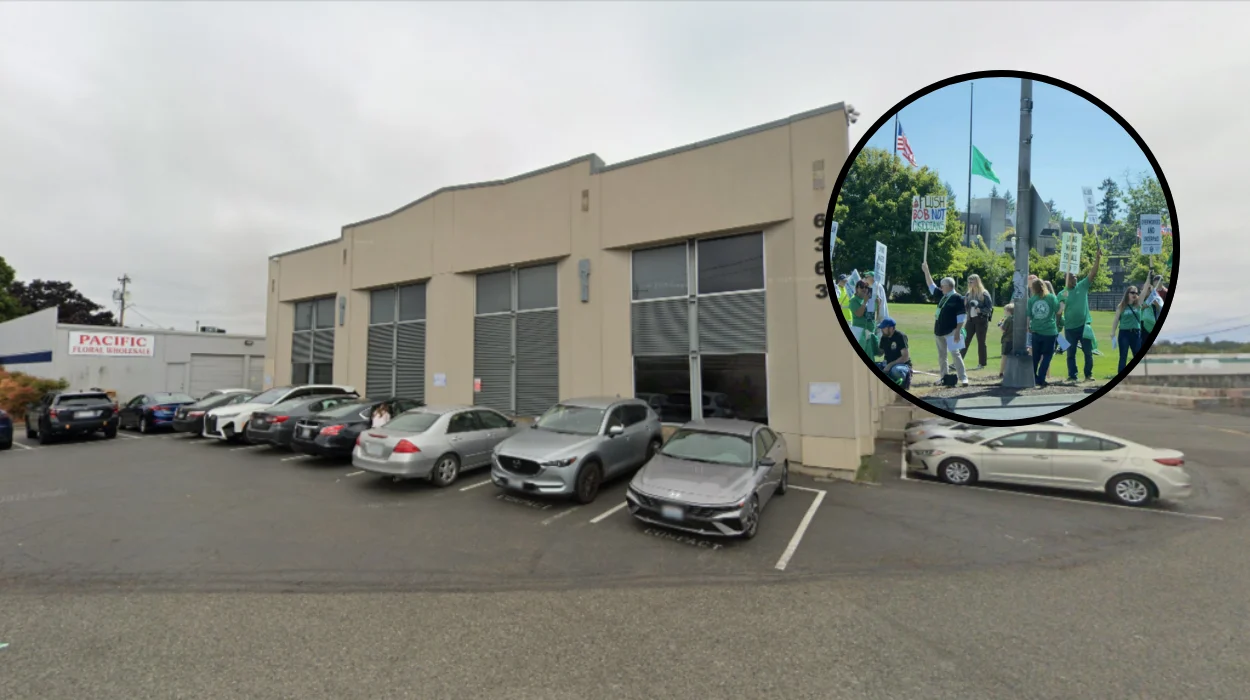
The demonstrations brought visible energy and noise to state properties, municipal centers, and highway agencies. Roughly 100 employees from various state agencies lined Capitol Way in Olympia, facing the domed Legislative Building where Governor Ferguson’s office resides. Participants waved picket signs bearing slogans such as “Living wages for all,” shook cowbells, and chanted continuously while passing motorists sounded their horns in solidarity.
Similar scenes played out across more than 125 worksites statewide. Sam Brown, an employee with more than a decade of service at the state Department of Agriculture, travelled from his office in Tumwater to join the Olympia demonstration. As reported by the Daily Fly, Brown shared his perspective on the administration’s posture, stating that
“I think they are just testing our unity. That’s what it seems like to me. We understand the state has limitations. But there are ways to try to deal with it.”
The walkouts also drew backing from broader labor coalitions. The Washington State Labor Council, AFL-CIO, which represents over half a million union members statewide, threw its weight behind the movement, posting on social media ahead of the event:
“We’re walking out with state workers on Monday to support their fight for a fair contract! Actions are planned in dozens of locations statewide, and everyone is invited to support the public workers we all rely on.”
What Specific Issues Are Fueling the Conflict?
Beyond general wage adjustments, union organizers emphasize that systemic workplace issues are driving high staff turnover. According to data from the Washington State Office of Financial Management, average annual staff turnover hovered just under 10% over the past four fiscal years, with resignations making up the vast majority of departures.
Union leaders argue that previous wage increases—including a 3% general wage increase in July 2025 and a subsequent 2% raise—have failed to offset skyrocketing inflation, housing costs, and swelling caseloads for front-line workers. WFSE President Mike Yestramski, who serves as a psychiatric social worker at Western State Hospital, previously emphasized the stakes of the negotiations. As reported by Mario Lotmore of the Lynnwood Times, Yestramski noted that
“Years of cuts and ballooning workloads for employees in high-stakes jobs, like protecting vulnerable children, maintaining public safety, and caring for intellectually and developmentally disabled folks, is a recipe for avoidable suffering and billions in liability.”
Yestramski added that members simply want to be compensated enough to
“pay their rent, buy enough groceries to feed their family.”
Fuerston highlighted that while a tentative health care agreement was reached recently—ensuring the state continues to cover 85% of monthly employee premiums at a cost of $348.5 million for the next biennium—other core bargaining points remain heavily contested. Fueston noted that the state has shown immense reluctance to move on proposals concerning workplace safety, staff discipline, and streamlined grievance processes that could actually save taxpayer money.
What Happened in Previous Budget Cycles?
Tensions between state unions and the executive branch are not entirely new. During budget planning phases, clashes over austerity measures have routinely sparked friction. In 2025, Governor Ferguson proposed state worker furloughs as a method to bridge fiscal gaps, but lawmakers ultimately shelved the proposal following swift, aggressive pushback from labor unions.
Reflecting on those past battles, Ashley Fueston of the WFSE drew a firm line regarding any attempts to revive similar cost-saving mechanisms. As reported by the Daily Fly, Fueston asserted that “We’re not going to agree to furloughs. We’re not going to agree to cuts. We’re not going to agree to takeaways. That’s not acceptable.”
Details surrounding the October 1 legal deadline continue to amplify urgency for both sides. Under state statutory guidelines, labor unions must ratify agreements by this specific date for the terms to be officially factored into the governor’s upcoming budget proposal. Missing this crucial cutoff can result in existing contracts being rolled over without any wage adjustments—a scenario that previously forced public employees to wait months for retroactive adjustments. With talks down to their final month, union leadership has warned that Monday’s walkout is only a precursor, with an even larger demonstration scheduled at the state Capitol if meaningful compromises are not finalized.