Key Points
- Contract Overview: HD Hyundai Samho has signed a turnkey contract with Washington United Terminals Inc. (WUT) to supply four port cranes to the Port of Tacoma.
- Equipment Specifications: The order comprises two new quay cranes (to replace aging units) and two new yard cranes to boost cargo handling efficiency.
- Delivery Schedule: HD Hyundai Samho is responsible for the design, manufacturing, transportation, installation, and commissioning, with full delivery slated for 2028.
- Strategic Context: The deal marks a practical rollout of the Korea–U.S. shipbuilding cooperation framework, designated as the Make American Shipbuilding Great Again (MASGA) project.
- Corporate Ties: WUT is the U.S. terminal operator subsidiary of HMM, South Korea’s primary container shipping line.
- Historical Track Record: HD Hyundai Samho previously supplied four quay cranes to WUT in 1999 and has delivered 20 port cranes across major U.S. ports since 1985.
- High-Level Diplomacy: The deal follows a May 2025 meeting between HD Hyundai Chairman Chung Kisun and U.S. Trade Representative Jamieson Greer regarding maritime equipment and shipbuilding collaboration.
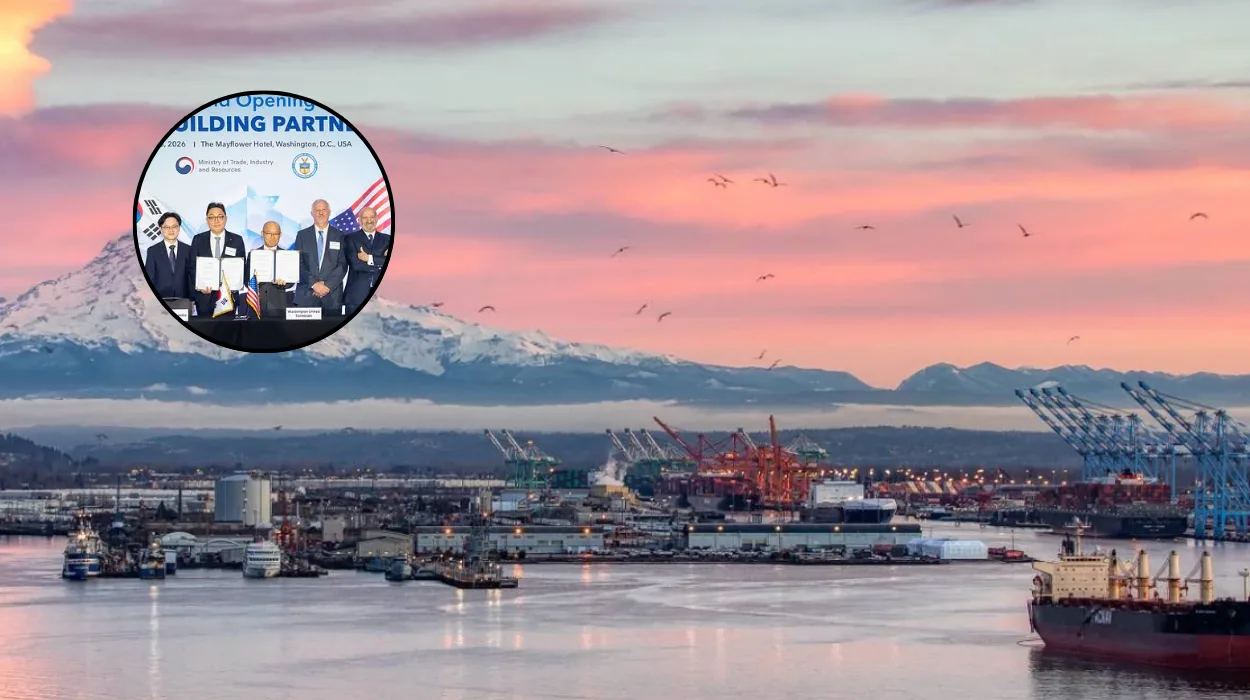
Tacoma (Evening Washington News) July 28, 2026 — As reported by PRNewswire via an official corporate announcement from HD Hyundai, HD Hyundai Samho secured a commercial agreement on Saturday, July 25, 2026, with Washington United Terminals Inc. (WUT) to manufacture and deploy four port cranes at the Port of Tacoma in Washington state.
- Key Points
- What Are the Key Terms of the Port of Tacoma Crane Agreement?
- How Does This Order Fit Into the Korea–U.S. MASGA Project?
- What Experience Does HD Hyundai Samho Bring to U.S. Port Infrastructure?
- Background of the Particular Development
- Prediction: How This Development Can Affect the Maritime Logistics and Terminal Operations Sector
What Are the Key Terms of the Port of Tacoma Crane Agreement?
According to details released by the media team at PRNewswire, the contract was structured as a comprehensive turnkey project. Under this structure, HD Hyundai Samho—the shipbuilding and heavy equipment subsidiary of HD Hyundai—will oversee the complete lifecycle of the machinery, including engineering design, fabrication, maritime transportation, on-site erection, and final operational commissioning.
The equipment package consists of two high-capacity quay cranes and two automated yard cranes. All four units are scheduled to be fully installed and operational by 2028.
The primary client, Washington United Terminals Inc. (WUT), functions as the North American terminal operating subsidiary of HMM (formerly Hyundai Merchant Marine), South Korea’s flagship ocean liner carrier. WUT currently manages eight quay cranes at its Port of Tacoma terminal facility.
The newly ordered equipment will directly replace two aging quay cranes originally installed during earlier phases of terminal development, while adding two additional yard cranes to increase container yard handling density.
As detailed in the official press release, the infrastructure overhaul forms part of a broader terminal modernisation project. The initiative aims to upgrade aging dockside machinery, expand berth capacity to accommodate ultra-large container vessels (ULCVs), and reduce vessel turnaround times at the Pacific Northwest gateway.
How Does This Order Fit Into the Korea–U.S. MASGA Project?
As reported in the corporate announcement distributed by PRNewswire, HD Hyundai frames this commercial transaction as an active launching pad for the Korea–U.S. shipbuilding cooperation initiative, officially referenced as the “Make American Shipbuilding Great Again” (MASGA) project.
The deal highlights a growing alignment between South Korean heavy industrial manufacturers and U.S. maritime supply chain strategies. As reported by PRNewswire, an unnamed official representing HD Hyundai Samho stated:
“The port crane order for the Port of Tacoma is a meaningful achievement that reflects the recognition of our technological expertise and quality competitiveness, built through a wide range of domestic and international projects. Going forward, we will support the MASGA project through the development of eco-friendly, high-efficiency port equipment.”
The press release further noted that this commercial milestone builds on high-level bilateral discussions conducted in mid-2025.
As detailed by PRNewswire reporting, HD Hyundai Chairman Chung Kisun met with United States Trade Representative Jamieson Greer in May 2025.
During that meeting, Chairman Chung formally presented HD Hyundai Samho’s crane manufacturing track record and proposed strategic avenues for industrial collaboration between South Korea and the United States to address port infrastructure deficits.
What Experience Does HD Hyundai Samho Bring to U.S. Port Infrastructure?
According to historical operational data cited by PRNewswire, the Port of Tacoma contract relies on a multi-decade supplier relationship between HD Hyundai Samho and North American port authorities.
HD Hyundai Samho’s initial engagement with Washington United Terminals dates back to 1999, when the manufacturer supplied four of the eight quay cranes currently operating at the Tacoma terminal. Since entering the U.S.
heavy port equipment sector in 1985, HD Hyundai Samho has fabricated and delivered a total of 20 port cranes to key maritime gateways across the U.S. Atlantic and Pacific coasts.
The company stated via PRNewswire that securing the modern Tacoma contract was made possible by its established familiarity with U.S.
terminal operating environments, compliance with federal maritime safety codes, and continuous operational performance from its legacy equipment delivered at the site 27 years prior.
Background of the Particular Development
The supply deal between HD Hyundai Samho and Washington United Terminals comes against the backdrop of heightened U.S. federal focus on maritime logistics security, port resilience, and supply chain integrity.
Over recent years, federal agencies and port authorities across North America have prioritised the physical and digital security of critical infrastructure.
Port cranes—particularly ship-to-shore (STS) gantry cranes—represent the single point of failure in container terminal operations.
Consequently, equipment procurement decisions are increasingly scrutinized for manufacturing quality, cybersecurity standards, operational reliability, and geopolitical risk mitigation.
Concurrently, global container shipping line alliances have deployed increasingly large vessels, placing pressure on container terminals to modernise berth infrastructure.
Terminals constructed in the late 1990s and early 2000s were engineered for smaller vessel classes; their legacy cranes lack the reach, height, and hoisting speeds required to clear modern stacked container ships.
To remain competitive against regional rivals, operators like WUT at the Port of Tacoma must systematically replace legacy cranes with larger, higher-capacity models capable of handling greater container volumes per hour.
Furthermore, South Korean industrial conglomerates have sought closer integration with U.S. industrial policy.
The MASGA project represents a joint effort to merge South Korea’s advanced commercial shipbuilding, steel fabrication, and engineering capabilities with North American trade requirements, establishing reliable supply lines for commercial maritime equipment.
Prediction: How This Development Can Affect the Maritime Logistics and Terminal Operations Sector
The delivery of four modern cranes to the Port of Tacoma by 2028 is expected to create tangible operational, economic, and strategic impacts across several key industry segments.
For Washington United Terminals, HMM, and cargo owners utilizing the Port of Tacoma, replacing legacy equipment with high-efficiency quay and yard cranes will directly increase berth productivity. Modern quay cranes offer higher outreach capacity and faster trolley speeds, allowing the terminal to service larger container ships with fewer delays.
This increased efficiency reduces vessel dwell times at berth, lowers fuel consumption for docked ships, and creates a smoother flow of cargo moving into intermodal rail and trucking networks across the U.S. Pacific Northwest.
This order reinforces South Korea’s role as a trusted equipment provider for critical North American infrastructure.
As port security and supply chain resilience remain top priorities for the U.S. government, non-domestic equipment suppliers face intense scrutiny regarding software integration and operational safety.
HD Hyundai Samho’s successful acquisition of this contract—backed by its 40-year track record in the U.S.—positions South Korean manufacturers as a primary alternative for U.S. terminal operators seeking to replace aging equipment while meeting strict federal operational guidelines.
From an industrial policy perspective, the successful execution of the Tacoma project through 2028 will likely serve as a blueprint for future MASGA-branded ventures.
Demonstrating that South Korean heavy industrial firms can deliver complex, turnkey maritime infrastructure projects in U.S. ports provides a framework for broader cooperation.
This may pave the way for additional joint ventures in commercial shipbuilding support, vessel repair networks, offshore energy infrastructure, and zero-emission port equipment across the United States.