
Key Points
- Bilateral Pact: The United States plans to announce a 123 Agreement with Saudi Arabia to help establish a civil nuclear programme in the kingdom.
- Economic Impact: The Trump administration expects the 30-year deal to generate billions of dollars for the American nuclear energy sector.
- Potential Enrichment Facility: Provisions reported by media suggest American firms could build a uranium enrichment plant in Saudi Arabia if a joint feasibility study approves it.
- Absence of Strict Safeguards: Sources report the deal omits the “Gold Standard” (banning domestic enrichment and reprocessing) as well as the International Atomic Energy Agency’s (IAEA) “Additional Protocol.”
- Congressional Review Window: Once submitted to the US Congress, lawmakers have 90 days of continuous session to review the pact, requiring a two-thirds majority in both houses to override a presidential veto and block it.
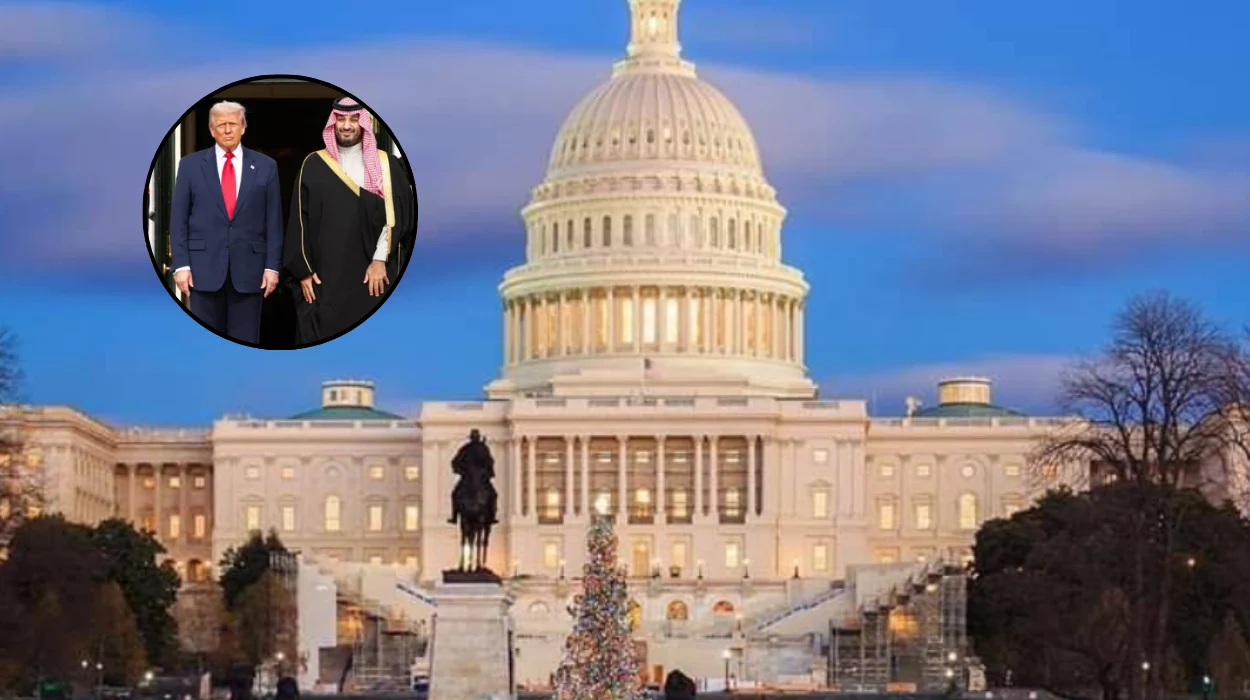
Washington (Evening Washington News) July 22, 2026 – The United States government is preparing to formally announce a major bilateral agreement with Saudi Arabia that would grant the Gulf nation access to a civilian nuclear programme. The deal, which comes against the backdrop of renewed regional conflicts involving Houthi forces in Yemen, marks a significant diplomatic and industrial shift in US-Middle East nuclear policy. As reported by two unnamed US officials in The New York Times, the Trump administration plans to formally sign and unveil the pact on Wednesday, presenting it as a multi-billion-dollar commercial boon for the American nuclear industry.
- Key Points
- What Are the Key Terms of the Proposed US-Saudi Civil Nuclear Agreement?
- Why Are Arms Control Experts Raising Proliferation Concerns Over the Pact?
- How Will the Congressional Approval Process Work Under Section 123?
- What Is the Background of Washington’s Civil Nuclear Negotiations With Riyadh?
- What Are the Predictions for How This Civil Nuclear Pact Will Affect Key Stakeholders?
What Are the Key Terms of the Proposed US-Saudi Civil Nuclear Agreement?
According to reporting by The Wall Street Journal, the bilateral pact is structured to last for 30 years. A notable provision within the text outlines that American industrial firms could build a uranium enrichment facility within Saudi Arabia, provided that a joint feasibility study determines such a facility is warranted.
As reported by Reuters, two independent sources confirmed that the administration intends to submit a document known as a 123 Agreement to the US Congress within days or up to a week.
The document will be signed by US Energy Secretary Chris Wright and Saudi Energy Minister Prince Abdulaziz bin Salman, following up on a preliminary framework signed between the two officials in Riyadh last year.
Named after Section 123 of the US Atomic Energy Act of 1954, a 123 Agreement is the mandatory legal prerequisite for the US government and private American enterprise to collaborate with foreign entities on developing a commercial nuclear energy infrastructure.
As cited by sources familiar with the matter, the agreement provides a legal framework for cooperation across the full nuclear fuel cycle, which encompasses uranium enrichment.
However, one source emphasized to Reuters that the text does not legally obligate the United States to transfer enrichment capabilities or technology directly to Saudi Arabia.
Why Are Arms Control Experts Raising Proliferation Concerns Over the Pact?
The reporting highlights significant concerns among nuclear proliferation experts and lawmakers regarding the specific regulatory guardrails—or lack thereof—included in the text.
As reported by sources speaking to Reuters on condition of anonymity, the accord does not incorporate the “Gold Standard” nonproliferation framework.
The Gold Standard explicitly legally binds a signatory nation from enriching uranium or reprocessing spent nuclear fuel—the two primary technological pathways to producing weapons-grade material.
Furthermore, sources indicated that the agreement excludes the IAEA’s “Additional Protocol,” a voluntary mechanism that grants UN inspectors enhanced, intrusive oversight capabilities, including the authority to conduct snap inspections at undeclared facilities.
These exclusions contrast with previous statements made by US Energy Secretary Chris Wright, who previously stated that the preliminary agreement was not focused on enrichment and maintained all nonproliferation standards under the Atomic Energy Act, describing them as among the strongest globally.
Proliferation advocates have frequently highlighted public statements made by senior Saudi leadership regarding regional security balance.
As reported by CBS in a 2018 interview, Saudi Crown Prince Mohammed bin Salman explicitly outlined the kingdom’s strategic posture regarding nonproliferation:
“Saudi Arabia does not want to acquire any nuclear bomb, but without a doubt if Iran developed a nuclear bomb, we will follow suit as soon as possible.”
The kingdom has maintained that as a sovereign state, it seeks to reserve the legal right to enrich its domestic uranium resources rather than relying entirely on foreign imports.
How Will the Congressional Approval Process Work Under Section 123?
Once the executive branch formally submits the 123 Agreement to Congress, a statutory review period of 90 days of continuous legislative session begins.
During this window, lawmakers have the opportunity to examine the terms and debate its national security implications.
Under US law, the agreement automatically enters into force upon the conclusion of the 90-day period unless Congress actively passes legislation to block it.
To successfully halt the pact, both the House of Representatives and the Senate would need to pass a joint resolution of disapproval and secure a two-thirds supermajority to override a potential presidential veto.
This legislative barrier presents a steep challenge for critics. However, bipartisan opposition remains plausible.
Many Democrats and select Republicans—including Secretary of State Marco Rubio during his tenure in the US Senate—have historically insisted that any civilian nuclear arrangement with Riyadh must contain strict nonproliferation guardrails to prevent a regional arms race.
What Is the Background of Washington’s Civil Nuclear Negotiations With Riyadh?
To understand the current agreement, it is necessary to examine the diplomatic precedent set in the region over the past two decades.
In 2009, the United States concluded a landmark 123 Agreement with the United Arab Emirates (UAE). In that pact, the UAE agreed to what became known in diplomatic parlance as the “Gold Standard,” voluntarily renouncing domestic uranium enrichment and spent fuel reprocessing in exchange for American technical assistance and technology transfers.
For years, US policymakers attempted to use the UAE agreement as a benchmark template for all subsequent civilian nuclear deals in the Middle East.
However, Saudi officials consistently rejected the Gold Standard condition, contending that their vast domestic uranium reserves justified building an indigenous fuel-cycle infrastructure.
Negotiations across multiple US administrations faced repeated stalls due to this fundamental divergence over domestic enrichment rights, regional security guarantees, and formal diplomatic normalization conditions in the Middle East.
What Are the Predictions for How This Civil Nuclear Pact Will Affect Key Stakeholders?
The formal announcement and eventual implementation of the US-Saudi 123 Agreement are expected to impact several geopolitical, industrial, and regulatory stakeholders:
For American nuclear technology exporters and engineering firms, the agreement opens access to a multi-billion-dollar commercial market.
If American companies secure contracts to construct Saudi reactors and potential enrichment facilities, it could revitalise domestic nuclear supply chains and establish long-term economic ties spanning decades.
If Saudi Arabia establishes a civil nuclear infrastructure with enrichment pathways, it will alter the strategic posture of the Persian Gulf.
Observers anticipate that regional rivals, particularly Iran, will closely monitor the technical capabilities transferred under the joint feasibility study, potentially influencing future nuclear diplomacy and security alignments across the region.
The omission of the Gold Standard and Additional Protocol in a major US bilateral agreement could set a new precedent for international civil nuclear commerce.
Future nations seeking nuclear energy partnerships with global powers may point to the Saudi framework to push back against stringent IAEA oversight standards or bans on domestic fuel enrichment.