Key Points
- Washington, D.C. briefly recorded the worst air quality among major cities globally after a large Independence Day fireworks display.
- Air quality tracking data from IQAir showed the city at or near the top of the global pollution chart for a short window in the early hours of Sunday, July 5.
- Fine particulate matter rose sharply after the fireworks, with one local sensor in the Navy Yard area reaching 212.8 micrograms per cubic metre at around 3 a.m..
- The Environmental Protection Agency’s 24-hour PM2.5 threshold is 35 micrograms per cubic metre, meaning the reading was far above the safe limit.
- City officials issued a Code Red air quality alert, urging residents, especially seniors, children and people with medical conditions, to limit time outdoors.
- The poor air quality followed a record heat wave and a delayed fireworks show that began after a severe thunderstorm.
- By later on Sunday, Washington had dropped far down the global pollution rankings, showing the spike was temporary.
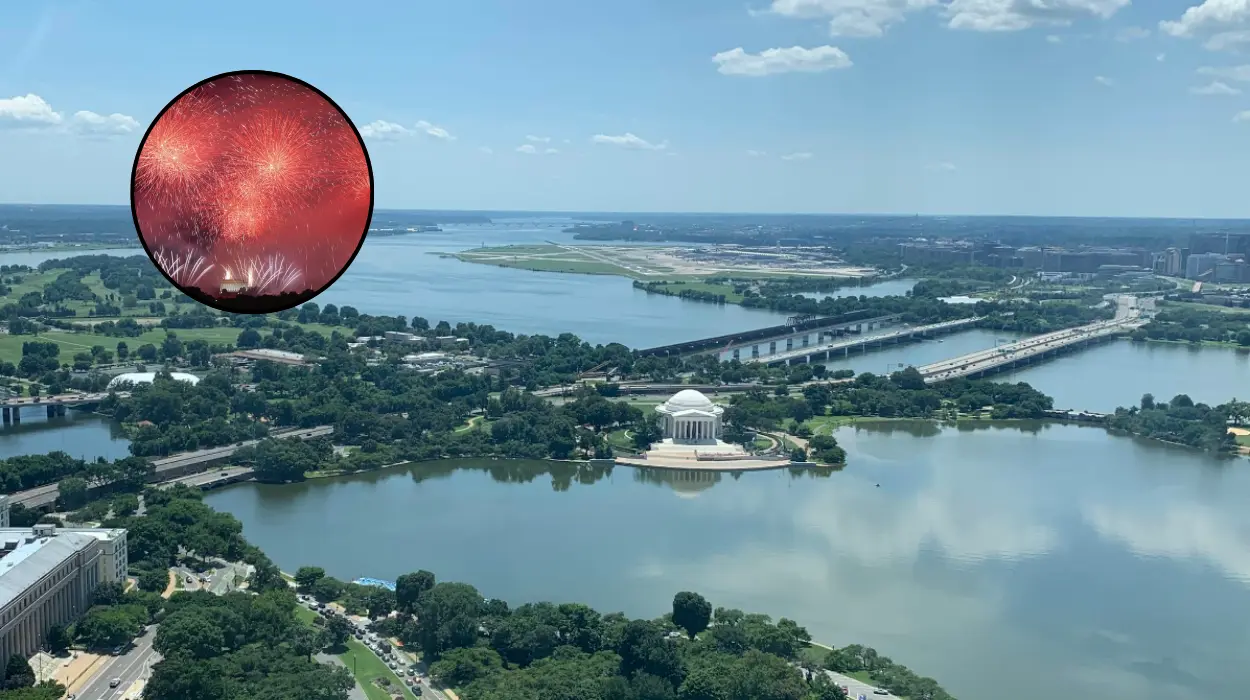
Washington, D.C. (Evening Washington News) July 7, 2026, briefly became the world’s most polluted major city after the Independence Day fireworks display sent fine particulate matter soaring across the capital, according to IQAir data and U.S. air-monitoring readings.As reported by [journalist name not provided in the available source] of The Washington Post, air quality in Washington remained unhealthy for more than 10 hours after the 40-minute fireworks show over the National Mall, with the smoke and pollutants lingering low to the ground instead of dispersing quickly.
The same report said a sensor in the southern Navy Yard neighbourhood recorded a peak of 212.8 micrograms per cubic metre at 3 a.m., which fell into the EPA’s “Very Unhealthy” band.
CNN reported that residents in Washington, DC, briefly experienced the worst air quality of any major city in the world on Sunday, before the city later slipped to a much lower position on IQAir’s list.
The report also noted that officials issued a Code Red Air Quality Alert and advised people to restrict outdoor activity.
How severe was the pollution?
The spike was serious enough to trigger warnings across the District and nearby parts of Maryland and Virginia.
Air quality monitors first detected smaller rises around 8 p.m. local time from community fireworks, before the main display pushed particulate levels much higher later at night.
According to The Washington Post’s reporting, parts of D.C. stayed in the unhealthy range until around 11 a.m. on Sunday, while some areas remained unhealthy for sensitive groups until about 1 p.m.
The report also said the smoke and other pollutants had spread across the region and remained trapped near the ground for hours.
The EPA limit cited in the reporting is 35 micrograms per cubic metre over 24 hours, so the measured peak was far above what health authorities consider safe.
That level of PM2.5 is especially concerning because those particles can enter deep into the lungs.
What was the fireworks display?
The fireworks were part of a major Independence Day celebration tied to the “Freedom 250” event. Reporting said White House-contracted Pyrotecnico aimed for a new world record by launching 850,000 fireworks over roughly 40 minutes.
A separate event page for the celebration noted hydration stations and complimentary water on site, reflecting the large public turnout and the need for safety measures during the gathering.
The fireworks were delayed by more than an hour after a severe thunderstorm, which pushed the launch to just before midnight.
The display also came during a record-breaking heat wave that had already disrupted holiday plans across the United States.
What did officials and monitors say?
City officials responded by issuing air quality warnings and urging residents to stay indoors where possible.
CNN reported that the alert specifically warned the air was unhealthy for seniors, children and people with medical conditions, and that even the general public could experience health issues.
IQAir data showed the pollution spike was temporary, with Washington later falling far down the global rankings after the early-morning peak.
The Washington Post’s reporting suggested the air quality worsened because the smoke lingered after the show rather than clearing quickly, extending the health risk into Sunday morning.
Explore More Local News
Minnesota Brings Crop Art to Trump’s State Fair: Washington DC 2026
U.S. Coast Guard Patrols Potomac Ahead of July 4 Celebrations, Washington D.C. 2026
Background of the development
Fireworks displays often cause short-term increases in PM2.5 because combustion releases fine particles into the air.
In this case, the effect was amplified by the size of the show, the delay caused by weather and the already stressed conditions created by intense summer heat.
The Washington Post reported that environmental scientist Jason Hill reviewed a decade of AirNow readings and said the July 4 pollution levels were comparable to past Independence Day events, but stayed high longer than in previous years.
That context suggests the event was not only a one-night spectacle but part of a broader pattern of holiday fireworks causing short-lived but significant air-quality deterioration.
Prediction for residents
For Washington, D.C. residents, especially children, older adults and people with asthma or heart or lung conditions, events like this are likely to mean more short-term indoor sheltering and greater caution around major fireworks displays.
If large celebrations continue to use similar-scale pyrotechnics, the city may keep seeing brief but sharp pollution spikes during major holiday events.
For people living in the District and nearby suburbs, the practical impact is likely to be clearer air-quality warnings, changes in outdoor plans and a stronger emphasis on monitoring real-time pollution data before spending extended time outside.