
Key Points
- Governor Bob Ferguson has signed an executive order establishing a 26-member Governor’s Economic Development Council to address Washington state’s slowing economic growth.
- The advisory panel is tasked with identifying regulatory barriers and drafting a comprehensive, statewide economic development plan by June of next year.
- Washington is facing rising economic headwinds, including slower-than-expected job creation, technology sector layoffs, and an unemployment rate of 5.2%, which sits above the national average.
- Major local businesses are shifting expansions out of state, exemplified by Starbucks expanding operations in Nashville and Janicki Industries launching an 800 million dollar manufacturing facility in Montana.
- The state is facing persistent fiscal challenges, including recent legislative tax hikes, spending cuts, an expected budget shortfall in 2027, and a formal warnings notice from top credit rating agencies.
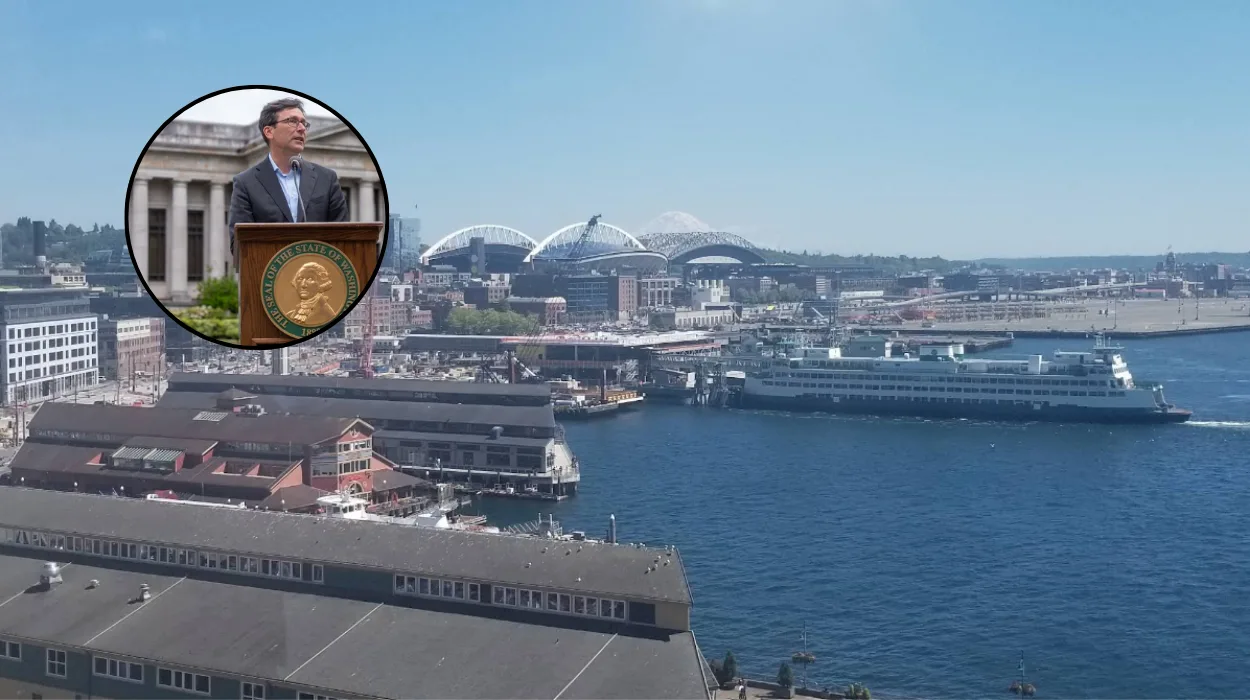
Seattle (Evening Washington News) June 27, 2026 — In a direct administrative intervention to counter systemic slowdowns across the regional economy, Governor Bob Ferguson signed an executive order on Thursday to establish a new 26-person advisory panel, named the Governor’s Economic Development Council, tasked with restoring the state’s fiscal competitiveness. The administrative action follows consecutive legislative sessions marked by tax increases and spending cuts implemented by Democratic lawmakers and the executive branch to plug consecutive budget shortfalls, with another multi-million-dollar gap projected to hit the state repository by 2027. Under the directives of the newly signed order, the panel will assess persistent regulatory challenges and formulate a comprehensive, statewide economic development strategy due by June of next year to prevent further corporate flight and stabilize local job markets.
- Key Points
- Why Is Governor Ferguson Forming a New Economic Development Council?
- What Economic Stress Signals Led to This Advisory Intervention?
- How Serious Are Washington State’s Fiscal Misalignments?
- Are Neighboring Blue-State Competitors Exploiting These Economic Cracks?
- Background of the Particular Development
- Prediction
Why Is Governor Ferguson Forming a New Economic Development Council?
As reported by political correspondents for the Washington State Standard, Governor Bob Ferguson enacted the executive order creating the 26-member advisory group to find concrete solutions for what analysts describe as structural warning lights flashing across the statewide marketplace.
The primary mission assigned to this broad panel of experts involves the formulation of actionable policy recommendations to market Washington as a premier destination for out-of-state corporate investments, alongside a thorough audit of the domestic regulatory landscape.
According to official executive documentation released by the Governor’s Office, the newly appointed council must deliver its finalized statewide economic development plan by June next year, focusing heavily on eliminating operational hurdles.
The administrative pivot highlights growing executive anxiety over a series of high-profile corporate relocations and expansion deviations that have dented the state’s long-standing reputation as an unshakeable hub for corporate innovation and commercial enterprise.
What Economic Stress Signals Led to This Advisory Intervention?
As documented in recent macroeconomic briefs published by the Washington State Standard, local employers successfully added jobs during the late spring cycles, yet the state’s headline unemployment rate has remained stubbornly stuck at 5.2%. This figure places Washington significantly above the national unemployment average, revealing underlying vulnerabilities within regional hiring patterns.
The labor market strain is further compounded by a continuous stream of mounting layoffs throughout the highly influential technology sector, which has historically served as the primary engine for the region’s affluent tax base and white-collar employment growth.
Furthermore, commercial vulnerabilities are altering long-term corporate strategies, as evidenced by a comprehensive member survey published by the Association of Washington Business (AWB). The empirical data gathered in the AWB Spring 2026 Employer Survey indicates that an increasing percentage of local business owners are actively considering moving substantial portions of their operations outside state borders.
The psychological and symbolic impact of these economic cracks was felt severely across regional commercial sectors following the recent high-profile decision by Seattle-born corporate giant Starbucks to bypass its home state in favor of expanding major corporate facilities in Nashville, Tennessee.
How Serious Are Washington State’s Fiscal Misalignments?
As reported by financial policy journalists for the Washington State Standard, the establishment of the Governor’s Economic Development Council coincides with deep structural challenges within the Olympia legislative chambers, where lawmakers have exhausted a series of short-term fiscal options.
To balance consecutive state budgets amidst lower-than-anticipated tax revenues, Democrats and Governor Ferguson have relied on a combination of controversial tax hikes and deep department-level spending cuts. Despite these measures, fiscal transparency reports confirm that another substantial budget gap looms heavily over the state’s 2027 fiscal projections.
The long-term sustainability of these budgetary maneuvers has attracted scrutiny from national financial watchdogs. As detailed in specialized coverage by the Washington State Standard, a top credit rating agency recently put the state of Washington on formal notice regarding its financial health.
The Wall Street credit evaluators specifically cited the state’s repeated reliance on temporary, one-time accounting maneuvers to execute its delicate fiscal balancing acts in Olympia, warning that a failure to establish structural revenue stability could threaten Washington’s high-grade credit standing and increase borrowing costs for future public infrastructure.
Are Neighboring Blue-State Competitors Exploiting These Economic Cracks?
The domestic regulatory and tax pressures building within Washington have increasingly turned the state into a prime target for aggressive recruitment campaigns led by out-of-state political executives.
As reported via official press releases issued by the Montana Governor’s Office, Montana Governor Greg Gianforte recently toured commercial corridors explicitly touting his state as an ideal destination for companies seeking an immediate alternative to what he characterized as
“high-tax, high-regulation blue states.”
This competitive rhetoric materialized into a tangible financial loss for the Pacific Northwest industrial ecosystem when Washington-based manufacturer Janicki Industries announced that it had selected Great Falls, Montana, for an extensive 800 million dollar manufacturing facility expansion.
The relocation of such a massive capital investment directly underscored the core warning delivered by regional business leaders: without regulatory relief and tax predictability, Washington risks losing its premier manufacturing and technology institutions to aggressive, business-friendly states positioned across the Intermountain West.
Background of the Particular Development
The creation of the Governor’s Economic Development Council represents a fundamental shift in how the executive branch under Governor Bob Ferguson approaches regional commerce, moving from an era of aggressive regulatory expansion to one of calculated defensive consolidation.
Over the past decade, Washington state built an economic model heavily reliant on a booming tech sector led by Microsoft and Amazon, alongside aerospace giants and global retail brands.
This rapid growth allowed legislative majorities in Olympia to enact ambitious environmental regulations, workplace mandates, and targeted tax structures, including the capital gains tax, while assuming commercial expansion would continuously outpace governance costs.
However, the post-pandemic macroeconomic landscape fundamentally shifted this dynamic, exposing structural faults in the state’s revenue dependency model. As remote work decoupled tech workers from physical offices in King County, corporate real estate values declined, and tech sector hiring contracted globally.
The state’s aggressive regulatory frameworks, which were easily absorbed during periods of double-digit economic growth, began to weigh heavily on mid-sized industrial corporations and smaller commercial entities.
The loss of Janicki Industries’ 800 million dollar project to Montana and the shifting footprint of Starbucks are not isolated incidents, but rather the culmination of a multi-year trend where the high cost of doing business in Washington has forced corporate boards to diversify geographically, eroding the state’s tax base exactly as federal pandemic relief funding evaporated.
Explore More Local News
Washington Gas Tax Rises Amid Severe Transportation Budget Shortfalls, Olympia 2026
American Freedom Initiative Independence Day Event Washington D.C. 2026
Prediction
The establishment of this 26-member council will directly affect the statewide business community, local labor forces, and regional taxpayers over the coming twenty-four months.
For corporate executives, mid-sized business operators, and industrial stakeholders, the panel’s upcoming June report will likely result in a targeted push for regulatory streamlining, particularly in commercial permitting pipelines and state-level compliance protocols, as the administration attempts to project a more welcoming business environment.
However, because Governor Ferguson remains politically aligned with legislative majorities committed to existing social and environmental programs, the council is highly unlikely to recommend sweeping rollbacks of core labor protections or flagship environmental taxes.
Consequently, for the general working public and regional consumers, this economic balancing act means that while the state may succeed in retaining certain industrial footprints, the structural budget shortfall projected for 2027 will remain a persistent challenge.
If the council’s marketing strategies and regulatory adjustments fail to trigger an immediate acceleration in tech and manufacturing job growth before the 2027 legislative session, everyday residents will likely face a secondary round of public service contractions or localized fee adjustments as Olympia struggles to close the structural revenue gap without downgrading its institutional credit standing.