Key Points
- Ideal Match Conditions: Brilliant sunshine and warm conditions are forecast for Friday’s FIFA World Cup Group D clash between the United States and Australia at Seattle Stadium.
- Kickoff Temperatures: Conditions at the scheduled noon kickoff are expected to sit comfortably around $75^\circ\text{F}$ ($24^\circ\text{C}$), rising steadily toward the low-to-mid $80\text{s}^\circ\text{F}$ (around $28^\circ\text{C}$) as the match concludes.
- Brief Weekend Dip: A weak, passing weather system will introduce patchy morning clouds and slightly cooler, mid-$70\text{s}^\circ\text{F}$ temperatures on Saturday.
- Solstice and Father’s Day Heat: Sunny skies return swiftly on Sunday for the summer solstice and Father’s Day, pushing regional temperatures back into the lower $80\text{s}^\circ\text{F}$.
- Elevated Fire Risks Ahead: A robust high-pressure ridge is building for early next week, threatening to bring widespread late-June heat near $90^\circ\text{F}$ along with heightened fire dangers due to parched vegetation.
- High-Stakes Group D Match: Both international squads enter the Seattle fixture on the back of opening-round victories, with the US Men’s National Team defeating Paraguay 4-1 and Australia securing a 2-0 win over Türkiye.
Seattle (Evening Washington News) June 19, 2026 – Clear skies and brilliant sunshine are set to grace the Pacific Northwest today, providing what meteorologists call absolute textbook conditions for the highly anticipated 2026 FIFA World Cup encounter between the United States and Australia. As reported by Meteorologist Abby Acone of Fox 13 Seattle, local weather models indicate that spectators heading out to the stadium will encounter nothing more than a few scattered, passing clouds. The afternoon is projected to transform into a warm, sun-drenched showcase, with daytime highs comfortably settling into the low-to-mid $80\text{s}^\circ\text{F}$.
The timing of this weather dynamic is particularly crucial for the local municipal infrastructure, as today’s high-stakes sporting event directly coincides with the regional observance of the Juneteenth federal holiday.
How Will the Matchday Weather Progress for Fans and Players?
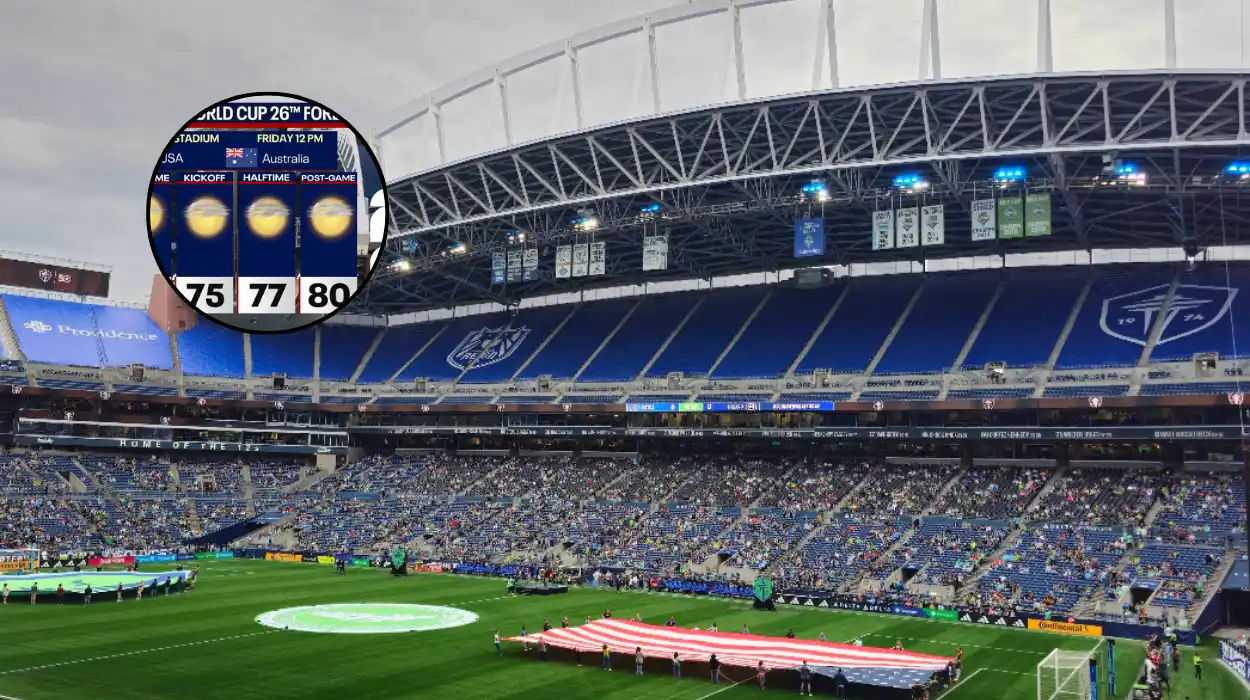
According to detailed atmospheric data published by the West Seattle Blog, the match is scheduled to kick off under clear skies around 12:00 p.m. local time (Pacific Time).
Weather forecasting models interpreted by the Fox 13 Seattle weather team show that ambient temperatures will hover near a pleasant $75^\circ\text{F}$ when the opening whistle blows.
However, as the match progresses through the second half, a steady warming trend will take hold. Temperatures are expected to approach the $80^\circ\text{F}$ mark by the time the final whistle sounds.
Local health authorities and weather experts have urged the thousands of fans filling Seattle Stadium to prepare adequately for the sustained direct sunlight. Stadium attendees are advised to prioritize hydration, apply high-factor sunscreen, and actively seek out shade within the concourses wherever possible to mitigate the risk of heat exhaustion.
What Changes Are Expected in the Weekend Forecast?
Beyond the immediate excitement of Friday’s international fixture, Western Washington is preparing for a minor atmospheric shift before a more intense summer pattern establishes itself. The Fox 13 Seattle weather team reports that a relatively weak and transient weather system will clip the coastal boundaries of the Pacific Northwest on Saturday morning.
This system is expected to reintroduce the familiar regional pattern of morning stratus clouds, which will temporarily suppress temperatures.
Saturday’s afternoon highs are forecast to experience a modest dip, topping out in the mid-$70\text{s}^\circ\text{F}$ before clearing away.
However, this cooler interlude will be brief. By Sunday, which marks both the official arrival of the summer solstice at 1:24 a.m. and the national celebration of Father’s Day, the high-pressure system will reassert its dominance. The region can expect a return to unbroken, bright sunshine with afternoon temperatures climbing safely back into the lower $80\text{s}^\circ\text{F}$.
Why Are Authorities Issuing Fire and Heat Warnings for Next Week?
While the current conditions are being lauded as excellent for outdoor recreation and international football, meteorologists are casting a cautious eye toward the upcoming workweek.
As documented by the regional forecasting desk of Fox 13 Seattle, the center of a strong, highly stable ridge of high pressure—which had previously been idling safely out over the waters of the Pacific Ocean—is projected to drift directly overhead by Monday and Tuesday.
This meteorological shift will usher in the first widespread, intense summer heatwave of the season for Western Washington. Temperatures on Monday are expected to surge rapidly into the upper $80\text{s}^\circ\text{F}$, with some inland microclimates potentially flirting with the $90^\circ\text{F}$ threshold.
Consequently, emergency management agencies are raising alarms regarding elevated regional fire dangers. The combination of rapidly drying surface vegetation, unseasonably warm afternoon temperatures, and a sharp drop in relative humidity levels has prompted public safety officials to ask residents to exercise extreme caution with any outdoor ignition sources.
Furthermore, those planning to spend extended periods outdoors early next week are being strictly reminded to take frequent breaks in air-conditioned spaces.
What Are the Competitive Stakes for the USA and Australia?
The flawless weather serves as a dramatic backdrop for a crucial sporting fixture that carries immense implications for Group D of the 2026 FIFA World Cup. As reported by the Fox Sports football writing staff, both national teams arrived in Seattle riding waves of momentum following highly successful opening-round performances.
The co-hosts, the United States Men’s National Team (USMNT), delivered an electric performance in their first tournament match, defeating a resilient Paraguay side by a commanding scoreline of 4-1. In that opening fixture, American forward Folarin Balogun proved to be in lethal form, netting two goals, while midfield star Gio Reyna also found the back of the net to thrill the home crowd.
On the other side of the pitch, the Australian national team, affectionately known as the Socceroos, enters the match with equal confidence.
According to official media statements released by the communications team at Socceros.com.au, the Australian squad commenced their World Cup campaign in Vancouver, Canada, where they registered a disciplined 2-0 victory over Türkiye.
The Australian goals were provided by the rising talent Nestory Irankunda in the 27th minute and a composed second-half strike by Connor Metcalfe in the 75th minute.
This historic Friday match in Seattle marks only the fifth time these two nations have faced off in senior men’s international football, and notably, it represents their first-ever meeting on the prestigious World Cup stage.
Background of the Seattle World Cup Matches
The selection of Seattle as a host city for the expanded 2026 FIFA World Cup represents the culmination of a multi-year municipal and state campaign to showcase the Pacific Northwest as a premier global soccer hub.
Historically known for its deeply rooted soccer culture—anchored by the passionate fanbase of the MLS franchise Seattle Sounders FC—the city underwent extensive infrastructural reviews by FIFA technical committees to ensure compliance with international tournament requirements.
Securing high-profile matches like the United States versus Australia fixture required significant capital investments, including advanced security measures, city-wide beautification initiatives, and transit upgrades designed to move tens of thousands of international visitors smoothly between downtown fan zones and the stadium complex.
Furthermore, the region’s unique maritime climate has historically played a significant role in scheduling logic, with June typically offering the most moderate and reliable playing conditions across North America, avoiding the extreme, oppressive humidity found in Eastern and Southern host venues.
Prediction
The convergence of near-$80^\circ\text{F}$ weather, a major international sporting event, and the Juneteenth holiday is predicted to create a massive wave of dense pedestrian congestion and unprecedented retail demand throughout the Seattle metropolitan grid.
For local commuters and casual transit users, the mid-day kickoff means that traditional Friday afternoon travel windows will be severely disrupted, with light rail networks and highway corridors experiencing heavy delays well into the evening.
Conversely, for hospitality business owners, restaurant operators, and street-level vendors, the clear skies and massive influx of international tourists are predicted to generate record-breaking single-day revenues.
Looking slightly ahead to next week, the predicted surge toward the upper $80\text{s}^\circ\text{F}$ will heavily impact regional energy infrastructure as residential air conditioning units are switched on across a city historically known for low AC penetration.
This sudden shift will require localized power grids to manage increased loads, while agricultural and forestry workers will face strict operational limits due to the rapidly compounding fire risks across Western Washington.