
Key Points
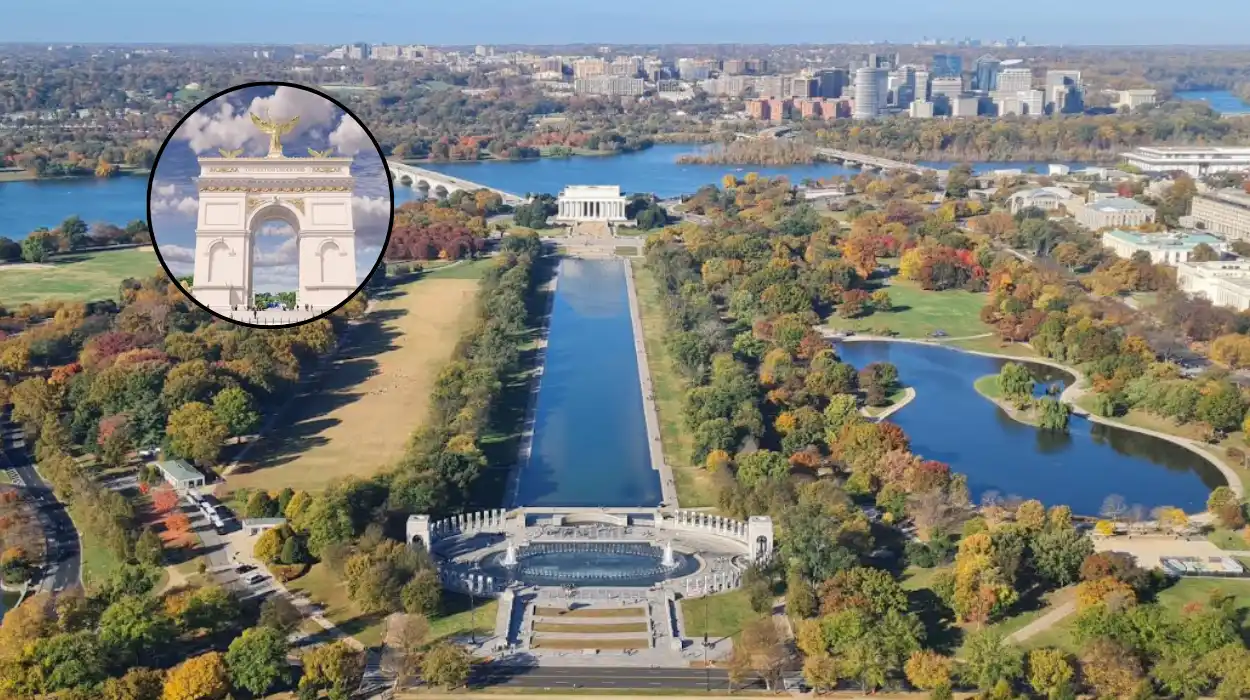
- Design Approval: The US Commission of Fine Arts (CFA) has officially approved the design for a monumental 250-foot-tall neoclassical triumphal arch at an entrance to Washington, DC.
- The “Arc de Trump”: Officially named the Triumphal Arch of Washington, D.C., the massive monument has been nicknamed the “Arc de Trump” by the media following remarks made by US President Donald Trump.
- Scale and Proportions: Designed by Atlanta-based Harrison Design, the structure will stand 250 feet (76 metres) tall—nearly 100 feet taller than the Arc de Triomphe in Paris and twice the height of the nearby Lincoln Memorial.
- Design Modifications: The final approved design retains three gilded figures at the top, including a 60-foot-tall Lady Liberty-like statue and two eagles. However, it eliminates four golden lions at the base and an underground pedestrian tunnel, following previous agency reviews.
- Unprecedented Public Opposition: The commission approved the plans despite reports that 99.5 per cent of nearly 1,000 public comments submitted prior to the vote were entirely unsupportive of the development.
- Legal and Jurisdictional Disputes: Preservation groups, historians, and a coalition of Vietnam War veterans have filed lawsuits in federal court to block construction, arguing the monument disrupts historic Civil War reunification sightlines and requires congressional authorization.
Washington, DC — (Evening Washington News) May 22, 2026 — The United States Commission of Fine Arts (CFA) has officially granted design approval for a highly controversial 250-foot-tall neoclassical monument at the gateway to the nation’s capital. Officially designated as the Triumphal Arch of Washington, D.C.—and colloquially dubbed the “Arc de Trump”—the massive structure was devised by Atlanta-based architecture firm Harrison Design. The federal panel, exclusively composed of appointees of US President Donald Trump, greenlit the revised architectural blueprints on Thursday during a session that disregarded overwhelmingly negative public feedback.
- Key Points
- How big will the Triumphal Arch be compared to other global monuments?
- What interior facilities and external features are included in the approved plans?
- Why did the Commission of Fine Arts alter the original October 2025 proposal?
- Why did the administration refuse to lower the height of the monument?
- Public Opposition and Legal Contestation
- What legal actions have been taken against the Trump administration over the arch?
- Background of the Development
- Prediction
As reported by Helen Stoilas of The Art Newspaper, the final design cleared the panel despite public commentary that was calculated to be “99.5% unfavourable” toward the project.
The decision marks a critical bureaucratic victory for the Trump administration’s broader civic agenda to reshape the architectural fabric of Washington, DC, ahead of the nation’s 250th anniversary of the Declaration of Independence.
How big will the Triumphal Arch be compared to other global monuments?
According to technical documentation published by Parametric Architecture, the approved neoclassical arch will stand 250 feet (76.2 metres) tall from its base to the crown of its topmost sculpture. This specific height is explicitly intended to represent one foot for every year of American independence since 1776.
At these proportions, the structure is slated to become the largest victory arch in the world, surpassing the 220-foot Monumento a la Revolución in Mexico City and the 197-foot Arch of Triumph in Pyongyang, North Korea.
Writing for NPR, journalist Anastasia Tsioulcas reported that the monument will dwarf its immediate structural neighbours on the Potomac River. Standing more than twice the height of the 99-foot-tall Lincoln Memorial, the arch will measure close to half the total height of the 555-foot Washington Monument, fundamentally altering the low-rise visual profile traditionally maintained across the capital skyline.
What interior facilities and external features are included in the approved plans?
As detailed by Dezeen, architectural schematics submitted by Harrison Design reveal three levels of inhabitable space built directly within the massive granite-clad structure. The interior will feature:
- A lower level dedicated entirely to ticketing and visitor reception.
- An elevated interior gallery space for exhibitions.
- A public observation deck situated near the apex, designed to provide visitors with 360-degree panoramic views of the District of Columbia and Northern Virginia.
Externally, the face of the monument will feature heavy neoclassical ornamentation. Large gold lettering will be inscribed across the upper parapets, reading “One Nation Under God” on one side and “With Liberty and Justice for All” on the reverse.
Why did the Commission of Fine Arts alter the original October 2025 proposal?
The design approved on Thursday reflects several key concessions made by architects following an initial conceptual review conducted by the CFA in April 2026. As reported by the Associated Press (AP), the original design included four large golden lion statues flanking the plinths at the base of the monument. CFA commissioners noted during early hearings that lions are not native to the North American continent and did not resonate as authentic emblems of American heritage. Consequently, the golden lions were completely excised from the final blueprints.
Furthermore, the Associated Press noted that the updated plans did away with an eight-foot platform base on which the arch originally stood, as well as an initially proposed 250-foot underground pedestrian tunnel.
Rather than forcing visitors to use a subterranean corridor to access the monument, the approved plans rely entirely on street-level pedestrian crosswalks and synchronised traffic lights to guide visitors safely into the center of the roundabout.
Why did the administration refuse to lower the height of the monument?
Despite structural adjustments to the ground-level layout, the administration flatly rejected requests from panel architects to reduce the height of the upper statuary. As reported by The Art Newspaper, CFA Vice Chairperson James McCrery II had previously recommended removing the three gilded sculptures from the crown of the arch entirely.
Omitting the figures would have brought the total height of the monument down from 250 feet to 166 feet, significantly reducing its visual impact on the surrounding historic landscape.
However, the administration declined to implement the modification. As reported by the Associated Press, Nicolas Charbonneau, a principal director at Harrison Design, formally informed the commissioners that President Trump had evaluated their recommendations
“but elected not to pursue such an option.”
According to Charbonneau, the president insisted on retaining the figures because he desired the monument to serve as a celebration of the living rather than the dead. Explaining the ideological framework behind the decision, Charbonneau stated:
“The intent of the arch is a celebration in America of 250 years of greatest freedom and posterity, for which we can only thank the wisdom of our founders and God’s providence. While it may celebrate the victories of America in various theories of war and the sacrifice of our fallen heroes, it is not primarily a monument dedicated to the dead, but to the living, to this free country, and its perseverance.”
Public Opposition and Legal Contestation
The rapid advancement of the project has generated significant pushback from preservationists, historians, and civic organisations.
Ten distinct representatives, including officials speaking on behalf of the National Trust for Historic Preservation and the DC Preservation League, presented formal testimonies opposing the project during Thursday’s hearing.
As reported by the Associated Press, opponents argue that placing a massive, gilded 250-foot monument on Memorial Circle directly interrupts a historically sacred sightline.
The existing visual axis between the Lincoln Memorial and Arlington House—located at the center of Arlington National Cemetery—was deliberately designed by city planners to symbolize the post-Civil War reunification of the American North and South.
Preservationists state that inserting the “Arc de Trump” directly into this corridor permanently severs that historical symbolism.
The dissent inside the commission room briefly turned personal. The Art Newspaper reported that commissioner Carter, whose parents are both buried within Arlington National Cemetery, was the sole panel member to aggressively advocate for a reduction in the arch’s decorative components. Carter drew a direct contrast between the “gaudy” gilded eagles of the project and the solemn simplicity of the white stone markers marking soldiers’ graves nearby.
Following a temporary recess called by CFA Chairman Rodney Mims Cook Jr., Carter did not return to the session, leaving the remaining four present commissioners to pass the final approval motion unanimously.
What legal actions have been taken against the Trump administration over the arch?
The dispute over the monument has escalated into the federal judicial system. According to The Washingtonian, a coalition consisting of historian groups and Vietnam War veterans has filed a formal lawsuit against the Trump administration in federal court.
The plaintiffs seek an immediate injunction to halt all preliminary development on Columbia Island.
The lawsuit alleges that the administration has unlawfully bypassed federal regulatory frameworks and deliberately avoided seeking congressional authorization.
Because the monument is slated for construction on federal land managed by the Department of the Interior, plaintiffs maintain that the project cannot proceed legally without an explicit act of Congress. Conversely, President Trump has publicly asserted that he maintains full executive authority over the site via the Department of the Interior, rendering congressional intervention unnecessary.
Background of the Development
The origin of the Triumphal Arch dates back to October 15, 2025, when President Trump first unveiled a physical scale model of the structure on his desk in the Oval Office.
When asked directly by CBS News reporter Ed O’Keefe who the monument was being built for, the president responded: “Me. It’s going to be beautiful.” This exchange immediately prompted national media titles to adopt the “Arc de Trump” moniker.
To ensure swift bureaucratic progress on the project, the administration fundamentally overhauled the regulatory bodies tasked with overseeing federal architecture. In October 2025, President Trump dismissed all existing members of the Commission of Fine Arts—a federal agency established in 1910 to advise the government on national design. In January 2026, the president installed seven loyalist appointees to fill the vacancies.
As reported by NPR, the current panel includes commissioners such as Chamberlain Harris, a 26-year-old former executive assistant to the president who possesses no formal background in the arts or architecture.
By populating the CFA with supportive personnel, the administration successfully insulated the project from traditional architectural design competitions, such as the public contest that birthed the St. Louis Gateway Arch in 1947.
Furthermore, investigative research published by Wikipedia indicates that the administration bypassed standard public bidding procedures entirely, utilising a pre-existing federal contract with engineering firm AECOM to begin National Park Service surveying work on Memorial Circle in mid-May 2026.
Prediction
The approval of the Harrison Design plans by the Commission of Fine Arts will directly impact several distinct audiences across the Washington metropolitan area, reshaping infrastructure, legal precedents, and civil tourism.
For local motorists and commuters from Northern Virginia, the construction phase will introduce significant logistical disruptions. Memorial Circle functions as a highly active traffic roundabout connecting the Arlington Memorial Bridge to George Washington Memorial Parkway and Route 50. Inserting a major construction zone into the center of this tight intersection will likely cause prolonged traffic delays for tens of thousands of daily commuters driving into the core of Washington, DC.
For the national preservation and legal community, the impending escalation of the federal veterans’ lawsuit will establish critical legal precedents regarding executive authority over public lands.
If the courts rule in favor of the administration, it will significantly expand the power of the executive branch to unilaterally construct large-scale monuments without legislative oversight from Congress.
Finally, for the millions of tourists and veterans visiting the National Mall, the physical reality of the structure will completely alter the sensory experience of the capital’s commemorative core.
Once construction begins, the sightlines from the steps of the Lincoln Memorial looking west will no longer look out across an unobstructed river landscape toward the quiet green hills of Arlington. Instead, visitors will see a dominant, granite-and-gold monument that re-centers the entire ceremonial axis of the city around the architectural legacy of the Trump presidency.
The project will move to its next regulatory checkpoint on June 4, 2026, when it undergoes formal review by the National Capital Planning Commission.