
Pike Place Market sits in downtown Seattle, Washington. This public market spans nine acres and draws 10 million visitors yearly.
- What Is Pike Place Market?
- Where Is Pike Place Market Located?
- When Did Pike Place Market Open?
- What Are the Must-See Food Spots at Pike Place Market?
- What Attractions Stand Out at Pike Place Market?
- What Foods Define Pike Place Market?
- How Has Pike Place Market Evolved Over Time?
- What Events Happen at Pike Place Market?
- Why Visit Pike Place Market in the Evening?
- What Statistics Highlight Pike Place Market’s Impact?
- How to Navigate Pike Place Market Efficiently?
What Is Pike Place Market?
Pike Place Market is a public farmers’ market in Seattle founded in 1907. It covers 9 acres across multiple levels with over 500 businesses selling fresh produce, seafood, crafts, and prepared foods. Daily visitors exceed 10,000, making it one of the oldest continuously operated public markets in the United States.
Pike Place Market occupies the area between Pike Street and Virginia Street, overlooking Elliott Bay and Puget Sound. The market includes the main arcade, post office, and economy building. Farmers sell directly to consumers to eliminate middlemen costs.
Seattle City Council established the market through Ordinance 16636 on August 5, 1907. Thomas Revelle led the effort amid high food prices and low farmer returns. On opening day, August 17, 1907, six to twelve farmers sold out by lunchtime.
By 1909, the market averaged 64 farmers daily and 300,000 visitors monthly. Demand doubled stalls by 1911. The city added canopies for weather protection, creating the “dry row.” Expansions in 1916 included the Economy Market.
In the 1970s, citizens passed Initiative 25 to save the market from demolition for urban renewal. This vote preserved its historic structures. Today, the market generates $110 million in sales annually from vendors.
Where Is Pike Place Market Located?
Pike Place Market lies at 85 Pike Street in downtown Seattle, Washington, ZIP code 98101. It stretches from Pike Street to Virginia Street along the waterfront. Public transit includes buses, light rail, and the Seattle Monorail nearby.
The market’s main entrance features the Public Market Center sign installed in 1975. Rachel, the bronze piggy bank statue, stands at this entrance since 2008. Visitors insert coins to support market charities.
Coordinates place it at 47°36′31″N 122°20′31″W. Parking includes garages at Virginia Street and Western Avenue. The market connects to the Seattle waterfront via stairs and elevators.
Foot traffic dominates access. Walking from the Seattle Center takes 20 minutes. Ferries from Bainbridge Island arrive five minutes away. Street parking limits availability during peak hours.
When Did Pike Place Market Open?
Pike Place Market opened on August 17, 1907. Seattle farmers brought wagons of produce to the site after City Council approval on August 5, 1907. Operations continue daily except for major holidays like Thanksgiving and Christmas Eve afternoons.
Council President Thomas Revelle proposed the ordinance to address food price complaints. Farmers bypassed commission houses for direct sales. Opening day success led to rapid growth.
By 1921, the City Council rejected relocation proposals. Stalls shifted indoors under new ordinances. The market operated through World War II with rationing adaptations.
Citizens voted in 1971 to block redevelopment. The National Historic District designation followed in 2007 for the centennial. Current hours run 9 a.m. to 6 p.m. weekdays and longer on weekends.
What Are the Must-See Food Spots at Pike Place Market?
Top food spots include Pike Place Fish Market for flying fish and chowder, Piroshky Piroshky for savory pastries, and Matt’s Gourmet Hot Dogs for lamb sausages. Clam chowder at Pike Place Chowder serves 1,000 bowls daily. These vendors draw crowds for fresh Pacific Northwest ingredients.
Pike Place Fish Market tosses 30-pound salmon to customers since 1930. The family-owned business sells Dungeness crab and geoduck clams. Their chowder uses cream, clams, and potatoes.
Piroshky Piroshky bakes Russian hand pies at 1908 Pike Place since 1992. Savory options feature beef cheese, potato cheese, and smoked salmon pate. Sweet varieties include rhubarb with Bavarian cream.
Pike Place Chowder offers New England and Manhattan styles in bread bowls. Lines form for the creamy clam version with bacon and onions. Daily production reaches 500 gallons.
Matt’s Gourmet Hot Dogs specializes in lamb and beef Hebrew-style links. Toppings include caramelized onions and secret sauce. The stand operates from a small counter.
Other examples: Beecher’s Handmade Cheese produces 200 pounds of fresh curds daily; Le Panier French Bakery sells croissants and eclairs.
What Attractions Stand Out at Pike Place Market?
Key attractions feature Rachel the Pig statue, the original Starbucks at 1912 Pike Place, and the Giant Shoe Museum. Fish-throwing at Pike Place Fish adds spectacle. The Post Alley Gum Wall covers 900 square feet.
Rachel, a 500-pound bronze pig, collects coins for preservation since 2008. Visitors rub her snout for luck. The statue replaced earlier versions from 1985.
The first Starbucks opened in 1971 at 1912 Pike Place. It retains the original brown logo and roasts beans on-site. Crowds queue for 45 minutes on peak days.
Giant Shoe Museum displays 25 oversized shoes inside Old Seattle Paperworks. The collection stems from a quest for the world’s tallest man’s shoe. View through peepholes.
Post Alley Gum Wall started in 1993 when theatergoers chewed gum. It spans three alleys with millions of pieces. Cleanings occur annually, removing 2,350 pounds.
What Foods Define Pike Place Market?
Signature foods encompass fresh seafood like salmon and geoduck, piroshkies with savory fillings, clam chowder in bread bowls, and chocolate-covered cherries. Vendors source from Puget Sound fisheries and local farms.
Seafood dominates with king salmon, spot prawns, and oysters. Pike Place Fish handles 1,000 pounds daily. Geoduck clams sell for $30 per pound live.
Piroshkies fill with beef, cheese, onions, and cabbage. Potato onion versions use Yukon Golds. Sweet apple cinnamon pairs with coffee.
Chowder recipes blend hake, clams, and Yukon potatoes. Bread bowls from Grand Central Bakery absorb broth. Pike Brewing Company pairs chowder with craft beer.
Chukar Cherries dips Bing cherries in milk chocolate. Dark chocolate and candied salmon follow. Annual sales exceed 1 million pounds.
How Has Pike Place Market Evolved Over Time?
The market expanded from 10 stalls in 1907 to 500 vendors today. Canopies added in 1911 protected sellers. Initiative 25 in 1971 preserved it from demolition.
Early growth doubled stalls by 1911. The 1916 Economy Market addition housed wholesalers. Sanitary Market formed in the 1920s for social gatherings.
Post-1929 Depression, the city added bathrooms and fish processing. World War II brought victory gardens. Urban renewal threats peaked in 1961 plans.
Voters approved preservation in 1971 with 62% support. Centennial celebrations in 2007 drew 100,000. Recent upgrades include seismic retrofits completed in 2020.
What Events Happen at Pike Place Market?
Seasonal events include What’s In Season celebrations, holiday markets, and fish-throwing demos. Summer features berry tastings; winter offers gingerbread and greenery stalls. Free public events occur weekly.
What’s In Season highlights Pacific Northwest produce monthly. Strawberry Day in May samples 20 varieties. Corn Festival in August roasts ears on-site.
Holiday Magic transforms the market with lights and crafts from Thanksgiving to New Year’s. Vendors sell mulled cider and wreaths. Attendance reaches 50,000.
Fish-throwing occurs hourly at Pike Place Fish. Workers hurl 20-pound kings 20 feet. This tradition boosts sales by 30%.
Why Visit Pike Place Market in the Evening?
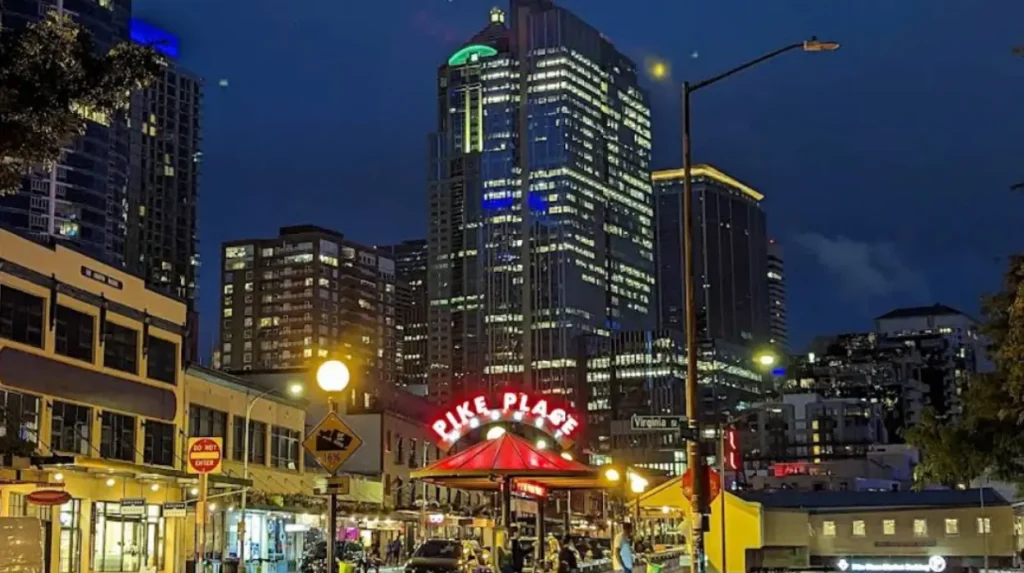
Evening visits from 4 p.m. offer shorter lines at food stalls like Piroshky Piroshky and fewer crowds at attractions. Lights illuminate Rachel and the sign. Sunset views over Puget Sound enhance the waterfront walk.
Markets close at 6 p.m. weekdays, extending to 8 p.m. weekends. Piroshky lines shorten after 4 p.m. Chowder remains hot till closing.
Twilight highlights neon signs and string lights. Gum Wall glows under alley lamps. Pike Brewing serves till 10 p.m. nearby.
Fewer tourists arrive post-5 p.m. Locals dominate for happy hours. Ferries provide evening returns with bay views.
What Statistics Highlight Pike Place Market’s Impact?
The market hosts 10 million visitors yearly, generates $110 million in sales, and employs 10,000 people. It preserves 80 historic buildings and diverts 1 million pounds of food waste annually.
Vendor count reaches 500, with 200 farmers. Seafood sales total 1.5 million pounds yearly. Craft sales add $20 million.
Tourism contributes $2.5 billion to Seattle’s economy. The market’s preservation initiative saved 17 acres. Footprint equals 80 football fields.
Waste programs compost 500 tons yearly. Energy retrofits cut usage 20% since 2015. These efforts maintain operations through 2026 and beyond.

How to Navigate Pike Place Market Efficiently?
Enter at Pike Street sign, head downstairs to fish market, then loop to Post Alley for gum wall. Use elevators for upper levels. Download the Pike Place Market app for maps.
Downstairs levels house crafts and produce. Main arcade runs north-south. Economy Building connects north end.
Three floors total: street level for fish, lower for flowers, upper for views. Stairs number 100 flights. Restrooms locate near fish stalls.
What is Pike Place Market famous for?
Pike Place Market is famous for flying fish, fresh seafood, local farmers, handmade crafts, the original Starbucks, and the Gum Wall. It is one of the oldest continuously operating public markets in the United States.