
Key Points
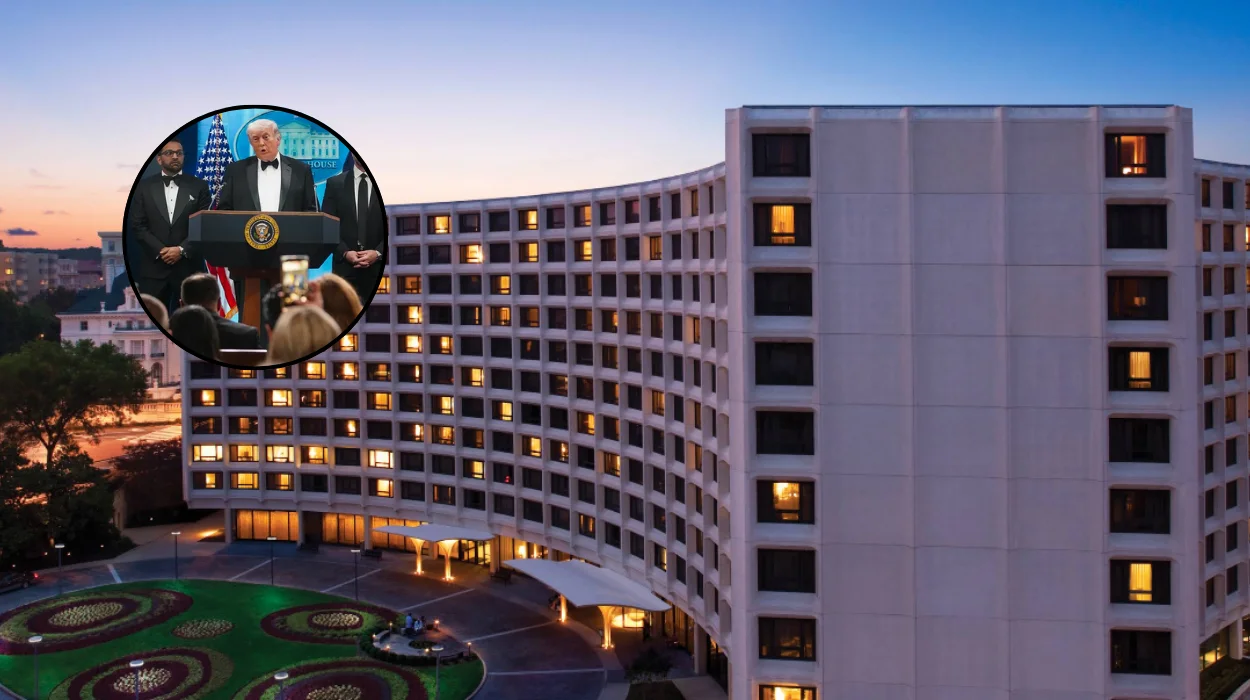
- Shots rang out at the Washington Hilton during the White House Correspondents’ Association Dinner on Saturday night, April 25, 2026, as President Donald Trump sat in the ballroom.
- A suspected gunman, identified as Cole Allen, aged 31, allegedly rushed past a security checkpoint armed with a shotgun, handgun, and multiple knives, leading to a gunfight with Secret Service agents.
- This marks the third apparent assassination attempt on President Trump since 2024, following incidents in Butler, Pennsylvania, in July 2024 and at his golf club in West Palm Beach, Florida, in September 2024.
- The Washington Hilton previously hosted the 1981 assassination attempt on President Ronald Reagan by John Hinckley Jr., who fired six shots from a .22 calibre revolver as Reagan left after addressing AFL-CIO union members.
- In the Reagan incident, lead Secret Service agent Jerry Parr threw Reagan into the limousine; the sixth bullet ricocheted off the vehicle and struck Reagan, while others hit White House press secretary James Brady, D.C. police officer Thomas Delehanty, and Secret Service agent Tim McCarthy.
- President Trump, First Lady Melania Trump, Vice-President JD Vance, Press Secretary Karoline Leavitt, and other administration members were present and rapidly evacuated.
- FBI Director Kash Patel, Acting Attorney General Todd Blanche, and U.S. Attorney for the District of Columbia Jeanine Pirro held a news conference confirming federal charges against Allen, including attempted assassination.
- CNN’s Wolf Blitzer, present at the event, reported witnessing the suspect firing several rounds with a “very serious” weapon.
- President Trump addressed reporters post-incident and shared social media footage and an image of the handcuffed suspect.
- The incident has prompted renewed scrutiny of security protocols at high-profile events, echoing past criticisms from a bipartisan Senate report on the 2024 Butler rally.
Washington, D.C. (Evening Washington News) April 28, 2026 – Shots rang out at the Washington Hilton on Saturday night as President Donald Trump attended the White House Correspondents’ Association Dinner, placing the venue once more at the heart of a presidential security crisis.
- Key Points
- What Happened at the Washington Hilton During the Dinner?
- Why Is the Washington Hilton Linked to Presidential History?
- How Does This Fit Into Recent Assassination Attempts on Trump?
- What Security Questions Are Being Raised?
- Background of the Development
- Prediction: How This Affects Political Event Attendees and Officials
What Happened at the Washington Hilton During the Dinner?
The incident unfolded when a heavily armed suspect, later named Cole Allen, 31, allegedly bypassed a security checkpoint inside the hotel and opened fire, targeting President Trump and administration members in the ballroom.
Secret Service agents intercepted him before he reached the main area, engaging in a gunfight that prompted panic and a swift evacuation of the president, First Lady Melania Trump, Vice-President JD Vance, Press Secretary Karoline Leavitt, and senior officials.
As reported by YouTube channel coverage from an unnamed source, authorities described it as an assassination attempt on President Trump at the high-profile event, with guests noting lax security leading up to the ballroom.
Footage shared on social media by President Trump showed the suspect rushing through a checkpoint before agents opened fire; he was armed with a shotgun, handgun, and multiple knives. CNN anchor Wolf Blitzer, who witnessed the event, stated on air that he saw the suspect firing several rounds with a “very serious” weapon.
FBI Director Kash Patel, Acting Attorney General Todd Blanche, and U.S. Attorney for the District of Columbia Jeanine Pirro confirmed at a news conference that Allen was taken into custody at the scene and faces three federal charges, including one count of attempted assassination against President Trump.
President Trump addressed reporters afterwards, as covered in YouTube footage, confirming the thwarted attempt.
Why Is the Washington Hilton Linked to Presidential History?
This event echoes the hotel’s dark legacy from March 30, 1981, when John Hinckley Jr. fired six shots from a .22 calibre revolver at President Ronald Reagan from 15 feet away as he exited after speaking to AFL-CIO union members in the ballroom. Reagan had ended his remarks with the line:
Del Wilbur, author of “Rawhide Down” – referring to Reagan’s Secret Service code name – detailed how lead agent Jerry Parr, inspired to join the agency after seeing Reagan portray one in a film, threw the president into the limousine. Wilbur noted that Hinckley’s sixth shot
“slaps against the side of the limousine, flattens to the size of a dime, slips through a gap an inch and a half wide between the door and the door frame and hits Reagan.”
Bullets also struck White House press secretary James Brady in the head, paralysing him; D.C. police officer Thomas Delehanty in the back; and Secret Service agent Tim McCarthy in the chest. Presidential historian Tevi Troy, a senior fellow at the Reagan Institute, recalled Reagan’s insistence on walking into George Washington University Hospital despite his condition, collapsing inside to avoid national panic:
“It’s important to remember how close he came to dying… He rallied so the nation wouldn’t panic and think he was dying.”
The 1981 attempt marked a pivotal shift for the Washington Hilton and presidential security protocols.
How Does This Fit Into Recent Assassination Attempts on Trump?
Journalists and commentators have framed the shooting in the context of heightened political violence, noting it as the third apparent attempt on President Trump’s life since 2024.
The first occurred at a rally in Butler, Pennsylvania, in July 2024, where a gunman grazed his ear; a bipartisan Senate report later cited Secret Service communication failures as “predictable, avoidable, and directly linked” to the event, with unresolved deficiencies.
A second attempt took place in September 2024 at Trump’s golf club in West Palm Beach, Florida. Coverage from NPR in 2024 highlighted post-Butler enhancements, including an independent review, bolstered protection for Trump and Vice-President Kamala Harris at the time, and extension to independent candidate Robert F. Kennedy Jr.
Wikipedia’s entry on the incident confirms the Hilton as the second such site for a Trump-era attempt, paralleling Reagan’s. YouTube analysis linked it to ongoing security scares since Trump’s 2024 campaign.
What Security Questions Are Being Raised?
Criticism has focused on event security, with reports of lax measures before the ballroom. President Trump shared an image of the shirtless, handcuffed suspect surrounded by agents.
This mirrors a 2024 Senate report on Butler, where the Secret Service acknowledged findings aligning with its internal review for future prevention.
BBC coverage raised questions about Trump-era protections amid repeated incidents. The rapid response prevented harm, but the breach has renewed calls for scrutiny.
Background of the Development
The Washington Hilton’s role in presidential history stems from its frequent hosting of high-profile events, including the annual White House Correspondents’ Association Dinner, attended by the president, journalists, and officials since 1921.
The 1981 Reagan attempt led to immediate security overhauls, such as metal detectors and expanded perimeters, influencing modern protocols. Recent Trump incidents, including Butler and Florida, prompted a 2024 Senate probe revealing communication gaps, while the Secret Service expanded protections. The 2026 dinner, held amid Trump’s ongoing term post-2024 reelection, underscores persistent vulnerabilities at such venues despite layered defences.
Prediction: How This Affects Political Event Attendees and Officials
This development could lead to stricter security at gatherings like the White House Correspondents’ Dinner for attendees, including journalists, officials, and guests, through measures such as advanced screening, fewer entry points, and AI surveillance.
Political figures and their entourages may face longer evacuations and restricted movements, potentially delaying events. Organisers might limit guest numbers or shift to fortified locations, impacting access for media and raising costs passed to sponsors. For the Secret Service and law enforcement, it may accelerate post-2024 reforms, like integrated agency comms, affecting response times at future high-risk events.