
Each spring, Washington, DC’s cherry blossoms draw millions of visitors who come to see the soft pink and white blooms framed by the city’s iconic monuments and waterways. This guide explains how peak‑bloom forecasts are calculated, outlines the best and most accessible viewing spots, and provides practical planning data so travelers can time their visit for maximum visual impact.
- What are DC cherry blossoms and why do they matter?
- What is peak bloom and how is it defined?
- How do forecasters predict DC cherry blossom peak bloom?
- When does DC cherry blossom season usually occur?
- How long does peak bloom last in DC?
- What is the difference between peak bloom and “full bloom”?
- Where are the best cherry blossom viewing areas in Washington, DC?
- Why is the Tidal Basin the most popular viewing spot?
- How crowded do the cherry blossom areas get?
- What are the best times of day to visit the cherry blossoms?
- How do weather and climate affect DC cherry blossoms?
- What transportation and access options work best for cherry blossom viewing?
- How can visitors plan for multiple viewing visits across the season?
What are DC cherry blossoms and why do they matter?
Cherry blossoms in Washington, DC are flowering trees of the genus Prunus, most prominently the Yoshino cherry (Prunus × yedoensis), planted along the Tidal Basin, the National Mall, and surrounding parks. The National Park Service manages over 18,000 cherry trees on federal land in the city, and more than 3,700 of them line the National Mall and its immediate parkland. These trees are a key feature of the National Cherry Blossom Festival, a multiweek event that celebrates the 1912 gift of 3,000 cherry trees from Tokyo Mayor Yukio Ozaki to the United States.
The blossoms function as both a cultural symbol and a seasonal anchor for tourism. In a typical year, peak‑bloom days can generate several hundred thousand visitors to the Tidal Basin alone, along with corresponding hotel, transportation, and event‑related spending. Because the bloom window is short—often just a few days at peak—the timing of visitation directly affects crowd experience, photography conditions, and local business activity.
What is peak bloom and how is it defined?
Peak bloom is the single day when approximately 70 percent of the Yoshino cherry blossoms on the Tidal Basin are fully open, not just budding or partially flowering. This 70 percent threshold is the official metric used by the National Park Service in Washington, DC, and it is measured by trained staff and partners who observe specific tree clusters daily during the bloom window. Once peak bloom occurs, the show typically lasts about five to seven days, depending on weather, before petals begin to fall rapidly.
Multiple independent forecasters and organizations track temperature, daylight, and historical data to estimate the likely peak‑bloom date. The National Park Service and the National Cherry Blossom Festival organization publish an official forecast each year, often narrowing the window to a set of dates (for example, March 29–April 1 for 2026). Additional private trackers, such as CherryBlossomWatch.com, also publish their own models, which can differ by a few days but generally converge as the season approaches.
How do forecasters predict DC cherry blossom peak bloom?
Forecasting DC’s peak bloom relies on phenological models: statistical relationships between temperature, day length, and historical bloom dates. The National Park Service and partner scientists feed daily minimum and maximum temperatures from monitoring stations near the Tidal Basin into a regression model that compares current conditions with bloom records going back decades. If spring warms up earlier than average, the model returns an earlier predicted peak‑bloom window; if the weather remains cool, the forecast shifts later.
These models are validated against an archive of documented peak‑bloom dates, which now span more than 100 years. Over that period, the average peak‑bloom date around the Tidal Basin has shifted earlier into March, reflecting regional warming trends. Forecasters also integrate satellite imagery and ground‑level observations from the National Cherry Blossom Festival and park staff to refine their estimates in the final weeks. As a result, the published forecast window is usually accurate within a few days, though sudden storms, heavy rain, or unseasonal cold can still shorten or lengthen the visible bloom.
When does DC cherry blossom season usually occur?
Cherry blossom season in Washington, DC is generally defined as the period from the first noticeable opening of buds to the complete drop of petals along the Tidal Basin and National Mall. In most years, this window runs from late March through mid‑April, with peak bloom clustered in the last week of March or the first few days of April. For example, the 2026 National Cherry Blossom Festival ran from March 20 through April 12, structured around an official peak‑bloom forecast of March 29–April 1.
Historical data show that the exact timing can vary by more than two weeks from one year to the next, depending on winter severity and spring temperatures. Documented peak‑bloom dates over the past century include occurrences as early as the mid‑March and as late as early April. Travelers who want to emphasize bloom coverage over festival events typically target the last 10 to 14 days of March and the first week of April, while those who value crowds and festival programming often plan around the earlier part of that envelope.
How long does peak bloom last in DC?
Peak bloom itself is a single‑day definition, but from a visitor’s perspective the “peak‑like” viewing period typically spans about five to seven days when 50–70 percent of blossoms are open. After peak bloom, petals begin to fall, and the visual effect transitions from dense puffy canopies to scattered blooms and pink‑carpeted ground.
The duration depends heavily on weather. Sustained wind above 20 miles per hour, heavy rain, or gusts from passing storms can strip trees of blossoms in as little as 24 hours, effectively shortening the peak‑like window to three days or fewer. In contrast, mild, dry conditions with moderate temperatures can extend the full flowering period for older and younger trees of different cherry varieties, so other areas of the city (such as the National Arboretum or East Potomac Park) may still show strong blooms even after the Tidal Basin canopy has thinned.
What is the difference between peak bloom and “full bloom”?
Peak bloom and full bloom are related but distinct concepts. Peak bloom is a technical, single‑day definition: the day when 70 percent of Yoshino blossoms along the Tidal Basin are fully open. Full bloom is a more general term often used in public communications and media, describing the period when the majority of trees appear completely covered with flowers, even if the exact 70 percent threshold is not met.
In practice, full bloom can begin a few days before and extend a few days after the official peak‑bloom date, especially if different cherry varieties (for example, Somei‑yoshino versus Kwanzan) are growing in the same area. Forecasters and the National Park Service use peak bloom for consistency across years, while event planners and tourism boards often use full bloom to describe the best‑looking stretch of the season for visitors.
Where are the best cherry blossom viewing areas in Washington, DC?
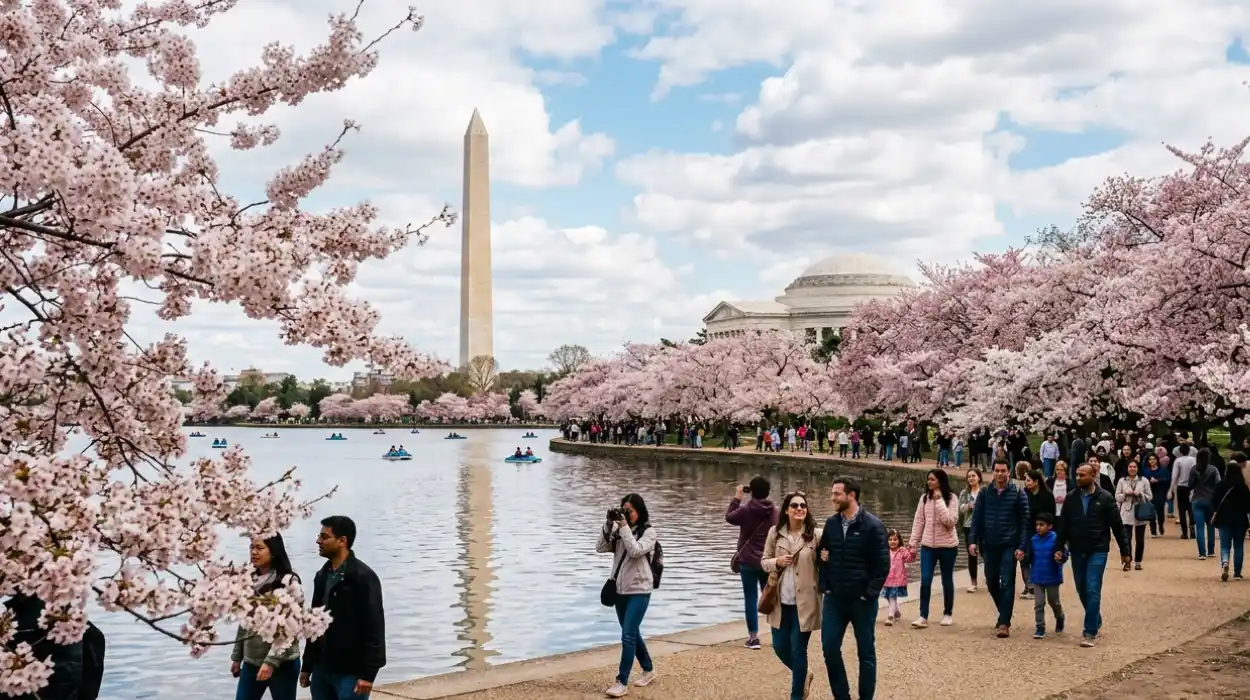
The most iconic and heavily visited cherry blossom viewing areas are concentrated on the National Mall and its immediate waterfront. The Tidal Basin is the primary focal point, with roughly 3,700 cherry trees encircling the water, creating framed views of the Jefferson Memorial, Martin Luther King, Jr. Memorial, and Franklin Delano Roosevelt Memorial. A continuous 2.1‑mile loop around the Basin allows visitors to walk past the largest contiguous blossom clusters, making it the default choice for first‑time visitors and photographers.
Beyond the Tidal Basin, other major sites include:
- National Mall (especially around the Washington Monument and from the Lincoln Memorial toward the Reflecting Pool), where additional cherry trees line pathways and provide foregrounds for monument shots.
- East Potomac Park and Hains Point, which extend the tree‑lined shoreline southward with fewer crowds than the Tidal Basin and more open space for picnics and casual strolls.
- U.S. National Arboretum, Dumbarton Oaks, Anacostia Park, and smaller clusters at Stanton Park and Oxon Run Park, which offer quieter alternatives and different cherry‑tree varieties that may bloom slightly earlier or later than the Tidal Basin trees.
Why is the Tidal Basin the most popular viewing spot?
The Tidal Basin is the most popular viewing spot because of its high density of Yoshino cherry trees, its proximity to major monuments, and its iconic framing in widely circulated photos and official festival imagery. The circular layout of the Basin, combined with the 2.1‑mile loop path, creates multiple vantage points where blooms and memorials appear together in a single shot, such as the view of the Jefferson Memorial framed by cherry branches.
Accessibility also plays a role: the Tidal Basin is reachable via multiple Metro lines (Blue, Orange, Silver) with the Smithsonian station as the closest stop, plus several Metrobus routes that deposit visitors near the Washington Monument and the Mall. Because of this, the Tidal Basin routinely logs the highest visitor counts during peak‑bloom days, with tens of thousands of people circulating the loop in a single day. Helicopter and drone‑shot footage of the pink‑ringed Basin is often used in promotional material for the National Cherry Blossom Festival, reinforcing its status as the primary destination.
How crowded do the cherry blossom areas get?
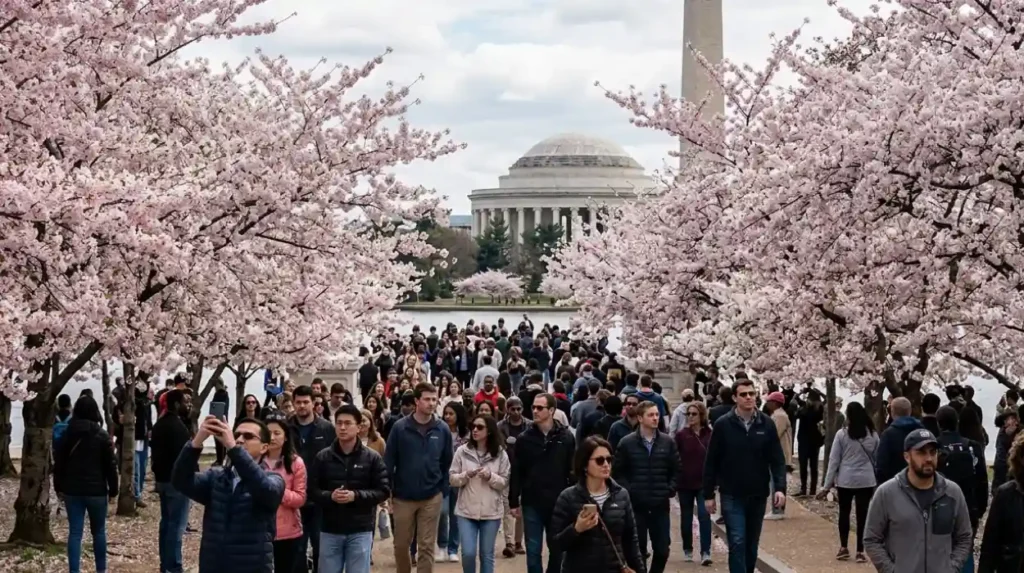
Crowd levels near cherry blossom sites can range from moderate mid‑week mornings to extremely high festival‑weekend levels, especially on the Tidal Basin loop and around the National Mall. On peak‑bloom days, the National Park Service and local transport agencies report that the Tidal Basin can see well over 100,000 visitors in a 24‑hour period, with denser concentrations between 9:00 a.m. and 6:00 p.m.
Secondary locations such as East Potomac Park and the National Arboretum experience far fewer people, typically drawing only a fraction of the Tidal Basin crowd even on the same weekend. Metrobus and parking‑area wait times also increase during peak‑bloom windows, with some shuttle and park‑and‑ride services reporting lines of 30 minutes or more. Travelers who prioritize uncrowded photo opportunities often choose early‑morning visits (before 8:00 a.m.) or off‑weekend days, or shift focus entirely to quieter parks such as Dumbarton Oaks or the Arboretum.
What are the best times of day to visit the cherry blossoms?
The best times of day for visiting DC cherry blossoms are early morning (roughly 6:00–8:00 a.m., local time) and late afternoon near sunset (4:30–6:30 p.m.), when light and crowd dynamics are most favorable. Early morning offers softer, cooler light, fewer visitors, and calmer water surfaces around the Tidal Basin, which improves reflections and reduces lens flare in photographs.
By mid‑morning, foot traffic and tour‑group arrivals increase sharply, with the busiest hours typically running from 10:00 a.m. to 4:00 p.m. Late afternoon light can also yield strong images, particularly when the sun strikes the trees from one side, but the higher number of people may interfere with wide‑angle shots and monument‑framing compositions. Visitors who cannot avoid peak‑hour timing often benefit from using lesser‑used access routes, such as entering the Tidal Basin from the FDR or MLK memorials rather than the main Independence Avenue entrance, to avoid the densest bottlenecks.
How do weather and climate affect DC cherry blossoms?
Weather and climate directly influence both the timing and longevity of DC cherry blossoms. The National Park Service’s peak‑bloom model is based largely on accumulated heat units (a measure of daily warmth above a certain threshold) through late winter and early spring. Years with unusually warm late‑February and early‑March temperatures tend to push peak bloom earlier into March, while cooler springs delay the opening of buds and shift the forecast window into early April.
Once the trees are in bloom, wind speed, rainfall, and temperature swings control how long the flowers last. Sustained winds above 20 miles per hour or heavy downpours can strip petals quickly, reducing the visible bloom from a full‑tree canopy to scattered blossoms in less than a day. Mild, dry conditions with temperatures in the 50s and 60s (°F) help preserve the petals and extend the window in which trees appear densely covered. Long‑term climate data also show that the average peak‑bloom date has moved earlier over the past century, reflecting broader regional warming trends.
What transportation and access options work best for cherry blossom viewing?
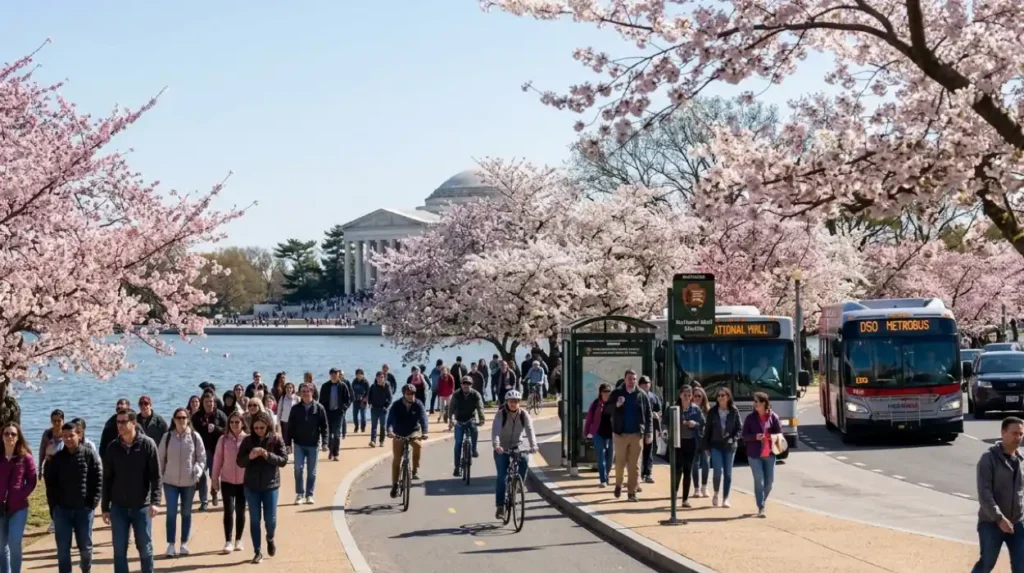
For cherry blossom viewing in Washington, DC, the most efficient access options are Metrorail, Metrobus, and walking or biking along the Mall and riverfront paths. The closest Metrorail stations to the Tidal Basin are Smithsonian (Blue, Orange, Silver lines) and Foggy Bottom (Blue, Orange, Silver lines), with the Smithsonian platform requiring a 15–20 minute walk south along the Mall to reach the Basin. Multiple Metrobus routes, including the D50, A29, and F19, serve the Mall and provide access points near the Washington Monument and Constitution Avenue, from which the Blossom‑view areas are within a 15–30 minute walk.
Driving and parking are strongly discouraged during peak‑bloom weekends because on‑street and garage capacity near the Tidal Basin is overwhelmed, and many streets are closed or restricted to manage pedestrian flow. Bike access is viable via the National Mall bike paths and the East Potomac Park trails, which connect the Tidal Basin to Hains Point and other blossom‑lined areas with relatively low‑speed, shared‑use lanes. For visitors with limited mobility, the National Park Service and the National Cherry Blossom Festival provide information on accessible routes and shuttle services that operate during festival weekends.
How can visitors plan for multiple viewing visits across the season?
Planners can optimize multiple visits by aligning trips with different stages of the bloom cycle and different locations to experience both crowds and quieter alternatives. A first visit early in the National Cherry Blossom Festival (around March 20–25) can focus on bud‑to‑partial‑bloom stages, often with fewer people and more forgiving light for photography. A second visit around the forecasted peak‑bloom window (for example, March 29–April 1) can center on the Tidal Basin and immediate Mall areas, accepting higher crowds for the fullest visual impact.
A third visit later in the festival (early to mid‑April) can shift attention to slower‑bloom varieties at the National Arboretum, Dumbarton Oaks, or East Potomac Park, where the flowering period may extend beyond the Tidal Basin’s peak. Planning around public‑transit schedules and using tools such as the WMATA Trip Planner or the National Cherry Blossom Festival’s official transportation page helps minimize wait times and parking stress. By spacing visits across these stages and sites, visitors can capture the full transition from tight buds to full canopy and then to petal‑fall, while also experiencing a range of crowd densities and neighborhood atmospheres.
What are cherry blossoms in Washington, DC and why do they matter?
Cherry blossoms in Washington, D.C. are flowering trees—mainly Yoshino cherries—planted around the Tidal Basin and National Mall, symbolizing friendship between the United States and Japan.
They originate from a 1912 gift of 3,000 trees from Tokyo and now total over 18,000 trees managed by the National Park Service.
These blossoms are both a cultural landmark and a major tourism driver, attracting millions of visitors annually during the National Cherry Blossom Festival.