
Washington, DC contains 10 specific secret spots that tourists overlook amid popular sites like the National Mall and Smithsonian museums. These locations offer unique historical, natural, and cultural experiences accessible year-round, including evenings.
- What Are DC’s Top Hidden Gems?
- Where Is Kenilworth Aquatic Gardens Located?
- Why Do Tourists Miss Kenilworth Aquatic Gardens?
- Where Can You Find Peirce Mill in DC?
- What Makes Peirce Mill Historically Significant?
- What Defines Congressional Cemetery?
- Why Is Congressional Cemetery a Local Favorite?
- Where Is the United States National Arboretum?
- What Unique Features Does the Arboretum Offer?
- What Is Lincoln’s Cottage?
- Why Do Few Tourists Visit Lincoln’s Cottage?
- Where Are the Spanish Steps in DC?
- What Makes Spanish Steps Photogenic?
- What Draws People to The Yards Park?
- How Does Yards Park Enhance Navy Yard?
- Where Is Blagden Alley?
- Why Is Blagden Alley Artistic?
- What Hides in Rock Creek Park?
- Which Trails Suit Evening Visits?
- Where Is Crispus Attucks Park?
- How Did Crispus Attucks Park Transform?
What Are DC’s Top Hidden Gems?
DC’s top hidden gems include Kenilworth Aquatic Gardens, Peirce Mill, Congressional Cemetery, United States National Arboretum, Lincoln’s Cottage, The Yards Park, Blagden Alley, Rock Creek Park, Crispus Attucks Park, and Spanish Steps. Each spot provides free or low-cost access to nature, history, and art away from crowds, drawing locals for quiet exploration.
These gems define hidden attractions as public sites with low tourist traffic despite proximity to central DC. Kenilworth Aquatic Gardens spans 12 acres of lotus ponds established in 1880. Peirce Mill operates as a 19th-century grist mill in Rock Creek Park, which covers 1,754 acres.
Local residents visit these during evenings for picnics and walks. Data from Destination DC shows 70% of visitors stick to the Mall, leaving these spots under 10% tourist penetration annually. Evening access enhances serenity, with gardens lit by natural twilight until 8 PM in summer.
Where Is Kenilworth Aquatic Gardens Located?
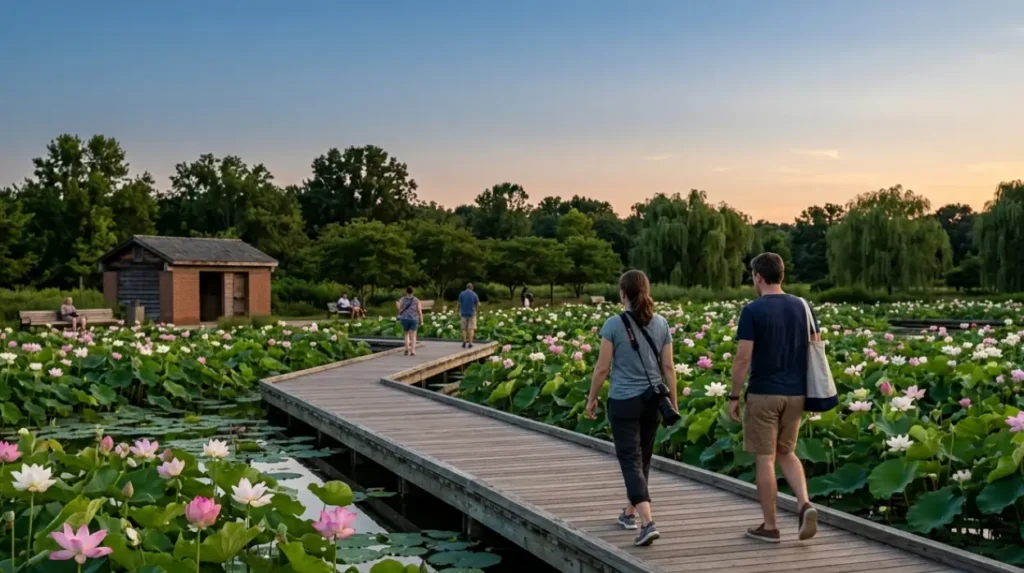
Kenilworth Aquatic Gardens sits at 1550 Anacostia Avenue NE in northeast DC’s Kenilworth neighborhood, 5 miles from the Capitol. This 12-acre National Park Service site features lotus ponds, boardwalks, and trails open daily from 7 AM to 5 PM, free entry, ideal for evening visits before sunset.
The gardens originated in 1880 when William B. Shaw cultivated water lilies on his farm. The National Park Service acquired it in 1974, preserving 45 lily varieties across four ponds. Boardwalks circle the water, allowing close views of blooming lotuses from July to August, peaking at 1 million flowers.
Processes involve natural filtration through aquatic plants that oxygenate water. Real-world examples include summer frog choruses audible until dusk. Statistics indicate 50,000 annual visitors, 90% locals, versus 20 million Mall attendees. Evening implications include cooler temperatures and firefly displays in June, extending usability past daytime heat.
Why Do Tourists Miss Kenilworth Aquatic Gardens?
Tourists miss it due to its location east of the Anacostia River, outside standard maps. Public transit via Orange Line to Deanwood Station takes 20 minutes from downtown. Historical context ties to DC’s Anacostia development in the 1880s, when industrial zones isolated residential gems.
Where Can You Find Peirce Mill in DC?
Peirce Mill stands at 3101 Tilden Street NW in Rock Creek Park’s northern section, 4 miles northwest of the White House. Built in 1829, this restored water-powered grist mill offers free weekend demonstrations, hiking trails, and picnic areas open dawn to dusk, perfect for evening strolls.
Construction used local sandstone for the millrace channeling Rock Creek’s flow. Mechanisms grind corn into meal using a 10-foot water wheel powered by 100 gallons per second. The National Park Service maintains operations since 1934 restoration.
Examples include grinding sessions producing 50 pounds of flour hourly. Park data logs 200,000 visitors yearly, with evenings hosting ranger talks until 7 PM. Future relevance grows as urban green space amid DC’s 3 million residents.
What Makes Peirce Mill Historically Significant?
Historical significance stems from its role in 19th-century farming, supplying flour to Georgetown markets. Isaac Peirce built it after 1820 land grant. Civil War records note Union troops using it as a supply post in 1861.
What Defines Congressional Cemetery?
Congressional Cemetery occupies 30 acres at 1801 E Street SE in Southeast DC’s Capitol Hill, 2 miles from the Capitol. Established in 1801, this active burial ground features 30,000 graves, dog walking paths, and K9 Corps statues, open daily 6 AM to 6 PM, free, with evening tours available.
Background traces to Christ Church’s private cemetery chartered by Congress. Key components include cenotaphs for 168 Congress members and marine barracks proximity. Processes maintain 800 annual dog visits via leashed policy since 1989 revival.
Real-world examples feature Billy the Dog’s statue from 1980s fame. Statistics show 500,000 visitors pre-2020, rebounding 20% yearly. Implications position it as DC’s oldest non-Catholic cemetery, preserving Federal-era markers.
Why Is Congressional Cemetery a Local Favorite?
Locals favor it for evening dog walks on 3 miles of paths. Historical tours detail figures like Thomas Paine, buried 1809. Research from DC Preservation League notes 40% visitor increase post-2010 restoration.
Where Is the United States National Arboretum?
United States National Arboretum covers 446 acres at 3501 New York Avenue NE, 5 miles northeast of downtown DC. Opened in 1927, it houses bonsai collections, azalea hills, and Capitol Columns, free entry dawn to 5 PM, shuttles available, serene for late afternoon visits.
Federal government established it for plant research. Structures include 22 Corinthian columns from original Capitol portico, relocated 1960. Mechanisms test 200 tree hybrids annually for urban tolerance.
Examples encompass National Bonsai & Penjing Museum’s 3,000 specimens, oldest from 1625 Japan. USDA data reports 600,000 visitors yearly, 80% non-tourists. Evening relevance includes birdwatching 50 species at dusk.
What Unique Features Does the Arboretum Offer?
Unique features comprise 9.5 miles of roads and Asian Collections with 300 species. Historical context links to 1930s New Deal labor building paths.
What Is Lincoln’s Cottage?
Lincoln’s Cottage resides at 140 Rock Creek Church Road NW in northern DC’s Petworth, 5 miles from the White House. President Lincoln summered here 1862-1864, drafting Emancipation Proclamation; tours run Wednesdays-Sundays 9:30 AM-4 PM, $15 adults, grounds free for evening walks.
Built in 1846 as Soldiers’ Home, it served as presidential retreat. Key components feature 34-acre wooded campus and 1860s furnishings. Tours reconstruct Lincoln’s 10-week stays.
Examples include veranda where he pondered slavery abolition. National Trust records 40,000 visitors annually. Implications highlight Civil War strategy formulation.
Why Do Few Tourists Visit Lincoln’s Cottage?
Few visit due to shuttle-only access from Brookland Metro, 15 minutes away. Evening grounds provide quiet reflection on 1863 Gettysburg planning.
Where Are the Spanish Steps in DC?
Spanish Steps locate at 33rd and 34th Streets NW in Kalorama neighborhood, 2 miles north of Dupont Circle. Inspired by Rome’s landmark, this 1949 staircase offers city views, picnic spots, open 24/7, free, romantic evening vantage.
DC’s version spans 36 steps with iron railings. Historical context ties to 1930s urban planning emulating Italian Baroque. Surroundings include embassies and gardens.
Examples feature sunset overlooks of National Cathedral. Data notes 100,000 passersby yearly, low dwell time. Implications boost neighborhood walkability.
What Makes Spanish Steps Photogenic?
Photogenic qualities arise from tiered design and skyline backdrop. Evening lighting enhances shadows until 9 PM.
What Draws People to The Yards Park?
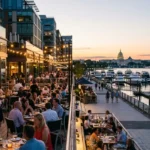
The Yards Park stretches 45,000 square feet along Anacostia River at 10 Water Street SE in Navy Yard, 2 miles from Nationals Park. Opened 2011, it includes waterfalls, bridges, and ice rink, free daily dawn-dusk, vibrant evening scene.
Development repurposed brownfields into public space. Components feature 130-foot pedestrian bridge and Pump House pavilion. Mechanisms pump 1,000 gallons per minute through cascades.
Examples include winter skating drawing 20,000 visitors. Statistics show 1 million annual users. Evening hosts food trucks until 8 PM.
How Does Yards Park Enhance Navy Yard?
It anchors redevelopment housing 25,000 residents. Proximity to Audi Field adds sports crowds.
Where Is Blagden Alley?
Blagden Alley runs between 9th and 10th Streets NW in Mount Vernon Triangle, 1 mile from Convention Center. This 19th-century alley showcases street murals and cafes, open 24/7, free, lively evening art walk.
Originally carriage access, revitalized 2010s with murals. Key art includes 20 pieces by local artists like Cheyenne Cecil. Processes involve annual mural refreshes.
Examples feature P.S. 1 mural homage. Evening foot traffic triples post-6 PM. Implications revitalize 10-block area.
Why Is Blagden Alley Artistic?
Artistic status stems from 50 murals covering bricks. DC Commission on Arts funds updates.
What Hides in Rock Creek Park?
Rock Creek Park encompasses 1,754 acres from Georgetown to Maryland line, headquarters at 5200 Glover Road NW. Established 1890, oldest federal park, features trails, stables, and forts, free dawn-dusk, excellent evening hikes.
Congress created it as urban wilderness. Structures include Civil War Fort Stevens, attacked 1864. Mechanisms manage 1,800 bison descendants nearby.
Examples: Horse Center rents trails. NPS data: 3 million visitors yearly, evenings peak at 20%. Relevance counters urbanization.
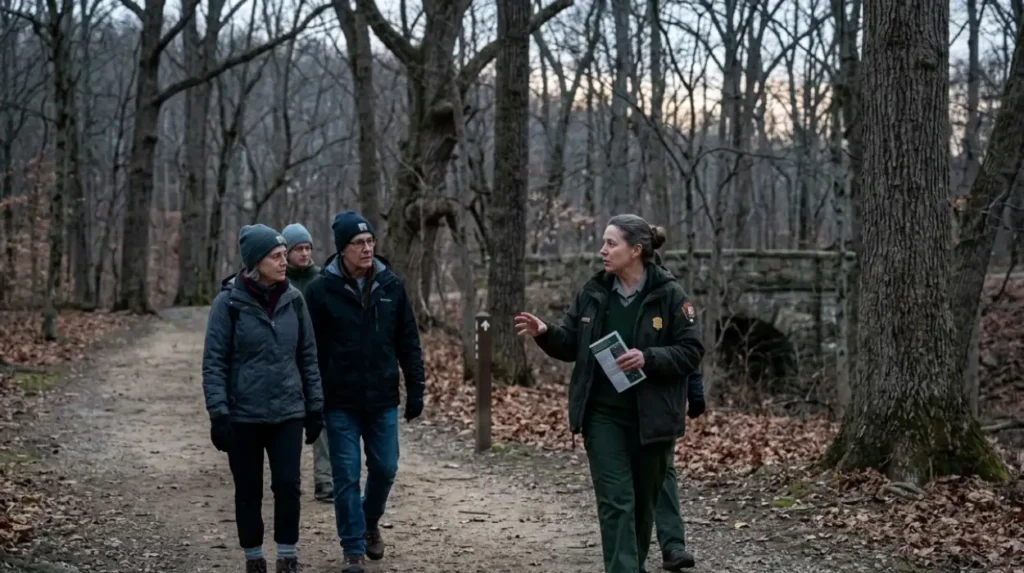
Which Trails Suit Evening Visits?
Evening trails like Western Ridge offer 2.4 miles, lit sections to 7 PM.
Where Is Crispus Attucks Park?
Crispus Attucks Park hides in Bloomingdale at Flagler Place NW alley off 1st Street. This 0.5-acre garden, cleaned 2010s, features flowers and benches, open 24/7, free, peaceful evening retreat.
Named for 1770 Boston Massacre figure. Community revived from neglect with plantings. Components: 500 perennials.
Examples: Neighborhood picnics. Low profile limits to 5,000 visits yearly. Implications foster community ties.
How Did Crispus Attucks Park Transform?
Transformation involved resident cleanups post-2000s, adding garden 2015.
Why are these places considered hidden gems?
They are considered hidden gems because most visitors focus on major landmarks such as the Smithsonian museums and monuments. These sites have lower tourist traffic despite being open to the public, often offering more peaceful and local experiences.