Key Points
- Washington, D.C. briefly displayed Australian flags instead of British flags near the White House and the Eisenhower Executive Office Building ahead of King Charles’ visit.
- About 15 Australian flags were reportedly installed among hundreds of banners put up for the royal trip.
- The District of Columbia Department of Transportation corrected the mistake quickly after it was noticed.
- The confusion appears to have been linked to the similarity between the Australian and British flags, especially the Union Jack in the Australian design.
- The mistake prompted online discussion, including jokes and comments noting that King Charles is also Australia’s head of state.
- King Charles is due in the United States for a state visit marking the 250th anniversary of the Declaration of Independence.
Washington, D.C., (Evening Washington News) April 25, 2026 – Washington, D.C. briefly displayed Australian flags instead of British ones near the White House as preparations continued for King Charles’ upcoming visit, according to reporting by The Independent’s article
“Down Under blunder: DC mistakenly displays Australian flags instead of British ones ahead of King Charles visit.”
What happened near the White House?
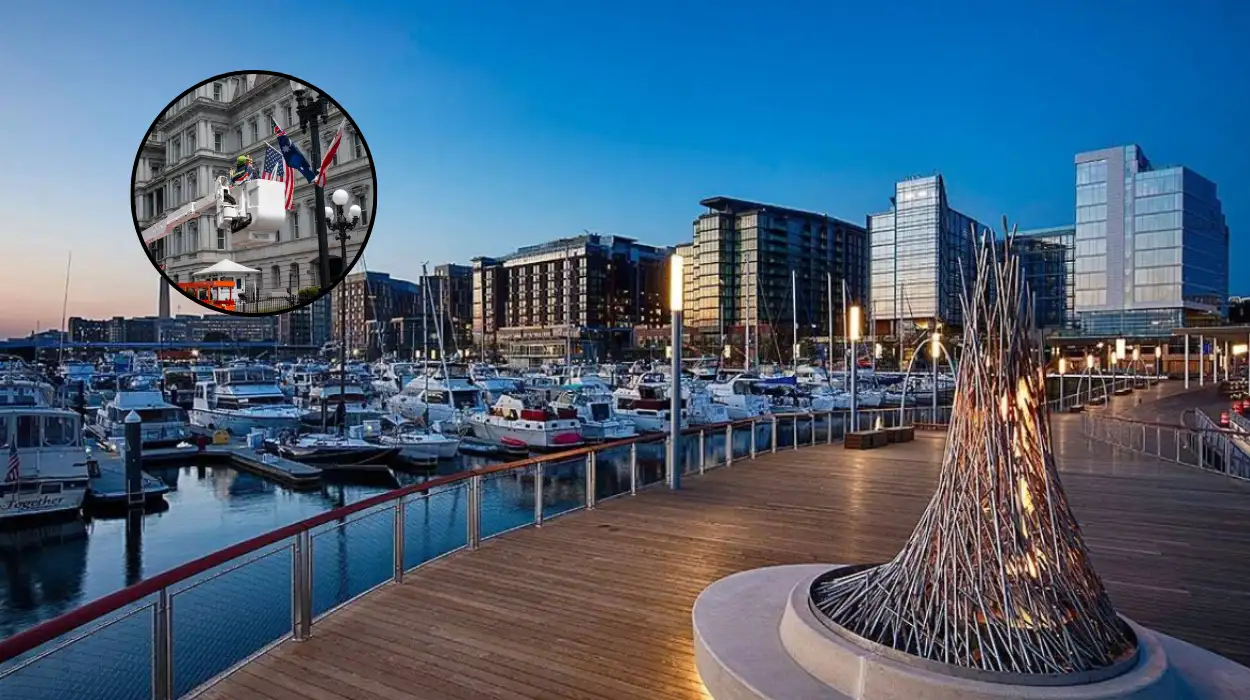
As reported by Reuters via The Independent, 15 Australian flags were mistakenly included among the national banners installed in the capital, with clusters seen on black lamp posts near the White House and the Eisenhower Executive Office Building.
The flags were part of a broader decorative effort that included British and American emblems for the royal visit. The D.C. Department of Transportation later removed the incorrect flags and replaced them with the proper British flags.
Why was the mistake made?
The reporting suggests the error may have stemmed from the visual similarity between the Australian and British flags, since Australia’s flag also includes the Union Jack in the upper-left corner.
The Australian version is still distinct because it has a blue background and six white stars. That overlap appears to have been enough to cause confusion during the flag installation.
Who responded to the error?
A D.C. Department of Transportation official told Reuters that the mistake was corrected quickly once it was identified.
The correction came before the full arrival of King Charles, limiting the duration of the error. The incident drew attention partly because it happened during an official preparatory display for a major state visit.
What reaction followed online?
The mix-up triggered online discussion and amusement, with some users mocking the error and others pointing out that the Australian flag was not entirely out of place because King Charles is also Australia’s head of state.
The Independent reported that one commenter joked about
“George Bush and no child left behind,”
while another suggested the workers should have simply searched for the UK flag. The reaction showed how quickly a minor protocol mistake can spread across social media when it involves a high-profile international event.
What is the wider diplomatic context?
King Charles is scheduled to arrive in the United States for a four-day state visit that is meant to mark the 250th anniversary of the signing of the Declaration of Independence. According to The Independent, he and Queen Camilla are due to travel to Washington, D.C., New York and Virginia during the visit.
The flag error did not change the itinerary, but it did momentarily distract from the formal welcome being prepared.
Background of the development
This incident came during the final stages of preparations for one of the most symbolic royal visits to the United States in recent years.
The Washington display was intended to present British and American flags in honour of the monarch, but the accidental use of Australian flags created a brief protocol error.
Because Australia remains a Commonwealth realm with King Charles as head of state, the mistake was humorous to some observers, even though it was still incorrect for the specific occasion. The quick correction suggests the error was treated as a practical installation problem rather than a diplomatic dispute.
Prediction
For the diplomatic audience, including officials managing the visit, the episode is likely to be remembered as a minor embarrassment rather than a serious issue. For the public and online audience, it may reinforce how closely royal visits are scrutinised and how quickly ceremonial mistakes become viral talking points. For event planners and city workers, the incident may encourage tighter checks on flag selection and installation before high-profile state occasions.