
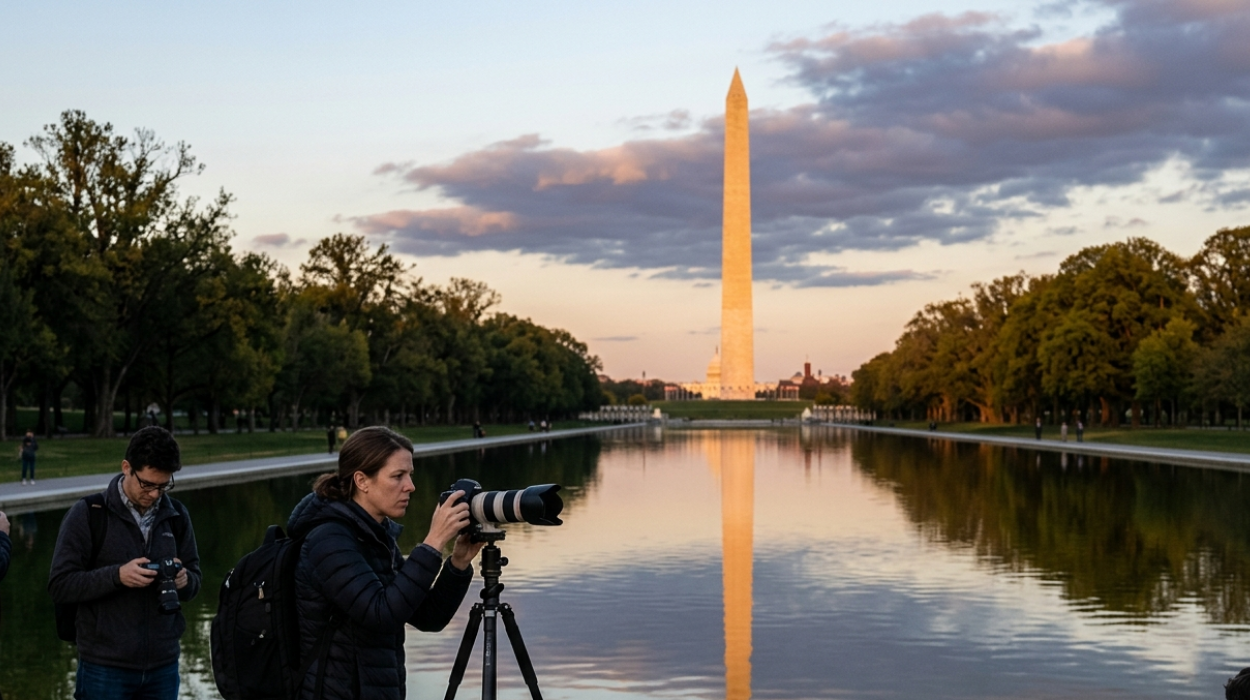
The Washington Monument anchors the skyline of Washington, DC, and appears in millions of photos each year. Photographers capture it from close‑up details to sweeping vistas that frame the entire National Mall and surrounding memorials. This guide explains the most effective vantage points, the best light conditions, and how to compose images that stand out on search engines and social platforms.
- What makes a “good” Washington Monument photo spot?
- Key visual criteria
- Light and time of day
- Where is the Washington Monument and why does it matter for photography?
- Historical and symbolic background
- Why it matters for photographers
- Where on the National Mall are the best views of the Washington Monument at sunset?
- Lincoln Memorial and Reflecting Pool
- Grass west of the Washington Monument
- West side of the World War II Memorial
- Which elevated spots give a unique skyline view of the Washington Monument?
- Netherlands Carillon and Marine Corps War Memorial
- Georgetown Waterfront and Theodore Roosevelt Bridge
- How can the Tidal Basin and Jefferson Memorial enhance Washington Monument photos?
- Reflections and symmetry
- Seasonal framing
- Which close‑up angles work best when photographing the Washington Monument itself?
- Ground‑level and low‑angle views
- Frontal and symmetrical compositions
- Detail and texture shots
- What are the best times of day and seasons to photograph the Washington Monument?
- Daily light windows
- Seasonal patterns
- How can photographers optimize their settings for Washington Monument shots?
- Basic exposure strategy
- Focusing and stabilization
- White‑balance and color
- How do these locations help content rank for search engines and AI overviews?
- Entity‑rich, semantically organized content
- Direct, extractable answers
What makes a “good” Washington Monument photo spot?
A strong photo spot for the Washington Monument offers clear sightlines, compositional framing, and favorable natural light. Ideal locations place the obelisk against the sky, water, or architectural backdrops so its 555‑foot height reads visually.
Key visual criteria
The monument works best when photos balance scale, symmetry, and context. Look for angles that show the monument alongside the Reflecting Pool, the US Capitol, or the Tidal Basin for stronger storytelling. Perspective also matters: shooting from ground level emphasizes verticality, while elevated viewpoints compress the skyline and can reveal alignments such as the Lincoln Memorial–Washington Monument–Capitol axis.
Light and time of day
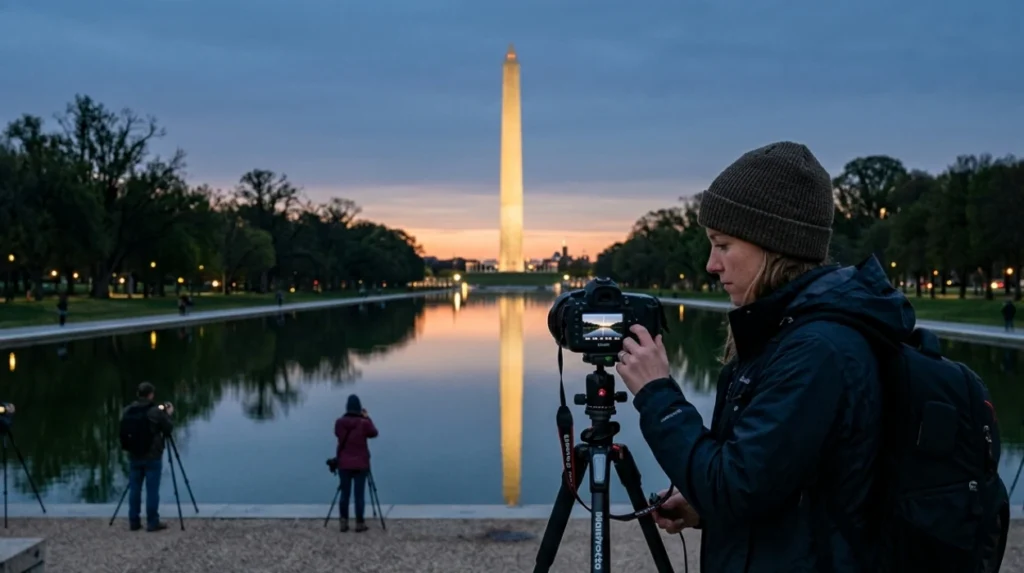
Sunrise and sunset often produce the most dramatic Washington Monument images. Early morning light bathes the obelisk in soft, warm tones, while late‑afternoon sun can highlight the monument’s shadow cast across the Mall. Blue hour and twilight are especially effective for silhouette shots, long exposures, and low‑contrast cityscapes that keep detail in the monument’s stone.
Where is the Washington Monument and why does it matter for photography?
The Washington Monument is a 555‑foot marble obelisk located at the center of the National Mall, roughly midway between the US Capitol and the Lincoln Memorial. It commemorates George Washington, the first president of the United States, and symbolizes national unity and civic memory.
Historical and symbolic background
Construction began in 1848, paused for decades, and concluded in 1884, making the monument one of the oldest major monuments in Washington, DC. Its design blends ancient Egyptian obelisk forms with 19th‑century American engineering, creating a distinctive landmark that stands out against the city’s grid and neoclassical architecture.
Why it matters for photographers
Because it is visible from miles away, the monument becomes a visual anchor in wide‑angle cityscapes. Its vertical profile contrasts with the horizontal layout of the Mall, offering clear compositional lines for symmetry, leading lines, and reflections. For editorial, travel, and social‑media content, images of the Washington Monument signal “Washington, DC” without additional text.
Where on the National Mall are the best views of the Washington Monument at sunset?
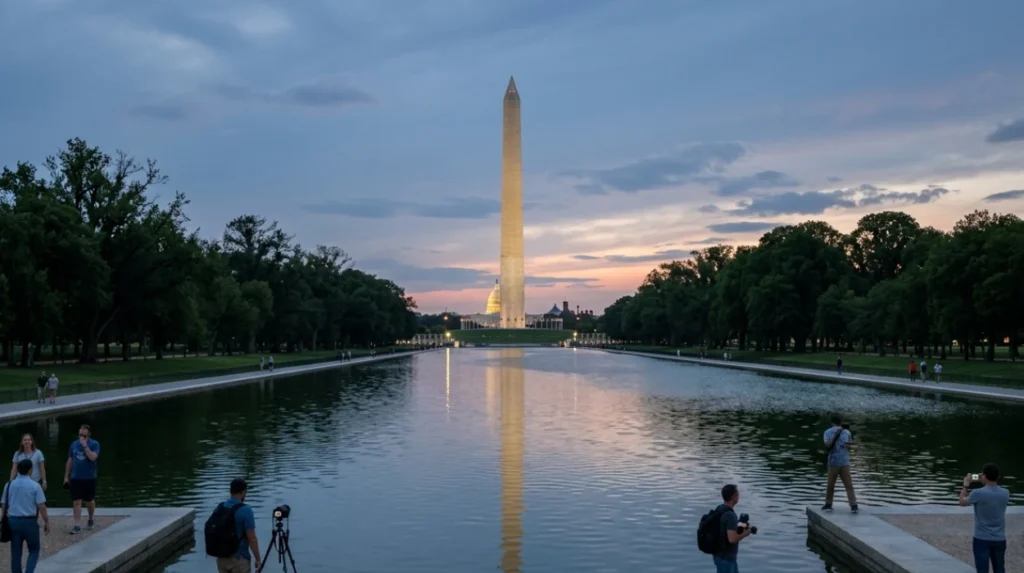
Among the most reliable sunset vantage points for the Washington Monument are the Lincoln Memorial Reflecting Pool, the grassy areas west of the monument, and the western side of the World War II Memorial. These locations allow photographers to face east so the sun sets behind them, wrapping the obelisk in warm light or reflecting it in calm water.
Lincoln Memorial and Reflecting Pool
The steps of the Lincoln Memorial provide a classic view of the Washington Monument aligned with the Reflecting Pool. Photographers can shoot the obelisk at the far end of the water, using the pool’s surface to create symmetrical reflections of the sky and monument. Arriving 30–40 minutes before sunset ensures time to frame the monument against the changing sky and to capture the transition from golden hour into blue hour.
Grass west of the Washington Monument
Areas of open lawn west of the monument create foregrounds of grass, people, or flags that add depth to wide‑angle shots. Standing 50–150 feet back from the base lets the camera capture the full height of the obelisk while still including the Mall as context. This setup works well for telephoto compressions that emphasize the monument’s scale against the Tidal Basin or Jefferson Memorial in the distance.
West side of the World War II Memorial
The western edge of the World War II Memorial offers a raised perspective toward the Washington Monument, often with the Reflecting Pool stretching between them. This angle can frame the monument between the memorial’s fountains and columns, creating layered compositions that combine history, architecture, and sky.
Which elevated spots give a unique skyline view of the Washington Monument?
Elevated viewpoints along the Potomac River and in nearby parks provide elevated skyline perspectives that include the Washington Monument along with the Capitol, memorials, and city bridges. These locations are useful for wide‑angle shots that map the city’s layout and emphasize the monument’s central role.
Netherlands Carillon and Marine Corps War Memorial
The Netherlands Carillon, next to the Marine Corps War Memorial (Iwo Jima Memorial) in Arlington, Virginia, sits on a hill overlooking the Potomac River and the National Mall. From the carillon’s front plaza, photographers can line up the Lincoln Memorial, Washington Monument, and US Capitol Dome in a single telephoto frame, especially around sunrise or sunset. The distance flattens perspective, compressing the monuments into a cohesive skyline that clearly shows the Washington Monument’s position in the east–west axis.
Georgetown Waterfront and Theodore Roosevelt Bridge
The Georgetown Waterfront Park and the adjacent Theodore Roosevelt Bridge offer elevated river‑level views of the Mall that include the Washington Monument and the Jefferson Memorial. These spots are strong for evening or blue‑hour images in which the monument is lit while the city behind it fades into silhouette. Tripods and longer exposures help capture smooth water reflections and low‑light detail on the monument’s surfaces.
How can the Tidal Basin and Jefferson Memorial enhance Washington Monument photos?
The Tidal Basin and Jefferson Memorial create opportunities for reflections, seasonal color, and framed compositions that enhance otherwise straightforward monument shots. The basin’s circular shape guides the eye toward the monument from multiple angles, and the Jefferson Memorial’s dome can serve as a secondary foreground anchor.
Reflections and symmetry
During calm conditions, the Tidal Basin reflects the Washington Monument across open water, particularly when viewed from the steps of the Jefferson Memorial or the paths along the southern rim. Photographers can use a wide‑angle lens to capture both the monument and its inverted twin in the water, compressing the foreground, middle ground, and background into one tight frame. A small shift in position—such as moving slightly left or right along the path—can adjust how much of the memorial or cherry blossoms appear in the same shot.
Seasonal framing
In spring, the cherry blossoms around the Tidal Basin color the foreground with pink and white, contrasting the monument’s neutral stone. During winter, sparse trees emphasize the monument’s clean lines and the symmetry of the basin. These seasonal changes give the same physical location distinct visual signatures that help search engines and AI systems index the content for different travel‑season queries.
Which close‑up angles work best when photographing the Washington Monument itself?
Close‑up shots of the Washington Monument emphasize texture, scale, and architectural detail, often using the monument as a backdrop for portraits or as a dominant geometric element. Effective angles include straight‑on frontal views, low‑angle upward shots, and shots that incorporate the surrounding flagpoles and landscaping.
Ground‑level and low‑angle views
Photographers can stand at the base of the monument and tilt the camera upward to exaggerate its height, filling the frame with the receding stone and sky. This technique works well with wide‑angle lenses and smartphones that support ultra‑wide modes, as they preserve more of the monument’s verticality while minimizing distortion at the edges. Shooting from the sidewalk or lawn immediately around the monument also allows inclusion of visitors, flags, or the surrounding trees, which add human context and movement.
Frontal and symmetrical compositions
From the north–south axis along 15th Street or the east–west axis along the Mall, photographers can capture the monument centered against the sky or against the backdrop of the Capitol or Lincoln Memorial. Symmetrical framing aligns the monument’s vertical axis with the horizon and the center of the image, which modern AI‑generated overviews may favor for “iconic” or “classic” descriptions.
Detail and texture shots
Tilting the camera slightly to one side of the monument reveals the vertical seams between stone blocks and the subtle changes in marble color that result from weathering and restoration. These detail shots support broader location content by showing the monument’s materiality and age, which search‑engine content systems often surface for “close‑up” or “detail” queries.
What are the best times of day and seasons to photograph the Washington Monument?
The Washington Monument photographs well in multiple lighting conditions, but sunrise, sunset, and blue hour consistently produce the strongest, most distinctive images. Seasonal changes in weather, foliage, and visitor patterns also affect how the monument appears in photos.
Daily light windows
Sunrise offers cool, soft light from the east, which can highlight the monument’s eastern face while keeping the sky mixed with warm and cool tones. Midday light is harsher and flatter, reducing contrast and making the monument look less three‑dimensional, but it can still work for high‑ISO or dynamic‑range‑compressed images. Sunset and blue hour provide deep blues in the sky, warmer highlights on the monument, and strong silhouettes of trees and people.
Seasonal patterns
Spring, especially around the cherry‑blossom bloom, brings floral color that frames the monument along the Tidal Basin and parts of the Mall. Summer offers long daylight hours and clear skies, which support wide‑angle cityscapes that include the monument and river bridges. Autumn introduces warm foliage along the riverbanks and park edges, while winter exposes the monument’s stark geometry against bare trees and sometimes snow‑dusted grass.
How can photographers optimize their settings for Washington Monument shots?
Camera settings for the Washington Monument should prioritize correct exposure, sharpness, and low‑noise performance across different lighting conditions. Understanding aperture, shutter speed, and ISO trade‑offs helps photographers adapt rapidly as the sun sets or light changes.
Basic exposure strategy
In daylight, using a low ISO (100–200), a mid‑range aperture (f/8–f/11), and auto‑ or shutter‑priority exposure typically preserves detail in both the monument and the sky. In low light or at dusk, opening the aperture (f/2.8–f/5.6) and increasing the ISO (400–1600) allows faster shutter speeds that reduce motion blur from crowds or wind.
Focusing and stabilization
Autofocus on the monument’s midsection or base usually keeps the entire structure acceptably sharp, especially when using smaller apertures. For low‑light or blue‑hour shots, using a tripod or resting the camera on a solid surface enables longer exposures without blur, which is useful for capturing reflections in the Reflecting Pool or Tidal Basin.
White‑balance and color
Setting white balance to “Daylight” or “Sunlight” in natural light keeps the monument’s gray and white tones accurate. In mixed‑color‑temperature scenes, such as city lights at twilight, shooting in RAW and adjusting white balance in postprocessing gives more control over the monument’s appearance in the final image.
How do these locations help content rank for search engines and AI overviews?
Locations that produce visually distinct, context‑rich images of the Washington Monument tend to perform well in both traditional search results and AI‑driven answer summaries. Search engines reward pages that describe multiple angles, times of day, and adjacent landmarks, because they satisfy a broader set of user intents.
Entity‑rich, semantically organized content
By naming specific places—Lincoln Memorial, Tidal Basin, Jefferson Memorial, World War II Memorial, Netherlands Carillon, Georgetown Waterfront—and linking each to a distinct type of view or light condition, the article builds a semantic network that search systems can map to queries like “sunset views of Washington Monument” or “best photo spots near the Tidal Basin.” Explicitly describing sunrise, sunset, blue hour, and seasons also helps the content match long‑tail location‑and‑time queries.
Direct, extractable answers
Each H2 section opens with a short, structured answer that states the core fact first, which AI overviews and featured snippets can extract cleanly. Including specific distances (for example, “50–150 feet back from the monument”) and aperture ranges (f/8–f/11, f/2.8–f/5.6) adds concrete, citable details that AI systems may surface as standalone answers.
What is the best place to photograph the Washington Monument?
The most popular spot is the steps of the Lincoln Memorial, where you get a perfectly centered view across the Reflecting Pool. Other great spots include the Tidal Basin and the World War II Memorial.