Key Points
- Secretive Departure: President Donald Trump secretly departed Turkey last month on an alternate military aircraft, an Air Force C-32A, instead of the primary presidential jet.
- Elaborate Ruse: The White House maintained the appearance that Trump was traveling on the legacy “baby blue” Air Force One, which served as a decoy with journalists and some staff members aboard.
- Triggering Threat: According to The Washington Post, the operation was prompted by a “credible” Iranian assassination threat against the President amid rising hostilities.
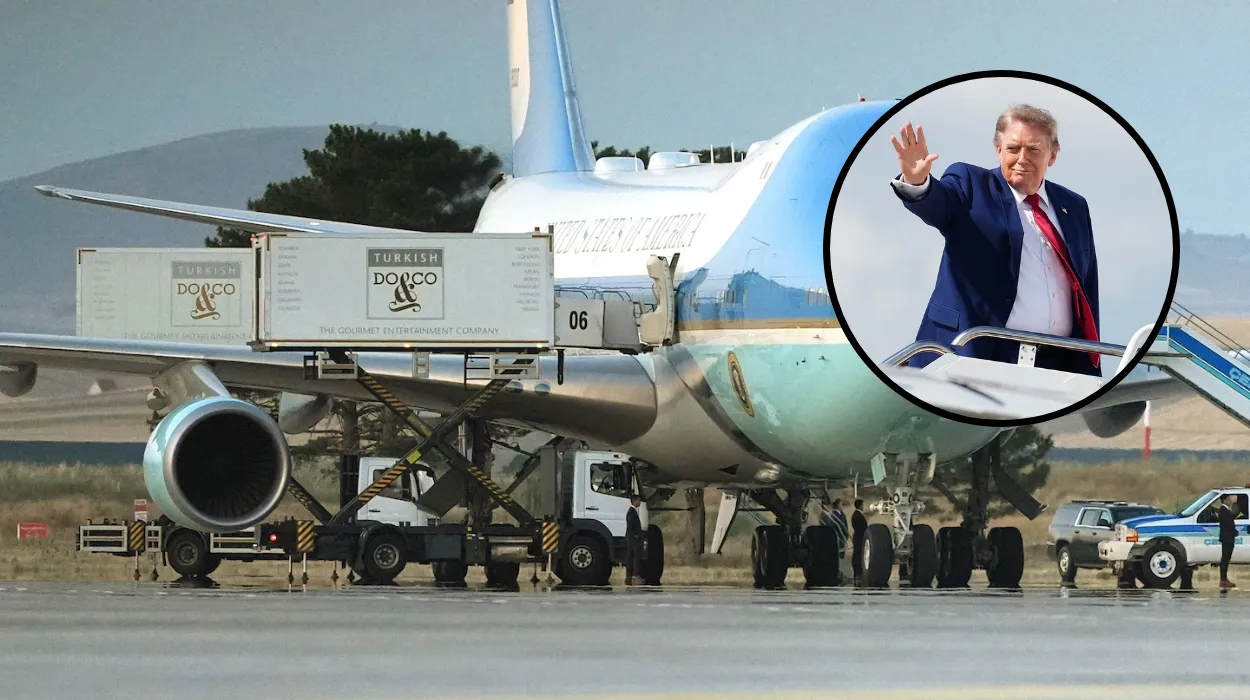
- Catering Truck Maneuver: After boarding the legacy Air Force One in front of cameras, the President was secretly shuttled to the secondary plane via an airport catering truck, typically used for loading meals and supplies.
- Media Misdirection: Journalists and staff on the decoy flight were instructed to keep their window shades closed, and the President’s true location remained concealed from them and many U.S. officials for hours.
- White House Response: While not confirming the specifics of the C-32A flight, White House Communications Director Steven Cheung stated that the administration uses “every tool at our disposal” to address threats against the President.
Ankara (Evening Washington News) August 11, 2026 – In an extraordinary security operation that unfolded under a veil of secrecy, U.S. President Donald Trump was whisked out of Turkey last month on a clandestine military flight after a credible assassination threat from Iran necessitated a high-stakes “deception operation,” according to reporting by The Washington Post. While the White House publicly maintained that the President had departed for Britain aboard the legacy “baby blue” Air Force One, he was, in reality, being secretly transferred to a smaller C-32A aircraft, leaving the presidential jet to serve as a decoy for the media and staff travelling in his wake.
Why was an elaborate ruse required for the President’s departure?
The operation was set in motion by intelligence officials who flagged a specific, credible threat of an attack on the President or his aircraft. As reported by The Washington Post, the incident occurred during a period of escalating hostilities between Washington and Tehran, following the collapse of ceasefire negotiations that had briefly paused their months-long war.
The Washington Post noted that the maneuver was designed to shield the President’s movements from potential adversaries. The threat was considered severe enough that security officials opted to utilize an unmarked, smaller military transport—the C-32A—rather than the high-profile jets that usually facilitate presidential travel.
How was the President moved from Air Force One?
The logistics of the operation were reportedly as unusual as the motivation behind it. According to the investigation by The Washington Post, Trump arrived at Ankara International Airport and boarded the legacy Boeing 747—the plane the public believed he would use—in full view of television cameras. However, moments after he was out of public sight, the President and several aides were moved through the aircraft to a side door.
As detailed by The Associated Press based on the Post’s findings, the group stepped into the elevated container of an airport catering truck, a vehicle commonly used for loading food and supplies. The truck then lowered the President and his team to the tarmac on the opposite side of the aircraft, far from the gaze of the press pool, before driving him to the waiting C-32A.
Explore More Politics News
Democracy Speaker Series Launches in Yakima 2026
Washington Democratic Revolution Fizzles Out in 2026
What did journalists and staff observe during the transit?
Journalists accompanying the President were completely unaware of the switch. They were instructed to board the legacy Air Force One, which was subsequently referred to as a “decoy” by U.S. officials cited in The Washington Post report. During the flight to RAF Mildenhall in Britain, reporters were told to keep their window shades closed, a measure later described by the President himself when he suggested to reporters that they were “probably on a dangerous flight.”
The Guardian reported that when pressed further about his travel arrangements, the President remarked,
“But if I go, you go. Right?”
This misdirection successfully concealed his actual whereabouts for the duration of the flight, keeping even some senior White House staff members in the dark.
Did the White House confirm the details of the operation?
The White House has not directly confirmed the report regarding the use of a third aircraft or the specific use of a catering truck for the President’s departure. However, they have defended the security measures taken to protect the President.
As reported by The Indian Express, White House Communications Director Steven Cheung provided a statement emphasizing the security protocols of the presidential fleet.
“As the President has said recently, there are many enemies of America who have their sights on him, and we use every tool at our disposal to address those threats,”
Cheung stated. He further noted that the newer, Qatari-gifted Boeing 747-8, which had also been part of the discussion regarding the President’s security, was fitted with “high-level security measures.”
How has the political sphere reacted to the news?
The revelation has sparked concerns regarding the nature of the threats and the transparency of the administration’s security operations. Democratic Senator Richard Blumenthal, speaking on CNN as noted by The Associated Press, described the situation as “unprecedented” and “surreal,” labeling the report “downright scary.”
Others, including former Secret Service personnel, have defended the necessity of such extreme measures. Ronald L. Rowe Jr., a former acting director of the Secret Service, emphasized to The Washington Post that the protection of the President is paramount and that operational security—keeping the “secret” in Secret Service—is vital in volatile environments.
The report from The Washington Post underscores the gravity of the ongoing conflict with Iran, as intelligence officials continue to monitor potential attempts to target the President. As the situation remains tense, questions regarding how such clandestine movements affect the public’s access to information and the standard protocols for presidential travel are likely to persist.