Key Points
- One fatality has been confirmed—a man swept away by massive waves off Liuqiu Island—and 527 people were injured across Taiwan amidst torrential rainfall and ferocious winds.
- Typhoon Champi, previously classified as a Category 5-equivalent super typhoon, skirted northeastern Taiwan before the center turned south around midnight, hugging the Yilan coastline and executing a rare loop offshore before moving northward away from the island.
- Peak gusts reached 227 kph (141 mph) along coastal areas. While weakening, the Central Weather Administration (CWA) reported Champi is still packing wind gusts of approximately 126 kph (78 mph) near its center as it sits about 170 km (106 miles) northeast of Taiwan.
- State utility Taipower reported over 288,000 households suffered power outages, though the majority have since been reconnected. Transport disruptions continued on Saturday with 259 flights cancelled, showing marked improvement from nearly 1,000 cancellations on Friday.
- Civic authorities across northern and central Taiwan, including the capital city of Taipei, issued orders for a second consecutive day of office and school closures on Saturday.
- Forecast tracks indicate Champi will continue tracking north up the eastern coast of mainland China—where landfall is currently not expected—before sweeping into southern Japan.
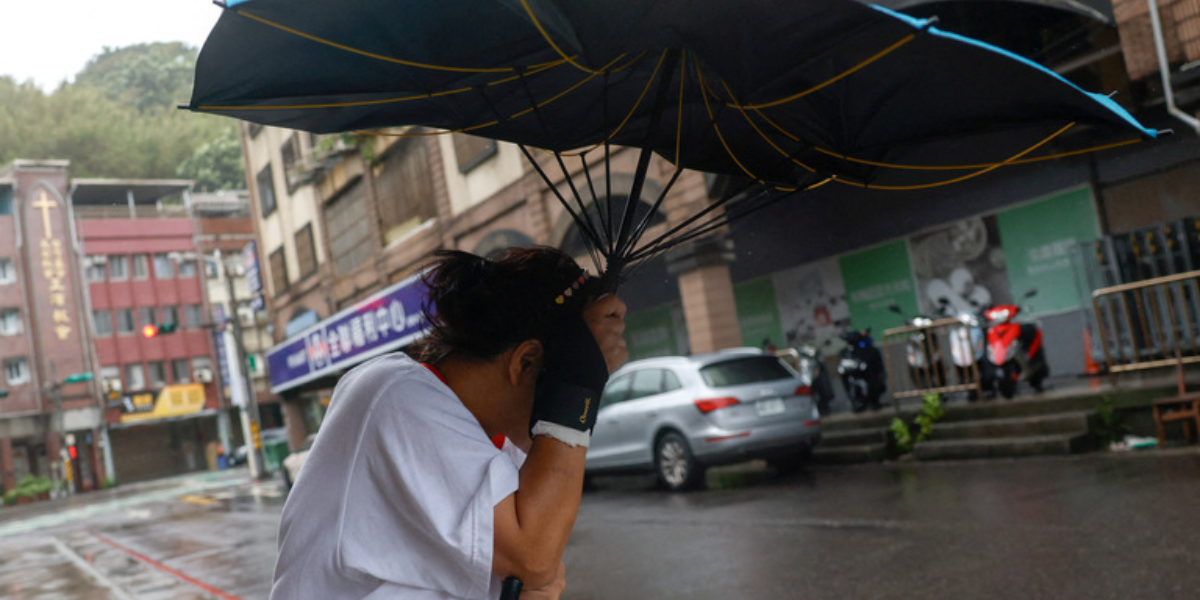
YILAN (Evening Washington News) October 24, 2026 – Typhoon Champi swept past Taiwan on Saturday, killing one person and injuring more than 500 while tearing down power lines, uprooting trees, and causing widespread travel chaos. Although the storm has begun to weaken from its former super typhoon status, it continues to track north towards the Chinese coastline, leaving a trail of physical destruction and administrative shutdowns across northern and central regions of the island.
- Key Points
- What Route Did Typhoon Champi Take Across Taiwan’s Coastline?
- How Have Local Residents Described the Impact of the Storm?
- What Is the Full Extent of Casualties and Damage Reported by Authorities?
- Background of the Particular Development
- Prediction: How This Development Can Affect the Local Population and Regional Infrastructure
As reported by journalists Yimou Lee and Ann Wang of Reuters, Typhoon Champi—which at its peak represented one of the most powerful marine weather events in the Pacific region this year—has begun to ease slightly. However, official readings provided by Taiwan’s Central Weather Administration (CWA) confirm that the system is still generating severe gale-force wind gusts of around 126 kph (78 mph) near its focal point.
What Route Did Typhoon Champi Take Across Taiwan’s Coastline?
According to technical tracking data released by the CWA and detailed by Reuters correspondents Yimou Lee and Ann Wang, the central mass of the storm was positioned roughly 170 km (106 miles) northeast of Taiwan on Saturday morning after directly glancing off the northeastern coastline of Yilan County during the early hours.
Weather forecasters observed an unusually volatile navigational trajectory as the core of the cyclone approached land. As documented by reporters Yimou Lee and Ann Wang of Reuters, the center of Typhoon Champi pivoted south around midnight, tightly hugging the immediate Yilan coastline before executing an unusual circular loop just offshore and subsequently charting a course northward into open waters.
During this intimate coastal approach, peripheral weather stations recorded extreme atmospheric pressure changes and wind gusts touching up to 227 kph (141 mph) in localized coastal pockets. These destructive forces severed electrical networks, stripped building structures, and sent roof tiles flying across urban and rural zones.
How Have Local Residents Described the Impact of the Storm?
Residents in the hardest-hit zones recounted a terrifying night as the cyclone made its unexpected maneuver along the coast.
As reported by journalist Yimou Lee of Reuters, a retired teacher surnamed Lin residing in Yilan County described the harrowing ordeal while clearing damaged crops:
“It was most terrifying around midnight. It was a sleepless night. I haven’t seen anything like this in many years,” Lin stated as he inspected uprooted banana trees scattered across his private garden.
Similar accounts of distress were noted further inland. As recorded by Reuters journalist Ann Wang, 70-year-old Taipei resident Thomas Wang compared the atmospheric noise and violent tremors to a classic supernatural horror film while stepping out to complete urgent morning errands.
“It felt like something out of the horror film Poltergeist. It was quite scary,” Wang told reporters.
In the capital city of Taipei, municipal cleanup crews encountered hundreds of downed trees blocking major thoroughfares, accompanied by persistent squally rain showers that continued intermittently throughout Saturday morning.
What Is the Full Extent of Casualties and Damage Reported by Authorities?
Official damage assessments released by Taiwan’s emergency services outline widespread disruption to human health, power grids, and transit infrastructure:
Human Impact and Medical Emergency Responses
Taiwan’s national fire department confirmed that the total fatality count stands at one individual. Emergency officials stated that a man was swept away into the ocean by massive storm-driven swell off the coast of Liuqiu Island, located off Taiwan’s southwestern peninsula. In addition to the single fatality, medical authorities verified that at least 527 individuals suffered varying degrees of physical injury due to fallen debris, high-speed wind accidents, and torrential rain hazards across the island.
Power Outages and Utility Restoration Efforts
State-run power utility Taipower reported that the cyclone severely disrupted local power grids, cutting electricity to more than 288,000 households at the height of the storm. Rapid deployment repair teams worked continuously through Friday night and early Saturday morning, successfully restoring electrical connectivity to the majority of affected properties by Saturday afternoon.
Transportation and Flight Disruptions
Data released by Taiwan’s Ministry of Transportation indicated that 259 commercial flights were cancelled on Saturday as air transit corridors gradually reopened. While significant, the figure represents a major logistical recovery compared to Friday’s peak disruption, during which nearly 1,000 domestic and international flights were grounded or diverted due to extreme atmospheric turbulence.
Civic Closures and Regional Shutdowns
In response to lingering risks of landslips, structural instability, and localized flooding, local governments across a wide swath of northern and central Taiwan—including the Taipei metropolitan region—officially declared a second consecutive day of full office and school closures on Saturday.
Background of the Particular Development
Typhoon Champi’s violent passage past Taiwan represents the latest severe meteorological event in what has been an exceptionally active and intense Pacific typhoon season. Tropical storm systems in the Western Pacific routinely threaten Taiwan, mainland China, the Philippines, and Japan between the months of July and November. However, Champi’s rapid intensification earlier in its lifecycle into a Category 5-equivalent super typhoon surprised forecasters, driven in part by elevated sea surface temperatures across the tropical Pacific.
Taiwan maintains one of the world’s most advanced disaster preparedness and civil defense networks specifically engineered for extreme typhoon events. Strict municipal building codes, early warning radar systems operated by the Central Weather Administration, and mandatory civil closures during major storms historically keep casualty rates comparatively low despite the island’s high population density and mountainous terrain prone to landslides. The rare coastal loop executed by Typhoon Champi off Yilan County highlights the growing unpredictability of cyclonic track movements near coastal landmasses, creating distinct operational challenges for emergency management teams predicting exact landfall coordinates.
Prediction: How This Development Can Affect the Local Population and Regional Infrastructure
The immediate and medium-term effects of Typhoon Champi will influence various sectors across Taiwan, mainland China, and Japan over the coming weeks:
- Local Residents and Agriculture in Taiwan: For residents in northern and eastern Taiwan, particularly Yilan County, the immediate focus shifts toward clearing fallen debris, repairing damaged residential roofing, and assessing agricultural losses. Farmers in rural coastal valleys face crop losses due to high wind shear and soil saturation, which may temporarily drive up domestic prices for fresh produce, bananas, and leafy vegetables in urban markets over the next month.
- Travelers and International Logistics: Although flight schedules are recovering from Friday’s peak cancellations, regional supply chains, air cargo schedules, and passenger travel across East Asia will experience a backlog over the next 48 to 72 hours as airlines reposition aircraft and crew to resume full operational capacity.
- Coastal Communities in Eastern China: As the meteorological forecast indicates Champi tracking northward along the Chinese coast, maritime shipping operations, offshore fishing fleets, and coastal ports in eastern China will remain on elevated safety alerts. Even without a direct landfall, high sea swells and coastal wind gusts could delay maritime cargo movements around major regional shipping hubs.
- Southern Japan Operations: Residents and local authorities in southern Japan must prepare for incoming heavy rainfall and potential localized transit halts as the weakened system continues its expected northeastward trajectory later into the weekend.