
Key Points
- Most evacuees in Spokane, Washington, have returned to their neighbourhoods near the burn zones despite warnings that the areas remain active hazardous materials sites.
- The Spokane Complex fires, which included the wind-driven Old Trails Fire suspected to be sparked by an arsonist, destroyed more than 900 structures.
- Burned residential zones are contaminated with hazardous items, such as lithium-ion batteries, exploded propane tanks, lead paint siding, and toxic ash.
- The federal Environmental Protection Agency has arrived to begin toxic debris removal, a process expected to take months or years.
- City officials stated they have no legal authority or intention to block residents from returning to their properties.
- City officials are focusing instead on documenting risks, handing out personal protective equipment, and providing public safety education.
- Assisted living and dementia care facilities near heavily charred plots are welcoming vulnerable residents back.
- Residents with surviving homes are advised to wear protective gear, get structural inspections, and flush water pipes due to contamination risks.
Spokane (Evening Washington News) August 25, 2026 — Weeks after catastrophic wildfires decimated hundreds of homes in what has become one of the most brutal fire seasons in Washington state history, the majority of evacuees have returned to the perimeter of the burn zones in Spokane.
However, as reported by Kirk Siegler of NPR, returning families are met not with immediate relief, but with an overwhelming array of lingering toxins, choking air quality, and daunting infrastructural hurdles.
City and federal emergency personnel warn that despite open access, the disaster areas are still active hazardous materials zones requiring strict caution.
What Are the Immediate Environmental and Health Hazards Facing Returning Residents?
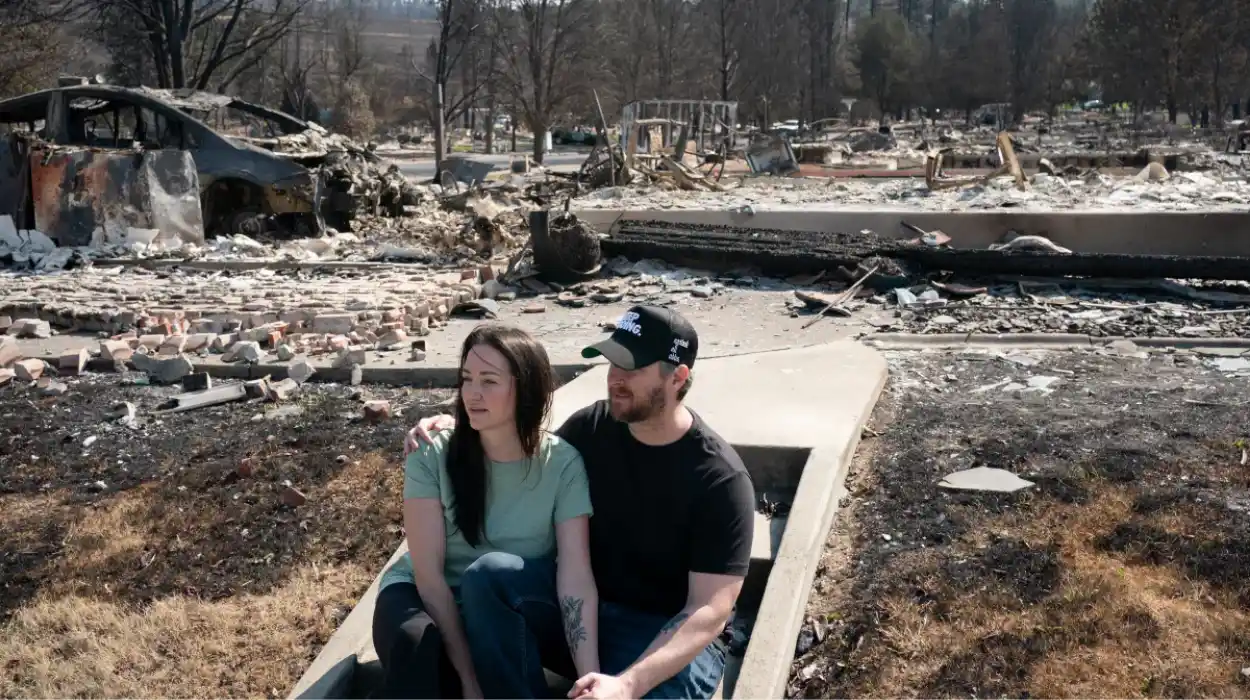
The physical landscape of several Spokane neighbourhoods resembles a militarised conflict zone following the disaster. As detailed by Kirk Siegler of NPR, local residents Melissa and Christopher Matthews returned to inspect the remains of their property on Old Fort Drive, which they built roughly three decades ago. Describing the scene to NPR, Melissa Matthews stated that
“when we turned onto our road, Old Fort Drive, I said it looked like a bomb went off here”.
Her husband, Christopher Matthews, concurred with NPR reporting, adding:
“Yeah, it looked like a war zone is what you said”.
The couple’s Prius was reduced to a twisted hunk of metal, and their home was completely flattened. While they have filed their insurance claims, Christopher Matthews told NPR that the overall outlook is intimidating:
“It’s daunting. I’m expecting it to be like three or four years before anything happens”.
This expectation aligns closely with historical data from prior catastrophic fires, such as the Camp Fire in Paradise, California, or events in Colorado and Maui, where comprehensive rebuilding took years, with studies showing only a minor fraction of burn zones restored even three years post-disaster.
The physical environment remains heavily compromised. A few lots away from the Matthews family, workers clad in full hazmat suits comb through toxic rubble. Good Samaritans have dropped off boxes containing safety masks, gloves, and wood-and-mesh sifters to help people sift through personal belongings. Yet, basic daily tasks are hazardous; wind gusts sweep up thick, toxic dust and acrid smells. Christopher Matthews told NPR:
“Yeah, the air is not good. I’ve had a sore throat for the last few days because of coming down here and everything”.
Explore More Spokane News
Arson Suspect Charged in Devastating Wildfires Threatening Spokane 2026
Spokane Wildfire Recovery and Resident Returns in Spokane 2026
Why Are Local Authorities Unable to Prevent Residents From Re-entering Burn Zones?
With immense pressure on housing and deep emotional attachments to property, many families feel they have nowhere else to go. Sarah Nuss, Spokane’s director of emergency management, addressed the delicate balance authorities must maintain while speaking with NPR’s Kirk Siegler.
As highlighted by NPR, Nuss explained the underlying administrative dilemma, stating:
“It is a very challenging thing. While folks are allowed to go back into those areas, there is still a hazmat situation going on. The burned houses and damaged places are going to have things like lithium-ion batteries, hazardous chemicals”.
When questioned by NPR regarding whether city authorities intend to block access, Nuss clarified:
“We have no legal ability to keep people out, nor are we trying to do that, let’s say. So I think what we are doing right now is just really trying to understand and document all the risks across what kind of household people are going back into”.
The local government’s primary mandate has thus shifted toward heavy public education, distributing personal protective equipment (PPE), and managing expectations. Before any meaningful rebuilding or foundation clearing can begin, the tedious, heavy lifting of toxic debris removal must take place. The federal Environmental Protection Agency (EPA) has just begun arriving to coordinate this primary phase, which officials caution will require months or even years of careful execution.
How Are Vulnerable Populations and Surrounding Areas Coping With the Aftermath?
The crisis extends far beyond properties that were entirely destroyed. Just a short distance from completely levelled lots, many homes escaped the flames entirely, standing completely intact amidst charred landscapes. However, life in these surviving structures is far from normal.
NPR reported that city officials have posted cautionary notices across these neighbourhoods, instructing residents whose houses are still standing to wear protective gear, arrange professional property inspections, and rigorously flush their water pipes to check for chemical or thermal contamination.
Experts point to lessons learned from previous disasters nationwide, such as post-fire water system recovery efforts managed by resilience researchers like Andrew Whelton, who assisted utilities following the 2018 Camp Fire and the Eaton and Palisades fires in Los Angeles. Whelton noted in insights shared via NPR coverage:
“If you don’t test for it, you won’t know that there’s a hazard still on your property. That is what Spokane should take away from these past disasters”.
Compounding these environmental worries is the return of vulnerable demographics to areas directly bordering destruction. NPR’s Kirk Siegler reported on a local dementia care facility situated in the middle of a burned district, where signs reading “Welcome home. We missed you” greeted arriving transport buses bringing patients back.
The chaotic nature of the initial evacuation remains fresh in the memories of community workers and caretakers. Don Simpson, a local facility operator who assisted in the emergency response, recounted to NPR the harrowing moments when the wind-driven Old Trails Fire threatened their center: with minutes to spare, he and police officers loaded patients into the back of a pickup truck, leaving wheelchairs behind on the sidewalk.
Recalling the volatile escalation to NPR, Simpson stated:
“And by that time it was either propane or something that just started blowing and shooting in the sky”.
Although Simpson and his residents have moved back into their surviving apartments, the long-term outlook remains uncertain.
While Simpson expressed deep admiration for the resilience and community support he has witnessed, he and countless other Spokane fire survivors acknowledge that normalcy remains a distant prospect as the city grapples with its prolonged hazmat reality.