Key Points
- The Minnesota Department of Agriculture and Explore Minnesota have partnered to establish a state pavilion at the “Great American State Fair” on the National Mall in Washington, D.C.
- Organized by Freedom 250 to commemorate America’s semiquincentennial (250th anniversary), the 16-day event runs from June 25 through July 10, 2026, but has faced widespread backlash as a “Trump-backed” partisan affair.
- At least ten states—mostly with Democratic governors, including Connecticut, Massachusetts, Illinois, Maine, Oregon, and Washington—have declined to participate, citing high operational costs and rising political polarization.
- Minnesota organizers are deliberately steering clear of political discourse by focusing their booth on natural resources, agricultural heritage, and a dedicated exhibition of traditional crop art.
- Participating local crop artists have expressed complex feelings regarding the exhibition, balancing their personal disapproval of the federal administration with a desire to ensure Minnesota is represented authentically.
- The fair has faced additional disruptions, including high-profile musical acts dropping out of the concert lineup due to undisclosed political ties, alongside public disputes over crowd sizes and funding logistics.
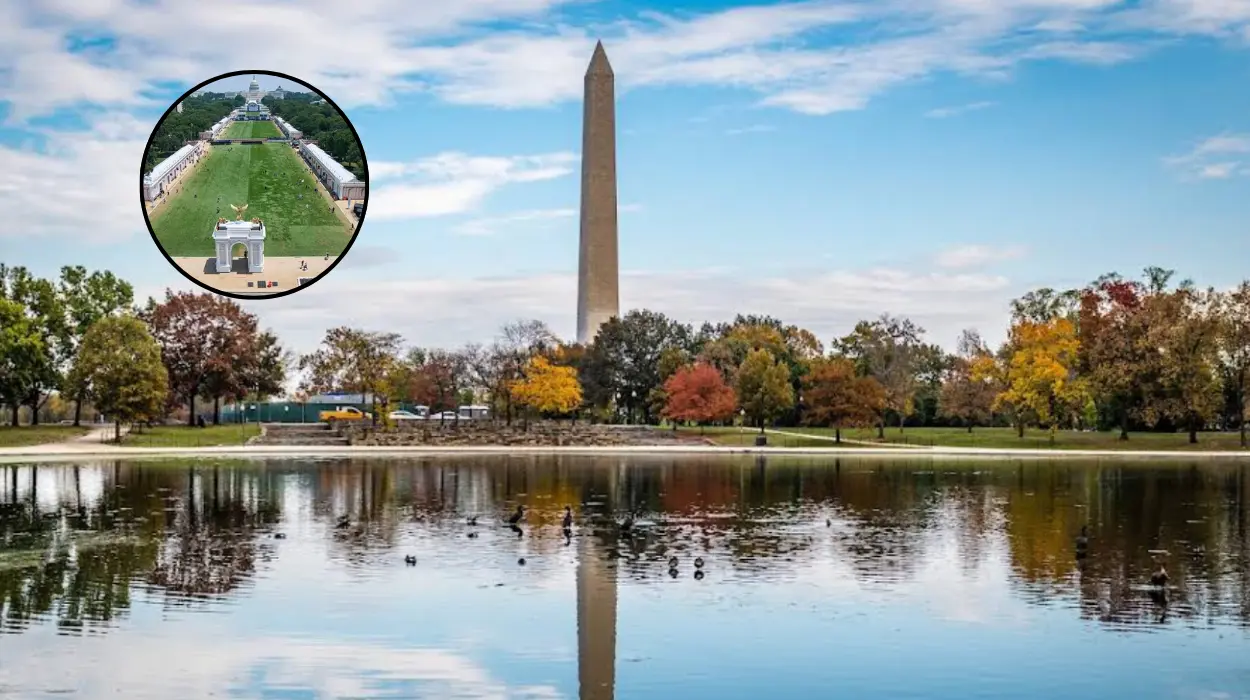
Washington, D.C. (Evening Washington News) July 4, 2026 – The Minnesota Department of Agriculture, in partnership with Explore Minnesota, officially opened its state exhibition pavilion at President Donald Trump’s “Great American State Fair” on the National Mall on July 4, 2026, navigating a highly charged political atmosphere by centering its showcase on regional agriculture, forestry, and traditional seed-based artwork.
- Key Points
- Can the Great American State Fair Remain Non-Partisan?
- How is Minnesota Representing Its Identity Amid a State Boycott?
- What do Local Artists Think About Their Work Being Displayed?
- Why did Major Musical Acts Withdraw From the Festival Lineup?
- Background of the Particular Development
- Prediction
As reported by food business development administrator Erika Camplin of the Minnesota Department of Agriculture via MPR News, the state’s delegation chose to participate despite a growing wave of boycotts from other state governments.
The 16-day exhibition, designed to mark the 250th anniversary of the United States, has faced significant scrutiny from state executives and performing artists who describe the gathering as a partisan rally rather than a neutral national celebration.
Amid these tensions, Minnesota booth staffers, including volunteer Julie Ramer, have actively redirectioned conversations away from national politics toward local agricultural topics whenever fairgoers brought up partisan divisions.
Can the Great American State Fair Remain Non-Partisan?
The event was originally conceptualised by the non-profit organisation Freedom 250 as a nationwide showcase, allocating a 600-square-foot pavilion to every U.S. state and territory. However, the festival has rapidly evolved into a focal point for national political divisions.
According to reports published by Kevin Carter of The New Republic, a total of six prominent blue states—including Massachusetts, Connecticut, Illinois, Maine, Oregon, and Washington—withdrew their participation prior to the opening day.
Press secretary Luke Harkins, representing Oregon Governor Tina Kotek, stated that the withdrawal was prompted by
“growing concerns that the event in Washington, D.C., is shaping up to be a more partisan affair than originally presented.”
Similarly, Washington Lieutenant Governor Denny Heck clarified the state’s fiscal and structural objections, noting:
“Given the significant costs associated with participating in the Great American State Fair, we chose to focus on supporting local efforts here in Washington state for this very important commemoration.”
The operational expenses have emerged as a primary point of contention between state houses and federal organisers.
While Freedom 250 spokesperson Rachel Reisner publicly maintained that there were no mandatory entry fees for individual states, participating administrations encountered escalating secondary costs.
As reported by Mark Pazniokas of the CT Mirror, Massachusetts officials estimated that shipping logistics, transport vehicle permits, and booth assembly on the National Mall would total closer to $200,000 per state.
In Connecticut, Governor Ned Lamont’s administration flatly rejected a last-minute donation of $100,000 from a private Republican donor group led by retired businessman RP Scelzo, who sought to fund a state booth.
Cathryn Vaulman, spokeswoman for Governor Lamont, stated that the offer arrived “too late” and emphasized that the decision to skip the fair was finalized long before it degenerated into a partisan battleground.
How is Minnesota Representing Its Identity Amid a State Boycott?
Rather than joining the multi-state boycott, Minnesota’s agricultural and tourism agencies elected to utilize their allocated space to highlight the state’s natural environment and cultural traditions.
The Minnesota pavilion features an interactive soundscape, a Paul Bunyan mural, a loon-themed educational game, and the distribution of 19,000 pollinator seed packets filled with native flora mixes.
The centerpiece of the pavilion, however, is an exhibition of authentic Minnesota crop art—a long-standing tradition at the Minnesota State Fair where intricate mosaics are composed entirely of native seeds, hulls, and stems. Organiser Erika Camplin explained the rationale behind selecting the specific medium:
“I think crop art is where Minnesota’s agricultural heritage kind of meets its creative spirit. It’s such a uniquely Minnesota tradition that reminds us of all the things we can grow that nourish us and inspire us and tell our story. I know other states do it, but I think that in Minnesota there’s become this sort of a beautiful cult community and culture around it that is uniquely Minnesotan.”
Three distinct pieces from the local seed-art community were transported to the capital: a depiction of the iconic Al’s Breakfast building in Minneapolis created by artist Ike Whiting, a “croppie” fish mosaic by Christy Klancher, and a rendering of a commemorative star from the historic First Avenue music venue by Marta Shore.
What do Local Artists Think About Their Work Being Displayed?
The inclusion of local artwork in a festival heavily associated with the current administration has caused friction among the participating creators.
Artists have expressed a distinct conflict between showcasing their regional pride and appearing to endorse the political event.
In an interview with MPR News, crop artist Ike Whiting, who has been practicing the medium since 2021, acknowledged his personal discomfort regarding the exhibition’s alignment:
“There has been a lot of thoughts and conversations about the inclusion of one of my pieces of art in this event I don’t 100 percent back and agree with and support. But I guess what I keep coming back to is if we let them, these national organizers, depict Minnesota on our behalf, we’ve already seen how the federal government has been treating Minnesota as a state for over a year now — I just wouldn’t trust them to depict our state in a fair way.”
Whiting further noted that his latest ongoing projects back home focus heavily on social commentary, including depictions of recent immigration-enforcement surges, and stated that the Washington exhibition remains
“just another way for us to show the world that Minnesota is a great place, despite what anybody else is saying about it.”
Why did Major Musical Acts Withdraw From the Festival Lineup?
The political polarization surrounding the Great American State Fair has extended past state governments and into the entertainment industry.
Within 24 hours of Freedom 250 announcing a star-studded performance roster, seven headline acts abruptly canceled their appearances after learning of the event’s specific political branding.
As documented by the independent media outlet NOTUS, prominent hip-hop artist Young MC publicly dissolved his contract upon discovering the festival’s background. Writing on social media, the performer stated:
“I HAVE INFORMED MY AGENTS THAT I WILL NOT BE PERFORMING AT THE FREEDOM 250 EVENT. The artists were never told about any political involvement with the event. And despite the claims by the organizers that the event is non-partisan, Spin magazine describes it as ‘Trump-backed.’ I hope to perform in D.C. in the near future at an event that is not so politically charged.”
The wave of cancellations quickly expanded across multiple genres. Renowned country music artist Martina McBride withdrew, stating via social media that she was presented with an opportunity to perform at what she believed was a non-partisan event aimed at bringing people together, but found the reality to be “misleading.”
The legendary funk band The Commodores similarly issued a formal statement clarifying that they “choose not to publicly affiliate with any single political party” and would not perform.
Minnesotan funk pioneer Morris Day also rejected his billing, posting an online statement reading, “It’s a No for Me.”
Freedom 250 Chief Executive Officer Keith Krach strongly defended the foundation’s operational neutrality, asserting that the entity remains strictly non-partisan, despite concurrently acknowledging that President Trump was instrumental in establishing the initial framework for the organization.
Ultimately, only a limited number of the originally billed artists, including pop-rap performer Flo Rida and rock vocalist Vanilla Ice, proceeded with their scheduled concert appearances on the National Mall.
Background of the Particular Development
The Great American State Fair is the culmination of a multi-year legislative and executive effort to plan the United States Semiquincentennial, marking 250 years since the signing of the Declaration of Independence in 1776.
Under the federal framework established during his first term and carried into his second, President Trump sought to centralize the national birthday celebration in the nation’s capital through a grand-scale exhibition modeled after traditional midwestern state fairs.
The execution of the project was delegated to Freedom 250, a Congressionally sanctioned but privately managed entity tasked with raising corporate sponsorships and coordinating state-level participation.
The project ran into immediate systemic friction as the broader political climate grew increasingly polarized. State fairs are historically decentralized, deeply rooted local institutions managed by state agricultural societies or regional boards.
By attempting to transplant this local, rural tradition into a centralized federal exposition on the National Mall, the organizers inadvertently exposed the project to intense federal partisan conflict.
The initiative became deeply entangled in debates over federal spending, executive overreach, and cultural representation, turning what was designed as a unifying historical milestone into a administrative dispute over logistics, state rights, and political alignment.
Prediction
The deep political division surrounding the Great American State Fair is expected to significantly alter how public cultural institutions, state tourism boards, and independent artists engage with federally managed national celebrations in the future.
For the primary audience of state agricultural departments and local artisans, this development signals an end to the assumption that state-funded cultural expositions can remain entirely insulated from federal partisan disputes.
In future national milestones, such as upcoming constitutional anniversaries or international expositions, state governments will likely demand strict, legally binding non-partisan clauses and comprehensive financial transparency before committing public funds or logistical resources.
Independent artists and cultural contributors will undoubtedly exercise extreme caution, requiring their talent agencies to conduct rigorous political vetting of event organizers to avoid unintended brand affiliations.
Consequently, future national celebrations are highly likely to become decentralized, with states prioritizing localized, home-based festivals over large-scale, centralized gatherings in Washington, D.C., thereby reshaping how American history and regional identity are presented to the public.