
Key Points
- US President Donald Trump and Iranian President Masoud Pezeshkian electronically signed a 14-point memorandum of understanding on Wednesday, June 17, 2026, to end the war
- The agreement took immediate effect and mandates a permanent halt to military operations across all fronts, including Lebanon
- Iran committed to on-site “down-blending” of its enriched uranium stockpile under International Atomic Energy Agency supervision
- The US will immediately waive oil sanctions crippling Iran’s economy and lift the naval blockade on Iranian ports
- Both nations have 60 days to negotiate a lasting agreement that would include a $300 billion reconstruction fund backed by regional nations
- Iran will instantly reopen the Strait of Hormuz with no tolls for maritime traffic, ending the crucial waterway’s shutdown
- The war launched February 28 by the United States and Israel has killed more than 7,000 people across the Middle East, mostly in Iran and Lebanon
- Pakistan Prime Minister Shehbaz Sharif mediated the agreement and stated it “shall enter into force with immediate effect”
- Trump threatened to resume attacks and “bomb the hell out of them” if Iran violates the agreement
- G7 leaders hailed the agreement at their summit in Évian-les-Bains, France, demanding immediate ceasefire in Lebanon
- Israeli Prime Minister Benjamin Netanyahu was not part of negotiations and Israel retains right to use force in Lebanon
- Trump recanted his February promise to destroy all Iran’s missiles, saying it would be “unfair” for other countries to have them while Iran doesn’t
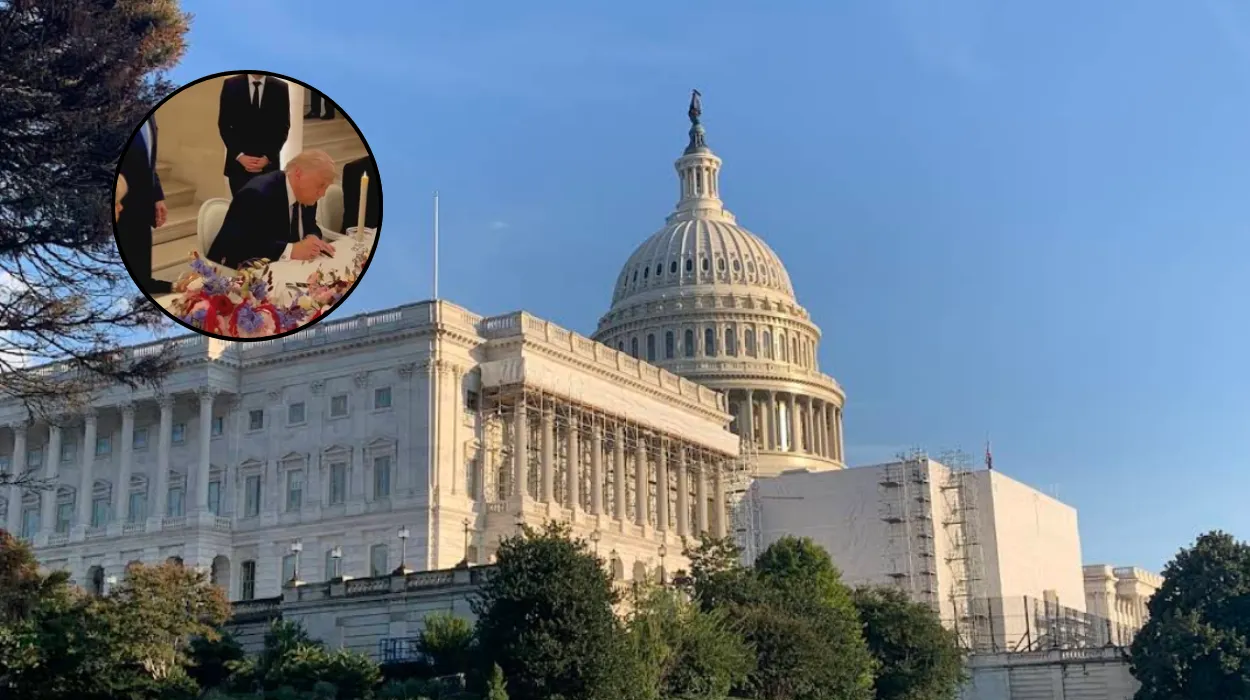
Washington (Evening Washington News) June 18, 2026 – US President Donald Trump and Iran’s President Masoud Pezeshkian signed a deal Wednesday meant to end the Middle East war, with Tehran agreeing to dilute its enriched uranium in return for large-scale economic relief and a $300 billion reconstruction fund backed by nations across the region. Trump put his signature to the memorandum of understanding during a candlelit dinner at the Palace of Versailles following a G7 summit, as host French President Emmanuel Macron and other guests applauded, a video posted by a Trump aide showed.
- Key Points
- How Will the Deal Immediately Affect Military Operations and the Strait of Hormuz?
- What Conditions Did Trump Set for Iran’s Compliance and What Warnings Did He Issue?
- What Did Iran’s Lead Negotiator Say About Achievements Through Negotiation Versus Military Action?
- How Did G7 Leaders Respond and What Happened with Israel’s Position on the Agreement?
- What Was the Human Toll of the War and What Did Trump Say About Iranians?
- What Did Pakistani Prime Minister Shehbaz Sharif Say About the Mediation and Signing Ceremony?
- Background of the US-Israeli War on Iran and Diplomatic Development
- What Impact Will This Interim Peace Deal Have on Middle Eastern Civilians and Global Markets?
- For Global Energy Markets and Oil Prices
- For Iran’s Economy and Reconstruction
- For Regional Security and US-Iran Relations
- For Israel and Lebanon
“Just signed it,” Trump told reporters as he emerged from the palace. Iranian Foreign Ministry spokesman Esmaeil Baghaei, quoted by the state news agency IRNA, said the document
“was finalised with the signatures of the presidents”.
The 14-point agreement extends a ceasefire announced in April by another 60 days, including in Lebanon, to allow the two sides to negotiate a final truce.
How Will the Deal Immediately Affect Military Operations and the Strait of Hormuz?
As reported by the media selangor correspondent of media selangor, the memorandum includes an immediate end to the war on all fronts, including Lebanon, the full resumption of maritime traffic “with no charge” in the Strait of Hormuz, the lifting of a US blockade of Iranian ports, the waiving of U.S. sanctions on Iran, the unfreezing of its assets, and a US$300 billion investment fund for the Islamic Republic’s post-war reconstruction.
“As a first step, Islamic Republic of Iran will instantly reopen the Strait of Hormuz and the United States of America will immediately lift the naval blockade,”
Sharif wrote. Under the text, Washington also commits to immediately waive oil sanctions crippling Iran’s economy.
The deal aims to draw a line under the war launched February 28 by the United States and Israel, prompting Iran to counterattack with missile and drone salvos across the region – and effectively shutting down the Strait of Hormuz, a crucial waterway for the world economy.
Oil prices fell again on Wednesday amid prospects for the reopening of the Strait of Hormuz, with Brent crude futures below US$80, at their lowest level since the war’s start.
What Conditions Did Trump Set for Iran’s Compliance and What Warnings Did He Issue?
As reported by the media selangor correspondent of media selangor, Trump, attending the G7 with other leaders in France, also withdrew at least one of his stated rationales for attacking Iran in the first place, saying it would be “unfair” for Tehran not to have ballistic missiles, having previously vowed to obliterate them.
“We are going to bomb the hell out of them if they violate the agreement. I do not want them to; I want them to honour the agreement,”
he said of Iran during a media conference. Earlier, the President had said,
“If I do not like it, if they do not behave, we will go right back to dropping bombs right smack in the middle of their head, OK?”.
Trump also called Iranians “smart people” as US and Iranian negotiators work on a permanent truce over the coming 60 days, which he hoped would usher in peace in the Middle East and lower oil prices.
What Did Iran’s Lead Negotiator Say About Achievements Through Negotiation Versus Military Action?
As reported by the media selangor correspondent of media selangor, Iran’s lead negotiator Mohammad Baqer Qalibaf told state television about the agreement, which includes the unfreezing of billions of dollars in Iranian assets:
“Everything we sought to achieve through military action, we obtained several times over through negotiation; it was not even comparable”.
Iran also undertakes not to build nuclear weapons, reaffirming a vow it had made for decades. It also agreed to the on-site “down-blending” of its stockpile of enriched uranium under the supervision of the International Atomic Energy Agency, although Trump had wanted to take it out of the country, which Iran has rejected.
How Did G7 Leaders Respond and What Happened with Israel’s Position on the Agreement?
G7 leaders hailed the agreement at their summit, held in the French town of Évian-les-Bains, an hour’s drive along the shore of Lake Geneva from where the US has said a formal signing ceremony for the US-Iran agreement was due to be held across the Swiss border on Friday.
The leaders of France, Germany, the United Kingdom, Japan, Italy, Canada, and the US demanded in a joint statement an immediate ceasefire in Lebanon, where the memorandum calls for a halt to hostilities between Israel and the Iran-backed Hezbollah group that has killed thousands of people and displaced more than a million people.
On Wednesday, Trump gently rebuked Israeli Prime Minister Benjamin Netanyahu, who has distanced Israel from the US-Iran agreement, over his tactics in Lebanon against Hezbollah.
“Netanyahu happens to be a good man, gets a little excited sometimes. We have a little dispute over Lebanon. I say you can do a little softer touch, Bibi,”
he told the media in Paris after leaving the summit.
“You do not have to knock down a building every time somebody walks into it, that is from Hezbollah,”
Israeli Prime Minister Benjamin Netanyahu was not part of the negotiations and Israel’s military is occupying southern Lebanon, says it retains the right to use force. Lebanese state media reported fresh Israeli air strikes and artillery fire in several southern towns throughout Wednesday.
What Was the Human Toll of the War and What Did Trump Say About Iranians?
The war has killed more than 7,000 people across the Middle East, most of them in Iran and Lebanon. As reported by the media selangor correspondent of media selangor, the US and Israel launched the war on Iran on February 28, assassinating the 86-year-old Supreme Leader Ayatollah Ali Khamenei and military leaders on the first day.
It quickly spiralled into a regional conflict that has killed more than 7,000 people, mostly in Iran and Lebanon; driven up energy prices; renewed inflationary pressures, and sparked concerns about a major food supply crisis in developing countries.
Trump also called Iranians “smart people” as US and Iranian negotiators work on a permanent truce over the coming 60 days. Despite his combative rhetoric, Trump appears to have achieved little of what he said he wanted in going to war, while Iran appears much closer to sanctions relief worth billions of dollars than before it was attacked.
Iran’s theocratic government remains in place, its stockpile of highly enriched uranium has not been surrendered, its ballistic missile capabilities have not been destroyed, and it has not ended its support for anti-Israel militias like Hezbollah in Lebanon.
Trump recanted his February promise to destroy all of Iran’s missiles and “raze their missile industry to the ground”.
“I am saying that if other countries have them, it is a little bit unfair for them not to have some,”
he told the media in Paris after leaving the summit.
What Did Pakistani Prime Minister Shehbaz Sharif Say About the Mediation and Signing Ceremony?
Prime Minister Shehbaz Sharif of Pakistan, which mediated the agreement, said on X that it “shall enter into force with immediate effect”.
The agreement had earlier been slated for signatures by Iran’s chief negotiator and parliament speaker, Mohammad Bagher Ghalibaf, and US Vice President JD Vance. Iran said an in-person ceremony was no longer needed.
But Sharif said an official ceremony will take place Friday in Switzerland and technical talks will commence. However, Iranian Foreign Ministry spokesman Esmaeil Baghaei cast doubt on this, telling IRIB’s News Network that because the two presidents had already signed,
“No signing ceremony will be held in Switzerland”.
US and Iranian officials said that both Trump and Iranian President Masoud Pezeshkian have digitally signed the memorandum in English and Farsi, with Iran’s Foreign Ministry saying the agreement was already in effect as of Wednesday.
And once a final agreement is reached on the Islamic Republic’s nuclear programme, the United States will also facilitate the release of a $300 billion reconstruction fund supported by regional nations, the deal says.
The memorandum is not a final peace agreement, but launches a 60-day negotiation period during which Washington and Tehran are expected to discuss Iran’s nuclear program, sanctions relief, frozen assets, the future administration of the Strait of Hormuz, and a final settlement to be endorsed by the UN Security Council.
Background of the US-Israeli War on Iran and Diplomatic Development
The conflict began on February 28, 2026, when the United States and Israel launched what they termed the “US-Israeli war on Iran”.
The first day of the war saw the assassination of 86-year-old Supreme Leader Ayatollah Ali Khamenei and military leaders.
The war was launched with Trump’s stated objectives including destroying Iran’s missile capabilities and obliterate their missile industry.
Prior to the interim deal, an earlier ceasefire had been announced in April, which the new 14-point agreement extends by another 60 days.
The conflict quickly spiralled into a regional war involving Lebanon, where Hezbollah, an Iran-backed militia, engaged Israeli forces. More than a million people have been displaced from their homes in Lebanon.
The Strait of Hormuz, a crucial waterway for the world economy between Iran and Oman, was effectively shut down by Iran as part of its counterattack with missile and drone salvos across the region.
The US responded by blocking shipping to and from Iranian ports. This closure drove up energy prices and renewed inflationary pressures globally.
European leaders share US concerns about Iran’s nuclear program but never endorsed the decision to go to war without United Nations authorization.
They worry Iran has gained leverage by withstanding the superpower onslaught and asserting control over the strait.
The agreement was mediated by Pakistan, with Prime Minister Shehbaz Sharif taking the lead in mediation efforts. Sharif had earlier stated on June 14 that a peace deal would “likely” be finalised within 24 hours and that Pakistan was preparing for electronic signing followed by technical talks.
What Impact Will This Interim Peace Deal Have on Middle Eastern Civilians and Global Markets?
The immediate cessation of military operations across all fronts will halt the killing that has already surpassed 7,000 fatalities. For the more than a million people displaced in Lebanon, the ceasefire demands a halt to hostilities between Israel and Hezbollah, though fighting has abated but not ceased since previous agreements.
Lebanese security sources reported ongoing Israeli air strikes and artillery fire, with Hezbollah launching drone attacks on Israeli forces.
The reopening of the Strait of Hormuz without tolls will restore maritime traffic that was shut down during the conflict.
This will directly benefit shipping companies and coastal communities that depend on this crucial waterway for trade and economic activity.
For Global Energy Markets and Oil Prices
Brent crude futures fell below US$80 on Wednesday, reaching their lowest level since the war’s start, amid prospects for Hormuz reopening. Trump explicitly stated he hoped the 60-day negotiation period would “lower oil prices”.
The waiver of oil sanctions crippling Iran’s economy will allow Iranian crude oil exports to resume, adding supply to global markets.
However, prices later regained more than one percent after Trump threatened renewed violence, demonstrating market sensitivity to compliance uncertainty.
The conflict had driven up energy prices and renewed inflationary pressures globally, according to media selangor.
For Iran’s Economy and Reconstruction
The unfreezing of billions of dollars in Iranian assets provides immediate economic relief. The waiving of U.S. sanctions on Iran, including those over Tehran’s weapons programs and human rights abuses, opens the door to ending all sanctions Iran faces from the US and at the UN.
The $300 billion reconstruction fund, supported by regional nations, will be facilitated once a final agreement on Iran’s nuclear program is reached.
Iran’s lead negotiator Mohammad Baqer Qalibaf stated that “everything we sought to achieve through military action, we obtained several times over through negotiation,” emphasizing the unfreezing of assets as a key achievement.
For Regional Security and US-Iran Relations
The 60-day negotiation period will address Iran’s nuclear program, sanctions relief, frozen assets, and the future administration of the Strait of Hormuz.
Iran committed to on-site down-blending of enriched uranium under IAEA supervision but rejected Trump’s earlier demand to remove stockpile from the country.
Trump’s threat to “bomb the hell out of them” if Iran violates the agreement creates ongoing uncertainty about long-term compliance.
The agreement is not final but launches negotiations for a settlement to be endorsed by the UN Security Council.
For Israel and Lebanon
Israel was not part of negotiations and retains the right to use force in southern Lebanon where its military is occupying territory.
Trump’s rebuke of Netanyahu over “soft touch” tactics in Lebanon against Hezbollah indicates US-Iran agreement may constrain Israeli military operations. The ceasefire demand in Lebanon remains partially unfulfilled with ongoing Israeli air strikes and Hezbollah drone attacks.
The development marks “a diplomatic triumph” for Iran according to Iranian leaders, arguing that sanctions relief and access to frozen assets reflect Washington’s failure to achieve military objectives.
However, Trump’s recanting of his February missile destruction promise while maintaining threat of renewed bombing creates contradictory signals about long-term US-Iran relations.