

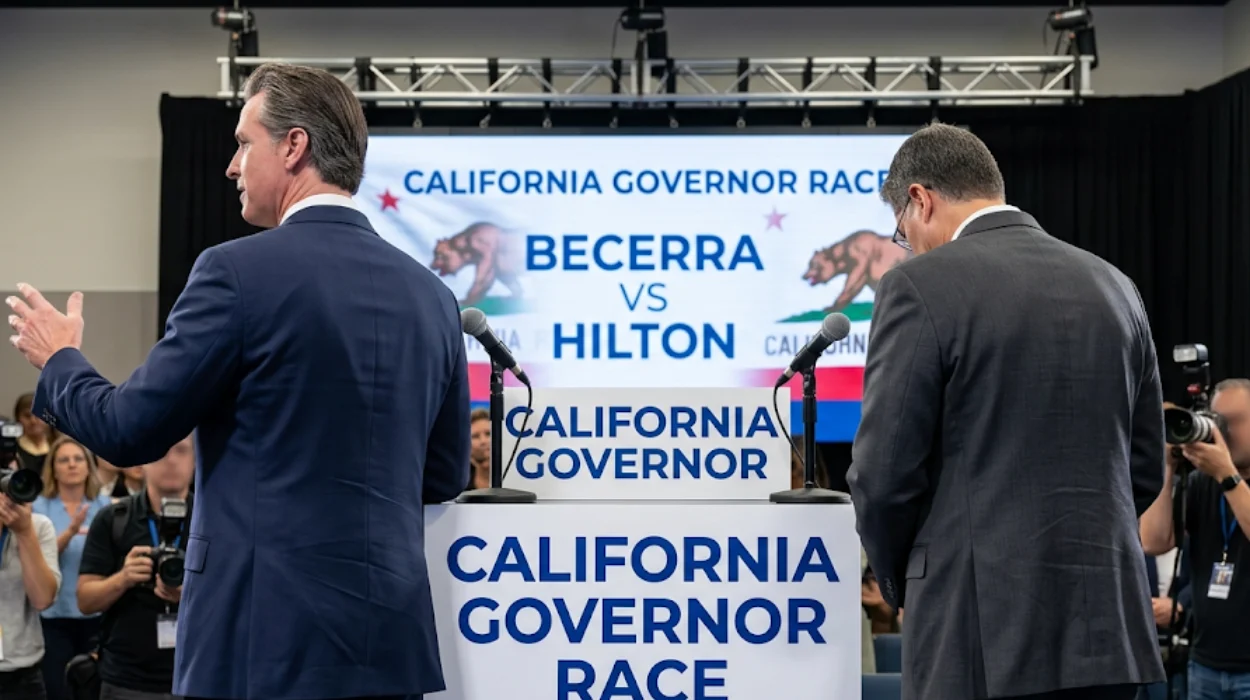
California governor race refers to the 2026 gubernatorial election to replace term-limited Democrat Gavin Newsom, with Democrat Xavier Becerra and Republican Steve Hilton advancing to the November 3 general election after the June 2 top-two primary. For Washington state residents tracking national political developments, this race offers critical insights into how California’s policies influence West Coast governance trends.
- What Is the California Governor Race and Why Does It Matter for Washington?
- Who Are the Leading Candidates in the 2026 California Governor Race?
- What Is Xavier Becerra’s Political Background and Qualifications?
- Who Is Steve Hilton and What Is His Political Profile for Washington Observers?
- Where Does Tom Steyer Stand in the Race?
- How Does California’s Top-Two Primary System Work?
- What Are the Key Issues Dominating the California Governor Race and Washington Concerns?
- How Serious Is California’s Housing Crisis and Homelessness Problem Compared to Washington?
- What Is California’s Budget Situation Relative to Washington State’s Economy?
- How Do Wildfires and Climate Change Impact Both California and Washington Elections?
- Why Is This Race Historically Significant for California and Washington Politics?
- When and Where Does the General Election Take Place for Washington Voters?
- What Happens After the Primary Results Are Certified for Washington State?
What Is the California Governor Race and Why Does It Matter for Washington?
The 2026 California governor race determines who will lead the nation’s most populous state with a $4 trillion economy, the fifth-largest globally, facing critical challenges including housing affordability, homelessness, wildfires, and a budget deficit—issues directly relevant to Washington state’s similar policy challenges.”
California’s gubernatorial election carries unprecedented national significance because the state represents 39.5 million residents and sets policy trends that influence federal legislation affecting Washington state residents. The winner will manage California’s massive budget, oversee environmental regulations affecting national climate policy, and potentially position themselves for a 2028 presidential run. This open-seat race occurred because incumbent Governor Gavin Newsom, a Democrat serving his second term, cannot run for re-election due to California’s two-term limit for governors.
Washington state policymakers closely monitor California’s governor race because both states face parallel challenges: Pacific Northwest wildfires mirror California’s fire seasons, Seattle’s housing crisis parallels Los Angeles’ affordability problems, and both states lead environmental protection initiatives. The race features a historically significant potential matchup between Democrat Xavier Becerra and Republican Steve Hilton, which would produce California’s first Republican governor since Arnold Schwarzenegger ended his two terms in 2011.

Who Are the Leading Candidates in the 2026 California Governor Race?
Former U.S. Health and Human Services Secretary Xavier Becerra leads with 25.7% of votes as a Democrat, while Fox News commentator Steve Hilton holds 26.9% as a Republican, with both securing over 1.1 million votes in the June 2 primary.”
What Is Xavier Becerra’s Political Background and Qualifications?
Xavier Becerra was born on January 26, 1958, in Sacramento, California, to a Mexican-born mother and Sacramento-born father, becoming the first in his family to graduate from college with a Stanford economics degree in 1980 followed by a law degree. He served 24 years in the U.S. House of Representatives from 1993 to 2017, representing Los Angeles area districts, where he became the first Latino on the Ways and Means Committee and chaired the Democratic caucus.
Becerra’s most significant legislative achievement involved crafting and securing votes for the Affordable Care Act (Obamacare), the landmark health care reform that expanded coverage to millions of Americans. After leaving Congress, Governor Jerry Brown appointed him California Attorney General in 2017 to fill Kamala Harris’s vacated seat, making him the first Latino to hold that position, and he won election to a full four-year term in 2018.
As Attorney General from 2017 to 2021, Becerra filed 122 lawsuits against the Trump administration defending the Affordable Care Act, challenging the border wall construction, and opposing environmental deregulation including offshore oil drilling expansion. President Joe Biden appointed him as the 25th U.S. Secretary of Health and Human Services from 2021 to 2025, where he became the first Latino to lead the department overseeing the CDC and FDA while reducing prescription drug prices. Washington state advocates for federal health care access see Becerra’s tenure as relevant to their own Medicaid expansion debates.
Who Is Steve Hilton and What Is His Political Profile for Washington Observers?
Steve Hilton is a 55-year-old British-American dual citizen born in the United Kingdom to Hungarian parents who fled communism, moving to the U.S. in 2012 after serving as British Prime Minister David Cameron’s director of strategy in Downing Street. He became best known in America as the Fox News Channel host of “The Next Revolution,” a political commentary show that established his national profile as a conservative commentator.
Hilton announced his candidacy for California governor on April 21, 2025, becoming the second high-profile Republican to enter the race after positioning himself as addressing California’s housing crisis, high taxes, and what he calls “staggering incompetence of Democrat one-party rule”. Despite Republican endorsement from President Donald Trump in April 2026, Hilton describes his campaign as “nonpartisan” rather than embracing the Republican label.
The former Atherton resident lived in the Bay Area for over a decade, raised his family there, taught at Stanford University, started a business, authored books, and led the nonprofit organization Golden Together before launching his gubernatorial campaign. His endorsement by Trump helped him surpass Riverside County Sheriff Chad Bianco, another prominent Republican contender, securing his position as the Republican frontrunner. Washington state Republicans watching California’s political shift note Hilton’s potential to break Democratic dominance similar to their own state’s competitive election landscape.
Where Does Tom Steyer Stand in the Race?
Democratic billionaire activist Tom Steyer finished third in the primary with 19.8% of votes, falling nearly 260,000 votes short of the leaders after securing 19.8%. Steyer’s net worth is estimated by Forbes at around $2 billion, made as the founder of a San Francisco hedge fund before selling his shares in 2012 to dedicate his life to politics and activism.
Steyer previously made an unsuccessful run for president in 2020 and founded NextGen America, a nonprofit supporting progressive approaches to climate change, immigration, healthcare, and education. He led ballot proposition campaigns to defeat Big Oil on climate issues, closed corporate tax loopholes for out-of-state companies, and raised the cigarette tax by taking on Big Tobacco. Despite his significant financial resources and political activism raising billions for California’s healthcare and public schools without taxpayer costs, Steyer could not overcome the momentum of Becerra and Hilton. Washington state environmental activists view Steyer’s climate advocacy as aligned with their own Pacific Northwest clean energy initiatives.
How Does California’s Top-Two Primary System Work?
California’s top-two primary system places all candidates for voter-nominated offices on one ballot regardless of party preference, with only the top two vote-getters advancing to the general election even if they share the same party.”
This open primary system allows voters registered with any party—or no party—to vote for any candidate regardless of the voter’s party registration, increasing competition and reducing party dominance. Voters enacted this system over a decade ago through a ballot measure, over the strenuous objections of both Democratic and Republican parties, and it became first implemented for congressional races in 2012 before expanding to state races. Washington state voters studying electoral reform note California’s system as a model for their own nonpartisan primary discussions.
The 2026 gubernatorial primary marks the first time California has utilized this open format since the late 1990s for governor specifically, creating the possibility of two Democrats or two Republicans advancing to November. Approximately 35 million ballots remain uncounted after the June 2 primary because California accepts mail-in ballots arriving up to a week post-Election Day if postmarked by that date, delaying final results.
This system fundamentally changes campaign strategy because candidates must appeal to the entire electorate rather than just their party base, often resulting in more moderate positioning and cross-party messaging. The top-two format frequently produces two Democrats in the general election due to California’s Democratic voter registration advantage, though the 2026 race potentially breaks this pattern with a Democrat-Republican matchup. Washington state’s growing political competitiveness mirrors California’s shift toward centrist messaging that appeals across party lines.
What Are the Key Issues Dominating the California Governor Race and Washington Concerns?
The 2026 California governor race centers on housing affordability, homelessness, wildfire insurance availability, anticipated budget deficits, and soaring housing expenses that voters face with rising grocery, utility, and fuel costs—challenges parallel to Washington state’s policy priorities.”
How Serious Is California’s Housing Crisis and Homelessness Problem Compared to Washington?
California faces a severe housing affordability crisis with soaring housing expenses that candidates must address through policy solutions. The state has the highest housing costs in the nation, with median home prices exceeding $800,000 in many metropolitan areas, making homeownership unattainable for most working families. Seattle’s housing market similarly struggles with median prices above $900,000, creating parallel affordability crises across the Pacific Northwest.
California hosts approximately 171,500 unsheltered individuals, representing over 30% of the national homeless population despite having only 12% of the U.S. population. Washington state faces its own homelessness challenge with approximately 17,000 unsheltered residents, particularly concentrated in Seattle and Tacoma urban areas. Recent funding cuts threaten California’s homelessness initiatives despite evidence that prior investments helped reduce unsheltered homelessness and expand housing placements, according to analysis by the California Budget Center. Washington state advocates studying California’s experience note that increased funding combined with regulatory reforms produces measurable reductions in unsheltered populations.
Candidates must balance increased funding for affordable housing development with regulatory reforms that accelerate construction and reduce costs. Both California and Washington states implement inclusionary zoning requirements mandating affordable units in new developments, though California’s approach faces greater legal challenges from property rights groups.
What Is California’s Budget Situation Relative to Washington State’s Economy?
California’s 2026-27 budget proposal includes a projected $2.9 billion shortfall announced in Governor Newsom’s last state budget, though this represents a modest deficit down sharply from previous forecasts thanks to continuing windfalls from tech and AI stocks. Washington state’s budget outlook remains more stable with a projected surplus of $1.2 billion, though both states face long-term challenges from infrastructure spending and education funding requirements.
The state’s $4 trillion economy includes major industries including technology in Silicon Valley, entertainment in Hollywood, agriculture in the Central Valley, and international trade through the Port of Los Angeles and Port of Long Beach. Washington state’s $700 billion economy centers on technology in Seattle (Microsoft, Amazon), aerospace in Everett (Boeing), international trade through the Port of Seattle, and agriculture in the eastern region. Economic challenges include high cost of living that drives middle-class families to other states, high taxes that businesses cite as discouraging expansion, and regulatory complexity that increases compliance costs—issues both states grapple with simultaneously.
How Do Wildfires and Climate Change Impact Both California and Washington Elections?
Wildfire threats represent a critical issue for California governors as climate change intensifies fire seasons and insurance companies increasingly refuse coverage in high-risk areas. Washington state faces parallel wildfire challenges with the 2021 and 2022 fire seasons destroying thousands of acres in eastern Washington, prompting similar insurance availability concerns. Candidates face demands to address wildfire insurance availability as residents struggle to obtain or maintain homeowners insurance in fire-prone regions across the state.
Water access remains a perennial challenge affecting agriculture, urban development, and environmental conservation in both states. California’s water system includes massive infrastructure projects like the State Water Project and Central Valley Project that distribute water from northern to southern regions, but drought conditions and environmental regulations create ongoing tensions between agricultural, urban, and environmental interests. Washington state’s water management focuses on the Columbia River system supporting salmon habitats, hydroelectric power generation, and agricultural irrigation in the eastern region.
Why Is This Race Historically Significant for California and Washington Politics?
This election could produce California’s first Republican governor since Arnold Schwarzenegger, who served from November 2003 to January 2011, ending a 15-year period of continuous Democratic gubernatorial control—potentially reshaping West Coast political dynamics affecting Washington state.”
Arnold Schwarzenegger won the 2003 recall election that removed Democratic Governor Gray Davis from office, becoming an international film star who successfully transitioned to politics and reshaped California’s political landscape. His tenure ended in 2011 after two terms, followed by Democratic governors Jerry Brown (2011-2019) and Gavin Newsom (2019-present), establishing Democratic dominance that could end if Hilton wins. Washington state’s political competitiveness—with Republicans holding the governorship from 1993 to 2003 and Democratic control since—demonstrates how West Coast states experience shifting party dominance based on economic conditions and demographic changes.
The race’s significance extends beyond party control because the winner will succeed Gavin Newsom, who has emerged as one of the most prominent Democratic voices nationally and is widely speculated to pursue a presidential run in 2028. Newsom admitted in a CBS Sunday Morning interview taped in October 2025 that he would be “lying” if he denied considering a presidential campaign after the 2026 midterm elections, though he acknowledged the decision remains years away. Washington state Democratic leaders watch California’s nomination process closely as potential presidential contenders shape national party platforms affecting their own state’s legislative priorities.
California’s political influence stems from its 54 electoral votes in presidential elections, the most of any state, and its policy leadership on climate change, technology regulation, labor laws, and environmental protection that often becomes a model for federal legislation. The governor’s office controls significant appointments including judges, utility commissioners, and members of dozens of boards and commissions that shape state policy for decades. Washington state policymakers frequently cite California’s environmental regulations as precedents for their own clean energy initiatives and carbon reduction targets.
When and Where Does the General Election Take Place for Washington Voters?
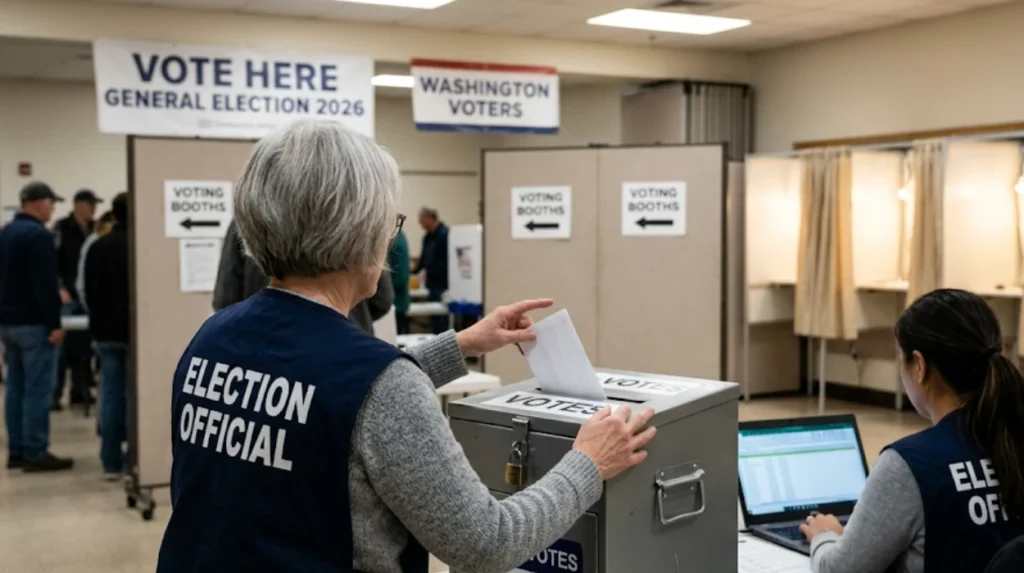
The general election for California governor occurs on November 3, 2026, with the winner taking office in January 2027 to serve a four-year term as the state’s chief executive—timing coinciding with Washington state’s own midterm elections.”
California Secretary of State records show Election Day polls remain open throughout the state from 7:00 a.m. to 8:00 p.m. on June 2, 2026, for the primary, with county elections officials beginning to report results at 8:00 p.m. that evening. The semifinal official canvass of votes continues with county officials reporting totals to the Secretary of State at least every two hours until completion, and the last day for county officials to certify election results is July 2, 2026. Washington state voters participating in November 2026 elections will see California’s results alongside their own governor’s race, state legislature contests, and federal representative elections.
The general election winner will govern California’s 58 counties ranging from rural Modoc County in the northeast to populous Los Angeles County with 10 million residents, managing diverse regional economies and political cultures. Campaigns intensify between June and November as candidates debate policies, raise funds, and advertise across television, digital, and radio platforms to reach California’s 22 million registered voters. Washington state political observers track California campaign spending patterns as indicators for their own election strategy investments.
What Happens After the Primary Results Are Certified for Washington State?
After the Associated Press declared Xavier Becerra the top spot on California’s ballot for governor, the second candidate remained uncertain for several days as ballot counting continued with Steve Hilton holding an advantage over Tom Steyer.”
The certification process requires county elections officials to complete the semifinal official canvass and report totals to the Secretary of State before final certification occurs by July 2, 2026. Once certified, Becerra and the second-place candidate advance to the general election where they face national party support, super PAC spending, and intense media scrutiny leading to November 3.
The winner will inherit administration infrastructure including 200,000 state employees, dozens of agencies, and ongoing initiatives in healthcare expansion, climate action, and economic development launched by the Newsom administration. They must navigate a Democratic-controlled state legislature while managing relations with President Donald Trump’s federal administration on issues including immigration enforcement, environmental regulations, and federal funding allocations. Washington state’s relationship with California on regional environmental cooperation, wildfire response coordination, and cross-Pacific trade policies will depend significantly on who assumes the governorship.
This comprehensive California governor race demonstrates how state elections increasingly shape national political dynamics, with policy experiments in California influencing debates across all 50 states including Washington about healthcare, climate change, housing, and economic inequality. Washington state residents tracking this race gain critical insights into Pacific West Coast governance trends that directly affect their own state’s policy development and political strategy.