
Key Points
- The story focuses on 1155 F Street NW in Washington, DC, which has become a major hub for crypto lobbying and political influence.
- The Information’s article frames the location as one of the most important real-world addresses in crypto’s push for legitimacy.
- The building houses or has housed key crypto industry lobbying activity, including the Blockchain Association’s Washington presence.
- Recent reporting also suggests crypto has made gains in Washington as market-structure legislation advanced through the Senate Banking Committee.
- The broader debate centres on how crypto is trying to present itself as a regulated, established industry rather than a fringe financial sector.
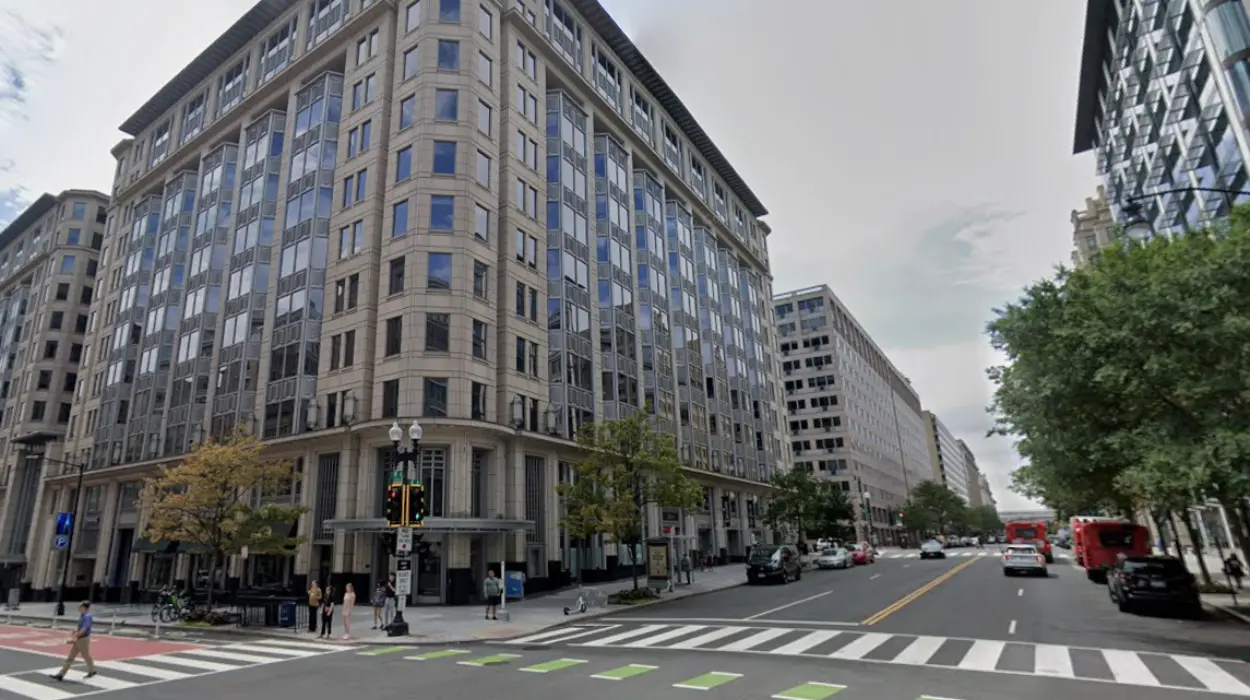
Washington (Evening Washington News) May 23, 2026 — Crypto’s effort to win political legitimacy in the United States has increasingly centred on 1155 F Street NW, a glass-paneled office tower in downtown Washington that has become a symbolic and practical base for lobbying, advocacy and legislative engagement.
Why is 1155 F Street so important to crypto?
As reported by the unnamed journalist at The Information, the building at 1155 F Street is described as “the most important real-world address in all of crypto,” reflecting the industry’s concentration of political work in Washington rather than on trading floors or exchange platforms. The address also matches the publicly listed Washington,
DC location tied to the Blockchain Association, a major trade group in the digital-assets sector. That makes the site more than a symbolic headquarters; it is also a functioning lobbying base in the capital.
How is crypto trying to gain legitimacy?
The Washington push is part of a wider industry strategy to move from regulatory uncertainty towards acceptance as a mainstream financial sector.
According to recent reporting, the crypto industry has recently notched gains in Washington after a fierce lobbying battle with banking interests, as a marquee market-structure bill advanced past a key Senate committee.
That development suggests the industry’s lobbying operations are not only for optics; they are tied directly to policy outcomes.
What does the building represent politically?
1155 F Street stands as a physical sign of how crypto has adapted to Washington’s power structure. Instead of relying only on public campaigns or online communities, the sector is investing in traditional influence channels such as trade associations, policy meetings and direct engagement with lawmakers.
In that sense, the building represents the industry’s attempt to speak the language of regulation, lobbying and institutional credibility.
What do the sources say about the wider context?
The The Information article places this address at the centre of a broader legitimacy battle, while Senate and industry reporting shows that crypto’s lobbying efforts are occurring during a period of legislative movement.
Public records and company listings show that organisations connected to the sector maintain an active Washington footprint at the same address, reinforcing its importance as a policy hub. Taken together, the sources point to an industry that is trying to shape how it is seen by regulators, banks and the wider public.
Explore More Business News
Washington Tax Burden Drives Rising Corporate Relocation Trends (Olympia 2026)
24% WA Businesses Consider Leaving State, AWB Survey Shows – Washington 2026
Background of the development
Crypto’s Washington strategy did not emerge overnight; it is the product of years of regulatory friction, market volatility and political scrutiny.
As digital assets grew, industry groups increasingly argued that clear rules were needed to support innovation and consumer protection, while critics pushed for stricter oversight because of risk, fraud and instability.
The concentration of lobbying activity at a single Washington address reflects how seriously the industry now treats legislative influence as part of its business model.
What could this mean for readers?
For policymakers, the development suggests crypto will continue to be a highly organised lobbying force in Washington and may affect the shape of future legislation. For investors and market participants, stronger political legitimacy could improve regulatory clarity, although it does not remove broader concerns about compliance and market risk.
For the public, the story shows how a once-decentralised technology industry has built a centralised political presence to pursue long-term acceptance.
Prediction
This development is likely to affect the crypto audience by increasing the pace of policy debate and raising expectations of clearer rules in the months ahead. If the industry continues to win legislative ground, market participants may see more confidence around compliance and product development, while critics are likely to intensify scrutiny of lobbying influence.
The most immediate impact for the crypto audience is that Washington will remain one of the sector’s most important battlegrounds, not just a place for policy discussion but a key determinant of the industry’s next phase.