

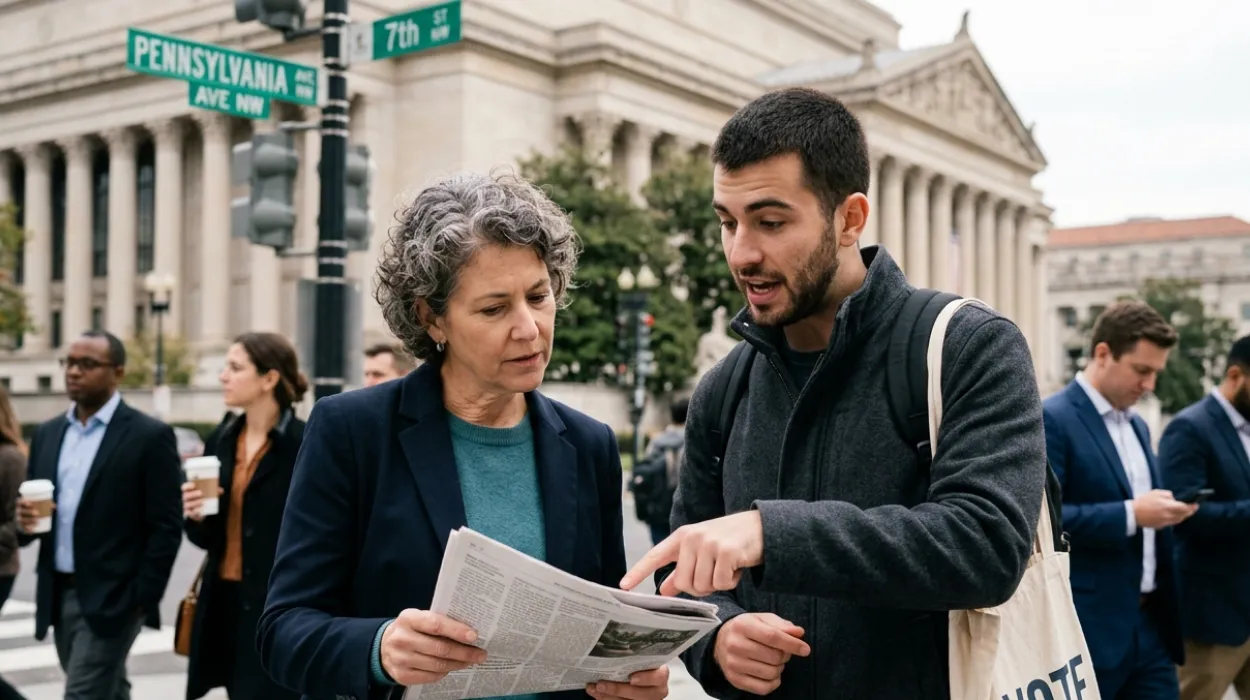
Politics shapes taxes, schools, healthcare, policing, and development in every Washington‑area community. In the United States, politics is the system through which citizens choose leaders, pass laws, and allocate public resources at the federal, state, and local levels. This article explains how American politics works, how it affects Washington‑area residents, and how people can participate more effectively.
- What is politics, and how does it work in the United States?
- How is the U.S. political system structured?
- What are the main political parties in the United States?
- How do elections work in the United States?
- What is the role of interest groups and lobbyists in U.S. politics?
- How does public opinion shape politics in the United States?
- How does federalism distribute power in the U.S. system?
- What are the main sources of political funding?
- How do courts influence politics in the United States?
- How does media coverage shape political outcomes?
- How can citizens participate effectively in U.S. politics?
- How does politics affect daily life in Washington‑area communities?
- What are the long‑term trends reshaping U.S. politics?
- How can readers stay informed about politics in a trustworthy way?
What is politics, and how does it work in the United States?
Politics is the process by which societies make binding decisions about power, rules, and resources. In the United States, politics operates through elections, political parties, government institutions, and civic participation. The U.S. system is a federal republic, meaning power is divided between a national government and 50 states, each with its own constitution and elected branches.
The core institutions are the legislative branch (Congress), the executive branch (President and federal agencies), and the judicial branch (federal courts and the Supreme Court). Each level has checks and balances: Congress passes laws, the President can veto them, and courts can strike them down as unconstitutional. States and localities mirror this structure with governors, state legislatures, mayors, and city councils.
Citizens influence politics mainly through voting, petitioning officials, joining advocacy groups, and running for office. In the U.S., elections are held at regular intervals for the President (every four years), Congress (House every two years, Senate every six by rotation), governors (most states every four years), and many local offices.
How is the U.S. political system structured?
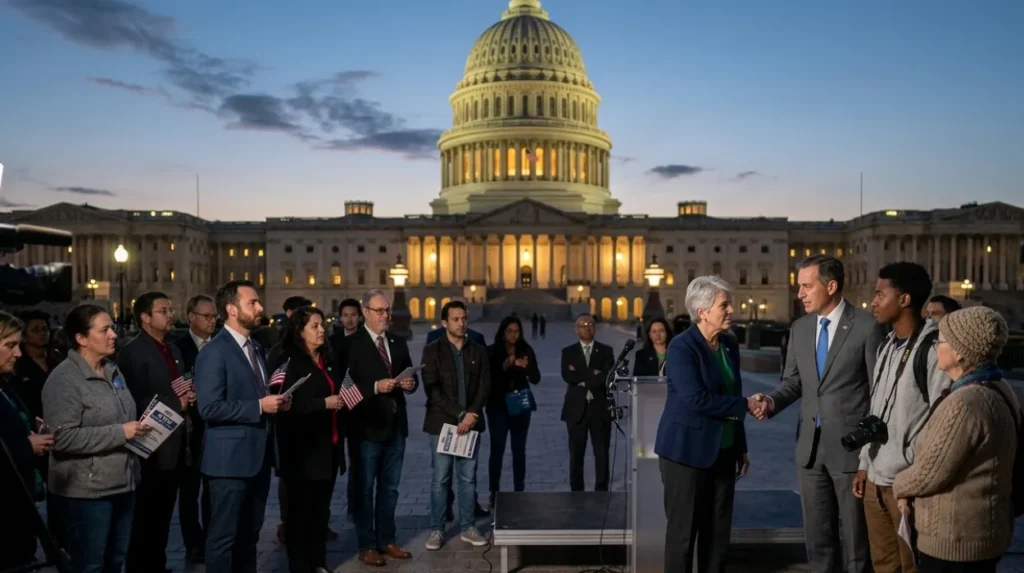
The U.S. political system has three main branches at the federal level and analogous structures in each state. The legislative branch makes laws, the executive branch enforces them, and the judicial branch interprets them. Washington, DC, is the federal seat of government, while states like Virginia and Maryland run their own parallel systems.
The federal legislature is the United States Congress, composed of the Senate (100 members, 2 per state) and the House of Representatives (435 members, apportioned by state population). Legislation becomes law only if both chambers approve it and the President signs it, or if Congress overrides a veto with a two‑thirds majority in each house.
The federal executive branch is led by the President, who serves a four‑year term and can be re‑elected once. The President appoints Cabinet secretaries, oversees the federal bureaucracy, commands the military as Commander‑in‑Chief, and negotiates treaties (with Senate approval).
The federal judiciary includes district courts, appeals courts, and the Supreme Court of the United States, which has nine justices appointed for life. Federal courts resolve disputes involving federal law, the Constitution, and the legality of government actions.
At the state level, each state has a governor, a state legislature (usually a house and senate), and a state supreme court. Local governments include counties, cities, towns, school boards, and special‑district authorities, which manage services such as trash collection, local schools, and transportation.
What are the main political parties in the United States?
The two dominant U.S. political parties are the Democratic Party and the Republican Party. These parties organise candidates, set policy platforms, and mobilise voters in every state and many localities. Smaller parties such as the Libertarian Party and the Green Party exist but rarely win major offices.
The Democratic Party generally supports a stronger federal role in healthcare, environmental regulation, social welfare, and consumer protection. Democrats often emphasise progressive tax structures, expanded social programmes, and protections for marginalised groups.
The Republican Party typically favours lower taxes, reduced federal regulation, stronger national defence, and more authority for states and localities. Republicans often stress free‑market policies, strict immigration controls, and traditional social values.
Party structures include national committees (Democratic National Committee, Republican National Committee), state parties, and county‑level organisations. These bodies recruit candidates, manage campaigns, and coordinate fundraising and messaging in every election cycle.
How do elections work in the United States?
Elections are scheduled contests in which citizens choose representatives through voting. In the U.S., federal elections include presidential elections every four years, House elections every two years, and Senate elections staggered every two years for one‑third of the 100 seats.
Most states and localities hold gubernatorial and legislative elections every four years, with some holding them every two years. Local ballots can include mayors, city council members, county commissioners, school board members, and judges in partisan or non‑partisan races.
To vote, citizens must register, usually with a state or local election office. Requirements vary by state but typically include U.S. citizenship, minimum age (18), and proof of residence. Some states allow same‑day registration, while others require registration weeks in advance.
Voting occurs by casting ballots in person on Election Day or through early in‑person voting, mail‑in ballots, or absentee ballots. Many states have expanded mail‑in voting in recent years, especially after the 2020 elections.
If no candidate wins a majority in some races, runoff elections may occur. In presidential elections, the Electoral College assigns each state a number of electors equal to its total Congressional representation; the national winner must secure at least 270 electoral votes.
What is the role of interest groups and lobbyists in U.S. politics?
Interest groups and lobbyists seek to influence public policy by representing specific constituencies or sectors. Examples include business associations, labour unions, environmental organisations, civil‑rights groups, and professional associations such as medical or legal societies.
These groups engage in activities such as drafting policy proposals, testifying at legislative hearings, publishing research, and mobilising members to contact officials. Lobbying at the federal level is regulated by laws requiring disclosure of clients, issues, and spending, mainly through the Lobbying Disclosure Act and the Senate Office of Public Records.
Lobbying can be “inside” (direct contact with legislators and staff) or “outside” (grassroots campaigns, media outreach, and public‑relations efforts). Many organisations operate in both arenas, combining lobbying with advertising and coalition‑building to shape public debate.
Scholars and watchdogs note that well‑funded interest groups can gain disproportionate influence, especially when campaign‑finance spending is high. Critics argue this can skew policy toward wealthy donors, while supporters claim it ensures diverse voices receive representation.
How does public opinion shape politics in the United States?
Public opinion influences how politicians frame issues, prioritise legislation, and respond to crises. Elected officials track sentiment through surveys, focus groups, media coverage, and direct feedback from constituents.
Major polling organisations such as Pew Research Center, Gallup, and the Associated Press–NORC regularly measure attitudes toward topics like healthcare, immigration, climate change, and gun control. These surveys often show that views vary by region, age, education, race, and party affiliation.
Candidates use polling to tailor messages, ads, and campaign strategies. For example, Washington‑area voters may place higher importance on federal‑government reform and transportation than on rural‑economic policy, which candidates may highlight in local campaigns.
Social media and news outlets amplify certain issues, sometimes shifting public attention rapidly. Sudden shifts in opinion can pressure politicians to introduce new legislation, issue executive orders, or change their stance on long‑standing debates.
How does federalism distribute power in the U.S. system?
Federalism divides authority between the national government and the 50 state governments. The U.S. Constitution grants specific powers to the federal government, reserves others to the states, and leaves some areas to concurrent or shared authority.
Enumerated powers include national defence, foreign policy, currency regulation, and interstate commerce. States retain powers over areas such as education, most criminal law, intrastate transportation, and local elections unless overridden by federal law or the Constitution.
Concurrent powers include taxation, borrowing, and spending on infrastructure and public services. Both federal and state governments can levy taxes, issue bonds, and fund roads, schools, and social‑welfare programmes, often in partnership.
Federal grants and mandates link national and state politics. The federal government distributes money through categorical grants (for specific purposes) and block grants (for broader areas), which states must administer according to federal rules.
What are the main sources of political funding?
Political funding in the United States comes from individuals, political parties, political action committees (PACs), and, in some cases, corporations and unions. Campaign‑finance laws allow contributions up to stated limits, with additional rules for “super PACs” and independent expenditure groups.
Individual citizens can donate directly to candidates, parties, and PACs, subject to federal caps. PACs pool money from members and contribute to campaigns or spend independently on advertising. Super PACs raise unlimited funds but cannot coordinate directly with candidates.
Federal elections are regulated by the Federal Election Commission (FEC), which enforces disclosure rules, contribution limits, and prohibitions on foreign funding. States have their own election‑finance laws and agencies for state and local races.
Research shows that large donors and special‑interest groups often account for a substantial share of campaign spending, especially in federal Senate and presidential contests. Critics argue this can distort representation, while reformers propose public‑financing schemes and stricter disclosure rules.
How do courts influence politics in the United States?
Courts resolve disputes over laws, regulations, and constitutional rights, thereby shaping how politics unfolds. Federal courts can invalidate statutes and executive actions they find unconstitutional, while state courts interpret state constitutions and laws.
The Supreme Court makes landmark rulings on issues such as voting rights, campaign finance, abortion, gun control, and civil rights. Its decisions bind lower courts and can force Congress or state legislatures to revise laws or adopt new policies.
Judges are appointed rather than elected, which insulates them from immediate electoral pressure but also raises questions about democratic accountability. Federal judges are nominated by the President and confirmed by the Senate, while most states use a mix of appointment and election for their judges.
Judicial decisions often spark political backlash or legislative responses. For example, rulings on campaign‑finance regulation have prompted new state‑level laws and federal reform proposals.
How does media coverage shape political outcomes?
Media coverage informs citizens, sets the agenda, and frames how issues are understood. Traditional outlets include newspapers, television networks, radio stations, and wire services, while digital platforms now dominate many news‑consumption habits.
Professional and partisan outlets vary in tone and framing. Some emphasise neutral reporting, while others adopt explicit editorial stances aligned with particular parties or ideologies. Social‑media platforms further amplify partisan content and misinformation.
Research indicates that media attention can raise the salience of specific issues, such as healthcare, crime, or immigration. Candidates appearing frequently in favourable coverage often gain name recognition and polling advantages.
Media also holds officials accountable by investigating scandals, policy failures, and conflicts of interest. Investigative journalism can prompt resignations, reforms, or new legislation, especially when combined with public pressure.
How can citizens participate effectively in U.S. politics?
Citizens can participate through voting, civic associations, protests, petitions, and direct contact with officials. Voting in every election, from local school boards to federal contests, is the most direct way to influence power.
Beyond voting, people can join parties, advocacy groups, or unions; attend town‑hall meetings; write letters or emails to representatives; and participate in public‑comment periods on proposed rules. Many local governments also allow residents to serve on advisory boards or commissions.
Running for office or supporting local campaigns is another channel. School‑board members, city councillors, and county commissioners often face low barriers to entry and can shape education, housing, and public‑safety policies.
Civic‑education programmes and community‑organising efforts help new participants understand policy details, procedural rules, and coalition‑building strategies. These skills make engagement more durable and effective over time.
How does politics affect daily life in Washington‑area communities?
Politics determines local services, tax burdens, and regulatory environments across Washington‑area jurisdictions. Federal decisions in Washington, DC, influence defence, immigration, environmental standards, and federal‑funding flows to states and cities.
State and local politics shape education funding, police and fire services, zoning rules, public‑transportation routes, and park maintenance. In the Washington‑metropolitan area, residents in Maryland, Virginia, and the District face different tax structures, school‑funding formulas, and local regulations.
Political decisions also affect housing affordability, traffic congestion, and environmental quality. For example, state‑level transportation‑funding packages and local zoning ordinances can either encourage or restrict dense, transit‑oriented development.
Because many Washington‑area residents work in or near the federal government, national‑level politics has an outsized impact on employment, budgeting, and regulatory priorities in the region. This creates a feedback loop between federal policy and local economic conditions.
What are the long‑term trends reshaping U.S. politics?
Several long‑term trends are reshaping U.S. politics, including demographic change, polarization, technological disruption, and institutional stress. Population growth, racial and ethnic diversification, and generational shifts are altering the electorates of many states and regions.
Partisan polarisation has increased since the 1990s, with Republicans and Democrats holding more extreme and distinct policy views. This has led to more gridlock in Congress, more frequent use of procedural tactics such as filibusters, and higher‑stakes elections.
Digital platforms and social media have transformed how campaigns reach voters, raise money, and mobilize supporters. Microtargeted advertising and data‑driven organizing now underpin many successful campaigns, but they also enable disinformation and foreign‑interference operations.
Scholars warn of “political decay,” where institutions become less responsive or adaptive to public demands. Symptoms include declining trust in government, rising inequality, and the perception that policy benefits elites more than ordinary citizens.
How can readers stay informed about politics in a trustworthy way?
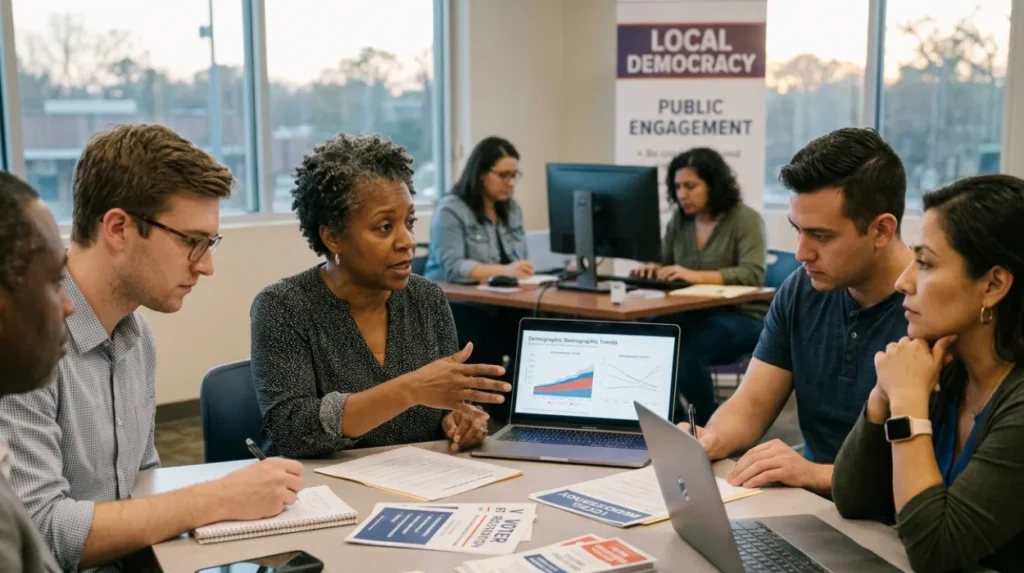
The reader can stay informed by relying on multiple reputable sources, checking facts, and understanding publishers’ biases. Established outlets such as major newspapers, national broadcasters, and academic‑affiliated research centres often subject their work to editorial review and fact‑checking.
Subscribing to several news organizations, following government information websites (such as Congress.gov or state‑agency portals), and using non‑partisan fact‑checking services can provide a balanced view of complex issues. Cross‑checking claims across sources reduces the risk of misinformation.
Civic‑education materials from universities, libraries, and nonprofit organizations help readers interpret polling data, understand legislative processes, and assess policy trade‑offs. These resources contextualize raw information and reduce susceptibility to partisan framing.
How does the U.S. political system work?
The United States uses a federal system with three branches of government:
Legislative branch (Congress) makes laws
Executive branch (President and agencies) enforces laws
Judicial branch (courts) interprets laws
Power is divided between the federal government and individual state governments.